
Selecting the right lunch bag isn’t just about style or brand preference—it’s about functionality. A poorly sized bag can lead to crushed containers, forgotten meals, or unnecessary bulk in your daily carry. Whether you're packing for a school commute, office workday, outdoor job site, or weekend outing, choosing the correct size ensures your food stays fresh, organized, and easy to transport. This guide walks through precise measurement techniques, common use cases, and key considerations so you can confidently select a lunch bag that fits your routine—not the other way around.
Why Lunch Bag Size Matters More Than You Think
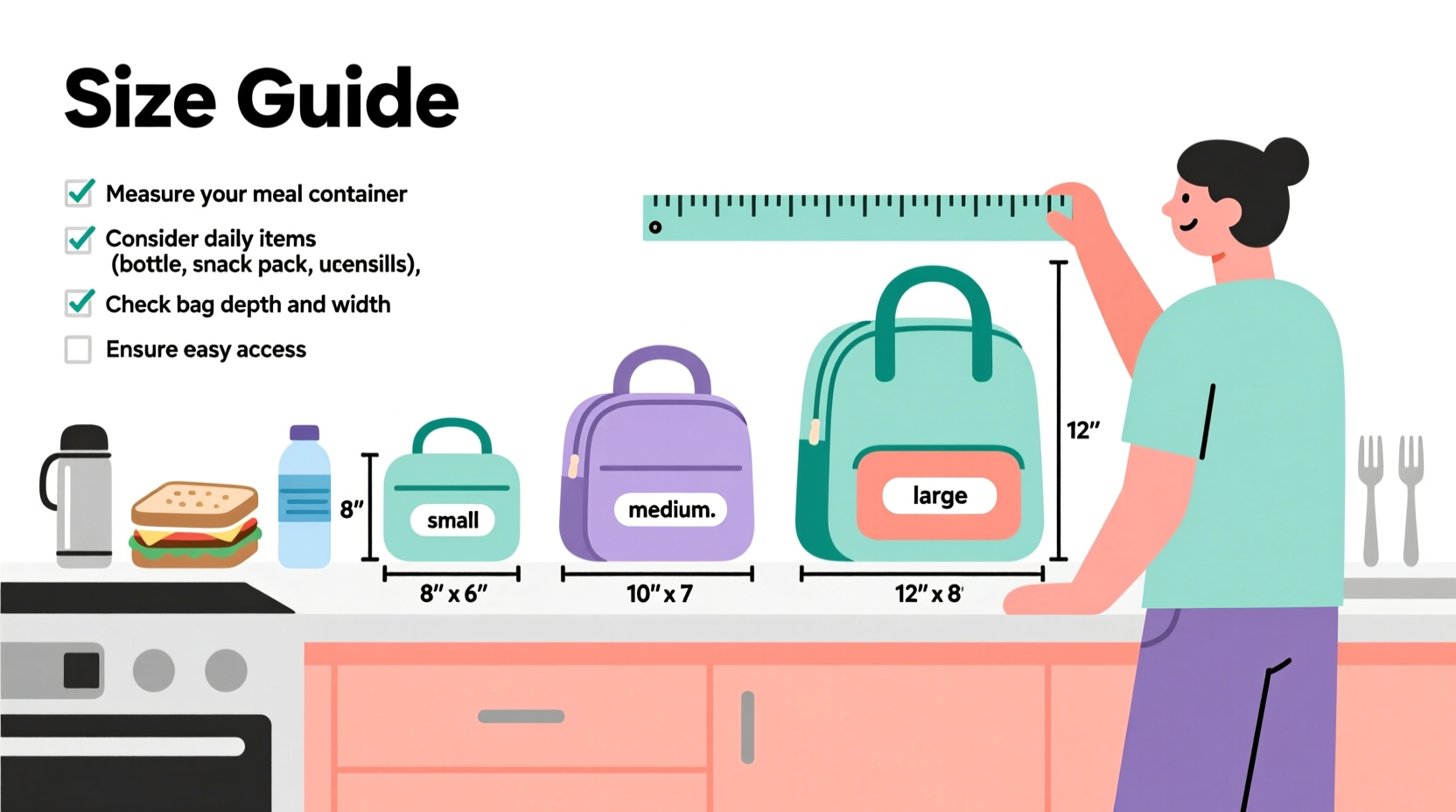
The size of your lunch bag directly affects meal quality, portability, and long-term usability. Too small, and you’ll be forced to skip items like drinks, snacks, or side dishes. Too large, and the bag becomes unwieldy, especially if carried alongside a backpack or briefcase. An oversized bag may also encourage overpacking, which increases weight and reduces insulation efficiency.
Proper sizing ensures:
- Optimal temperature retention (smaller gaps mean less air circulation)
- Better organization and protection for containers
- Comfortable carrying without adding strain
- Compatibility with storage spaces (e.g., under desks, in lockers, or bike baskets)
A well-fitted lunch bag supports consistent healthy eating by making it easier to bring balanced meals—without hassle.
Tip: Measure your most-used food containers before shopping—this is the most reliable way to determine required interior dimensions.Step-by-Step Guide to Measuring Your Ideal Lunch Bag Size
Accurate measurement prevents guesswork. Follow this sequence to find the perfect fit:
- Gather your typical meal components. Include your main container, drink bottle, snack boxes, cutlery, and ice pack.
- Arrange them as you would in a bag. Stack containers vertically or place side-by-side depending on your habits.
- Measure the total volume footprint. Use a ruler or tape measure to record:
- Height: from base to tallest point (usually 5–9 inches)
- Width: widest horizontal span (often 6–10 inches)
- Depth: front-to-back thickness (typically 3–6 inches)
- Add 0.5–1 inch to each dimension. This allows room for insulation, closure, and ease of insertion/removal.
- Calculate internal capacity. Multiply H × W × D to get cubic inches. Divide by 61 to convert to liters (approximate).
For example: A stack measuring 8\" (H) × 7\" (W) × 5\" (D) = 280 cubic inches ≈ 4.6 liters. Look for a bag with at least 5L internal volume.
Lunch Bag Sizing Categories and Use Cases
Lunch bags are generally categorized by capacity. The right category depends on your eating patterns, lifestyle, and portion sizes.
| Size Category | Volume Range | Ideal For | Not Recommended For |
|---|---|---|---|
| Compact / Mini | 1.5 – 3 L | Light eaters, kids, single-container meals, short commutes | Adults with full meals, multiple containers, or hydration needs |
| Standard / Medium | 3 – 6 L | Most adults, standard office workers, students, daily packed lunches | Outdoor jobs requiring heavy meals or extra gear |
| Large / Extended | 6 – 9 L | Active professionals, field workers, parents packing family portions, multi-meal prep | Minimalist commuters, tight storage environments |
| Extra-Large / Utility | 9+ L | Catering samples, team lunches, extended trips, bulky containers | Daily individual use; often too bulky and inefficient |
Choosing outside your actual needs leads to inefficiency. A construction worker might need 7L to carry hearty meals and tools, while an office employee may thrive with 4L.
Real-Life Example: Choosing for Different Lifestyles
Case Study: Sarah vs. James
Sarah, a graphic designer, packs a light lunch: a 16oz glass container with salad, a small yogurt cup, and a reusable water bottle. Her total stack measures 7\" × 6\" × 4\". She initially bought a large 8L bag but found it floppy and hard to close. After measuring, she switched to a 3.5L tapered tote—now her lunch fits snugly, stays cool, and slides easily into her work tote.
James, a park ranger, brings two large Tupperware meals, trail mix, an apple, and a 20oz insulated thermos. His setup requires 8\" × 9\" × 6\"—nearly 430 cubic inches. He uses a rugged 7.5L backpack-style lunch bag with external pockets for gloves and utensils. A smaller bag would crush his containers or leave no room for an ice pack.
Their choices reflect personal needs—not trends. One size does not fit all.
Key Features That Influence Effective Capacity
Capacity isn’t just about numbers. Design elements affect usable space:
- Insulation thickness: Thick linings reduce interior dimensions. A 6L labeled bag may only offer 5L of usable space.
- Shape and structure: Rectangular bags maximize container fit; cylindrical ones waste corners.
- Compartments: Multiple sections improve organization but can limit flexibility for larger items.
- Opening width: Narrow zippers make loading difficult, even if depth is sufficient.
“People underestimate how much insulation eats into space. Always check interior measurements, not just exterior claims.” — Dana Ruiz, Product Designer at EcoCarry GearTip: When shopping online, look for product specs that list *internal* dimensions, not just volume or exterior size.
Checklist: How to Choose the Right Lunch Bag Size
Before purchasing, verify these points:
- ✅ I’ve measured my most common meal setup including containers and ice pack
- ✅ I know my required internal dimensions (height, width, depth + 0.5” buffer)
- ✅ I’ve identified my usage category (compact, standard, large, etc.)
- ✅ I’ve considered additional items (napkins, cutlery, snacks) that take up space
- ✅ I’ve checked whether the bag’s shape matches my containers (rectangular vs round)
- ✅ I’ve confirmed the insulation type doesn’t compromise usability
- ✅ I’ve tested the opening width—can I insert my largest container easily?
Frequently Asked Questions
Can I use a small lunch bag if I eat large portions?
Only if you’re willing to compromise. Small bags typically max out at 3L, which may fit one large container but leaves little room for sides or cooling. You risk poor temperature control and difficulty closing the bag. Consider upgrading size or switching to compact, stackable containers.
Do lunch boxes take up less space than soft-sided bags?
Often, yes. Rigid bento-style boxes integrate compartments efficiently and maintain shape, reducing wasted air space. However, they lack flexibility. If your meal varies daily, a soft bag with adjustable interior may serve better despite slightly lower packing density.
How do I know if a bag is too big for my needs?
If the bag feels empty or your containers shift during transport, it’s likely oversized. Excess space reduces cooling efficiency and increases the chance of spills. A properly sized bag should hold your meal snugly—with room only for an ice pack and small accessories.
Make the Right Choice Today
Your lunch bag should support your lifestyle, not complicate it. By taking simple measurements, understanding your daily needs, and evaluating real-world capacity—not marketing labels—you can avoid the frustration of ill-fitting gear. Whether you're fueling a busy workday or preparing meals for active adventures, the right-sized bag keeps your food safe, fresh, and ready when you are.
💬 Found your ideal lunch bag size? Share your experience or tips in the comments to help others make smarter choices!








