That low, persistent hum—or sometimes a sharp, intermittent buzz—coming from your holiday light string isn’t just annoying. It’s an audible clue about what’s happening inside the wiring, transformers, and electronics. While many people dismiss it as “just how cheap lights sound,” the truth is more nuanced: some buzzing is entirely normal and benign; other types indicate wear, design limitations, or even potential hazards. Understanding the difference separates seasonal convenience from genuine electrical concern—especially when lights hang near flammable garlands, dry trees, or curious children.
The Physics Behind the Buzz: It’s All About Vibration
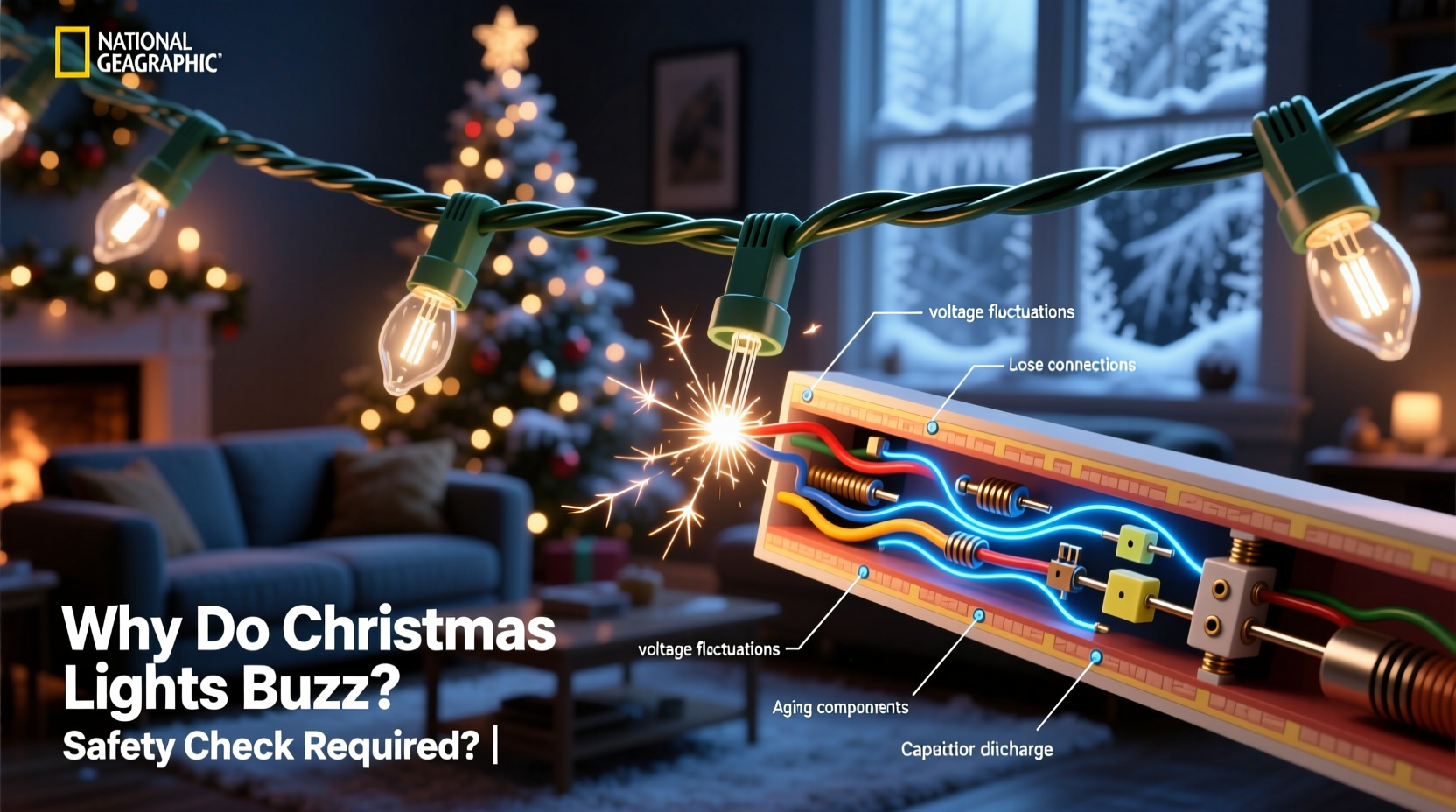
Christmas light buzzing originates from electromagnetic forces acting on physical components. In incandescent mini-lights (the classic two-wire, 2.5V bulb strings), the buzz typically comes from the filament itself. When alternating current (AC) flows through the thin tungsten wire—60 times per second in North America—the magnetic field around the filament fluctuates rapidly. This causes microscopic mechanical vibration in the filament, especially if it’s slightly loose in its mount or has developed micro-fractures from thermal cycling. The result? A faint 60 Hz hum, often barely audible unless the string is in a quiet room or bundled tightly against a surface that amplifies resonance.
For LED strings—especially those with built-in rectifiers and voltage converters—the source shifts. Most plug-in LED sets use a switching power supply to convert 120V AC to low-voltage DC (typically 5–12V). These supplies operate at high frequencies (10–100 kHz), but poor-quality designs may allow low-frequency ripple (often 120 Hz, or twice the line frequency) to persist. That ripple can cause ceramic capacitors or inductors to physically vibrate—a phenomenon called electrostriction. Cheaper components, loosely wound coils, or insufficient potting compound make this more likely. Unlike filament hum, LED buzzing tends to be higher-pitched and may pulse or change tone as the set warms up.
When Buzzing Is Normal (and When It Isn’t)
Not all buzzing carries equal weight. Context matters: voltage type, age of the set, ambient temperature, and load conditions all influence whether the sound reflects expected behavior—or an emerging problem.
Tip: Test the buzz in isolation: unplug all other devices on the same circuit, then listen. If the noise disappears, the issue may be voltage instability—not the lights themselves.Here’s how to assess what you’re hearing:
| Buzz Characteristic | Typical Cause | Level of Concern |
|---|---|---|
| Faint, steady 60 Hz hum from older incandescent strings | Filament vibration under AC; common in pre-2005 sets | Low — no action needed unless volume increases noticeably over time |
| Intermittent buzzing that starts after 10–15 minutes of operation | Thermal expansion stressing solder joints or cracked PCB traces in LED drivers | Moderate — inspect for flickering or partial outages; replace if warming correlates with onset |
| Sharp, high-pitched whine that changes pitch when dimmed or touched | Failing capacitor or overloaded transformer in low-voltage LED sets | High — stop using immediately; risk of overheating or component rupture |
| Buzz accompanied by visible arcing, burning smell, or discoloration at plug/base | Loose connection, corroded contacts, or internal short | Critical — unplug and discard. Do not attempt repair. |
| Hum that intensifies when multiple strings are daisy-chained | Transformer saturation or excessive load on final adapter in series | Moderate-High — violates UL 588 safety limits; redistribute load or use separate outlets |
A Real-World Example: The Case of the “Quiet” Neighborhood Display
In December 2022, a homeowner in Portland, Oregon, installed six 100-light LED net lights across her front porch eaves. For three nights, the display ran silently—until the fourth evening, when a distinct, rhythmic buzzing began emanating from the third string from the left. She noticed the buzz coincided with the porch light timer cycling on at dusk, and intensified each time her HVAC system kicked on. Using a multimeter, she measured voltage fluctuations between 112V and 127V on that circuit—well within utility tolerance, but enough to stress the marginal filtering in her $8.99 LED string’s driver board. Replacing that single string with a UL-listed, ETL-verified set (bearing the “Energy Star Qualified” label) eliminated the noise instantly. Crucially, she also discovered her daisy chain exceeded the manufacturer’s stated limit of four strings—she’d connected five. After reconfiguring to two independent runs of three strings each (on separate outlets), the entire display operated silently for the rest of the season—and passed inspection by her electrician during a routine home safety check.
Expert Insight: What Electrical Engineers Say
Dr. Lena Torres, Senior Research Engineer at the National Electrical Manufacturers Association (NEMA) and co-author of the ANSI C136.41 standard for decorative lighting, explains the threshold where acoustics become a reliability signal:
“The industry considers audible noise above 35 decibels at 1 meter—roughly the volume of a whisper—as a potential indicator of suboptimal component selection or aging. But decibel level alone isn’t diagnostic. What matters more is *change*. A new set shouldn’t buzz louder after two hours than it did at startup. Consistent increase in amplitude, harmonic complexity, or correlation with heat buildup tells us something’s degrading—often the electrolytic capacitor in the driver stage. That capacitor’s lifespan halves for every 10°C rise above rated temperature. So yes: buzzing can be your first warning before catastrophic failure.” — Dr. Lena Torres, NEMA Lighting Standards Division
Step-by-Step: How to Diagnose and Respond Safely
If your lights buzz, follow this sequence—not to fix them yourself (most consumer-grade light strings aren’t user-serviceable), but to determine whether they’re safe to keep using:
- Unplug immediately if you detect burning odor, smoke, visible melting, or sparking���even if the buzz seems mild.
- Let the string cool completely (at least 30 minutes), then visually inspect every bulb socket, wire junction, and plug for discoloration, corrosion, or bent prongs.
- Plug in only the suspect string—no daisy chains—directly into a GFCI-protected outlet. Listen at arm’s length for 90 seconds. Note whether the buzz starts instantly or develops gradually.
- Check temperature: After 5 minutes of operation, carefully touch the plug housing and any transformer box. If either is too hot to hold comfortably (>50°C / 122°F), discontinue use.
- Test voltage stability: Use a plug-in voltage monitor (under $25) to log readings for 10 minutes. If voltage swings exceed ±8% of nominal (e.g., below 110V or above 130V on a 120V circuit), consult an electrician before reusing any sensitive electronics—including lights.
- Compare to baseline: If you own an identical, newer string, run both side-by-side. If only the older one buzzes significantly, age-related degradation is likely.
What You Should Never Do
- Ignore buzzing that worsens over consecutive uses — cumulative thermal stress accelerates failure.
- Wrap buzzing strings in insulation, foam, or fabric — this traps heat and raises fire risk exponentially.
- Use extension cords rated below 16 AWG for permanent outdoor displays — undersized wire increases resistance, voltage drop, and driver strain.
- Repair damaged sockets or cut-and-splice wires with tape or wire nuts — these violate UL 588 and create shock/fire pathways.
- Continue using lights past their labeled indoor/outdoor rating — moisture ingress degrades insulation and promotes arcing, which often manifests as erratic buzzing.
FAQ
Can I fix buzzing Christmas lights myself?
No—consumer-grade light strings are not designed for field repair. Internal components like SMD drivers, capacitors, and rectifiers require specialized tools, soldering precision, and safety-rated enclosures. Attempting DIY fixes voids UL certification and introduces serious shock or fire hazards. Replacement is safer, more reliable, and often more economical than troubleshooting.
Do battery-operated LED lights buzz too?
Rarely—but it can happen. Low-cost coin-cell sets sometimes use crude boost converters that generate audible coil whine under load. Higher-end battery lights (especially those with regulated constant-current drivers) remain silent. If a battery set buzzes, check for weak or mismatched batteries—voltage sag stresses the converter and increases noise.
Is buzzing worse in cold weather?
Yes—particularly for incandescent strings. Cold temperatures increase filament resistance and reduce thermal mass, making vibration more pronounced. For LEDs, extreme cold (< –10°C / 14°F) can stiffen electrolytic capacitors, altering their resonant frequency and sometimes lowering the pitch of the buzz. Neither scenario is inherently dangerous, but cold-induced buzzing that disappears indoors suggests material fatigue.
Conclusion: Listen Closely, Act Decisively
That buzz isn’t just background noise—it’s data. It’s the sound of physics interacting with engineering choices, material quality, and usage history. Recognizing the difference between a harmless filament hum and the early tremor of capacitor failure empowers you to protect your home, your family, and your holiday peace of mind. Don’t wait for flickering, scorch marks, or tripped breakers to take action. If a set develops new or worsening buzz, retire it. Invest in UL-listed, ETL-verified lights with clear indoor/outdoor ratings—and never exceed daisy-chain limits. Your lights should spark joy, not suspicion. This season, let silence be your standard. And if you’ve resolved a buzzing mystery—or learned a hard lesson the loud way—share your experience in the comments. Real-world insights help others spot danger before it hums.
💬 Have you traced a buzz to a specific cause—or prevented a hazard by listening closely? Share your story below. Your insight could help another household stay safe this holiday season.








