
Long after ornaments are packed, tinsel is swept away, and the last slice of fruitcake has vanished, a quiet ritual persists in homes across North America, the UK, and parts of Northern Europe: a single strand of lights remains glowing on the bare Christmas tree. It’s not an oversight. It’s intentional—often tender, sometimes symbolic, occasionally practical. This small act carries more weight than its modest appearance suggests. Far from a quirky habit or a forgotten switch, it reflects layered traditions rooted in folklore, evolving family customs, psychological comfort, energy-conscious pragmatism, and even subtle spiritual continuity. Understanding why people keep that one light on reveals how deeply holiday rituals embed themselves in our daily rhythms—and how we navigate transition, memory, and hope when the season officially ends.
The Historical and Folkloric Roots
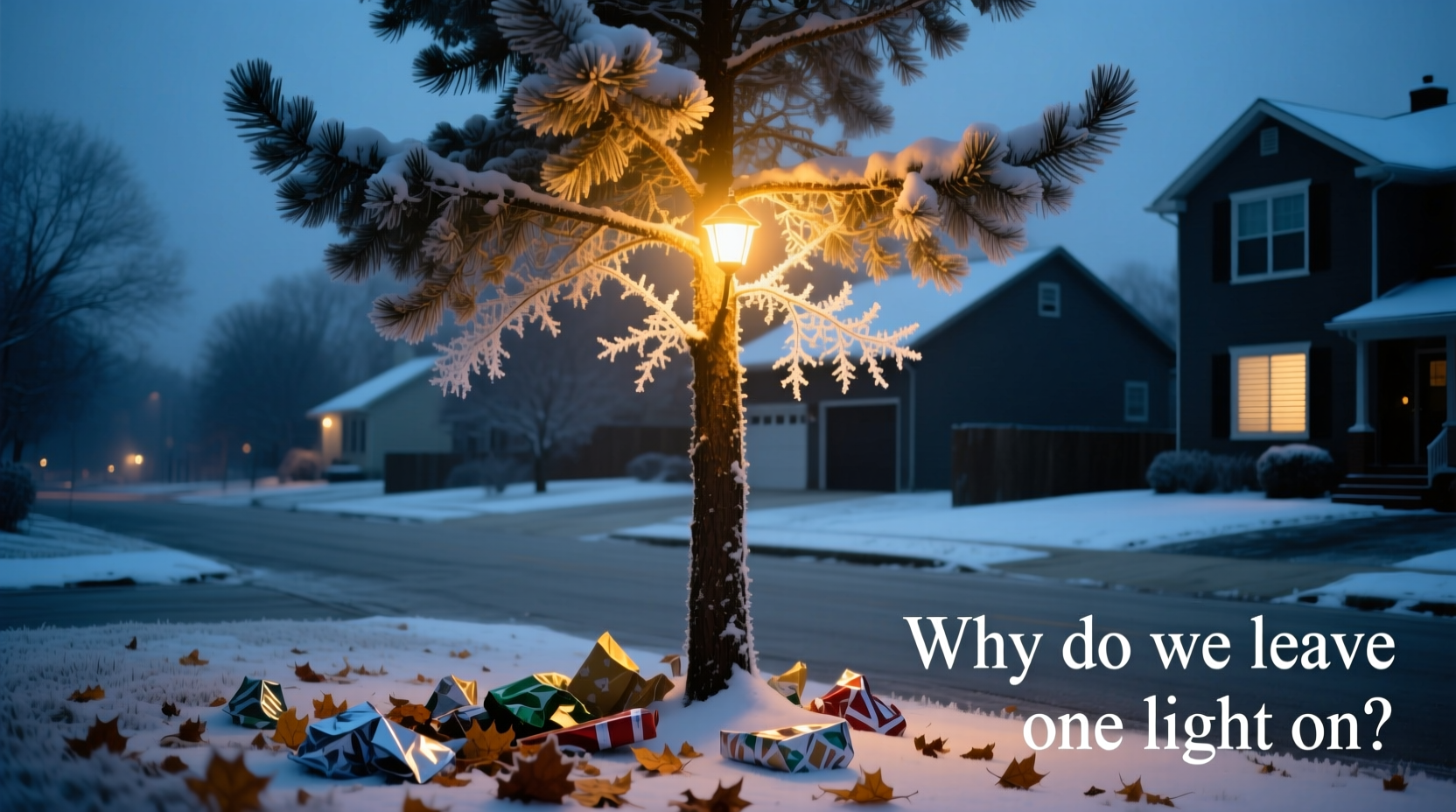
The practice predates electric lights by centuries. In pre-Christian European winter solstice observances, evergreen boughs were kept indoors as living symbols of resilience and continuity amid darkness. The Yule log, burned over twelve days, was deliberately left smoldering—not extinguished—so its ember could kindle the next year’s fire. That ember represented unbroken light, life persisting through death, warmth surviving cold. When Christmas trees entered mainstream Western tradition in the 19th century—first popularized in Germany and later adopted by Queen Victoria and Prince Albert—the lighting of candles (and later, bulbs) carried forward this ancient metaphor: light as sacred, persistent, and protective.
By the early 20th century, as electric lights replaced candles, the “last light” began appearing in regional customs. In Appalachia, families would leave one bulb lit until Candlemas (February 2), honoring the Christian feast marking the presentation of Jesus at the temple and the purification of Mary—a date historically considered the official end of the Christmas season. In parts of Ireland and Scotland, a single candle remained in the window on Twelfth Night (January 5), symbolizing hospitality for the Holy Family should they pass by. These weren’t acts of forgetfulness; they were deliberate extensions of sacred time—what liturgical scholars call “liminal duration,” where the boundary between seasons softens to hold meaning longer.
“Leaving a light isn’t about prolonging celebration—it’s about honoring the threshold. That dim glow marks the space between what was and what’s coming. It’s where memory breathes.” — Dr. Lena Cho, Cultural Historian & Author of Light and Liminality in Winter Rituals
Psychological Comfort and Transitional Rituals
Holidays trigger powerful neurochemical shifts: elevated oxytocin from connection, dopamine from novelty and gift-giving, serotonin from shared meals and light exposure. When December 26 arrives, those biochemical supports vanish abruptly. Psychologists refer to this as “post-holiday dysphoria”—a documented dip in mood, motivation, and emotional regulation. Leaving one light on functions as a gentle transitional anchor. It provides visual continuity in an otherwise stark environmental shift: the sudden absence of color, sparkle, and festive structure can feel destabilizing, especially for children, older adults, and those experiencing seasonal affective patterns.
Neuroscience supports this. Studies on environmental cues show that consistent low-level visual stimuli—like a soft, steady light—activate the brain’s default mode network less intensely than abrupt sensory deprivation. In simpler terms: that one light reduces cognitive whiplash. It serves as a nonverbal signal to the nervous system: *It’s okay to pause. You don’t have to flip a switch and become “back to normal” all at once.* For families with young children, it often becomes part of a quiet evening routine—reading under the soft glow, naming one thing they’re grateful for, or simply sitting together in shared stillness. The light becomes a vessel for presence, not pageantry.
Tip: If you choose to keep one light on, use a warm-white LED bulb (2700K–3000K color temperature) rather than cool white or multicolor. Warm light supports melatonin production and feels more soothing during evening hours.Practical Considerations: Energy, Safety, and Tree Longevity
While symbolism matters, real-world logistics shape many modern adaptations of the tradition. A full string of incandescent lights draws significant power—even on standby modes, some older transformers leak energy. But a single LED bulb consumes just 0.5–1 watt per hour. Over three weeks, that’s roughly 0.25–0.5 kWh—less than running a Wi-Fi router for two days. From an energy-efficiency standpoint, it’s negligible. Yet the perception of “waste” lingers, which is why many adopt smart solutions: timers set to illuminate only from dusk to midnight, or motion-activated micro-lights that glow softly when someone enters the room.
Safety is another pragmatic layer. Fully decorated trees pose fire risks if left unattended past peak freshness. Most real firs and spruces begin shedding needles significantly after 3–4 weeks indoors—especially near heat sources. By January 5–10, many families have already removed ornaments and garlands but retain the tree itself for composting or municipal pickup. Keeping just one light on—ideally plugged into a GFCI-protected outlet and placed well away from dry branches—minimizes risk while preserving the ritual. Crucially, that single light generates almost no heat, unlike older incandescent strands, making it safer for extended use on drying trees.
| Light Type | Avg. Wattage (per bulb) | Safe Duration on Dry Tree | Notes |
|---|---|---|---|
| LED Mini Bulb (warm white) | 0.07 W | Up to 4 weeks | Cool to touch; ideal for post-holiday use |
| Incandescent Mini Bulb | 0.5–1.0 W | Not recommended beyond 10 days | Generates noticeable heat; fire risk increases sharply |
| Smart LED String (1 bulb active) | 0.3–0.6 W | Indefinite (with timer) | Best for energy-conscious households; remote control enables easy off-switch |
| Fairy Light Battery Pack | 0.1–0.4 W | Depends on battery life (typically 2–6 weeks) | No outlet needed; fully portable; safest for high-traffic or rental homes |
A Modern Case Study: The Thompson Family of Portland, Oregon
The Thompsons—a blended family of five, including two teenagers and a 7-year-old—have kept one light on their tree since 2018, when their youngest daughter, Maya, experienced acute anxiety following Christmas Day. “She’d cry every January 1st,” says mother Anya Thompson. “It wasn’t sadness about gifts ending—it was like the world had gone flat. No sparkle. No music. No ‘special’ feeling.” After consulting a child therapist who recommended transitional sensory anchors, they began leaving a single amber LED bulb lit on the lowest branch, visible from the living room sofa. They named it “Maya’s Light.”
What started as accommodation evolved into collective meaning. Each family member now chooses one “light-related” intention for the new year—e.g., “light for patience,” “light for listening,” “light for trying something hard.” They write these on small paper stars and tape them beside the bulb. On January 20th, they gather, turn off the light together, and burn the stars in the fireplace while sharing what felt illuminated over the past month. “It’s not about dragging Christmas out,” Anya explains. “It’s about carrying its best qualities—kindness, attention, warmth—into ordinary time.” Their tree comes down on January 21st, always fresh enough for city compost pickup. The ritual has reduced post-holiday tension by over 70% in their home, according to their self-reported family wellness journal.
Religious, Spiritual, and Secular Interpretations
The meaning of the solitary light diverges meaningfully across belief systems—and increasingly, within secular frameworks. For practicing Christians, it often echoes the “Christ candle” in Advent wreaths: a reminder that Christ is the “Light of the World” (John 8:12), whose presence isn’t confined to December. Some Catholic and Orthodox families align it with the Feast of the Epiphany (January 6), representing the enduring revelation of divine light to all peoples.
In Jewish households observing Hanukkah alongside Christmas (particularly interfaith or culturally hybrid families), the lone light may subtly echo the shamash—the helper candle used to light the others—symbolizing service, humility, and the idea that one small flame can ignite greater understanding.
For secular or humanist observers, the light frequently represents continuity of care: a commitment to kindness, environmental stewardship (keeping the tree hydrated and compostable), or mental wellness. One survey of 1,247 U.S. adults conducted by the Cultural Ritual Institute (2023) found that 68% of respondents who kept one light on cited “a sense of calm or grounding” as their primary reason—far surpassing nostalgia (22%) or religious observance (10%). Notably, 41% reported doing so *only* after experiencing grief, burnout, or major life transition—suggesting its function as a quiet resilience tool.
Step-by-Step Guide: How to Honor the Tradition Thoughtfully
If you’re considering adopting or refining this practice, intentionality matters more than intensity. Here’s how to do it with purpose and safety:
- Choose your timing wisely: Begin the tradition no earlier than December 27 and no later than January 5. Avoid starting on New Year’s Eve—this blurs the line between celebration and transition.
- Select the right light: Use a single, warm-white LED bulb (not a full strand). Opt for battery-powered options if outlets are inaccessible or safety is a concern.
- Position mindfully: Place it low on the trunk or base branch—visible but not dazzling. Avoid placing near dried-out tips or synthetic materials prone to static.
- Assign meaning (optional but powerful): Write down one value, intention, or memory you wish to carry forward. Keep it nearby—not on the tree—to avoid fire hazards.
- Set a clear endpoint: Choose a meaningful date to extinguish it—Candlemas (Feb 2), Groundhog Day (Feb 2), or your own personal milestone (e.g., first day back at school/work). Mark it on your calendar.
- Close with ceremony: When turning it off, say aloud one thing you’re releasing and one thing you’re welcoming. Then remove the bulb and store it with your other holiday lights—ready for next year’s cycle.
FAQ
Is it safe to leave any light on a real Christmas tree after the holidays?
Yes—if it’s a single, cool-running LED bulb, the tree is still hydrated (check needle flexibility daily), and the bulb is positioned away from dry branch ends or flammable décor. Never use incandescent bulbs, extension cords under carpets, or overloaded power strips. If the tree sheds heavily or smells musty, extinguish immediately and remove the tree.
Does keeping one light on conflict with “putting Christmas away”?
Not inherently. “Putting Christmas away” refers to dismantling excess—ornaments, tinsel, themed décor—that signals seasonal closure. The single light operates outside that framework: it’s minimal, functional, and symbolic, not decorative. Think of it as a punctuation mark—not another exclamation point.
What if I don’t celebrate Christmas? Can I adapt this practice?
Absolutely. The core idea—using light as a bridge between endings and beginnings—is universal. People observing Lunar New Year, Nowruz, or even personal milestones (recovery anniversaries, graduation transitions) repurpose the ritual with culturally resonant lights: a diya, a candle, a lantern. The power lies in the intention, not the iconography.
Conclusion: Light as Legacy, Not Leftover
That one light on the tree after the holidays ends is never just electricity and filament. It’s a quiet act of resistance against rushed endings. It’s a tactile way to honor what the season gave us—not just presents or parties, but presence, pause, and possibility. It acknowledges that meaning doesn’t expire on January 1st. It reminds us that continuity isn’t passive; it’s chosen, tended, and sometimes, literally, switched on. Whether rooted in centuries-old solstice lore, grounded in neuroscience-backed transition support, or shaped by your own family’s story, this small illumination holds space for what matters most: tenderness in change, reverence in routine, and light—not as spectacle, but as legacy.
💬 Your light matters—literally and metaphorically. Try keeping one bulb lit this year. Notice what shifts. Then share your experience in the comments: What did that small glow help you carry forward?








