
Every December, a quiet transformation unfolds across suburban cul-de-sacs and tree-lined avenues: garages open, extension cords snake across lawns, inflatable Santas inflate with a hiss, and LED strings blink to life in synchronized precision. What begins as festive cheer often evolves—subtly, then unmistakably—into something sharper: competition. Neighbors compare wattage, count animatronics, time drive-by traffic, and even consult light-mapping apps to benchmark their display against the street’s “top three.” This isn’t just holiday enthusiasm—it’s a textbook case of social psychology playing out under twinkle lights. The rivalry isn’t frivolous or petty; it’s rooted in deeply human drives for status, belonging, visibility, and meaning-making during a high-stakes cultural moment. Understanding *why* these displays ignite rivalry reveals far more than seasonal behavior—it illuminates how identity, perception, and community cohesion operate in everyday life.
The Social Comparison Engine: Why We Can’t Help But Measure Up
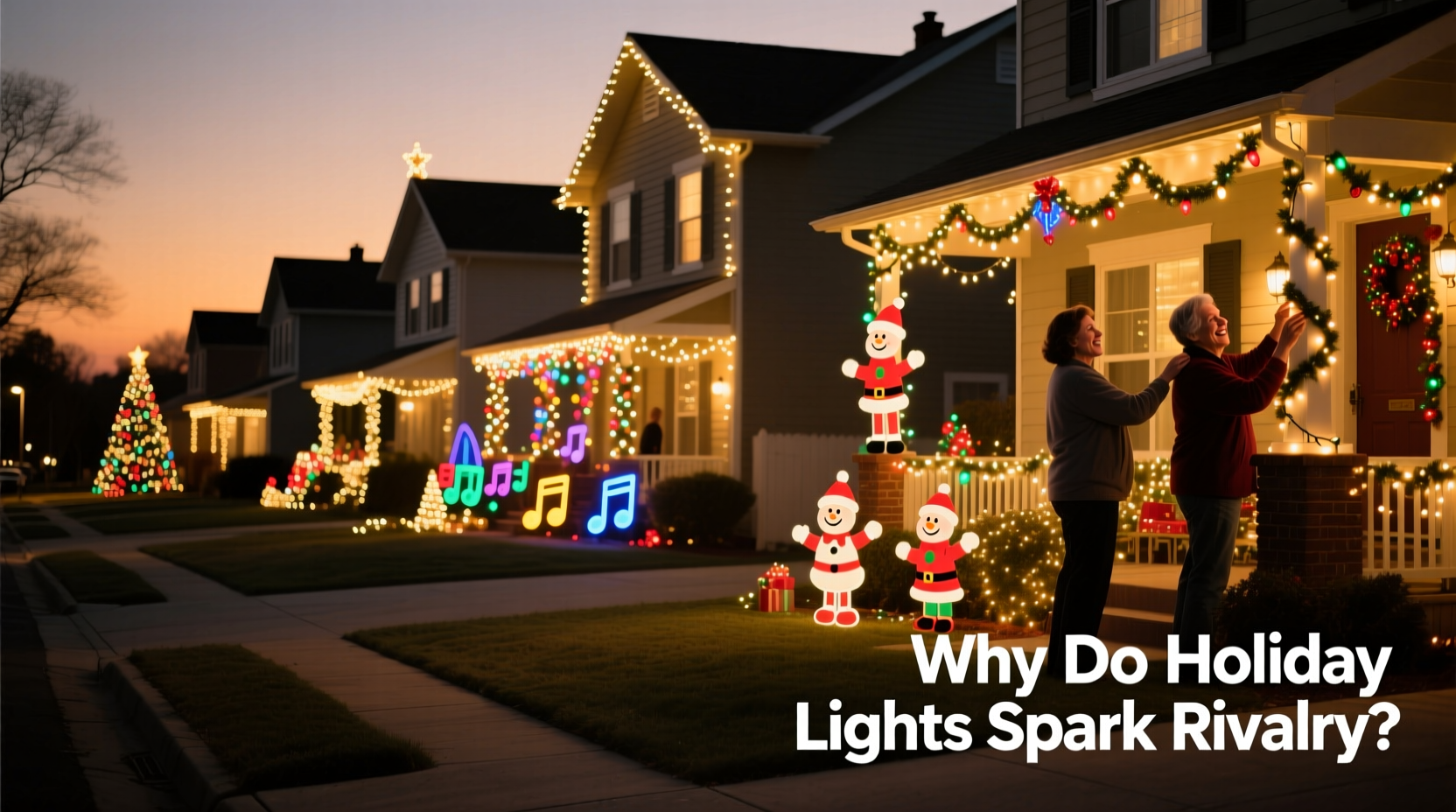
At its core, Christmas light rivalry is powered by Leon Festinger’s 1954 theory of social comparison: humans evaluate their own opinions, abilities, and circumstances not in isolation, but relative to others. During the holidays—when traditions are public, visible, and emotionally charged—the lawn becomes a de facto stage. A neighbor’s 12-foot animated reindeer doesn’t just signal festivity; it silently communicates effort, resources, technical skill, and commitment to communal celebration. When your display features 300 bulbs and theirs features 3,000 synchronized to Spotify playlists, the comparison isn’t about aesthetics alone—it’s about perceived investment, competence, and social capital.
This dynamic intensifies because holiday displays are unusually legible metrics. Unlike income or education—private, abstract, or difficult to assess—light counts, speaker volume, motion sensor responsiveness, and even visitor parking patterns are observable, quantifiable, and shareable (often via Nextdoor or Facebook). As Dr. Sarah Lin, behavioral sociologist at UCLA, explains:
“Christmas light displays function as ‘public résumés’—low-risk, high-visibility demonstrations of care, capability, and cultural fluency. When people invest hundreds of hours and thousands of dollars, they’re not just decorating. They’re staking a claim in the neighborhood’s emotional economy.” — Dr. Sarah Lin, Behavioral Sociologist, UCLA
Crucially, this comparison isn’t always upward. Some residents deliberately scale back—not from apathy, but as quiet resistance. A single wreath on the door or a modest string of white lights can become an act of anti-rivalry: a statement that warmth matters more than wattage, that presence outweighs production. Yet even that choice gains meaning only in contrast to the spectacle next door.
Status Signaling in Suburbia: Lights as Cultural Currency
In neighborhoods where homes look similar and lifestyles converge, differentiation becomes psychologically essential. Christmas lights serve as what anthropologists call “costly signals”—efforts so time-consuming, expensive, or technically demanding that they credibly communicate underlying traits: reliability (you’ll maintain it nightly), resourcefulness (you sourced 17 custom-made candy cane poles), and communal orientation (you’ve installed a QR code linking to your family’s charity donation page).
But status here operates on two distinct tracks:
- Traditional status: Measured in scale, brightness, novelty (e.g., drone light shows, laser projections, 50-foot trees).
- Counter-status: Measured in restraint, sustainability, craftsmanship (e.g., hand-blown glass ornaments, solar-powered circuits, vintage incandescent bulbs curated for nostalgic warmth).
Both forms generate social recognition—but different kinds. The first earns admiration and viral shares; the second garners respect and invitations to join the “Neighborhood Lights Stewardship Committee.” Neither is inherently superior, but both rely on the same psychological mechanism: using visible action to declare identity within a shared context.
Tip: If you feel pressured by light rivalry, reframe your display as an invitation—not a competition. Add a handwritten sign: “Stop for hot cocoa & stories. No judgment, just joy.” That shifts the metric from spectacle to connection.The Community Identity Loop: How Rivalry Reinforces Belonging
Paradoxically, rivalry often strengthens community bonds—even when it feels tense. Consider the annual “Light Crawl,” where residents map displays, vote for categories (“Most Whimsical,” “Best Use of Recycled Materials”), and donate to local schools based on participation. What looks like competition functions as ritualized cohesion. Psychologists call this the “boundary maintenance” effect: shared reference points (like comparing who has the better nativity scene) create implicit group membership. You may grumble about the Thompsons’ 8 a.m. light switch-on routine—but you also know their dog’s name, their kids’ soccer schedules, and that they’ll lend a ladder if your icicle lights fail.
This loop operates through three reinforcing stages:
- Observation: Noticing differences in displays activates social awareness.
- Interpretation: Assigning meaning (“They must love tradition,” “They’re new here and trying too hard,” “They’re honoring a lost parent”).
- Interaction: Commenting, complimenting, asking for wiring tips, or organizing joint caroling—all grounded in the shared visual language of lights.
Without the rivalry, there would be less reason to pause, point, and talk. The tension creates the opening for relationship-building.
A Real-World Snapshot: Maplewood Drive, 2023
Maplewood Drive—a quiet street of 22 homes in Portland, Oregon—offers a revealing microcosm. For years, the Rodriguez family held unofficial “light supremacy” with a 15-minute animated Nativity featuring motion-sensored narration and synchronized snowfall effects. In 2022, the Chen family moved in and installed a minimalist, programmable pixel-mapped archway spelling “PEACE” in shifting pastel hues—quiet, elegant, and powered entirely by rooftop solar.
Initial reactions were polarized: some neighbors praised the Chens’ innovation; others whispered that “it wasn’t *real* Christmas.” Tensions peaked when the Rodgriguez’s 2023 upgrade included a drone swarm forming a rotating star above their roof—drawing crowds that blocked driveways and triggered noise complaints. Rather than escalate, the neighborhood association convened a “Light Harmony Meeting.” Out of it came two outcomes: a voluntary lighting curfew (10 p.m.), and a new tradition—the “Maplewood Light Exchange,” where families swap bulbs, share wiring diagrams, and co-host a December 15th “Dark-to-Dawn” storytelling night lit only by candles and fire pits.
The rivalry didn’t vanish—but it transformed. What began as zero-sum comparison evolved into collaborative curation. The Chens helped troubleshoot the Rodriguezes’ drone sync issues; the Rodriguezes donated surplus LED strips to the community center’s youth art project. The display became less about individual achievement and more about collective narrative.
Do’s and Don’ts of Healthy Holiday Display Culture
Navigating light rivalry constructively requires intentionality—not just decoration. Below is a practical framework distilled from community psychologists, urban planners, and long-time neighborhood association leaders:
| Action | Why It Works | Risk If Ignored |
|---|---|---|
| Do: Coordinate start/end dates with 3+ neighbors | Creates shared rhythm; reduces “light whiplash” (sudden on/off transitions between yards) | Perceived as inconsiderate; triggers passive-aggressive notes |
| Do: Use warm-white LEDs (2700K–3000K) instead of cool-blue | Minimizes light pollution, supports circadian health, feels more inviting | Disrupts sleep for sensitive residents; violates municipal dark-sky ordinances |
| Don’t: Hide power sources or wiring under mulch | Prevents tripping hazards, simplifies maintenance, allows quick troubleshooting | Fire hazard; repeated damage to cords; neighbor frustration during repairs |
| Don’t: Compete on decibel level (speakers, sound effects) | Sound travels unpredictably; volume ≠ impact. Quiet moments resonate deeper. | Noise complaints; HOA violations; erosion of goodwill |
| Do: Include a non-electric element (handwritten sign, live plant, local art) | Signals humanity over hardware; invites personal engagement beyond spectacle | Displays risk feeling sterile, corporate, or emotionally distant |
FAQ: Addressing Common Concerns
Is light rivalry harmful—or just harmless fun?
It depends on impact. Harmless when it sparks conversation, inspires creativity, or funds community causes. Harmful when it fuels resentment, excludes lower-income households, increases energy use without offset, or leads to safety compromises (overloaded circuits, obstructed sidewalks). The line is crossed when joy becomes obligation—and generosity turns into performance.
How do I opt out gracefully without seeming Scrooge-like?
Lead with transparency and warmth. A small, well-placed sign works wonders: “Our family celebrates quietly this year—wishing you warmth, rest, and genuine connection.” Or shift focus: host a “Lights-Off Potluck” on a Saturday evening with lanterns and acoustic music. Opting out becomes an act of inclusion—not rejection.
Can rivalry ever be productive for neighborhood development?
Yes—when channeled intentionally. Several cities now treat light displays as civic infrastructure: Portland’s “Light the Way” initiative offers free energy audits and rebates for efficient systems; Austin’s “Luminaria Project” trains teens in circuit design and public art, with displays displayed along bike trails. Productive rivalry focuses on shared goals—sustainability, accessibility, intergenerational engagement—not solitary spectacle.
Conclusion: Beyond the Bulbs—Choosing Our Shared Light
Christmas light rivalry isn’t a flaw in our holiday spirit—it’s evidence of it. We compete because we care: about being seen, about contributing, about marking time meaningfully in a world that often feels anonymous and accelerating. The blinking LEDs are never just electricity and plastic. They’re proxies for hope, memory, aspiration, and the quiet, persistent human need to say, “I am here. I belong. And I want you to notice—not just my lights, but the heart behind them.”
So this season, ask yourself not “How bright can I go?” but “What kind of light do I want to cast in my corner of the world?” One that dazzles—or one that draws people in? One that competes—or one that connects? The most enduring displays aren’t measured in lumens, but in the conversations they spark, the hands they hold, and the quiet understanding that passes between neighbors when someone pauses, looks up, and says simply, “This means something.”
💬 Your turn: Share one small way you’ve turned light rivalry into neighborly connection—whether it’s borrowing a ladder, co-designing a street map, or swapping hot cocoa recipes. Your story might be the spark someone else needs.