
It’s a familiar holiday scene: strings of LED lights flicker across the eaves, cheerful carols play softly—and your dog stands rigid, ears forward, tail stiff, barking sharply at the pulsing red-and-green glow on the porch. Some dogs pace. Others whine, lunge, or retreat behind furniture. This isn’t “naughty” behavior—it’s a neurologically grounded response to visual stimuli that humans often overlook. Blinking lights trigger deeply rooted sensory processing patterns in dogs, and misreading this reaction can lead to ineffective corrections—or worse, heightened anxiety over time. Understanding the *why* is the first, essential step toward compassionate, evidence-informed intervention.
The Science Behind the Barking: Why Lights Trigger Dogs
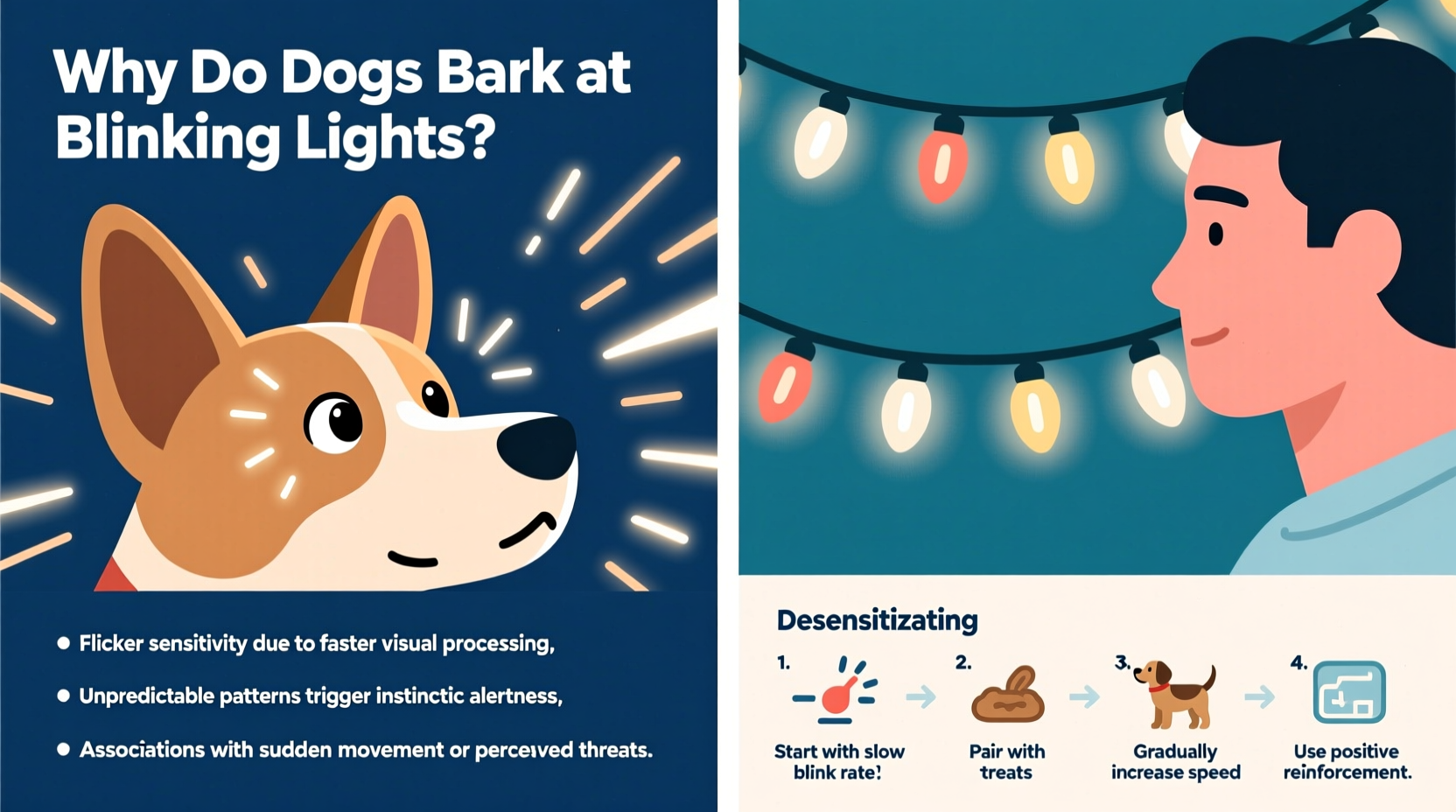
Dogs perceive light differently than humans. Their retinas contain a higher density of rod photoreceptors—cells specialized for low-light vision and motion detection. This gives them superior night vision but also makes them acutely sensitive to rapid changes in brightness and contrast. A standard LED string light flashing at 3–6 Hz (cycles per second) falls squarely within the range that activates a dog’s visual motion-detection circuitry—the same system that alerts them to a squirrel darting through grass or a leaf skittering across pavement.
Compounding this is the flicker fusion threshold: the frequency at which a flashing light appears continuous. Humans typically fuse flicker at 50–90 Hz; dogs require 70–80 Hz or higher. Most inexpensive holiday lights operate well below that—often between 40–60 Hz—meaning dogs see them as distinct, jarring pulses, not steady illumination. Add to that the unpredictable timing of many twinkle modes (random fade, chase, strobe), and you have a potent visual stressor.
Neurologically, this triggers the amygdala’s threat-assessment pathway. The brain doesn’t distinguish between a moving shadow and a blinking light when both signal potential novelty or unpredictability. For dogs with prior negative associations—like being startled by a sudden light flash during a storm—or those with underlying anxiety or noise sensitivity, blinking lights can activate a full fight-or-flight cascade. Barking becomes both an alarm signal (“Something’s wrong here!”) and a displacement behavior (“I don’t know what to do, so I’ll vocalize”).
Tip: Test your lights’ flicker rate using your smartphone camera. Point the camera at the lights—if you see rolling dark bands or visible strobing on screen, your dog is almost certainly seeing it more intensely than you are.What Not to Do: Common Missteps That Worsen the Response
Well-intentioned owners often escalate the problem unintentionally. Yelling “No!” or physically restraining a barking dog reinforces the association between the lights and emotional arousal. Punishment doesn’t teach the dog *what to do instead*—it only teaches them that the presence of lights predicts discomfort or confusion.
Equally unhelpful is complete avoidance—covering all windows, banning lights entirely, or isolating the dog in another room. While this reduces immediate stress, it prevents the nervous system from learning safety. Without gradual exposure paired with positive reinforcement, the dog’s perception of blinking lights remains unchanged: they’re still threatening, just temporarily out of view.
Another frequent error is rushing desensitization. Trying to go from “lights off” to “full outdoor display” in one evening overwhelms the dog’s capacity to process. Stress hormones like cortisol remain elevated for up to 72 hours after a single overwhelming event—meaning even if your dog seems calm the next day, their nervous system may still be primed for reactivity.
| Common Action | Why It Backfires | Better Alternative |
|---|---|---|
| Yelling or leash-popping during barking | Increases sympathetic nervous system activation; pairs lights with punishment | Redirect calmly with a known cue (“touch” or “find it”) + high-value treat |
| Leaving lights on 24/7 while ignoring barking | Creates chronic low-grade stress; no opportunity for positive association | Controlled, timed exposures with clear start/end cues |
| Using ultrasonic deterrents near lights | Adds aversive auditory layer; compounds fear and confusion | Remove competing stressors; simplify environment first |
| Assuming “they’ll get used to it” without guidance | Misses critical window for neural plasticity; habits solidify over time | Structured desensitization starting 4–6 weeks before peak lighting |
A Step-by-Step Desensitization Protocol (4-Week Timeline)
Effective desensitization isn’t passive exposure—it’s active, predictable, and reward-based conditioning. This protocol assumes your dog is medically cleared (no vision issues, pain, or untreated anxiety disorders). Begin at least four weeks before heavy holiday lighting begins.
- Week 1: Foundation & Baseline
Observe your dog’s current reaction to ambient light changes (e.g., turning lamps on/off). Note distance, duration, and body language. Introduce a “light cue”—a specific word like “glow”—paired with a treat *only* when no lights are present. Build reliability: say “glow,” mark with a click or “yes,” deliver treat. Repeat 10x/day for 3 days. - Week 2: Controlled Introduction
Use a single, dimmable LED bulb on a lamp. Start with light OFF. Say “glow,” then slowly brighten to 10% intensity for 2 seconds. Immediately treat. Repeat 5x/session, 2 sessions/day. If your dog looks away, freezes, or stops taking treats, reduce intensity or duration. Success = relaxed head position and voluntary eye contact during light-on phase. - Week 3: Adding Blink & Distance
Switch to a programmable light string (set to slow, gentle pulse mode—not strobe). Place it 12 feet away, behind a semi-opaque curtain. Say “glow,” turn on for 3 seconds, treat. Gradually increase duration to 10 seconds, then decrease distance by 1 foot every two days—*only* if your dog remains engaged and takes treats readily. Never push past soft blinking, lip licking, or whale eye. - Week 4: Integration & Generalization
Move light outdoors or to its final location. Practice with multiple light types (warm white, cool white, color-changing). Introduce mild distractions: play quiet music, have a family member walk nearby. End each session with a “lights off” cue followed by a jackpot reward (3–5 high-value treats). Maintain sessions at 3–5 minutes max; end on success, never fatigue.
Real-World Case Study: Luna, a 3-Year-Old German Shepherd Mix
Luna began barking at outdoor lights shortly after her family installed solar-powered pathway markers. Her reactivity escalated to lunging at the front window each evening, accompanied by whining and refusal to settle. Her owner initially tried covering the window—temporarily effective, but Luna soon redirected her anxiety to the back door, where she’d scratch incessantly at dusk.
Working with a certified behavior consultant, Luna’s plan began with observation: she only reacted to lights with intermittent movement—not steady ones. Her baseline was established using a phone flashlight on lowest setting. By Week 2, she accepted 5-second pulses at 8 feet. A key breakthrough came when her owner discovered Luna responded best to “look at that” cues paired with freeze-dried liver—not generic kibble. By Week 4, Luna sat calmly beside the front window while the pathway lights cycled, occasionally glancing at them, then returning to her owner for a treat. Crucially, her owner avoided holiday lights on the house itself until January—giving Luna’s nervous system time to consolidate learning without overload.
“Dogs don’t generalize well. Seeing a blinking light on a tree doesn’t automatically mean they’ll be fine with blinking lights on the roof. Each context, distance, and light pattern must be conditioned separately—and always at the dog’s pace.” — Dr. Sarah Chen, Veterinary Behaviorist, UC Davis School of Veterinary Medicine
Practical Support Strategies Beyond Desensitization
Desensitization lays the foundation—but environmental management and physiological support make it stick. Consider these complementary approaches:
- Light Selection: Choose lights labeled “flicker-free” or “constant current.” Look for specifications listing >100 Hz refresh rate. Warm-white LEDs (2700K–3000K) tend to be less stimulating than cool-white or RGB color-shifting models.
- Strategic Placement: Avoid placing lights at dog-eye level (12–24 inches off ground) or directly in high-traffic paths. Mount strings higher or use ground-level lighting only in areas your dog rarely accesses.
- Preemptive Calming: Administer calming supplements (e.g., L-theanine + alpha-casozepine) 60–90 minutes before scheduled light exposure—only after veterinary approval. Pair with low-stimulus activities like lick mats or scent work to shift autonomic state.
- Sensory Substitution: When lights are unavoidable (e.g., walking past decorated homes), carry a favorite toy or use a “find it” game with kibble scattered on grass. This redirects visual focus and engages the olfactory system, which has a direct calming effect on the limbic system.
FAQ: Addressing Key Concerns
Will my dog ever stop reacting completely—or is some barking normal?
Complete silence isn’t the goal. A healthy outcome is *functional calm*: your dog notices the lights, may briefly orient, then disengages to sniff, rest, or check in with you. Occasional soft vocalizations during early exposure are normal. Persistent, intense barking after 4+ weeks of consistent protocol suggests either insufficient pacing, an undiagnosed medical contributor (e.g., vision loss causing compensatory hyper-vigilance), or co-occurring anxiety requiring professional support.
Can I use a white noise machine to mask the “sound” of lights?
Christmas lights themselves are silent—but many dogs react to the faint electromagnetic hum emitted by cheap power adapters or transformers, especially in quiet environments. A white noise machine set to low-volume brown noise (not high-frequency hiss) *can* help mask this. However, never rely on sound masking alone; address the visual trigger directly. If your dog only reacts when lights are on *and* the adapter is audible, replace the transformer with a high-quality, low-EMF model.
My puppy is curious—not fearful—about the lights. Should I still desensitize?
Absolutely. Early positive exposure builds resilience. Puppies’ brains are highly plastic, making this the ideal time to create strong, safe associations. Use the same protocol—but shorten sessions to 60–90 seconds and increase frequency (3–4x/day). Reward curiosity (sniffing, soft gaze) immediately. Avoid letting puppies chase or bite lights—this can morph into obsessive behavior or frustration-based barking later.
Conclusion: Building Trust, One Pulse at a Time
Barking at blinking Christmas lights isn’t a flaw in your dog—it’s data. It tells you about their sensory world, their history, and their need for predictability in an environment saturated with human-designed stimuli. Desensitization isn’t about suppressing behavior; it’s about expanding your dog’s capacity for calm choice. Every successful “glow” cue, every relaxed blink in the presence of light, every moment your dog chooses connection over reactivity—it rewires neural pathways, strengthens trust, and affirms your role as a steady, attuned guide.
This holiday season, resist the pressure to rush. Start small. Celebrate micro-wins. Keep your treats ready, your patience deeper, and your expectations rooted in compassion—not convenience. Your dog isn’t broken. They’re communicating. And with consistency, clarity, and kindness, you can transform flickering lights from a source of alarm into a quiet, shared moment of peace.
💬 Have a desensitization success story—or a question we didn’t cover? Share your experience in the comments. Your insight could help another dog parent navigate the holiday glow with confidence.








