When decorating for the holidays, one of the most subtle yet powerful design decisions you can make is choosing the right type of Christmas lights. While colored bulbs have long been a staple of festive cheer—offering nostalgic charm and vibrant energy—many interior designers, photographers, and holiday enthusiasts are turning to clear incandescent or LED bulbs to showcase their ornaments. The reason? Clear bulbs create a more balanced, natural illumination that allows ornaments to truly shine. But why exactly does this happen? It comes down to light quality, color rendering, contrast, and how our eyes perceive depth and detail in low-light settings.
The Science of Light and Color Perception
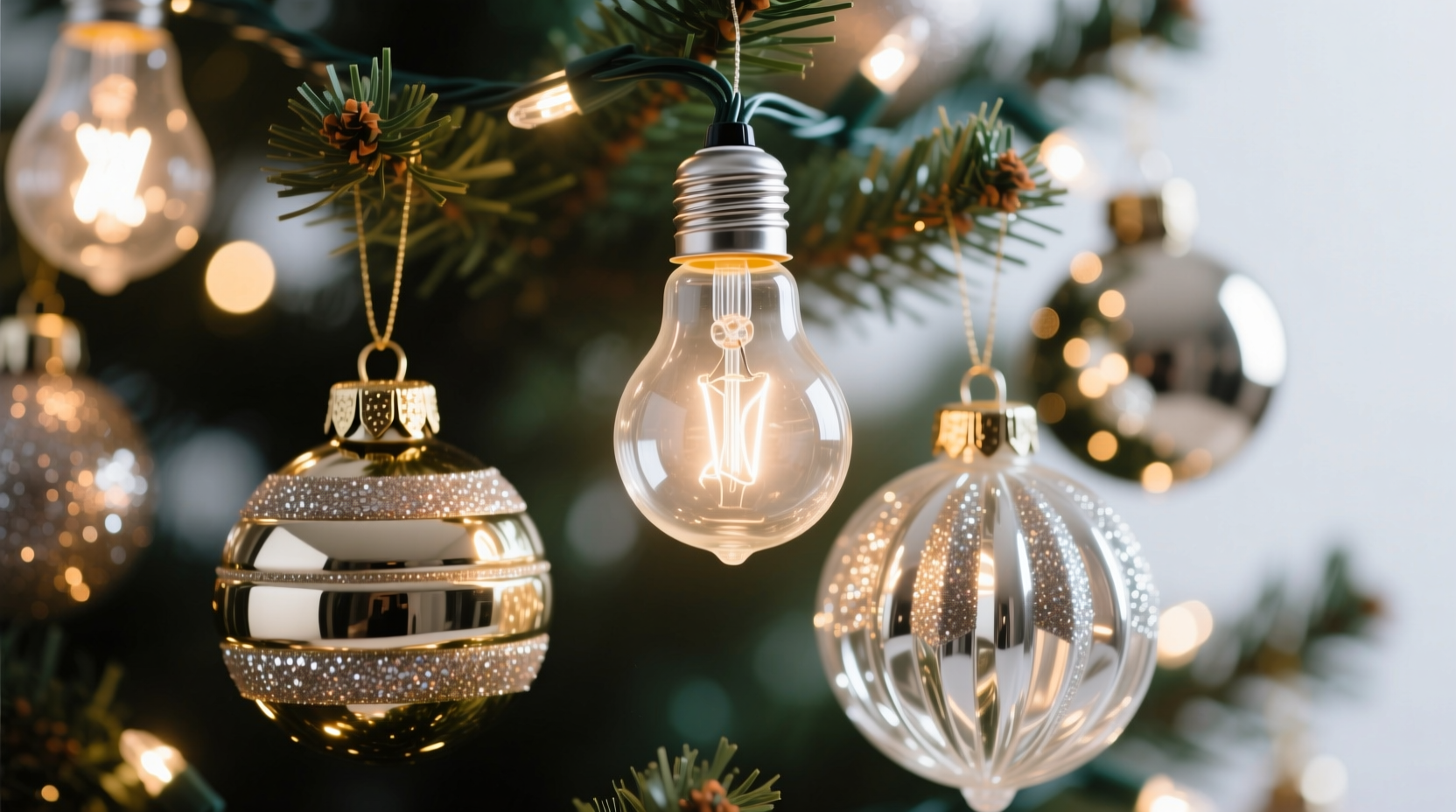
Human vision responds differently depending on the type of light illuminating an object. Colored lights alter the wavelengths reaching our eyes, which changes how we see colors on ornaments. A red bulb casts a warm, dominant hue across everything nearby, muting cooler tones like blues and greens. Similarly, blue lights suppress warmer shades such as golds and reds. This phenomenon is known as metameric failure, where objects appear different under varying light sources—even if they look identical under natural daylight.
Clear bulbs, especially traditional incandescents, emit a full-spectrum white light with a warm color temperature (typically around 2700K). This closely mimics candlelight or early evening sunlight, both of which render colors accurately and naturally. As a result, the true pigments in glass balls, hand-painted figures, and metallic finishes remain visible without distortion.
“Lighting is the silent director of attention in any space. With clear bulbs, you're not competing with artificial hues—you're enhancing what’s already there.” — Daniel Reyes, Lighting Designer & Architectural Consultant
How Clear Bulbs Enhance Ornament Detail and Depth
Ornaments are often crafted with intricate details: etched patterns, layered paint, glitter gradients, reflective coatings, and delicate filigree. These textures rely on contrast and shadow to be appreciated fully. Colored lights tend to flatten these features by washing out highlights and obscuring shadows with monochromatic glow.
In contrast, clear bulbs produce directional highlights and soft shadows due to their point-source nature. Each bulb acts like a tiny spotlight, creating micro-highlights on curved surfaces and emphasizing dimensional elements. This interplay of light and dark gives ornaments a three-dimensional appearance, making them seem to “pop” from the tree.
Consider a mercury glass ornament with a frosted outer layer and mirrored interior. Under colored lights, its reflective surface may simply reflect back the same hue, losing complexity. But under clear bulbs, the interplay between ambient glow and focused reflection reveals depth, texture, and craftsmanship.
Tip: For maximum ornament visibility, use C7 or C9 clear bulbs spaced evenly throughout the tree—avoid clustering too many near the trunk.Color Rendering Index (CRI) and Why It Matters
A key technical factor behind the superiority of clear bulbs is the Color Rendering Index (CRI), a measure of how accurately a light source reveals the true colors of objects compared to natural light. Incandescent clear bulbs have a near-perfect CRI of 100, meaning they display all colors faithfully. Most colored LEDs, especially budget varieties, score much lower—sometimes below 70—which means colors appear duller, less saturated, or even shifted.
This becomes especially noticeable with ornaments that feature multiple colors or iridescent finishes. A single ornament might contain red, green, silver, and gold accents. Under high-CRI clear lighting, each color remains distinct and vivid. Under low-CRI colored lights, adjacent hues bleed into one another, reducing clarity and visual interest.
Even premium colored LEDs struggle to match the spectral continuity of incandescent clear bulbs. While advancements in phosphor-coated LEDs have improved CRI scores, most decorative colored strings still prioritize brightness and energy efficiency over color fidelity.
Creating Visual Hierarchy with Neutral Lighting
Interior design relies heavily on establishing a visual hierarchy—guiding the eye to focal points through contrast, scale, and lighting. When using colored lights, the bulbs themselves become the dominant feature. The tree appears lit *by* red, green, and blue dots rather than being illuminated to showcase ornaments.
Clear bulbs recede visually. They provide illumination without drawing attention to themselves. This allows ornaments—the actual decorative elements—to take center stage. Think of it like museum lighting: art galleries use neutral, directional spotlights so paintings aren’t altered by tinted light. The same principle applies to a well-decorated Christmas tree.
Moreover, clear lights offer greater flexibility when mixing ornament styles. Whether you’re combining vintage finds with modern pieces, or blending sentimental handmade items with luxury designer baubles, a neutral light base ensures cohesion. There’s no risk of clashing with specific bulb colors or creating unintended color casts.
| Light Type | CRI Score | Ornament Clarity | Best Use Case |
|---|---|---|---|
| Incandescent Clear Bulbs | 100 | Excellent | Showcasing detailed, colorful ornaments |
| LED Clear Bulbs (High-Quality) | 90–95 | Very Good | Energy-efficient elegance |
| Colored Incandescent Bulbs | 80–85 | Fair | Retro or themed displays |
| Standard Colored LEDs | 65–75 | Poor to Fair | Bright outdoor displays, not detail-focused trees |
Mini Case Study: A Designer’s Holiday Transformation
Sarah Lin, a residential stylist in Portland, Oregon, was hired to redesign a client’s living room for a holiday photoshoot. The original setup featured a pre-lit tree with multicolored LED lights and a mix of heirloom ornaments. Despite the sentimental value of the decorations, the photographer struggled to capture their details—the images looked flat, and colors appeared muddy.
Sarah replaced the colored string lights with warm-white clear LED bulbs (CRI 93), added a few strands manually for even distribution, and adjusted the room’s ambient lighting. Immediately, the ornaments gained definition. Photographs showed individual brushstrokes on hand-painted wooden stars, the shimmer of antique tinsel, and the depth of cut-glass spheres. The client later reported receiving multiple compliments on social media about the “museum-quality” look of the tree.
“It wasn’t about adding more—it was about revealing what was already there,” Sarah said. “The clear bulbs didn’t overpower; they uncovered.”
Step-by-Step Guide to Optimizing Your Tree Lighting
If you're ready to let your ornaments take center stage, follow this practical sequence to upgrade your lighting strategy:
- Assess your current lights: Are they colored? Are they integrated into a pre-lit tree or removable strands?
- Choose high-CRI clear bulbs: Opt for incandescent or high-quality LED clear bulbs with a CRI of 90+ and a color temperature between 2700K and 3000K for warmth.
- Calculate strand needs: For a standard 6–7 foot tree, plan for 600–700 mini lights or 100–150 C7/C9 bulbs. More strands mean better coverage and fewer dark spots.
- String strategically: Begin at the base of the trunk and weave outward toward branch tips. Distribute bulbs evenly, focusing on inner layers to create depth.
- Layer with dimmers: Connect lights to a dimmer switch or smart plug. Lowering brightness slightly enhances contrast and prevents glare, making ornaments stand out more.
- Add reflective elements: Place mirrored trays or silver garlands beneath the tree to bounce light upward, further illuminating lower ornaments.
- Evaluate during evening hours: View your tree after dusk under normal room lighting. Adjust placement or add strands if certain areas feel dim or cluttered.
Common Misconceptions About Colored Lights
Many people assume colored lights are inherently more festive. While they evoke childhood memories and classic holiday imagery, they aren't always the best choice for showcasing decoration. Another myth is that “more colors equal more joy.” In reality, visual overload can diminish focus. When every bulb emits a different hue, the brain struggles to settle on a focal point, leading to sensory fatigue.
There’s also a belief that clear bulbs look “too plain” or “like porch lights.” This stems from outdated associations with utility lighting. Modern clear bulbs come in various shapes (vintage Edison, globe, flame-tip) and finishes (antique brass filament, frosted glass) that add elegance without sacrificing performance.
Checklist: Lighting Upgrade for Ornament Emphasis
- ☐ Remove or supplement existing colored lights with clear bulbs
- ☐ Verify CRI rating is 90+ (for LEDs)
- ☐ Ensure warm color temperature (2700K–3000K)
- ☐ Distribute lights evenly from trunk to tips
- ☐ Test lighting at night in normal viewing conditions
- ☐ Dim lights slightly for enhanced contrast
- ☐ Clean ornaments before lighting—they reflect better when dust-free
FAQ
Can I mix clear and colored bulbs?
You can, but do so intentionally. Using mostly clear bulbs with a few colored ones as accents (e.g., red at the tips of branches) can work. However, large sections of colored lights will still distort nearby ornament colors. For a cohesive look, stick to clear bulbs and let colored ornaments provide the palette.
Are LED clear bulbs as effective as incandescent?
High-quality LEDs are very close. Look for brands advertising “full spectrum” or “high CRI” (90+). Avoid cheap LED strings that produce harsh, cool-toned light. Some users prefer incandescent for their slight glow and heatless operation isn’t always necessary indoors.
Do clear bulbs use more energy?
Traditional incandescent clear bulbs do consume more power than LEDs. However, LED clear bulbs offer the same visual benefits with up to 80% less energy usage. If efficiency is a concern, choose LED clear bulbs with high CRI ratings.
Conclusion
The magic of a beautifully decorated Christmas tree lies not just in the ornaments themselves, but in how they are seen. Clear bulbs, often overlooked in favor of flashier colored alternatives, serve as the ultimate supporting actor—illuminating without overshadowing. By delivering accurate color, enhancing texture, and preserving visual harmony, they allow each ornament to express its full character. Whether you’re displaying family heirlooms, artisan creations, or whimsical collectibles, switching to clear lighting can transform your tree from a bright display into a curated showcase.
💬 Have you tried switching from colored to clear bulbs? Share your experience, favorite brands, or before-and-after insights in the comments—your story could inspire someone else’s holiday upgrade!








