Every holiday season begins with the same ritual: pulling out the Christmas lights, untangling them from last year’s storage, and draping them across the tree or along the roofline. But then comes the disappointment—only half the strand lights up. You plug it in, check the outlet, swap bulbs, yet one section remains stubbornly dark. This is one of the most common electrical frustrations during the holidays, but it’s rarely random. There are predictable causes behind why Christmas lights only partially work—and more importantly, there are reliable ways to diagnose and fix them.
This guide dives deep into the mechanics of traditional incandescent mini-light strands, explains how their circuitry works, and walks you through a systematic approach to restore full illumination. Whether you’re dealing with vintage strings or newer models, understanding the root causes can save time, money, and seasonal stress.
How Traditional Christmas Light Strands Are Wired
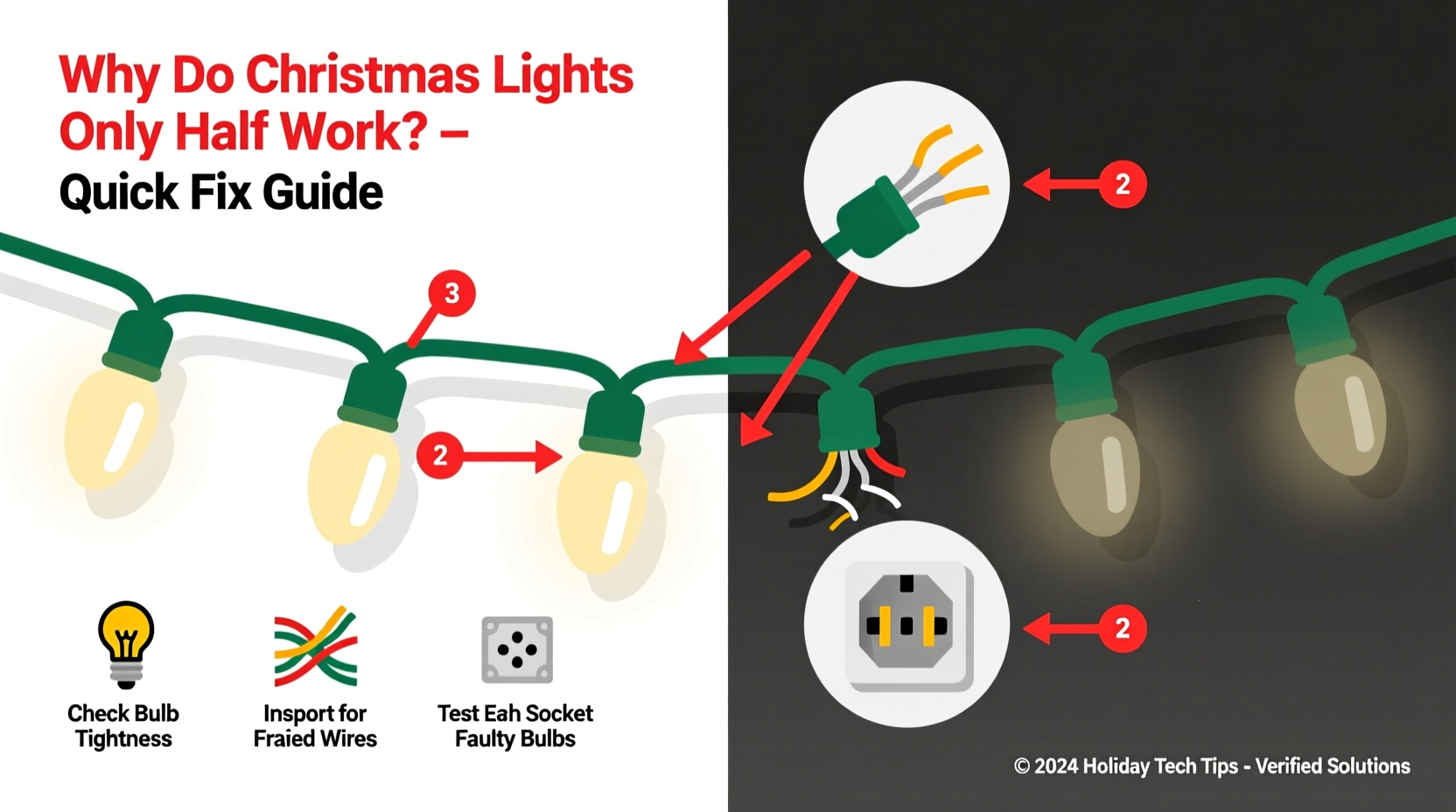
To understand why only half a strand might light up, you first need to know how most older-style Christmas lights are wired. Unlike modern LED strings that often use parallel circuits, many incandescent mini-lights operate on a **series circuit**. In this setup, electricity flows through each bulb in sequence. If one bulb fails—or is loose—the entire circuit breaks, cutting power to all downstream bulbs.
However, some manufacturers design their strands with a clever workaround: **shunted sockets**. These allow current to bypass a dead bulb so the rest of the strand stays lit. Even with this innovation, problems can still occur when multiple failures happen, or when the failure isn’t just a missing bulb but a broken wire, faulty shunt, or damaged socket.
In two-wire series circuits, especially those rated for 120 volts with 50 bulbs (each using about 2.5 volts), the removal or failure of one bulb increases the voltage load on the remaining ones. Over time, this overvoltage can cause cascading burnouts. That’s why you’ll often see an entire second half go dark after replacing a single bulb—it was masking deeper issues.
“Many people assume a blown bulb is the only issue, but in reality, poor connections, degraded insulation, and worn sockets contribute significantly to partial lighting.” — Daniel Reeves, Electrical Technician & Holiday Lighting Specialist
Step-by-Step Troubleshooting Guide
When only half your Christmas light strand illuminates, follow this logical process to isolate and resolve the problem. Work methodically to avoid unnecessary replacements.
- Unplug the strand immediately. Safety first. Never handle electrical components while powered.
- Inspect the visibly dark section. Look for cracked bulbs, discolored sockets, frayed wires, or bent metal contacts inside the sockets.
- Check for loose or missing bulbs. Even if a bulb appears seated, press gently to ensure it’s fully snapped in. A loose bulb breaks the circuit.
- Test each bulb in the dark half manually. Using a bulb tester or multimeter, check continuity. Alternatively, remove and test each bulb by inserting it into a known working socket.
- Look for “flasher” or “twinkle” bulbs in the wrong position. These specialty bulbs have different internal resistance and can disrupt the circuit if placed outside designated slots.
- Examine the wire between halves. Run your fingers along the length where the working section ends. Feel for cuts, kinks, or melted insulation that could indicate a break.
- Use a non-contact voltage detector (if available). Plug the strand in briefly and scan along the wire to see where voltage stops flowing.
- Check the shunts (if applicable). In shunted sockets, a small conductive bridge should carry current past a dead bulb. Corrosion or manufacturing defects can prevent this.
- Inspect the male and female plugs. Bent prongs, corrosion, or cracked housings can interrupt connectivity between sections.
- Test continuity with a multimeter. Set to ohms or continuity mode. Place probes at both ends of the dark segment to verify if the circuit path is intact.
Common Causes of Half-Lit Strands
While bulb failure is the obvious suspect, several other factors frequently lead to partial operation:
- Single open filament: One burned-out bulb breaks the circuit in non-shunted designs.
- Damaged wiring: Rodents, foot traffic, or improper storage can cut internal wires.
- Frayed or pinched insulation: Exposed copper can short-circuit or ground out.
- Corroded or oxidized contacts: Moisture exposure leads to poor conductivity in sockets and plugs.
- Failed shunt: In shunted bulbs, the bypass mechanism may not activate due to age or defect.
- Overloaded circuit: Connecting too many strands end-to-end exceeds wattage limits, causing thermal cutoffs.
- Internal fuse blowout: Some plug heads contain fuses; one may be blown while the other still conducts.
A particularly deceptive issue occurs in dual-circuit strands—some sets actually contain two separate circuits within one string. If one fuse blows or one side develops a fault, exactly half the lights go dark. These are often marketed as “dual-wave” or “two-in-one” effect lights and require checking both fuses in the male plug.
Tips for Preventing Future Issues
Prevention is far easier than repair. With proper care, a quality set of Christmas lights can last 10 years or more. Follow these best practices to minimize future failures.
Tip: Always unplug lights before adjusting or storing them—even low-voltage strands can pose risks when damaged.| Action | Benefit | Frequency |
|---|---|---|
| Store coiled loosely in a tubular reel or cardboard tube | Prevents wire kinking and socket stress | After each season |
| Keep in a climate-controlled space | Reduces moisture and temperature damage | Ongoing |
| Use a surge-protected outdoor-rated extension cord | Protects against voltage spikes and weather | Each use |
| Inspect before installation | Catches early signs of wear | Annually |
| Label functional vs. repair-needed strands | Saves time next season | During storage |
Avoid hanging lights where they’ll be walked on, pinched under eaves, or exposed to sprinkler spray. UV degradation from sunlight also weakens insulation over time, so consider rotating displays or shielding vulnerable runs.
Real-World Example: The Garage Strand Mystery
Tom from Colorado pulled out his favorite C7 red-and-white lights each November. For three years, they worked perfectly. On the fourth year, only the first half lit. He replaced every visible bulb, checked the outlet, and even bought a new plug adapter—all to no avail.
Eventually, he used a multimeter to test continuity and discovered the break wasn’t in a bulb—but in the wire just behind the third socket in the dark half. Closer inspection revealed a tiny gnaw mark. A mouse had nested in his garage storage bin and chewed through the insulation, severing one conductor.
He spliced in a short jumper wire, heat-shrunk the connection, and restored full function. The lesson? External damage isn’t always visible at a glance. Physical inspection must include tactile examination along the entire run.
Checklist: Fixing Half-Working Christmas Lights
Use this actionable checklist to troubleshoot efficiently:
- ✅ Unplug the strand completely
- ✅ Visually inspect all bulbs and sockets for damage
- ✅ Reseat every bulb in the dark section
- ✅ Test individual bulbs with a known good socket or tester
- ✅ Check for specialty bulbs (e.g., flashers) in standard positions
- ✅ Examine wire integrity for cuts, kinks, or rodent damage
- ✅ Inspect male and female plug ends for bent pins or cracks
- ✅ Replace both fuses in the plug head (even if one looks fine)
- ✅ Use a voltage detector to find where current stops
- ✅ Consider replacing with LED if repairs fail—more durable long-term
FAQ: Common Questions About Partially Lit Christmas Lights
Can a single bad bulb really turn off half the strand?
Yes, especially in series-wired incandescent strings. Since current must flow through each bulb in order, one failed filament interrupts the entire circuit downstream. Even with shunted sockets, some failures bypass inconsistently.
Why do my lights work when alone but fail when connected to another strand?
This usually indicates an overload. Each strand has a maximum wattage rating. When daisy-chained beyond that limit, the internal fuse may blow or the circuit breaker trips. Check manufacturer specs—typically no more than 3–5 strands should be linked.
Should I switch to LED Christmas lights?
For reliability, yes. Most LED strings use parallel or semi-parallel circuits, so one dead bulb won’t kill the whole strand. They also draw less power, generate less heat, and last significantly longer—often 25,000+ hours. While the upfront cost is higher, the long-term savings in energy and replacement make LEDs a smart upgrade.
Conclusion: Restore Your Lights with Confidence
Half-working Christmas lights aren’t magic—they’re mechanics. Behind every darkened bulb is a solvable issue rooted in physics, wear, or environmental damage. By understanding how your lights are wired, applying structured troubleshooting, and practicing preventative care, you can reclaim your festive glow without frustration.
Don’t rush to replace entire strands at the first sign of trouble. Invest a little time in diagnosis, use the right tools, and you’ll likely extend the life of your favorite lights for many seasons. And when repair isn’t feasible, consider upgrading to modern LED alternatives designed for durability and ease of use.
💬 Have a tricky light problem you solved? Share your story in the comments—your insight could help another holiday decorator save their display!








