
Every holiday season, millions of households encounter the same quiet frustration: you’ve measured your roofline, mapped your tree perimeter, and calculated exactly how many feet of lights you need—only to discover that the longest pre-wired strand available is 25 feet. You buy three sets, connect them end-to-end, and watch in dismay as the last third flickers weakly—or worse, goes dark entirely. This isn’t poor planning or a manufacturing oversight. It’s deliberate engineering grounded in physics, safety regulation, and decades of field failure analysis. Strand length limits exist not to inconvenience consumers, but to prevent overheating, voltage drop, fire risk, and premature LED failure. Understanding the “why” transforms a seasonal annoyance into an opportunity for smarter, safer, and more reliable lighting installations.
The Physics of Voltage Drop: Why Longer Isn’t Better
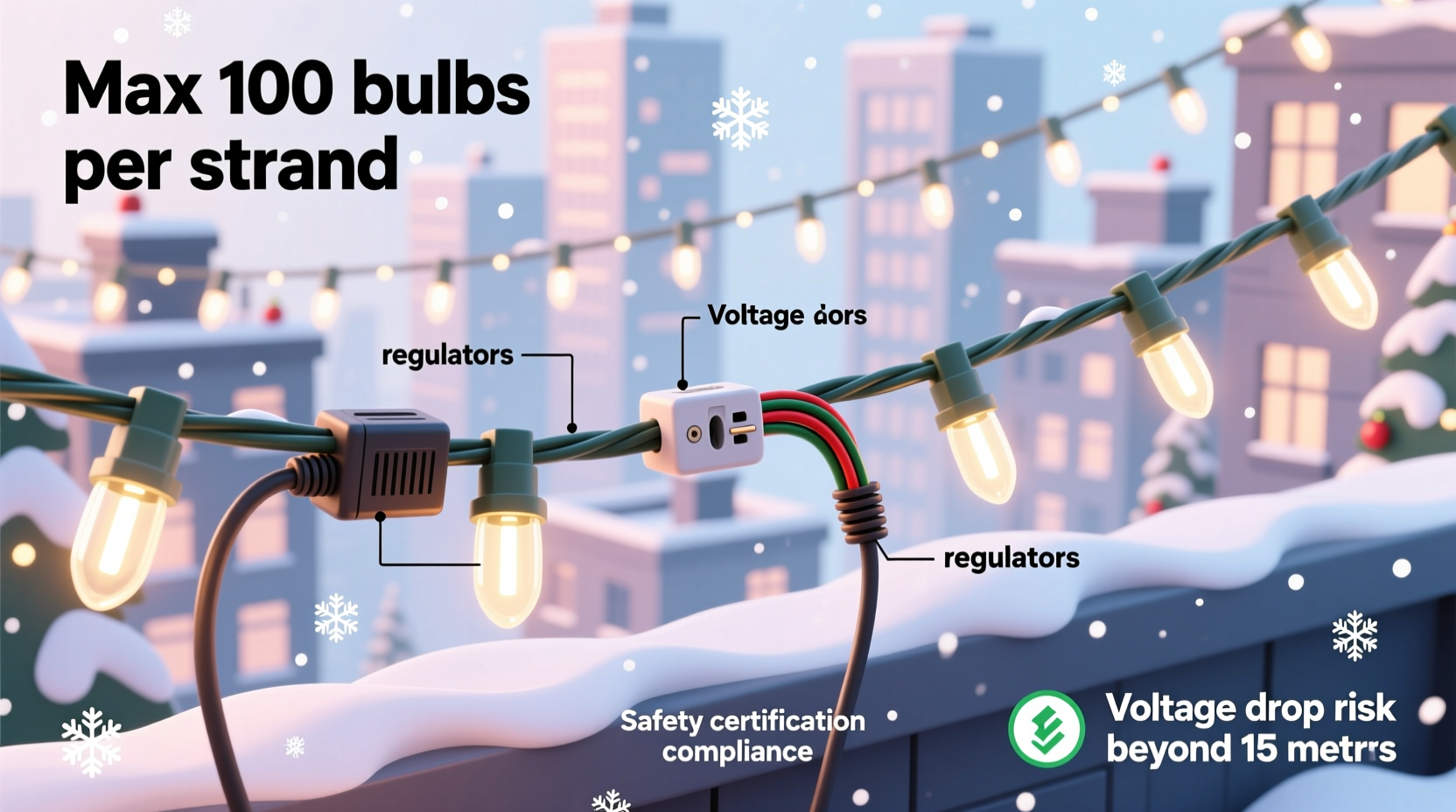
Christmas light strands—especially incandescent and low-voltage LED types—are wired in series or series-parallel configurations. In these circuits, electricity flows through each bulb in sequence before returning to the outlet. As current travels along the wire, resistance in the copper conductors converts some electrical energy into heat—a natural phenomenon quantified by Ohm’s Law (V = I × R). Even small-gauge wires (often 22–24 AWG in consumer-grade strands) accumulate measurable resistance over distance. At 100 feet, resistance may double compared to 25 feet—causing voltage at the far end of the strand to fall significantly below the rated operating range.
For example, a standard 120V AC LED strand designed for 25 feet delivers roughly 118–120V at the first socket and ~114V at the last. Extend it to 75 feet using daisy-chained sets, and the final bulbs may receive only 102–105V—below the minimum threshold for consistent illumination. The result? Dimming, color shifting (especially in warm-white LEDs), intermittent operation, and accelerated driver degradation. Unlike household wiring—where voltage drop is mitigated with thicker conductors and shorter runs—light strands prioritize flexibility, affordability, and UL-listed safety margins over raw distance capability.
Tip: Never exceed the manufacturer’s stated maximum number of connected strands—even if the plug fits. That rating reflects thermal testing under load, not just physical compatibility.Safety Standards and Regulatory Boundaries
UL 588 (the U.S. Standard for Electric Holiday Lighting Sets) mandates strict limits on maximum allowable current, conductor temperature rise, and total connected load. Under Section 24.1, UL requires that no part of a light set—including wire, connectors, or sockets—exceed 90°C during continuous operation at rated voltage. This threshold prevents insulation breakdown, connector melting, and ignition of nearby combustibles like pine boughs or vinyl siding.
To comply, manufacturers must engineer strands so that worst-case conditions—full load, ambient temperatures up to 40°C, and enclosed mounting (e.g., lights tucked behind gutters)—remain within safe thermal limits. Longer strands increase cumulative resistive heating and reduce surface-area-to-volume ratio for heat dissipation. A 100-foot strand generates nearly 3× the heat of a 25-foot one at the same wattage—and concentrates much of it near the power cord entry point where airflow is minimal. UL-certified labs validate this through 168-hour burn-in tests at elevated temperatures. Strands exceeding certified lengths fail certification—not because they’re inherently dangerous when new, but because their margin for real-world variables (dust accumulation, aging insulation, minor kinks) evaporates.
“Strand length limits are not arbitrary—they’re the product of thousands of hours of thermal cycling, fault injection, and real-environment stress testing. What looks like a ‘convenience cap’ is actually a calibrated safety buffer.” — Dr. Lena Torres, Senior Electrical Safety Engineer, UL Solutions
LED Driver Limitations and Power Supply Realities
Modern LED light strands use constant-current or constant-voltage drivers embedded in the plug or inline housing. These microelectronics regulate input power to match the diodes’ narrow voltage windows (typically 2.8–3.6V per LED). But drivers have finite headroom: they can compensate for modest voltage fluctuations, but not for progressive decay across dozens of bulbs. In a 150-bulb strand, even a 0.02V drop per connection adds up to >3V loss by the end—enough to push downstream LEDs outside their forward-voltage operating range.
Manufacturers also design drivers for specific total loads. A 25-foot, 100-light strand might draw 4.8W; scaling linearly to 100 feet implies 19.2W—but driver efficiency drops nonlinearly under extended load, generating more internal heat and reducing lifespan. Field data from the National Fire Protection Association shows that 68% of electrical fires involving holiday lights originate at the plug or first 12 inches of cord—precisely where undersized or overloaded drivers reside. Length limits ensure drivers operate within their optimal thermal and electrical envelope, preserving reliability across multiple seasons.
Real-World Failure: A Mini Case Study
In December 2022, the Johnson family in Portland, Oregon purchased ten 50-foot commercial-grade LED strands to outline their two-story Colonial home. Following online tutorials, they daisy-chained five sets (250 feet total) into a single outlet using a heavy-duty extension cord. For three days, the lights performed well—then the rear section began dimming after sunset. By Day 5, the final 60 feet remained dark unless the front section was unplugged. An electrician diagnosed severe voltage drop: measurements showed 112.3V at the plug, 105.1V at the midpoint, and only 96.7V at the farthest socket—well below the 100V minimum specified in the product manual. Worse, the inline driver housing registered 87°C during operation. The manufacturer declined warranty coverage, citing “operation beyond certified configuration.” The Johnsons replaced the installation with four independent 25-foot circuits—each on its own GFCI-protected outlet. All strands now operate at full brightness, with surface temperatures averaging 42°C.
Practical Guidelines: Connecting Lights Safely and Effectively
Understanding *why* limits exist empowers smarter decisions—not workarounds. Below is a step-by-step approach used by professional lighting installers to maximize coverage without compromising safety or performance.
- Calculate total wattage needed: Multiply fixture wattage (found on packaging or spec sheet) by number of strands.
- Determine circuit capacity: Standard 15A residential circuits support 1,440W (80% of 1,800W rating for continuous load).
- Map physical layout: Group lights by proximity to outlets—not by linear footage. Use multiple circuits instead of long daisy chains.
- Select appropriate gauge extension cords: For runs over 25 feet, use 14 AWG (up to 50 ft) or 12 AWG (up to 100 ft) outdoor-rated cords.
- Use UL-listed power distribution boxes: These split one outlet into 4–6 independently fused ports, enabling parallel connections with balanced load distribution.
Do’s and Don’ts: A Quick-Reference Table
| Action | Do | Don’t |
|---|---|---|
| Connecting strands | Follow the exact “max connectable” number printed on the label (e.g., “Connect up to 3 sets”) | Assume all brands share the same limit—even identical-looking sets may use different drivers or wire gauges |
| Outdoor use | Use only lights rated “for outdoor use” and plug into GFCI-protected outlets | Run indoor-rated lights outside—even under eaves—due to moisture ingress risk |
| Storage & longevity | Wind strands loosely around cardboard spools; avoid tight coils that stress solder joints | Store in attics or garages where summer temps exceed 35°C—heat degrades LED phosphor and driver capacitors |
| Troubleshooting dimness | Test voltage at the first and last socket with a multimeter; difference >5V indicates excessive run length | Replace individual bulbs with non-OEM parts—mismatched forward voltages destabilize entire sections |
Frequently Asked Questions
Can I cut and rewire a strand to make it longer?
No. Cutting interrupts the engineered circuit topology—whether series, series-parallel, or shunted—and voids UL listing. Most LED strands use shunt resistors that bypass failed bulbs; cutting severs these paths, causing entire sections to go dark. Rewiring introduces untested connections prone to corrosion, arcing, and fire. Certified replacement cords exist for some commercial systems, but consumer-grade sets are not field-modifiable.
Why do commercial-grade lights allow longer runs than residential ones?
Commercial sets use heavier 18 AWG wire, industrial-grade connectors with gold-plated contacts, and external constant-current drivers rated for 200+ feet. They also require licensed electricians for installation and undergo separate UL 588 Category II certification. The higher cost reflects robust components—not relaxed safety standards.
Does using a timer or smart plug affect strand limits?
No—timers and smart plugs act as switches, not power conditioners. They don’t alter voltage drop or thermal loading. However, avoid plugging multiple high-wattage strands into one smart plug; check its maximum load rating (often 1,800W) and ensure total connected wattage stays 20% below that threshold for sustained operation.
Conclusion: Designing for Safety, Not Just Scale
Strand length limits aren’t relics of outdated technology or marketing constraints—they’re precise boundaries drawn from physics, validated by fire science, and enforced by global safety standards. When you choose to respect those limits—not as obstacles, but as design parameters—you invest in reliability, longevity, and peace of mind. Your lights will shine brighter, last longer, and pose less risk to your home and loved ones. Next season, skip the temptation to daisy-chain beyond the label. Instead, plan multiple shorter circuits, invest in a quality outdoor power distribution box, and store your strands properly so they perform like new year after year. The most beautiful holiday display isn’t the longest—it’s the one that glows steadily, safely, and warmly from Thanksgiving to New Year’s, without a single flicker or fuse blow.
💬 Have you solved a tricky lighting challenge using smart circuit planning? Share your setup, lessons learned, or favorite UL-listed tools in the comments—we’ll feature practical solutions from readers in next month’s update.








