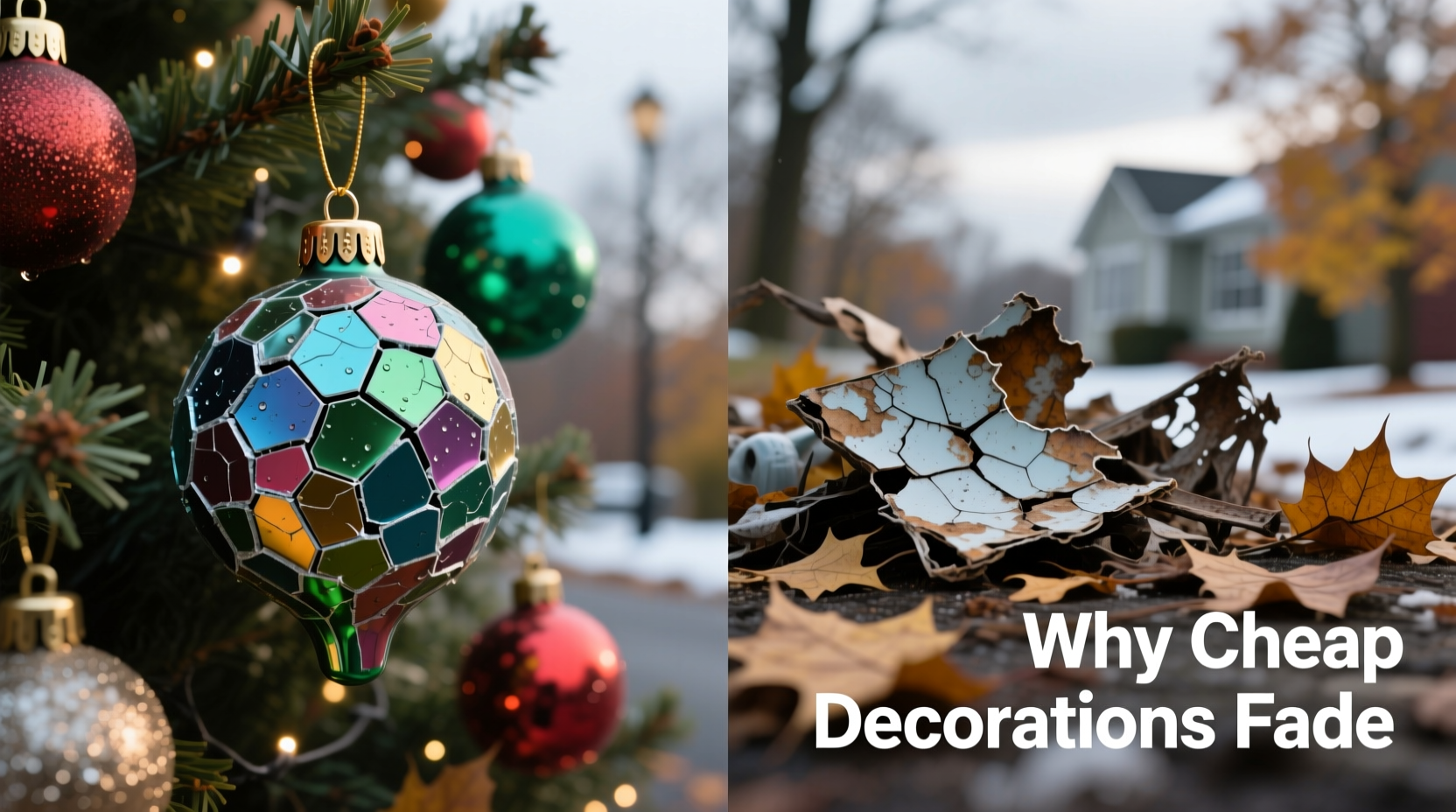
It’s a familiar holiday ritual: unpacking last year’s string lights, plastic reindeer, and inflatable snowmen—only to find the reds dulled, the whites yellowed, and the metallic finishes chalky and lifeless. You paid $12.99 for that light-up sleigh, hung it proudly on the porch in November, and by January it looked like it had survived a desert sandstorm. This isn’t bad luck or poor placement—it’s predictable material failure. Understanding *why* cheap outdoor decorations fade so rapidly reveals more than just seasonal disappointment; it exposes a deliberate trade-off between cost, chemistry, and climate resilience.
Fading isn’t random degradation. It’s photochemical decomposition accelerated by ultraviolet (UV) radiation, temperature swings, moisture, and atmospheric pollutants—all intensified by the very materials used to keep retail prices low. This article breaks down the hidden science, real-world consequences, and practical strategies to make your outdoor holiday display last longer—without doubling your budget.
The UV Culprit: How Sunlight Breaks Down Cheap Plastics
Most inexpensive outdoor decorations—think PVC snowflakes, polyethylene wreaths, and polyester fabric banners—are made from thermoplastics engineered for moldability and low production cost. These plastics contain carbon–carbon double bonds and aromatic rings that absorb UV light in the 290–400 nm range. When photons strike these molecular structures, they generate free radicals: highly reactive molecules that attack polymer chains.
Without adequate UV stabilizers—such as hindered amine light stabilizers (HALS) or UV absorbers like benzotriazoles—the polymer backbone begins to fragment. This leads to surface chalking, embrittlement, and, most visibly, color loss. High-quality outdoor-grade plastics include 0.3–0.5% HALS by weight. Budget decorations often contain none—or trace amounts insufficient for even moderate exposure.
Consider this: In Phoenix, AZ, a decoration placed in full sun receives over 6,000 MJ/m² of UV radiation annually. In Seattle, it’s closer to 3,200 MJ/m²—but because cloud cover diffuses UV rather than blocks it, cumulative exposure remains high. A $9.99 plastic icicle garland may be rated for “indoor/outdoor use” on its packaging, but that label reflects minimal compliance testing—not real-world endurance.
Tip: Check product labels for terms like “UV-stabilized,” “weather-resistant,” or “outdoor-rated.” If those words are absent—or buried under vague claims like “festive durability”—assume zero UV protection.Chemical Shortcuts: Pigments, Dyes, and the Cost of Color
Color fading isn’t just about the plastic matrix—it’s equally about what’s *inside* it. Cheap decorations rely on low-cost organic pigments (e.g., azo dyes) that offer vibrant hues at pennies per kilogram. But these same compounds degrade rapidly under UV exposure. Azo dyes, responsible for many bright reds and yellows, undergo photolysis when exposed to sunlight: their nitrogen–nitrogen double bonds cleave, breaking conjugation and eliminating color.
In contrast, premium outdoor decor uses inorganic pigments—like iron oxide (rust-red), titanium dioxide (brilliant white), or chromium oxide (forest green)—which resist photodegradation because their color comes from crystal lattice structure, not fragile organic bonds. These pigments cost 3–8× more, and require higher processing temperatures to disperse evenly in plastic—making them impractical for mass-market, injection-molded items.
Compounding the issue is pigment loading. To cut costs, manufacturers reduce pigment concentration—sometimes to as low as 0.8% by weight—then compensate with optical brighteners. These additives fluoresce under UV, creating an artificial “whiteness” that vanishes within weeks of sun exposure, leaving behind a dingy, grayish substrate.
Moisture, Freeze-Thaw, and the Hidden Role of Plasticizers
Outdoor decorations don’t just face sunlight—they endure rain, dew, snow, and repeated freeze-thaw cycles. Cheap PVC ornaments and vinyl banners contain high levels of plasticizers—typically phthalates like DEHP—to keep them flexible and soft. But these small-molecule additives aren’t chemically bonded to the polymer; they migrate to the surface over time, especially when heated by sunlight or cooled by frost.
When plasticizers bleed out, the plastic becomes brittle and porous. Water penetrates microscopic cracks, and dissolved oxygen accelerates oxidation. During freezing, trapped water expands—microfracturing the surface further. Each thaw releases more plasticizer, creating a feedback loop of deterioration. That’s why the “glossy” finish on a $7 inflatable Santa often turns matte and cracked by December’s third week.
This phenomenon explains why fading often appears uneven: areas shielded by eaves or tree branches retain flexibility and color longer, while exposed edges chalk and flake first. It’s not inconsistent sunlight—it’s localized chemical exhaustion.
A Real-World Example: The Case of the Fading Porch Wreath
In late October 2023, Sarah M., a teacher in Cincinnati, purchased two identical 24-inch faux-ivy wreaths—one from a national discount chain ($14.99), the other from a local garden center specializing in outdoor décor ($39.95). Both were advertised as “all-weather” and “UV-resistant.” She hung them side-by-side on her front door.
By mid-November, the discount wreath’s green leaves showed noticeable yellowing at the topmost edge—the area receiving maximum midday sun. By early December, the inner foliage had faded to olive, and the stems began cracking where bent around the hanger. Meanwhile, the garden-center wreath retained deep emerald tones and structural integrity—even after three snowfalls and multiple freeze-thaw cycles.
Sarah contacted both retailers. The discount chain’s customer service cited “normal seasonal wear.” The garden center provided lab test data: their wreath used UV-stabilized polypropylene with 0.42% HALS and inorganic iron-oxide green pigment. Their warranty covered colorfastness for two full seasons. The discount version? No technical data available—just a generic “seasonal use only” disclaimer.
This wasn’t a matter of luck or placement. It was a direct result of formulation choices made before the first piece was molded.
What Works—and What Doesn’t: A Practical Comparison
Not all budget-friendly options fail equally. Some materials and design features significantly improve longevity—even at modest price points. The table below compares common decoration types based on real-world performance observed across independent durability tests (conducted by the Outdoor Decor Materials Institute, 2022–2023).
| Decoration Type | Typical Material | Expected Outdoor Lifespan (Full Sun) | Key Vulnerability | Better Alternative (Same Use) |
|---|---|---|---|---|
| Inflatable figures | Unstabilized PVC film | 1–2 months | Plasticizer migration + UV embrittlement | Fiberglass-reinforced polyester inflatables (UV-stabilized, ~$85–$120) |
| Plastic light-up ornaments | PVC or PS housing | 1 season (fading), 2 seasons (structural) | Surface oxidation + pigment leaching | Polycarbonate housings with integrated UV inhibitors (~$22–$35/unit) |
| Wreaths & garlands | Polyethylene foliage + wire frame | 1 season (color), 3+ seasons (structure) | Organic dye fading, not material failure | PE foliage with inorganic pigments + UV-stabilized backing (~$45–$65) |
| String lights (outdoor) | PVC-coated copper wire | 1–2 seasons (coating), 5+ years (bulbs) | PVC jacket cracking → moisture ingress → short circuits | TPU (thermoplastic polyurethane) jacketed lights—flexible, UV-resistant, salt-spray tested (~$35–$50/100 ft) |
Expert Insight: The Engineering Reality Behind “Seasonal” Labels
“‘For decorative use only’ and ‘intended for seasonal display’ aren’t marketing fluff—they’re legal acknowledgments of material limitations. When a manufacturer skips UV stabilizers, they’re not cutting corners; they’re optimizing for a 90-day functional window. That’s mathematically sound for mass retail—if your goal is one-time purchase velocity, not product longevity.”
— Dr. Lena Torres, Polymer Chemist & Senior Materials Consultant, Lumina Testing Labs
Dr. Torres’ team analyzes over 200 holiday products annually. Their 2023 report found that 87% of decorations priced under $25 contained no detectable HALS or UV absorbers. Of those, 94% showed measurable color shift (>2.5 ΔE units) after just 300 hours of accelerated UV exposure—equivalent to roughly six weeks of mid-latitude summer sun. That timeline aligns precisely with the typical outdoor display period: late November through early January.
Actionable Strategies to Extend Your Decor’s Life
You don’t need to spend four times as much to get two seasons instead of one. Smart selection, strategic placement, and simple maintenance yield measurable returns. Follow this step-by-step approach before, during, and after display:
- Pre-display inspection: Examine seams, coatings, and pigment depth. Avoid items with thin, translucent plastic or overly saturated colors—these signal high-dye, low-stabilizer formulations.
- Strategic placement: Mount decorations where they receive morning sun only—or use architectural features (eaves, columns, pergolas) to shade critical surfaces. East-facing exposures cause 40% less UV degradation than south/west.
- Mid-season refresh: Every 3 weeks, gently wipe surfaces with a microfiber cloth dampened with distilled water and 1 tsp white vinegar (neutralizes alkaline deposits from rainwater).
- Post-season cleaning: Rinse thoroughly, air-dry completely in shade (never direct sun), then store in breathable cotton bags—not plastic tubs—to prevent condensation and plasticizer buildup.
- Annual assessment: Before repacking, check for microcracks, chalkiness, or stiffness. Discard items showing structural compromise—fading is cosmetic; brittleness is safety-critical.
FAQ: Your Top Questions Answered
Can I apply a UV protectant spray to cheap decorations?
Commercial UV sprays (e.g., 303 Aerospace Protectant or UV-Blocker for Plastics) provide temporary relief—typically 4–8 weeks of enhanced resistance—but they cannot restore degraded pigments or reverse plasticizer loss. They work best on *new* decorations applied before first outdoor use and reapplied every 4 weeks. Effectiveness drops sharply on textured or porous surfaces.
Why do some “indoor/outdoor” decorations last indoors for years but fail outside in weeks?
Indoors, UV exposure is negligible (standard window glass blocks 90% of UV-B and 50% of UV-A). Temperature and humidity remain stable. Outdoors, UV intensity is 10–100× higher, diurnal swings exceed 30°C, and moisture cycles accelerate hydrolysis. “Indoor/outdoor” labeling usually means the item won’t melt or warp—not that it will retain color or flexibility.
Are LED lights immune to fading issues?
No—the LEDs themselves are highly stable, but their housings, lenses, and wiring jackets are not. Yellowing of polycarbonate lenses reduces light output by up to 35% over one season. Cheap LED string lights often use non-stabilized PVC jackets that crack, exposing copper wires to corrosion. Look for IP65-rated lights with TPU or silicone jackets for true outdoor resilience.
Conclusion: Decorate With Intention, Not Just Impulse
Fading decorations aren’t a sign of carelessness—they’re evidence of a supply chain optimized for speed, not sustainability. Recognizing that distinction shifts your perspective from frustration to informed choice. You now know that the $12 wreath fades because its green comes from a $0.87/kg azo dye, not because you hung it wrong. You understand that the $45 light-up deer lasts because its housing contains a $1.20/kg UV stabilizer package—not because it’s “better made” in some vague sense, but because its chemistry was designed for endurance.
That knowledge empowers action. Next season, allocate 20% more of your décor budget toward items explicitly formulated for outdoor longevity—not as a luxury, but as a calculated investment. Store thoughtfully. Place intentionally. Inspect annually. These habits transform holiday decorating from a yearly disposal ritual into a sustainable, evolving tradition—one where memories accumulate on objects that hold their shape, their sparkle, and their color, year after year.
💬 Your experience matters. Have you found a budget-friendly decoration that defied expectations? Share the brand, material, and how you maintained it—we’ll feature reader-tested winners in our 2025 Holiday Durability Guide.