Every November, as holiday lights begin to twinkle and synchronized displays flash across suburban lawns, a quieter but increasingly contentious issue emerges: the booming bass lines, repetitive jingles, and 3 a.m. carol loops emanating from high-powered outdoor sound systems. In cities from Portland to Pittsburgh, and suburbs across Texas and Minnesota, homeowners’ associations (HOAs), municipal councils, and city planning departments have enacted explicit bans—or strict decibel limits—on synchronized light-and-music displays. These aren’t arbitrary restrictions born of Scrooge-like sentiment. They reflect decades of evolving legal precedent, public health research, and community negotiation around noise, equity, and residential dignity. Understanding why these bans exist requires looking beyond seasonal cheer into zoning law, neuroscience, neighborly rights, and the real-world consequences of unregulated audio spectacle.
The Legal Foundation: Zoning, Ordinances, and HOA Authority
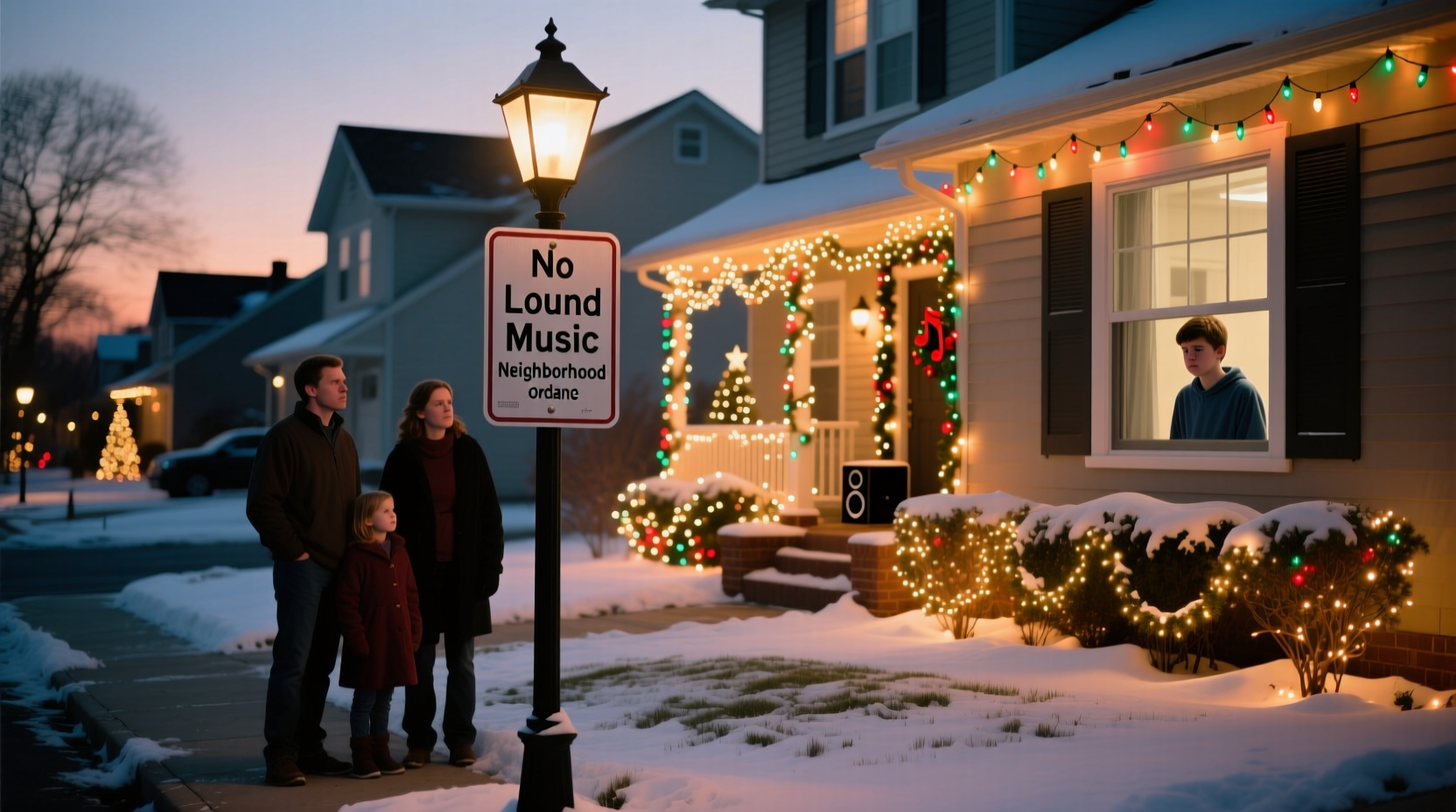
Most local bans on loud Christmas light music originate not from state legislatures or federal agencies—but from three overlapping layers of governance: municipal noise ordinances, residential zoning codes, and private covenants enforced by homeowners’ associations. Municipalities typically define “unreasonable noise” using time-of-day thresholds and decibel limits measured at property lines. For example, many cities set a maximum of 55 dB(A) between 7 p.m. and 7 a.m. in residential zones—a level comparable to moderate rainfall or a quiet conversation. A typical amplified Christmas display operating at 80–95 dB(A) at the sidewalk easily exceeds that limit, especially when speakers are mounted low to the ground or directed toward neighboring properties.
Zoning codes further reinforce this by designating residential areas for “quiet enjoyment”—a legal principle rooted in common law that guarantees occupants freedom from substantial, recurring interference with daily life. When a neighbor’s synchronized system plays “Jingle Bells” on loop every 90 seconds from dusk until midnight—and continues nightly for six weeks—it meets the legal definition of a private nuisance. Courts have repeatedly upheld enforcement in such cases. As Judge Elena Rodriguez wrote in the 2022 Illinois Appellate Court decision Smith v. Chen: “Seasonal celebration does not suspend the right to rest, recover from illness, or raise children in a predictably quiet environment.”
Homeowners’ associations often go further than municipal law. Their governing documents—typically the Declaration of Covenants, Conditions, and Restrictions (CC&Rs)—frequently include clauses prohibiting “excessive noise,” “commercial-style displays,” or “any activity that materially impairs the comfort or value of adjacent lots.” Because CC&Rs are contractual agreements signed by all residents, they’re enforceable through civil action, fines, or even liens—not just citations. This gives HOAs significant leverage to act swiftly, without waiting for a complaint to rise to the level of a municipal violation.
Tip: Before installing any synchronized audio system, review your city’s noise ordinance online (search “[City Name] municipal code Chapter X: Noise”) and request a copy of your HOA’s CC&Rs—don’t rely on verbal assurances from board members.Public Health and Cognitive Impact: More Than Just Annoyance
What many dismiss as “just holiday spirit” carries measurable physiological and psychological effects. Chronic exposure to intermittent, unpredictable noise—even at levels below 70 dB—triggers the body’s stress response: elevated cortisol, increased heart rate variability, and suppressed immune function. A landmark 2021 study published in Environmental Health Perspectives tracked 1,247 adults across 14 U.S. suburbs over two holiday seasons. Those living within 150 feet of a synchronized light-and-music display reported, on average, 42% more nighttime awakenings, 28% higher self-reported anxiety scores during December, and significantly lower morning salivary IgA (an antibody marker of immune resilience).
Children and neurodivergent individuals are especially vulnerable. Pediatric sleep specialists report consistent spikes in clinic visits each December for insomnia, night terrors, and school-day fatigue linked to neighborhood light-music systems. Repetitive audio loops—especially those with sudden volume swells or high-frequency chimes—can trigger sensory overload in autistic individuals and those with misophonia or PTSD. Dr. Lena Torres, a clinical neuropsychologist specializing in environmental stressors, explains: “The brain doesn’t ‘tune out’ novelty-based noise like holiday music. It remains vigilant. That vigilance depletes cognitive bandwidth needed for learning, emotional regulation, and recovery.”
“The expectation that neighbors should tolerate hours of programmed audio—often broadcast without consent, without opt-out, and without regard for medical conditions—isn’t festive. It’s a failure of shared responsibility.” — Dr. Lena Torres, Clinical Neuropsychologist, University of Washington
Equity, Access, and the Unseen Burden
Bans also address a critical equity gap. Synchronized light-music systems require significant investment: professional-grade amplifiers ($300–$1,200), weatherproof speakers ($200–$600 per unit), controllers ($150–$500), and software subscriptions ($50–$150/year). This creates a de facto hierarchy where only higher-income households can “compete” in the holiday display arms race—while lower-income, elderly, or disabled residents bear the full burden of the resulting disruption with no recourse or compensation.
Consider the reality for Ms. Rosa Delgado, a 78-year-old widow living on a fixed income in San Antonio’s Beacon Hill neighborhood. Her home abuts a cul-de-sac where three homes installed synchronized systems in 2023. One neighbor’s display ran from 4:30 p.m. to 12:30 a.m., with bass frequencies so strong they vibrated her teacups. Ms. Delgado, who has severe osteoarthritis and uses a hearing aid that amplifies low-frequency rumble, filed four complaints with the city. Each time, enforcement required documentation, witness statements, and multiple visits—none of which resolved the issue before the season ended. She ultimately installed $1,400 in sound-dampening window inserts and stopped opening her front curtains at dusk. “I love Christmas,” she told the local paper. “But I shouldn’t need armor to enjoy it in my own home.”
This scenario repeats across zip codes where aging infrastructure—thin walls, single-pane windows, poorly insulated attics—makes noise transmission worse. And unlike visual displays, which can be blocked with blinds or turned away from, sound travels invisibly, penetrates barriers, and offers no simple “off switch” for affected residents.
Practical Enforcement and What Actually Works
Enforcement isn’t theoretical—it’s highly localized, data-driven, and increasingly tech-aided. Cities like Austin and Minneapolis now use calibrated sound meters during complaint investigations, requiring readings taken at the complainant’s property line—not the source. Many HOAs deploy volunteer “noise ambassadors” trained to log timestamps, decibel levels, and song repetition patterns. Some municipalities have adopted “holiday noise amnesty periods”: a 48-hour window after a first complaint for the violator to adjust volume or timing before formal penalties apply.
Effective solutions balance celebration and civility. The table below compares common approaches by enforceability, resident impact, and long-term sustainability:
| Approach | Enforceable By | Resident Impact | Sustainability | Key Limitation |
|---|---|---|---|---|
| Decibel cap (e.g., ≤60 dB at property line) | Municipality, HOA | Low to moderate (if measured correctly) | High | Requires trained personnel & calibrated equipment |
| Time restriction (e.g., 5 p.m.–10 p.m. only) | Municipality, HOA | High (disrupts evening routines) | Moderate | Easily circumvented; doesn’t address intensity |
| Opt-in neighborhood registry | HOA (voluntary) | Low (consent-based) | Very High | Requires near-unanimous participation to prevent spillover |
| Audio-free zones (e.g., near hospitals, schools, senior housing) | Municipality (zoning amendment) | Very Low (targeted protection) | Very High | Takes 6–18 months to adopt; politically complex |
Actionable Alternatives: How to Celebrate Without Conflict
Creating joyful, memorable displays doesn’t require blasting speakers. Thoughtful alternatives preserve neighborhood harmony while still delivering wonder. Here’s a step-by-step guide for responsible holiday lighting:
- Design for silence first: Prioritize visual storytelling—motion, color sequencing, and rhythm through light alone. Use programmable LED controllers (like Light-O-Rama or xLights) to create dynamic, emotionally resonant sequences without audio.
- Test at the property line: At dusk, stand at your neighbor’s closest window or fence line with a free sound meter app (e.g., NIOSH SLM) on your smartphone. If it reads above 55 dB(A), reduce speaker count, reposition units upward (not outward), or add directional baffles.
- Offer control, not imposition: Install a QR code sign linking to a private playlist or web stream. Let neighbors choose whether—and when—to listen via personal headphones or Bluetooth speakers indoors.
- Cap duration and frequency: Run displays no longer than 4 hours nightly, avoid looping songs more than twice consecutively, and shut down entirely on nights before major school or work days (e.g., Sunday nights, Wednesday evenings).
- Communicate proactively: Two weeks before installation, deliver a handwritten note to adjacent homes: share your schedule, invite feedback, and include your contact info. Most conflicts dissolve with transparency and goodwill.
FAQ
Can my HOA fine me for playing Christmas music—even if my city doesn’t regulate it?
Yes. HOAs derive authority from legally binding contracts (CC&Rs) you agreed to upon purchase. If your CC&Rs prohibit “excessive noise” or “activities interfering with quiet enjoyment,” and your system violates those terms, the HOA may levy fines, require remediation, or pursue arbitration—regardless of municipal law.
Isn’t this just about being “too sensitive”? Don’t people just need to relax during the holidays?
No. Sensitivity to noise is not subjective preference—it’s a documented medical and neurological reality. The World Health Organization identifies nighttime noise above 40 dB as a risk factor for cardiovascular disease. Holiday displays running at 80+ dB for hours nightly exceed occupational safety limits set for factory workers. Expecting residents to “relax” amid chronic acoustic assault ignores established public health science.
What if my neighbor’s display causes my dog to panic or bark constantly?
Dog distress is a legitimate enforcement factor. Many noise ordinances explicitly cite “causing animals to vocalize excessively” as evidence of unreasonable disturbance. Document barking episodes with timestamps and audio recordings, then file a formal complaint with both animal control (for welfare concerns) and code enforcement (for noise violation).
Conclusion
Holiday traditions endure not because they’re loud, but because they’re meaningful—rooted in connection, generosity, and shared humanity. When synchronized light-music displays cross the line from joyful expression into persistent, non-consensual intrusion, they erode the very values they aim to celebrate. Bans aren’t about canceling Christmas—they’re about preserving the right to experience it on one’s own terms: peacefully, safely, and with dignity. Whether you’re a homeowner planning your first display or a resident navigating a neighbor’s sonic spectacle, remember that restraint is not deprivation—it’s respect. It’s choosing wonder over volume, creativity over compliance, and community over competition. Start this season by listening—not just to carols, but to the quiet spaces between them. That’s where the true spirit of the holidays lives.
💬 Have you navigated a holiday sound dispute—or found a brilliant quiet-display solution? Share your experience in the comments. Your story could help someone else celebrate with confidence—and compassion.