
Cats have a reputation for being graceful, intelligent, and oddly mischievous. One of their most baffling behaviors—knocking objects off tables, shelves, and countertops—has left countless owners puzzled, frustrated, and even suspicious. Is your cat doing it out of spite? Are they conducting tiny feline-led physics experiments? Or is there something deeper at play in their whiskered minds?
The truth is more nuanced than simple malice or curiosity. This behavior stems from a blend of evolutionary instincts, sensory exploration, communication, and sometimes, pure entertainment. Understanding why cats engage in this seemingly destructive habit allows owners to respond with empathy rather than frustration.
The Science Behind the Swat: Instinct and Sensory Input
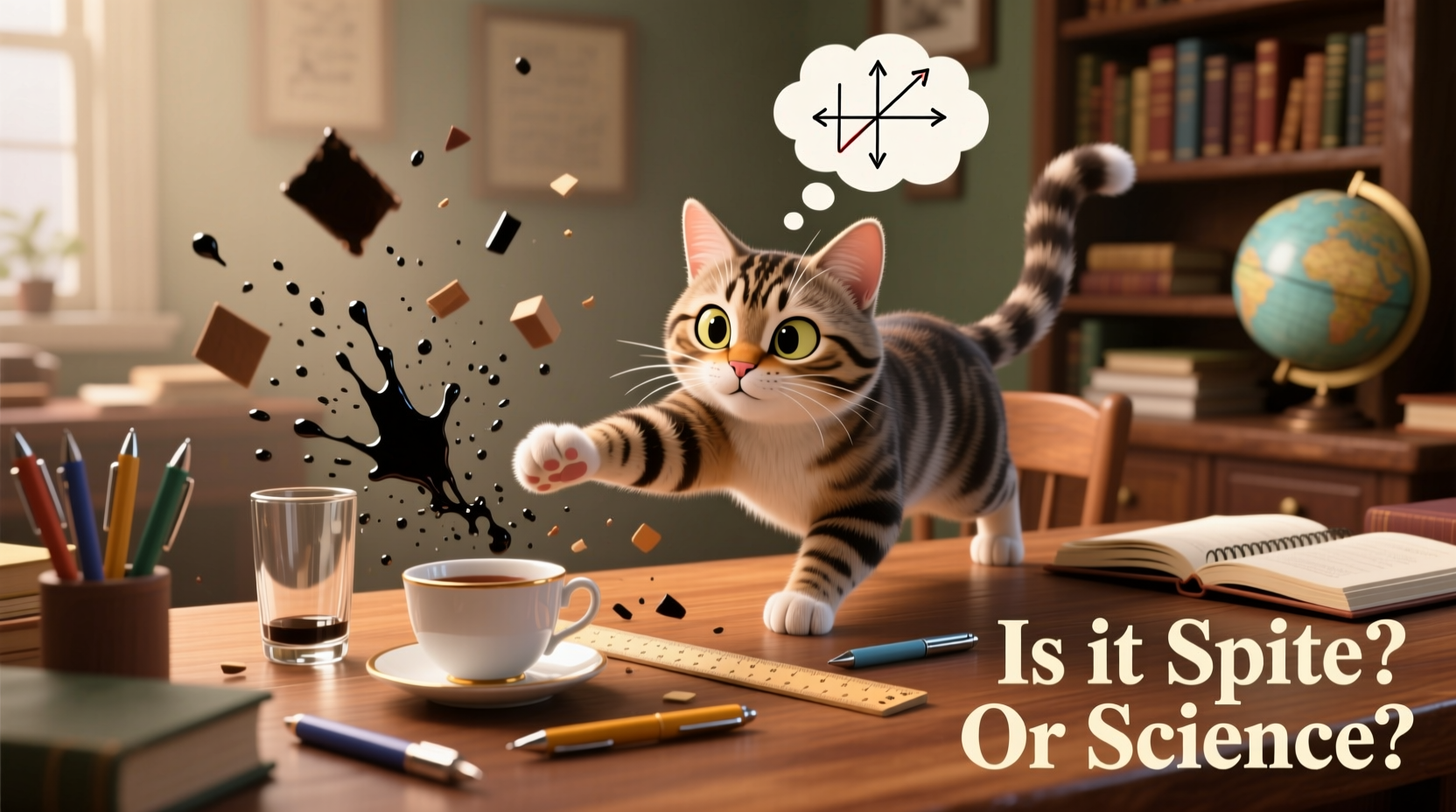
Cats are predators by nature. Even well-fed domestic cats retain the hunting instincts of their wild ancestors. When a cat sees an object perched on the edge of a table, its brain may interpret it as potential prey—something small, movable, and possibly alive. A gentle paw tap tests the object’s reaction, mimicking how a cat might investigate a mouse or insect in the wild.
This interaction provides valuable sensory feedback. The sound of the crash, the movement of the fall, and the tactile sensation of contact all stimulate the cat’s senses. These inputs help them understand their environment. In essence, knocking something over isn’t random—it’s data collection.
“Cats use their paws like hands to explore the world. Every swipe, push, or knock helps them assess texture, weight, and motion.” — Dr. Lydia Ryan, Feline Behavior Specialist
Moreover, domestic cats often live in environments that lack sufficient mental stimulation. Without birds to stalk or insects to chase, household items become substitutes. A pen rolling off a desk mimics the erratic movement of prey, triggering a predatory sequence: observe, stalk, pounce, and manipulate.
Tip: Rotate toys weekly to maintain novelty and reduce interest in household objects.Spite vs. Communication: Debunking the Myth of Feline Vengeance
A common misconception is that cats knock things over to get back at their owners—to express “spite” for being ignored or scolded. However, veterinary behaviorists agree: cats don’t act out of revenge in the human emotional sense.
While cats are capable of complex emotions like anxiety, fear, and attachment, they lack the cognitive framework for calculated retaliation. What looks like spite is usually either attention-seeking behavior or a response to environmental stressors.
If a cat learns that knocking over a glass gets an immediate reaction—someone rushing into the room, shouting, or picking them up—they may repeat the action to trigger that response. It’s not about anger; it’s about cause and effect. The cat has discovered a reliable way to influence their environment and gain interaction.
Signs Your Cat Is Seeking Attention (Not Being Spiteful)
- Knocks things over when you're focused elsewhere (e.g., working or watching TV)
- Makes eye contact after the act
- Follows up with meowing or rubbing against you
- Only targets certain areas where you frequently spend time
Feline Physics Experiments: Curiosity and Cause-and-Effect Learning
Calling a cat’s actions “physics experiments” might sound whimsical, but it’s surprisingly accurate. Kittens begin exploring cause and effect as early as six weeks old. Pushing a toy off a ledge and watching it fall teaches them about gravity, momentum, and spatial relationships.
This learning continues into adulthood. Cats are naturally curious and benefit from cognitive enrichment. Each knock is a test: *What happens if I push this? Does it roll? Does it make noise? Can I catch it mid-air?*
Studies in animal cognition show that cats understand basic principles of object permanence and physical causality. For example, they expect hidden objects to still exist and are surprised when outcomes defy expectations—like a ball floating instead of falling.
| Behavior | Possible Explanation | Underlying Motivation |
|---|---|---|
| Repeatedly knocks pens off desk | Object moves unpredictably when pushed | Sensory stimulation, play |
| Pushes cup near edge but doesn’t tip it | Testing limits, practicing control | Motor skill development |
| Knocks item when owner enters room | Gets immediate reaction | Attention-seeking |
| Ignores same object later | No longer novel or responsive | Habituation, loss of interest |
This experimental mindset explains why some cats prefer certain types of objects: those that roll, rattle, or bounce are more engaging than static ones. The more dynamic the result, the more rewarding the action feels.
Environmental and Health Factors Influencing the Behavior
While instinct and curiosity drive most cases, environmental conditions can amplify the tendency. Overstimulation, under-stimulation, anxiety, or medical issues may contribute.
Cats in homes with limited vertical space, few toys, or inconsistent routines may resort to self-entertainment using whatever is available—even your favorite mug. Conversely, overly busy households with loud noises or sudden movements might cause a stressed cat to act out in unpredictable ways.
In rare cases, neurological conditions or vision problems can lead to clumsy or compulsive pawing. If your cat suddenly begins knocking things over excessively—or seems disoriented while doing so—consult a veterinarian to rule out underlying health concerns.
Mini Case Study: Luna and the Midnight Knock
Luna, a 3-year-old tabby, began knocking water glasses off her owner’s nightstand every night around 2 a.m. Her owner assumed she was being spiteful for being put to bed early. After consulting a behaviorist, it was discovered that Luna had no structured play routine before bedtime.
The solution? A 15-minute interactive play session using a wand toy each evening, followed by a small meal to mimic the “hunt-eat-groom-sleep” cycle. Within a week, the nighttime knockings ceased. Luna wasn’t angry—she was bored and hunting on schedule.
How to Respond: Practical Strategies for Cat Owners
You don���t need to eliminate the behavior entirely—nor should you. Pawing and swatting are natural expressions of feline intelligence. Instead, redirect the impulse toward appropriate outlets.
Step-by-Step Guide: Managing Table-Knocking Behavior
- Assess the Environment: Identify high-risk zones (desks, shelves, coffee tables) and remove fragile or dangerous items.
- Provide Alternatives: Place puzzle feeders, rolling toys, or treat-dispensing balls nearby to satisfy curiosity.
- Engage Daily: Schedule two 10–15 minute play sessions using wand toys to simulate hunting.
- Use Positive Reinforcement: Reward calm behavior near tempting objects with treats or affection.
- Modify Surfaces: Apply double-sided tape or aluminum foil to surfaces you want to protect—cats dislike the texture.
- Rotate Toys: Introduce new textures and motions weekly to prevent boredom.
Checklist: Cat-Friendly Home Adjustments
- ✅ Remove breakable items from edges
- ✅ Install shelves or cat trees for climbing
- ✅ Use stable, weighted containers for decor
- ✅ Offer daily interactive play
- ✅ Provide scratching posts and hiding spots
- ✅ Keep food puzzles or treat balls accessible
FAQ: Common Questions About Cats Knocking Things Over
Do cats know they’re breaking things when they knock them over?
Cats understand that their actions cause movement and sound, but they don’t grasp human concepts of value or fragility. They aren’t trying to destroy your belongings—they’re exploring or seeking engagement.
Is this behavior a sign of intelligence?
Yes. The ability to test cause and effect, remember outcomes, and adapt behavior based on results reflects advanced cognitive processing. Cats that frequently experiment with objects often show higher problem-solving skills.
Will my cat grow out of this behavior?
Some kittens do become less impulsive with age, especially if given proper mental stimulation. However, many adult cats continue to enjoy playful swatting throughout life. With redirection, the behavior can be managed effectively without suppression.
Conclusion: Embracing the Chaos with Insight and Care
The next time your cat sends a book flying off the coffee table, resist the urge to assume malice. That flick of the paw isn’t an act of defiance—it’s a window into a rich, curious mind testing the rules of its world. Whether driven by instinct, sensory exploration, or a bid for attention, this behavior is deeply rooted in what makes cats fascinating companions.
By understanding the motivations behind the knock, you can foster a home that satisfies your cat’s natural urges while protecting your belongings. Replace frustration with strategy, punishment with play, and confusion with clarity. A harmonious coexistence isn’t about stopping feline experimentation—it’s about guiding it wisely.
💬 Have a story about your cat’s most surprising knockdown? Share your experience and tips with fellow cat lovers in the comments below!