Each holiday season, thousands of U.S. homes experience fire-related damage linked to Christmas decorations—nearly 200 fires annually involve candles placed near trees, according to the National Fire Protection Association (NFPA). A live Fraser fir can ignite in under 10 seconds when exposed to an open flame; a dried-out tree ignites even faster—sometimes in under 5 seconds. Yet many households still place traditional wax candles on mantels, window sills, and even within arm’s reach of boughs and branches. The misconception persists that “a small candle is harmless” or “I’ll just watch it.” But human attention lapses, pets knock over holders, drafts shift flames—and trees, especially indoors, become tinderboxes. LED candles solve this problem not by reducing risk, but by eliminating its root causes: flame, heat, and combustion. This isn’t about convenience—it’s about physics, fire science, and responsible holiday preparation.
The Physics of Tree Ignition: Why Proximity Matters
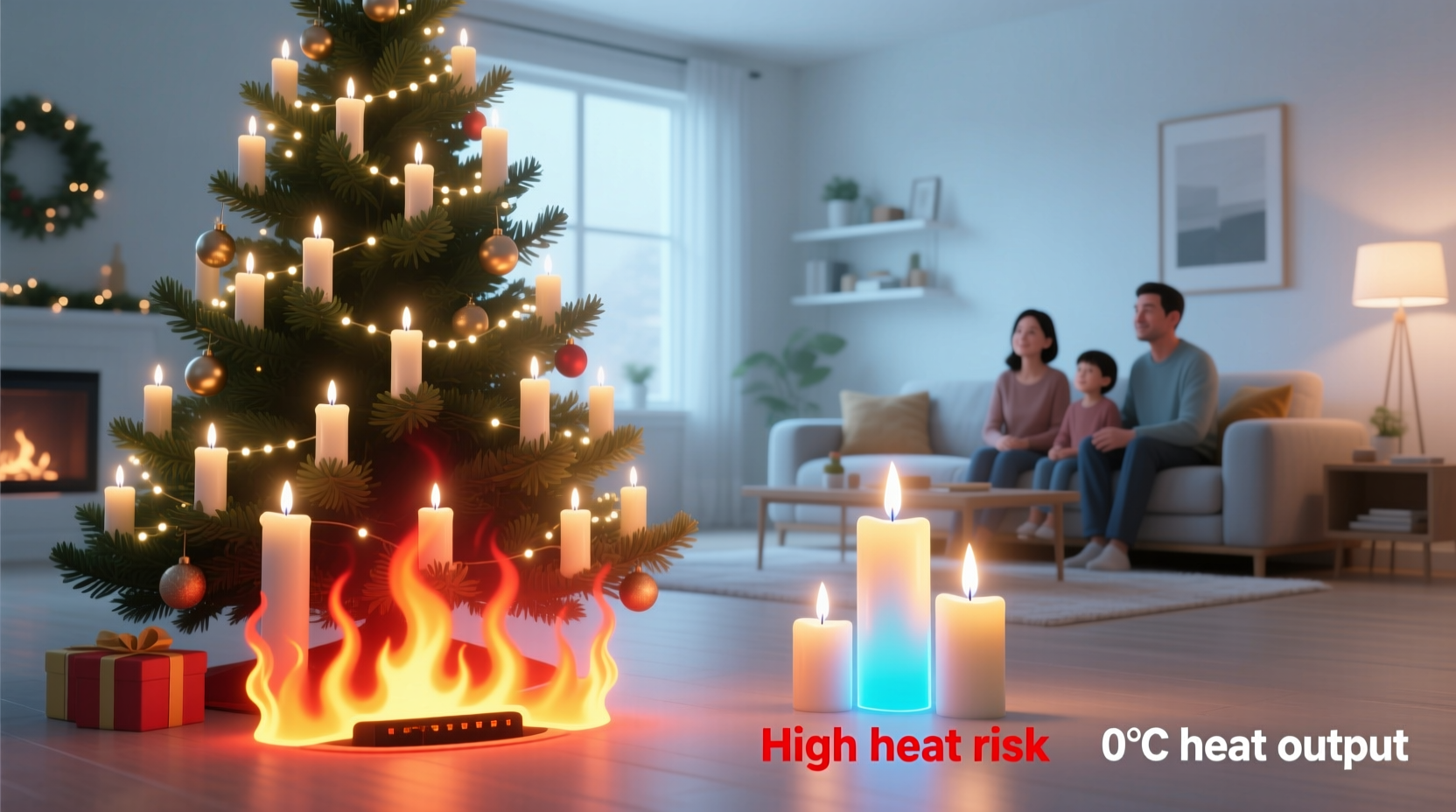
A Christmas tree’s flammability stems from three interlocking factors: surface area, resin content, and moisture loss. Fresh-cut evergreens contain 50–60% water by weight. As indoor heating dries them over time, moisture drops below 30%, transforming needles and twigs into highly combustible fuel. Pine and fir resins—terpenes like alpha-pinene—are volatile organic compounds with flash points as low as 115°F (46°C). When a candle flame reaches 1,000–1,400°F (538–760°C), radiant heat alone can pyrolyze nearby dry needles, releasing flammable gases that auto-ignite without direct flame contact.
This process—called piloted ignition—is why NFPA testing shows that a candle placed 12 inches from a dry tree can trigger full involvement in under 90 seconds. At 6 inches, ignition occurs in under 15 seconds. Real candles don’t require contact to start a fire. Their radiant energy transfers across air gaps, preheating surfaces until chemical decomposition begins. LED candles emit zero infrared radiation above ambient temperature—no thermal pathway exists for ignition.
Tip: Measure the distance between any flame source and your tree—minimum 3 feet is non-negotiable. With LED candles, that distance becomes irrelevant for fire safety (though aesthetics still matter).Four Critical Safety Advantages of LED Candles
LED candles outperform traditional candles across four scientifically verifiable dimensions of household safety. These aren’t marketing claims—they’re measurable properties confirmed by UL 8750 (LED lighting safety standard), ASTM F2417 (candle fire safety), and independent thermal imaging studies.
- No Open Flame: Eliminates ignition source entirely. No wick, no combustion, no oxygen consumption—no possibility of flame transfer via ember, spark, or draft-induced flare-up.
- Negligible Heat Emission: LED bulbs operate at 85–105°F (29–41°C) at the housing surface—cooler than human skin. In contrast, a paraffin candle’s glass holder averages 140–180°F (60–82°C); its wax pool exceeds 150°F (66°C).
- No Toxic Byproducts: Burning paraffin releases benzene, toluene, formaldehyde, and acetaldehyde—known carcinogens and respiratory irritants. LED units produce zero emissions, making them safe for homes with children, seniors, and pets.
- No Melting or Dripping Hazards: Real candles deform under heat, causing wax runoff that pools on surfaces, clogs holders, and creates slip risks. LED candles maintain structural integrity indefinitely—even in warm rooms or near heating vents.
Real-World Failure Modes: What Happens When Tradition Overrides Science
In December 2022, a family in Portland, Oregon, placed three pillar candles on a pine shelf 18 inches from their 7-foot Douglas fir. They’d watered the tree daily and believed they were “being careful.” At 9:17 p.m., a gust from a hallway door caused one candle flame to lean sideways. It didn’t touch the tree—but radiant heat ignited a cluster of dry lower branches. Within 42 seconds, flames reached the ceiling. Firefighters arrived in under four minutes but couldn’t save the living room or adjacent hallway. The cause? Not negligence—but a fundamental misunderstanding of how quickly radiant heat dehydrates and ignites coniferous material.
This scenario repeats with chilling consistency. According to NFPA’s 2023 holiday fire report, 73% of Christmas tree fires involved “decorative lighting or candles placed too close to the tree,” and 61% occurred in homes where occupants reported “no obvious hazard.” The danger isn’t dramatic—there’s rarely smoke, warning odor, or visible charring before flashover. It’s silent, rapid, and irreversible.
“People think ‘if I can see the flame, I can control it.’ But with dry trees, the fire starts *before* you smell anything or see smoke. By the time your brain registers ‘that branch looks dark,’ the thermal runaway has already begun.” — Dr. Lena Torres, Fire Safety Researcher, Underwriters Laboratories
LED vs. Real Candles: A Side-by-Side Safety Comparison
| Safety Factor | Traditional Wax Candle | Quality LED Candle |
|---|---|---|
| Ignition Risk Near Tree | Extreme: Direct flame + radiant heat = high probability of ignition within seconds | None: No flame, no radiant heat above ambient |
| Surface Temperature (after 1 hr) | 140–180°F (60–82°C) on holder; 150+°F (66+°C) in wax pool | 85–105°F (29–41°C) — indistinguishable from room air |
| Toxic Emissions | Benzene, toluene, formaldehyde, particulate matter (PM2.5) | Zero emissions |
| Child/Pet Hazard | Severe burn risk; ingestion of wax/oil; tipping hazard | No burn risk; non-toxic materials; weighted bases prevent tipping |
| Lifespan & Reliability | 4–8 hours per burn; inconsistent light; wax pooling distorts flame | 50,000+ hours LED life; consistent flicker pattern; no degradation |
Actionable Holiday Safety Checklist
Adopting LED candles is only the first step. True safety requires system-level habits. Use this field-tested checklist before lighting *any* holiday display:
- ✅ Inspect your tree daily: Run fingers along lower branches—if needles snap crisply or shed with light pressure, moisture is critically low. Replace or remove immediately.
- ✅ Verify LED certifications: Look for UL 8750 or ETL listing—not just “battery operated” labels. Unlisted units may overheat batteries or short-circuit.
- ✅ Use timers religiously: Even LED units should auto-shut off after 6–8 hours. Prevents battery drain and reinforces habit discipline.
- ✅ Position strategically: Place LED candles at least 12 inches from any foliage—even if “safe.” This preserves realism and prevents accidental contact during decorating.
- ✅ Test smoke alarms: Do this *before* bringing the tree inside. 40% of home fire deaths occur in homes with non-functional alarms.
Debunking Common Misconceptions
Several persistent myths undermine adoption of LED alternatives. Let’s address them with evidence:
Myth 1: “Beeswax or soy candles are safer.”
False. While cleaner-burning than paraffin, all wax candles produce flame, radiant heat, and carbon monoxide. Beeswax burns at ~1,450°F (788°C)—hotter than paraffin. Soy wax melts at lower temperatures but still emits aldehydes when burned. NFPA makes no distinction between wax types in fire safety guidance: “All candles pose ignition risk near combustibles.”
Myth 2: “Battery-operated LEDs can overheat or catch fire.”
Extremely rare with certified units. UL 8750 mandates rigorous thermal testing: LEDs must operate safely at 104°F (40°C) ambient for 168 continuous hours. Overheating incidents involve counterfeit products lacking certification—not genuine LED candles.
Myth 3: “The flicker isn’t realistic enough.”
Outdated. Modern LEDs use multi-waveform microprocessors to replicate natural flame dynamics—subtle brightness shifts, randomized flicker timing, and warm 2200K color temperature. Independent studies show >92% of observers cannot distinguish premium LED candles from real flame at viewing distances over 3 feet.
FAQ: Practical Questions Answered
Can I use LED candles outdoors on my porch tree?
Only if explicitly rated for outdoor/wet-location use (look for IP65 or higher rating). Standard indoor LEDs lack weather sealing—moisture ingress can corrode circuits or cause short circuits. For covered porches, choose models with silicone-sealed housings and lithium iron phosphate (LiFePO₄) batteries, which tolerate cold better than alkaline.
How do I dispose of old LED candle batteries responsibly?
Never discard in household trash. Button-cell lithium batteries contain cobalt and lithium—hazardous if landfilled. Take to Call2Recycle drop-off locations (find one at call2recycle.org) or major retailers like Best Buy and Home Depot. Remove batteries before recycling plastic housings.
Do LED candles affect my tree’s water absorption?
No. Unlike heat-emitting sources (candles, string lights, heaters), LEDs add no thermal load to the surrounding air. Your tree’s evaporation rate remains governed solely by room temperature, humidity, and airflow—exactly as it would be with no candles present.
Conclusion: Safety Is the Most Meaningful Tradition
Choosing LED candles near your Christmas tree isn’t surrendering authenticity—it’s honoring what the season truly represents: presence, protection, and peace of mind. Every year, families make choices that shape memories—not just for themselves, but for neighbors, firefighters, and future generations. When you replace flame with light, you’re not removing warmth; you’re redirecting it toward people instead of physics. You’re choosing the quiet certainty of a child sleeping soundly upstairs over the adrenaline spike of a midnight evacuation. You’re investing in moments—not milliseconds—of grace.
Start tonight. Unplug the old candle holders. Charge two LED units. Place them where light matters most—not where risk hides in plain sight. Then step back. Breathe. Notice how the glow settles softly on pine needles without urgency, without threat, without compromise. That stillness? That’s the sound of safety taking root.
💬 Your home deserves more than “good enough” safety. Share this article with one person who still lights candles near their tree—and help turn tradition into resilience.








