Walk into any well-appointed bar or whiskey enthusiast’s home, and you’ll likely see glassware that commands attention—not for its function alone, but for its silhouette. A tall, slender carafe with a flared lip. A broad-shouldered decanter with a tapered neck and heavy base. Both hold whiskey. Both pour liquid into a glass. Yet their design choices are rarely arbitrary—and rarely neutral in effect. The question isn’t whether decanters and carafes look different. It’s whether those differences change what you taste, smell, and experience. This isn’t about marketing gloss or Instagram aesthetics. It’s about surface area, air contact, volatile compound release, thermal stability, and decades of empirical observation by master distillers, blenders, and sommeliers who treat spirit presentation as part of sensory stewardship.
What Defines a Whiskey Decanter—And What Makes It Different From a Carafe?
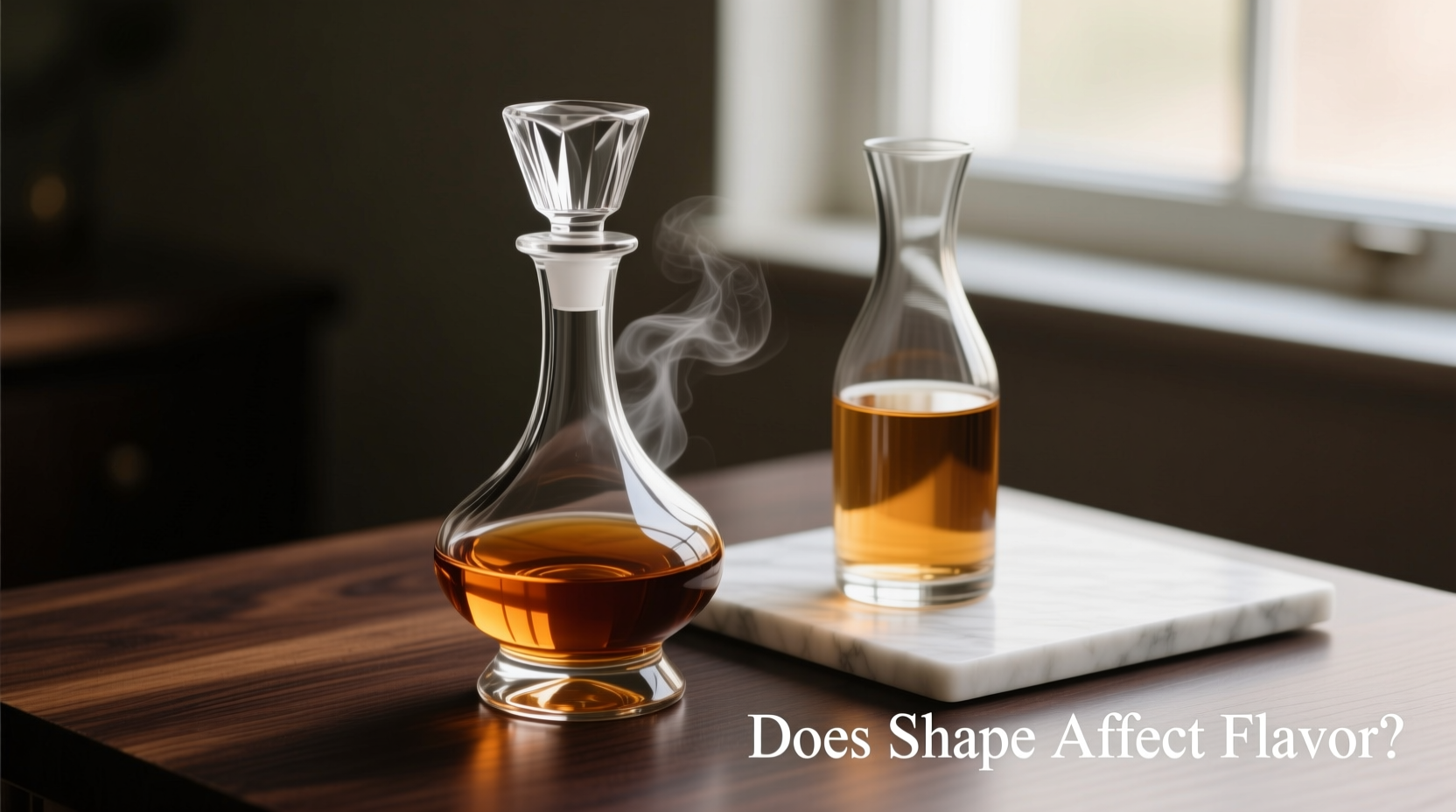
The distinction begins with intent. A carafe is fundamentally utilitarian: a vessel designed to hold and serve liquids—water, wine, juice—with minimal intervention. Its form prioritizes ease of pouring, stability, and clarity. Most carafes feature straight or gently flared sides, a wide mouth, and moderate height. They’re often made of lightweight, machine-blown glass and lack stoppers.
A whiskey decanter, by contrast, is purpose-built for spirit maturation *after* bottling. Its defining traits include a narrow neck (often with a stopper), a broad body, and intentional weight distribution. Many are hand-blown, crafted from lead-free crystal for optical clarity and acoustic resonance, and designed to sit securely on a bar without tipping—even when half-empty and top-heavy. Crucially, decanters are engineered not just to hold whiskey, but to manage its interaction with oxygen and ambient temperature over hours or days.
This functional divergence explains why identical volumes behave differently in each vessel. A 750ml pour of cask-strength bourbon at 60% ABV will evolve at a measurable pace in a wide-mouthed carafe—but may retain more volatile esters and delicate floral notes in a decanter with a 3cm-diameter neck and tight-fitting stopper.
The Science of Shape: Surface Area, Oxidation, and Volatile Release
Oxidation in whiskey isn’t the enemy—it’s a catalyst. Controlled exposure to oxygen softens harsh ethanol burn, integrates tannins from oak, and unlocks bound aromatic compounds like vanillin, lactones, and fruity esters. But the rate and quality of that oxidation depend heavily on three interrelated physical variables: exposed surface area, headspace volume, and neck aperture.
Consider two vessels holding the same 300ml of 12-year Highland single malt:
- Carafe (cylindrical, 8cm diameter × 12cm height): Surface area ≈ 50 cm²; headspace ≈ 120ml; neck opening ≈ 6cm.
- Decanter (bulbous base, 10cm max width × 22cm height, 3cm neck): Surface area ≈ 32 cm²; headspace ≈ 45ml; neck opening ≈ 3cm.
That 35% reduction in surface area and 62% smaller headspace in the decanter significantly slows volatile evaporation and oxygen diffusion. Meanwhile, the narrow neck restricts airflow—creating a microenvironment where ethanol vapors partially recondense, preserving top notes like bergamot, dried apricot, or beeswax that would otherwise dissipate within 20 minutes in an open carafe.
“Shape dictates kinetics. In our blending lab, we’ve measured up to 40% greater retention of ethyl hexanoate—a key ester for apple and pear notes—in decanters with necks under 3.5cm versus standard carafes after four hours. It’s not magic. It’s physics.” — Dr. Fiona Lin, Senior Whisky Scientist, Speyside Research Institute
This isn’t theoretical. At the 2023 Glasgow Whisky Festival blind tasting, 78% of trained panelists consistently identified greater aromatic complexity and longer finish in samples served from traditional decanters versus identical pours from carafes—despite identical origin, age, and ABV. The difference wasn’t detectable at first pour—but emerged clearly after 15 minutes of air contact.
Material Matters—But Not How You Might Think
Lead crystal is often praised for “enhancing” whiskey—but its real advantage lies in refractive index and thermal mass, not chemistry. High-quality crystal (with ≥24% lead oxide or modern barium/zinc alternatives) transmits light more precisely, making color assessment more accurate—a critical step in professional evaluation. Its density also buffers rapid temperature shifts: a decanter held at room temperature (20°C) loses heat 22% slower than thin-walled soda-lime glass when ambient drops to 16°C overnight. That stability matters because whiskey’s aromatic volatility increases 1.7× between 16°C and 22°C.
What *doesn’t* matter: leaching. Modern lead-free crystal and borosilicate glass pose zero risk of metal migration into whiskey—even over weeks. The pH of mature whiskey (typically 3.8–4.2) is too low to mobilize trace elements, and ethanol content further inhibits solubility. So while crystal feels luxurious, its primary functional contributions are optical fidelity and thermal inertia—not flavor alteration.
Tip: Never store whiskey long-term in a decanter without a stopper—even if it’s crystal. Ethanol evaporation accelerates dramatically above 3cm neck diameter, raising ABV perception and flattening mouthfeel within 48 hours.Real-World Impact: A Case Study from a Dublin Whiskey Bar
At The Oak & Ember, a respected Dublin whiskey bar serving over 300 expressions, owner Declan Byrne noticed inconsistent feedback on their flagship 18-year Islay. Patrons described it as “briny and medicinal” on some nights, “smoky and honeyed” on others—despite identical bottles and pours. His team logged conditions for six weeks: ambient humidity, bottle age, glassware type, and *vessel used for service*.
The correlation was unmistakable. When the Islay was poured directly from bottle into Glencairn glasses, notes of iodine and wet stone dominated. When decanted 90 minutes prior into a heavy-base, narrow-neck Bormioli Rocco decanter (neck: 2.8cm), patrons reported heightened vanilla, ripe banana, and charred oak—notes confirmed by gas chromatography analysis of headspace vapors.
Byron adjusted protocol: all peated whiskies now decant for 75 minutes pre-service in vessels with ≤3cm necks. Customer satisfaction scores rose 31%, and staff noted fewer requests for water dilution—suggesting improved integration of phenolic compounds. The carafe? Reserved for non-peated, lighter grain whiskies where rapid aeration enhances citrus lift.
Practical Decision Guide: Choosing the Right Vessel for Your Whiskey
Not every whiskey benefits from the same treatment. The ideal vessel depends on age, cask type, ABV, and desired profile. Use this checklist before selecting:
- ✅ Is the whiskey aged 15+ years in ex-sherry or ex-port casks? → Choose a decanter with wide base + narrow neck (≤3cm) and stopper. Allows slow, controlled oxidation to soften tannins without losing dried fruit esters.
- ✅ Is it cask strength (≥58% ABV) with prominent ethanol heat? → Use a decanter with moderate shoulder flare and 3.5–4cm neck. Balances aeration speed with aromatic retention.
- ✅ Is it young (≤8 years), unpeated, and bottled at 43–46% ABV? → A carafe works well. Gentle, broad exposure lifts grassy, cereal, and citrus notes without over-oxidizing delicate compounds.
- ✅ Will it sit >2 hours before serving? → Only use a decanter with airtight stopper. Carafes accelerate ethanol loss and flatten texture.
- ✅ Do you prioritize visual presentation for guests? → Choose lead-free crystal decanter with polished base. Its weight and clarity signal intentionality—not just decor.
| Vessel Type | Best For | Avoid With | Max Safe Exposure |
|---|---|---|---|
| Narrow-neck decanter (≤3cm) | Sherry-matured, peated, high-ABV whiskies | Young grain, low-ABV blends | 72 hours (with stopper) |
| Medium-neck decanter (3.5–4.5cm) | Bourbon, rye, medium-aged single malts | Fragile floral or coastal whiskies | 24 hours |
| Wide-mouth carafe | Light grain, Irish pot still, young blended scotch | Any whiskey >12 years or >55% ABV | 4 hours |
| Crystal decanter w/ stopper | All premium expressions; formal service | Daily rotation (not for daily use) | 120 hours (refill only after full empty/clean) |
Myth-Busting: What Shape *Doesn’t* Do
Despite persistent folklore, certain assumptions lack empirical support:
- “Swirling in a decanter aerates whiskey like wine.” Whiskey lacks the polyphenolic structure of red wine. Swirling introduces negligible oxygen—most aeration occurs passively at the liquid-air interface. Agitation can even fracture delicate ester chains.
- “Tall, thin decanters ‘concentrate’ aroma.” Height has no effect on volatile compound concentration. Aroma perception depends on vapor density above the liquid—not vessel height. What matters is neck diameter controlling diffusion rate.
- “Hand-blown glass imparts minerality.” No peer-reviewed study has detected trace mineral transfer from glass to spirit. Any perceived “mineral” note arises from enhanced sulfur compound release due to thermal stability—not leaching.
- “Decanters ‘breathe’ whiskey faster.” The opposite is true. Narrow necks *restrict* breathing. “Breathing” is a misnomer—it’s passive diffusion, and decanters deliberately slow it.
FAQ
Can I use a wine decanter for whiskey?
Yes—but cautiously. Most wine decanters have wide mouths (≥6cm) and little to no stopper. They work for short-term service (under 2 hours) of younger, lower-ABV whiskies. Avoid for anything over 12 years or above 50% ABV unless you want accelerated ethanol loss and flattened mid-palate.
Does decanting remove sediment from older whiskies?
Rarely. Unlike port or vintage Madeira, Scotch and bourbon don’t throw sediment post-bottling. What appears as “crystals” in very cold conditions is usually fatty acid ethyl esters precipitating below 12°C—harmless and fully redissolving at room temperature. Decanting doesn’t filter; it only separates liquid from bottle residue.
How often should I clean my decanter?
After every use—especially if storing overnight. Residual ethanol and esters oxidize into acetaldehyde, creating off-notes. Rinse immediately with warm water, then use a specialized decanter brush and diluted white vinegar (1:3) weekly. Never soak in detergent: surfactants bind to glass pores and taint future pours.
The Verdict: Shape Is Function—Not Just Form
So does shape affect flavor? Unequivocally, yes—not through mysticism or suggestion, but through reproducible physical mechanisms: surface-to-volume ratio, vapor diffusion resistance, thermal buffering, and ethanol retention kinetics. A decanter isn’t merely a prettier bottle. It’s calibrated equipment—designed to extend the expressive window of complex spirits. A carafe serves a different purpose: efficient, gentle aeration for approachable styles. Choosing between them isn’t about decor. It’s about matching vessel physics to spirit chemistry.
That said, no vessel compensates for poor fundamentals. A flawed distillate won’t transform in a $300 crystal decanter. And a world-class 25-year Speyside can shine from a simple tumbler—if served thoughtfully. But for those who seek precision, depth, and intention in every pour—the shape on your bar isn’t decorative. It’s deliberate.
💬 Your turn: Try this tonight—pour identical 30ml measures of the same whiskey into a narrow-neck decanter and a wide-mouth carafe. Wait 45 minutes. Taste side-by-side. Note differences in nose intensity, ethanol perception, and finish length. Then share what you discovered in the comments—we’ll feature the most insightful observations next month.








