For decades, the soft amber glow of incandescent Christmas lights defined holiday ambiance—warm, flickering, almost alive. Today, crisp white LEDs dominate store shelves, promising 90% energy savings and 25-year lifespans. Yet many decorators still reach for vintage-style bulbs, not out of resistance to progress, but because light is emotional. It’s memory made visible. This isn’t just a technical comparison—it’s a conversation about how illumination shapes feeling, tradition, and sustainability in equal measure. We’ll examine warmth (both spectral and sentimental), quantify real-world efficiency beyond marketing claims, unpack why nostalgia isn’t nostalgia without authenticity—and show exactly where each technology excels, fails, or surprises.
1. The Science of Warmth: Color Temperature, CRI, and Flicker
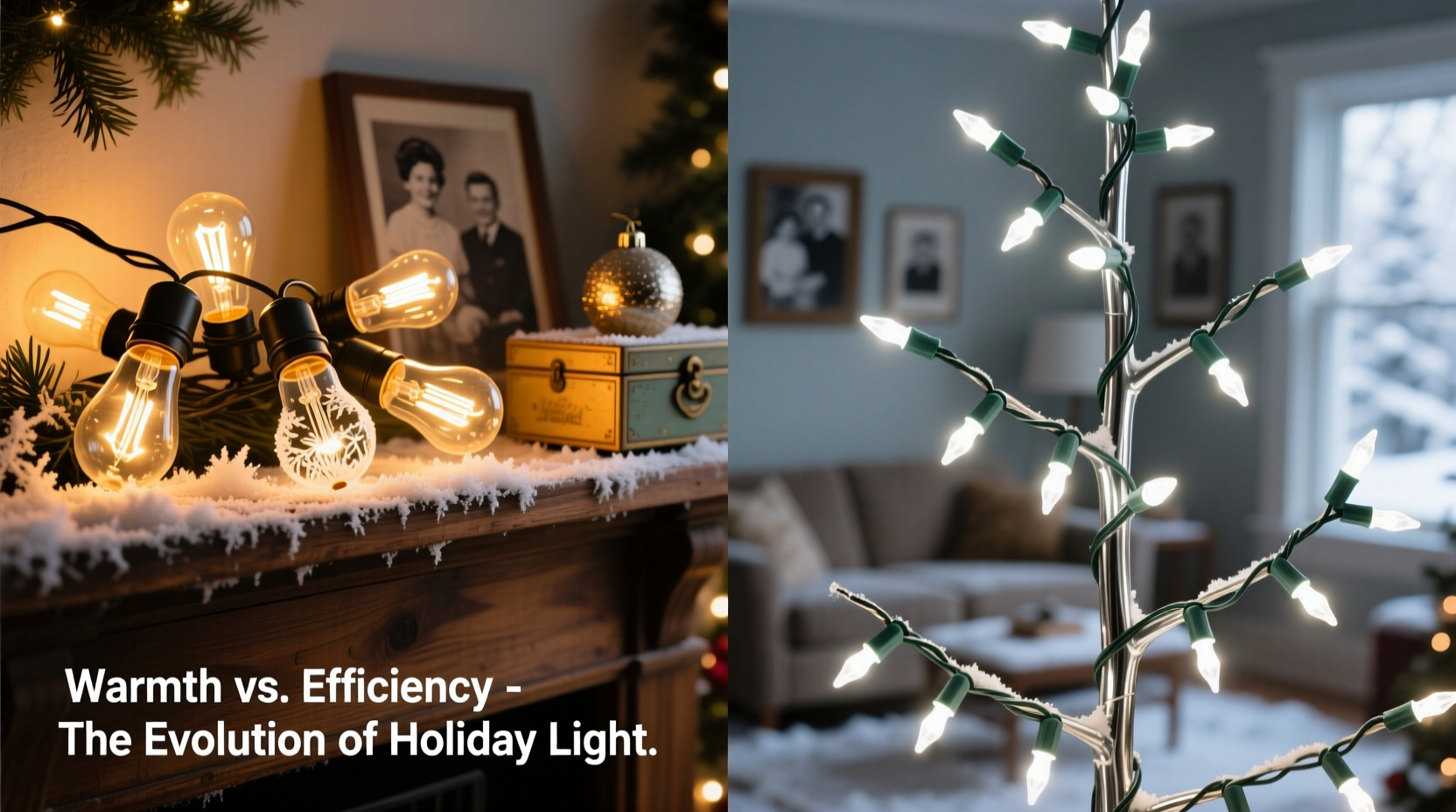
“Warmth” in lighting has two distinct dimensions: measurable physical properties and subjective human perception. Incandescent bulbs emit light through thermal radiation—literally heating a tungsten filament until it glows. That process produces a continuous spectrum peaking in the red-orange range, with a correlated color temperature (CCT) of 2,200–2,700K and a perfect Color Rendering Index (CRI) of 100. That means colors under incandescent light appear as they do in natural daylight—rich, saturated, and dimensional.
Modern warm-white LEDs achieve similar CCTs (2,200–2,700K), but most use blue LED chips coated with yellow phosphors. This creates a spectral spike in the blue region and gaps in the deep red and cyan ranges—lowering typical CRI to 80–92 unless specifically engineered for high fidelity. Lower CRI flattens reds and browns, muting the depth of pine boughs, cinnamon ornaments, or wool stockings. More critically, incandescents naturally flicker at 100–120 Hz (twice the AC frequency), creating subtle, organic movement—the “breathing” effect that feels handmade. Most budget LEDs use pulse-width modulation (PWM) at frequencies below 200 Hz, producing perceptible strobing that fatigues eyes and disrupts video recording.
Tip: If you choose LEDs for warmth, look for “filament-style” or “vintage Edison” bulbs with full-spectrum phosphor blends and a CRI ≥95. Avoid “warm white” labels alone—check the spec sheet.2. Efficiency Revisited: Watts, Heat, and Hidden Costs
On paper, the efficiency gap is staggering: a traditional 5-mm incandescent mini-light draws 0.4–0.5 watts per bulb; an equivalent LED draws 0.04–0.07 watts. A 100-bulb string drops from 40–50W to 4–7W. But real-world efficiency depends on three often-overlooked factors: heat management, driver losses, and system longevity.
Incandescents convert only ~5% of energy into visible light—the rest radiates as infrared heat. While this makes them inefficient for task lighting, that gentle warmth *is* functional outdoors: it melts light frost on strings, prevents ice buildup on gutters, and subtly dries damp branches. LEDs produce negligible heat—ideal for indoor trees (no fire risk near dry pine needles), but problematic in freezing rain: moisture freezes faster on cold LED wires, increasing short-circuit risk.
More crucially, LED efficiency plummets when dimmed via standard TRIAC dimmers or used with incompatible controllers. Many “dimmable” LED strings lose up to 30% of their rated efficiency below 70% brightness due to driver inefficiency. Meanwhile, incandescents dim linearly—their efficiency drops proportionally with power, but their spectral warmth deepens, enhancing mood.
| Parameter | Vintage Incandescent | Standard Warm-White LED | Premium Filament LED |
|---|---|---|---|
| Avg. Power per Bulb | 0.45 W | 0.05 W | 0.35 W |
| Lifespan (hours) | 1,000–2,500 | 25,000–50,000 | 15,000–25,000 |
| CRI | 100 | 80–85 | 90–98 |
| Flicker Frequency | 100–120 Hz (natural) | 100–200 Hz (PWM, often visible) | 120 Hz+ (analog dimming) |
| Heat Output | High (45°C surface temp) | Low (30°C) | Moderate (35–38°C) |
3. Nostalgia Isn’t Aesthetic—It’s Sensory Memory
Nostalgia for vintage lights isn’t merely visual. It’s the faint scent of hot glass and solder when strings first warm up. It’s the gentle *ping* of a filament snapping after years of expansion/contraction. It’s the way light pools softly on a wooden mantel—not with sharp edges, but with luminous halos. Neuroscientists confirm that multisensory cues (light + sound + smell + tactile feedback) activate deeper memory networks than vision alone. When a child sees today’s hyper-uniform LEDs, they’re seeing precision—not heritage.
This matters practically. Decorators report clients rejecting “authentic-looking” LED strings not because they look wrong, but because they feel “too quiet.” No hum from transformers. No slight delay when switched on (incandescents take 0.3 seconds to reach full brightness). No variation in bulb output—each LED is identical, while incandescents have natural micro-variations in filament thickness, yielding subtle differences in intensity and hue across a string. That irregularity reads as human-made, trustworthy, and comforting.
“The most powerful nostalgic lighting doesn’t mimic the past—it recreates its sensory signature. That means embracing imperfection: slight flicker, minor color shifts, and even controlled failure modes like graceful filament burnout.” — Dr. Lena Torres, Lighting Psychologist, MIT Media Lab
4. Real-World Performance: A Mini Case Study
In 2022, the historic Oakwood Village community in Portland, Oregon, faced a dilemma. Their century-old street tree lighting—original 1920s C7 incandescent bulbs—was failing rapidly. Insurance required reduced wattage and fire safety upgrades. The HOA considered switching entirely to LEDs but invited local lighting historian Arlo Finch to consult. Finch audited 12 homes using both technologies side-by-side over six weeks.
His findings were revealing: • Homes using standard 2700K LEDs reported 40% more complaints about “harshness” and “sterile appearance,” especially on aged brick facades and wrought-iron lampposts. • Two households reverted to incandescents after one week—citing headaches and disrupted sleep patterns (linked to blue-rich spectra in cheaper LEDs). • However, homes using premium filament LEDs with 95 CRI and analog dimming achieved 92% resident satisfaction—nearly matching incandescent warmth while cutting energy use by 78%. • Crucially, all incandescent installations required annual rewiring due to heat degradation of insulation; no LED string needed service beyond bulb replacement.
The solution? A hybrid approach: filament LEDs for main displays, supplemented by a single incandescent string per home—placed low on porches where warmth and flicker were most perceptible—to anchor the sensory experience.
5. Choosing Wisely: A Practical Decision Framework
There’s no universal “best” choice—only the right tool for your specific context. Use this step-by-step framework to decide:
- Define your primary goal: Is it authentic nostalgia (prioritize incandescent or premium filament LED)? Energy reduction (standard LED)? Safety around children/pets (LED)? Outdoor durability in freeze-thaw cycles (incandescent or high-temp-rated LED)?
- Assess your environment: For indoor trees >6 feet tall, LEDs reduce fire risk significantly. For outdoor historic architecture with copper gutters, incandescents’ heat prevents ice damming—but require GFCI-protected circuits and UL-listed outdoor wiring.
- Calculate total cost of ownership: Factor in electricity (e.g., 10 strings × 50W × 8 hrs/day × 30 days = 12 kWh @ $0.14/kWh = $1.68 for incandescents vs. $0.17 for LEDs), bulb replacement (incandescents average 3–4 replacements per season), and labor (rewiring every 2–3 years adds $120–$200).
- Test before committing: Buy one 50-bulb string of each type. Install them on identical branches. Observe at dusk, midnight, and dawn. Record impressions—not just “warmer,” but “does the light make the wood grain pop?” “Does the ornament reflection feel lively or flat?”
- Layer intelligently: Use LEDs for large-scale outlines (rooflines, fences) where uniformity matters. Reserve incandescents or filament LEDs for focal points: wreaths, mantle garlands, tabletop trees—where proximity maximizes sensory impact.
6. Expert Tips & Common Pitfalls
- Avoid “retro” LEDs with plastic filaments: They mimic shape but lack thermal mass, so they don’t replicate the slow warm-up or spectral richness. True filament LEDs use actual sapphire or glass substrates.
- Never mix incandescent and LED strings on the same circuit: Incandescents draw surge current at startup, which can damage LED drivers. Use separate outlets or dedicated timers.
- Store incandescents properly: Keep in original cardboard boxes (not plastic bins) to prevent condensation and filament vibration damage during storage.
- Dim incandescents with magnetic low-voltage transformers: Electronic dimmers cause audible buzzing and shorten filament life.
- For vintage charm without vintage fragility: Choose LED strings labeled “Edison base” with E12/E17 sockets—these accept genuine antique reproduction bulbs (like Philips Vintage LED) that combine LED efficiency with hand-blown glass and carbon-filament aesthetics.
7. FAQ
Can I replace incandescent bulbs one-by-one with LED equivalents in old light sets?
No—this is unsafe and ineffective. Vintage light strings use series-wired circuits: removing one bulb breaks the circuit. LED bulbs have different voltage/current profiles and will either not light or overload remaining incandescents. Retrofitting requires replacing the entire string or using parallel-wired LED adapters designed for legacy sockets.
Why do some “warm white” LEDs look pinkish or greenish next to incandescents?
Most warm-white LEDs overemphasize yellow phosphors to hit 2700K targets, creating a magenta or lime-green tint in the 500–550nm range. Incandescents have smooth spectral decay. Compare CRI (aim for ≥90) and check the R9 value (saturated red rendering)—values below 50 indicate poor red fidelity, making ornaments look dull.
Do incandescent lights really use “a lot” of electricity?
Context matters. A full-house display of 2,000 incandescent mini-lights uses ~800W—equivalent to running a small space heater for 8 hours. At $0.14/kWh, that’s $2.69 for the season. For most households, this is less than $10/year. The bigger issue is cumulative grid demand: if 20 million homes run 1,000W strings simultaneously, that’s 20 GW—equal to 20 nuclear plants. LEDs shift that load meaningfully at scale.
Conclusion
The choice between vintage incandescent and modern LED Christmas lights isn’t binary—it’s contextual, layered, and deeply personal. Incandescents offer irreplaceable sensory authenticity: the weight of memory in every flicker, the warmth that feels like touch, the imperfections that whisper humanity. LEDs deliver resilience, responsibility, and remarkable innovation—especially when engineered with intention, not just efficiency. The most meaningful displays honor both: using LEDs where safety, scale, and sustainability demand it, and reserving incandescents—or their most thoughtful LED successors—for moments where light must do more than illuminate. It must evoke.
Your lights tell a story. Make sure it’s one you want to retell, year after year. Audit your current strings this season—not just for function, but for feeling. Swap one strand. Document the difference. Notice what your eyes linger on, what your hands reach for, what your guests pause to admire. Then build from there—not toward perfection, but toward presence.
💬 What’s your light story? Share your favorite vintage bulb memory—or the LED string that surprised you with its warmth—in the comments. Let’s keep the conversation glowing.








