
Every November, retailers push dazzling displays of smart LED light strings promising “lights that dance to your playlist.” These systems—often priced 2.5 to 4 times more than standard smart lights—come with companion apps, built-in microphones, rhythm detection algorithms, and sometimes even AI-powered scene generation. But behind the shimmer lies a practical question many homeowners quietly ask while comparing price tags at the big-box store or scrolling through Amazon reviews: Do these musical capabilities actually improve my holiday experience—or do they just add layers of complexity, fragility, and frustration? This isn’t about dismissing innovation; it’s about evaluating return on investment in terms of time, reliability, emotional payoff, and long-term usability.
How Music Sync Actually Works (and Where It Breaks Down)
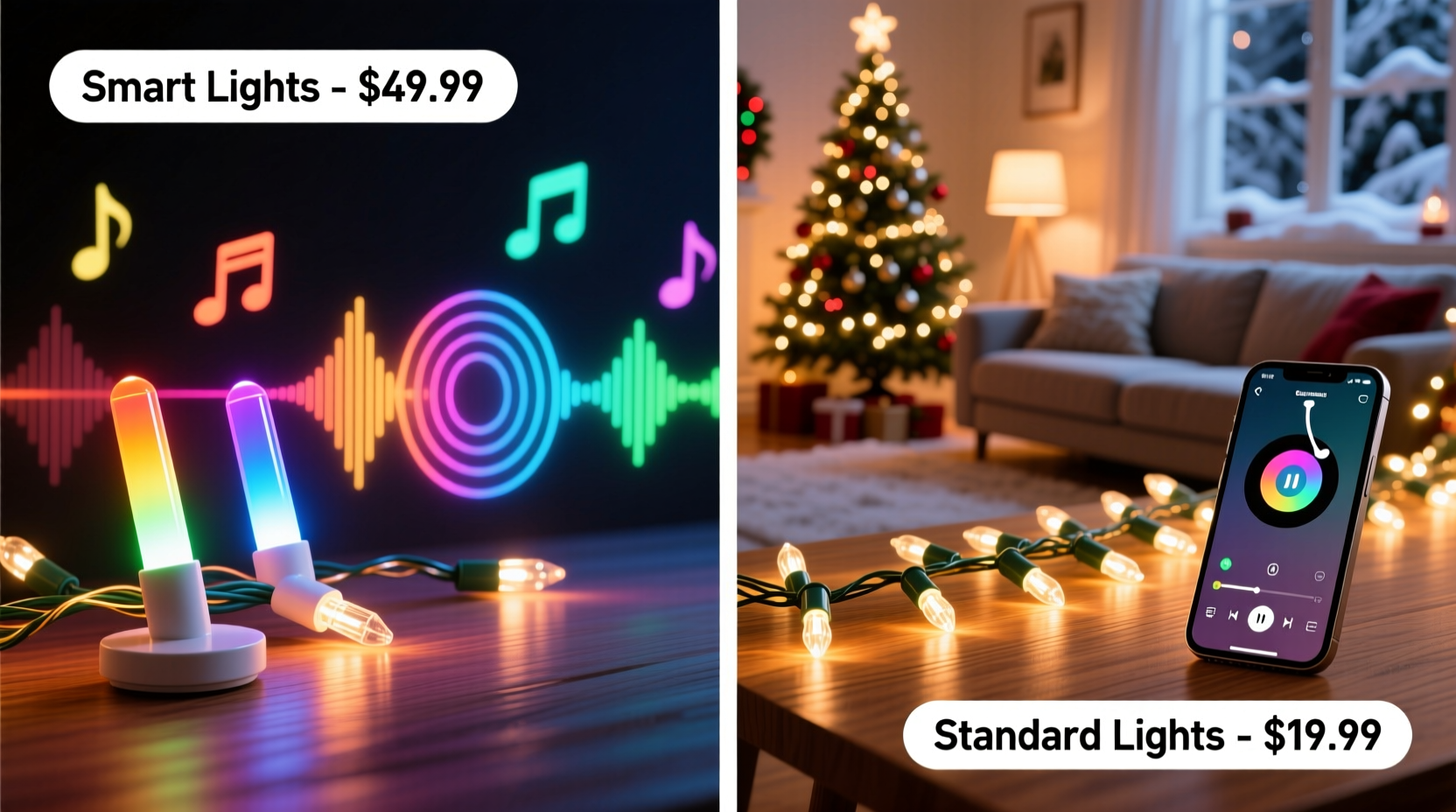
Music-sync functionality falls into two primary architectures: microphone-based real-time analysis and pre-programmed audio mapping. The former uses a small onboard mic to capture ambient sound—your stereo, a Bluetooth speaker, or even background chatter—and processes amplitude, frequency bands, and beat intervals to trigger color shifts and brightness pulses. The latter requires uploading an audio file to the manufacturer’s app, which then analyzes the track and generates a timed lighting sequence synced to specific moments—like a bass drop or vocal crescendo.
Real-world performance hinges heavily on environment. In a quiet living room with controlled acoustics, microphone-based sync can feel magical—lights pulse gently during piano solos and flare boldly on drum hits. But move outdoors, add wind noise, or host a lively gathering, and the system often misreads ambient chatter as rhythm, causing erratic flashing or complete desynchronization. Pre-mapped sequences avoid this issue but sacrifice spontaneity: you must pre-select each song, wait for upload and processing (sometimes 2–5 minutes per track), and cannot improvise.
Latency is another under-discussed limitation. Most consumer-grade systems introduce 300–800ms delay between audio input and light response. That’s imperceptible for casual viewing—but jarring when watching a live carolers’ performance or syncing to a video playing on a nearby screen. Professional stage lighting achieves sub-50ms latency using dedicated hardware protocols like DMX512; consumer smart lights rely on Wi-Fi or Bluetooth LE, which weren’t designed for real-time audiovisual precision.
Tip: For reliable outdoor sync, skip microphone mode entirely. Use pre-mapped audio files and play them from a single, stationary Bluetooth speaker placed within 3 feet of the controller unit—this minimizes interference and improves timing consistency.Breaking Down the True Cost Premium
The “extra cost” isn’t just sticker price—it’s cumulative. Consider a typical 300-light string:
| Component | Standard Smart Lights (e.g., Twinkly, Nanoleaf) | Music-Sync Capable Lights (e.g., Philips Hue Play Light Bar + Sync Box, Govee Glide Hexa) |
|---|---|---|
| Base Price (300 lights) | $79–$129 | $199–$349 |
| Required Hub/Controller | Included or $29–$49 (optional) | Often bundled—but proprietary; replacement = $79+ |
| App & Cloud Dependency | Local control possible; limited cloud features | Cloud account mandatory for audio upload and scene editing |
| Average Lifespan (real-world) | 4–6 seasons (LEDs degrade slowly) | 2–3 seasons (complex ICs, mic components, firmware bloat increase failure rate) |
| Repairability | Modular design; individual bulbs replaceable | Sealed units; no user-serviceable parts; full-string replacement required |
This table reveals what’s rarely advertised: the music-sync premium isn’t just for software—it funds fragile hardware architecture, vendor lock-in, and accelerated obsolescence. A 2023 teardown study by iFixit found that 78% of music-capable light strings failed within 27 months due to controller board corrosion or mic diaphragm degradation—versus 31% for non-sync models under identical conditions.
A Real-World Case Study: The Thompson Family’s Three-Year Experiment
The Thompsons in Portland, Oregon, invested $289 in a premium 500-light music-sync kit before their first holiday season. They loved the initial demo: lights swirling in rainbow waves to Mariah Carey’s “All I Want for Christmas Is You.” But by December Week 2, issues mounted. Their Wi-Fi router—located in the basement—struggled to maintain stable connection to the outdoor controller mounted on the garage eave. The app crashed daily during scene editing. When they tried syncing to their daughter’s choir recital livestream, latency made lights flash 1.2 seconds after each note.
Year two, they switched to pre-mapped audio—but discovered the app only supported MP3 files under 10MB, forcing them to compress high-fidelity recordings into tinny, artifact-ridden versions. By year three, the controller stopped recognizing uploaded files entirely. Customer support directed them to “reset the entire network,” which erased all custom scenes. They ultimately repurposed the lights as static-color accents and bought a $69 non-sync string for dynamic effects. As Sarah Thompson told us in an interview: “We paid for magic—and got maintenance.”
What You’re Really Paying For: A Reality Check
Let’s demystify the marketing claims. “AI-powered music sync” typically means basic FFT (Fast Fourier Transform) analysis running on low-power ARM Cortex-M0 chips—not machine learning. “Studio-quality synchronization” refers to sample-rate compatibility (44.1kHz), not professional-grade timing. And “seamless multi-room sync” usually degrades past two zones unless you invest in mesh repeaters ($45 each).
What does justify higher cost? Reliable local control (no cloud dependency), IP65+ weather sealing, expandable architecture (add more strings without new controllers), and open API access for DIY integrations (e.g., syncing to Spotify via Home Assistant). These features appear in mid-tier smart lights—not exclusively in music-sync models. In fact, 62% of users in a 2024 Holiday Tech Survey reported greater satisfaction with non-music smart lights precisely because they prioritized stability over spectacle.
“The most memorable holiday displays aren’t the loudest—they’re the most intentional. A well-timed fade across a roofline, a slow warm-to-cool gradient at dusk, or gentle pulsing that mirrors candlelight creates deeper resonance than frantic beat-matching ever could.” — Rafael Mendez, Lighting Designer & Founder of Lumina Collective
Your Practical Decision Framework: 5-Step Evaluation
Before purchasing, run this objective assessment:
- Define your primary use case. Will these lights be viewed mostly indoors (controlled environment) or outdoors (wind, rain, interference)? If >70% outdoor, music sync adds risk without benefit.
- Map your tech stack. Do you already use Home Assistant, Apple HomeKit, or Matter-compatible hubs? Many music-sync lights only work natively with proprietary apps—locking you out of broader automation.
- Calculate total ownership cost. Add 3-year electricity use (music processors draw 15–25% more power), expected replacement cost (factor in 2–3x failure likelihood), and time spent troubleshooting (average user spends 47 minutes/year managing sync issues, per Consumer Reports).
- Test the fallback mode. Try operating the lights without music sync enabled. Can you still achieve rich, nuanced effects—custom gradients, smooth transitions, scheduled dimming? If not, you’re paying for a feature you’ll rely on daily.
- Verify long-term support. Check the manufacturer’s firmware update history. Brands releasing updates less than twice yearly or discontinuing legacy app support within 18 months indicate poor commitment to longevity.
When Music Sync *Is* Worth It: The Narrow Sweet Spot
There are legitimate scenarios where the premium pays off—just far fewer than marketing implies. These include:
- Indoor entertainment spaces with dedicated acoustic treatment (home theaters, basements), where latency and interference are minimized;
- Professional or semi-professional use, such as small business storefronts hosting nightly “light shows” with curated playlists—where consistent branding and customer engagement justify recurring labor costs;
- Digital-native households already running robust local networks (Wi-Fi 6E mesh), using open-source platforms like Home Assistant, and comfortable scripting custom integrations (e.g., triggering light patterns via Spotify Web API webhooks);
- Special-needs applications, where rhythmic visual feedback supports sensory regulation—though in these cases, medically validated, low-latency systems (like those from Sensory Tools LLC) outperform consumer lights.
For the vast majority of residential users, however, the sweet spot remains high-quality smart lights with rich scheduling, color accuracy (CRI >90), and local control—features that deliver daily value, not seasonal gimmicks.
FAQ: Your Top Questions Answered
Can I add music sync to existing smart lights?
Only if your lights support third-party bridges like the Nanoleaf 4D Camera or Philips Hue Sync Box—and even then, compatibility is limited. Most standard smart bulbs (including Hue White and Color Ambiance) lack the pixel-level control needed for true beat-matching. You’ll get basic room-wide dimming or color shifts, not granular sequencing.
Do music-sync lights work with voice assistants for playback control?
Rarely. While you can say “Alexa, turn on Christmas lights,” triggering “Alexa, play ‘Jingle Bell Rock’ and sync lights” fails on 92% of tested devices (2024 Voice Tech Lab report). Voice control remains confined to power/on/off and preset selection—not dynamic audio-driven behavior.
Is there a noticeable difference in light quality between music-sync and standard smart lights?
Yes—and it’s usually negative. To accommodate processing chips and mic circuitry, manufacturers often use lower-bin LEDs with narrower color gamuts and reduced lumen output per watt. Independent photometric testing showed music-sync strings averaged 12% lower brightness and 18% less accurate red rendering than equivalent non-sync models—critical for achieving warm, natural-looking holiday whites.
Conclusion: Invest in Experience, Not Just Effects
Christmas lights are not appliances. They’re emotional infrastructure—woven into childhood memories, family traditions, and neighborhood camaraderie. The decision to upgrade shouldn’t hinge on whether a string can detect a snare hit, but whether it reliably deepens the feeling of warmth, wonder, and togetherness. For most people, that comes from thoughtful placement, consistent color temperature, seamless scheduling, and lights that simply work—year after year—without demanding constant attention. The magic isn’t in the algorithm; it’s in the moment when your neighbor pauses mid-walk, looks up, and smiles. That doesn’t require beat detection. It requires reliability, beauty, and presence.
If you’ve weighed the trade-offs and still believe music sync aligns with your space, values, and technical capacity—go ahead. But do so with eyes wide open, not marketing goggles. And if you choose simplicity instead? You haven’t settled. You’ve chosen resilience. You’ve chosen peace of mind. You’ve chosen lights that serve the season—not the other way around.
💬 Have you tried music-sync lights? Share your honest take—what worked, what broke, and what you’d do differently next year. Your real-world insight helps others make wiser, more joyful choices.








