
For pet owners, managing fur is a daily chore. Whether it's clumps of dog hair on the sofa or cat dander drifting across hardwood floors, keeping your home clean can feel like a never-ending battle. While both robot vacuums and traditional upright vacuums promise relief, they deliver very different experiences when it comes to tackling pet hair. The choice isn’t just about convenience—it’s about effectiveness, maintenance, and long-term value.
This guide dives deep into how each type performs in real homes with real pets. We’ll compare suction power, brush roll design, filtration, maintenance demands, and smart features, all through the lens of pet hair cleanup. By the end, you’ll know exactly which machine earns its place in a pet-friendly household.
Suction Power and Hair Pickup Performance
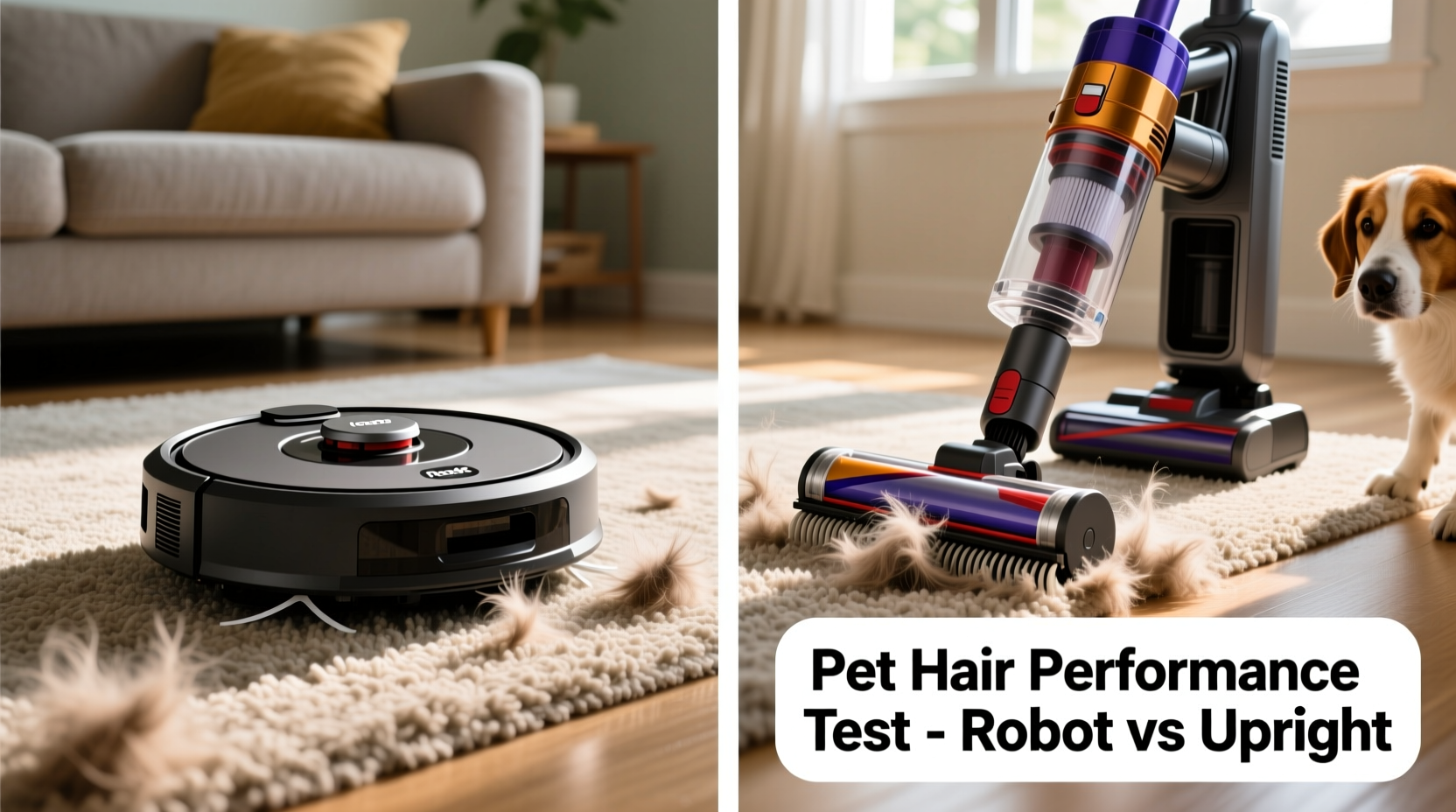
Suction strength is the backbone of any vacuum’s ability to lift embedded pet hair from carpets, rugs, and crevices. Traditional upright vacuums typically outperform robot models in raw power. Most uprights offer 150–300+ air watts (AW), while even high-end robot vacuums rarely exceed 2,500 Pa (roughly equivalent to 100–120 AW).
This difference becomes evident on medium-pile carpets where pet hair weaves deeply into fibers. Uprights with motorized brush rolls and direct airflow paths pull up clumps that robots often leave behind after a single pass. However, robot vacuums have improved dramatically. Models like the Roborock S8 Pro Ultra and iRobot Roomba j9+ use dual rubber brushes and anti-tangle technology to reduce hair wrap and improve pickup on hard floors and low-pile rugs.
Still, no robot currently matches the deep-cleaning capability of a full-sized upright during a thorough weekly clean. Robots excel at surface-level maintenance—ideal for picking up daily shedding—but fall short when dealing with neglected corners or thick carpet layers.
Tip: For homes with wall-to-wall carpeting and heavy shedders, pair a robot vacuum for daily touch-ups with an upright for weekly deep cleans.Brush Roll Design: Tangle Resistance Matters
One of the biggest pain points with pet hair is brush roll tangling. Traditional uprights often use bristle-and-brush combinations that trap long strands quickly, requiring frequent manual cleaning. Some newer models now include tangle-free brush rolls made of rubber or silicone strips, such as those found in Dyson and Shark Vertex series, which significantly reduce hair wrap.
Robot vacuums have taken this challenge seriously. Many now avoid bristles altogether, opting for dual counter-rotating rubber rollers that separate debris from hair and push it into the bin. The iRobot Roomba j9+, for example, uses J-shaped extractors designed specifically to resist pet hair buildup. Similarly, Ecovacs Deebot X2 Omni features a tangle-free roller with self-cleaning capabilities.
In side-by-side tests, robots consistently require less frequent brush maintenance than traditional vacuums—especially on hard flooring. On carpets, however, longer-haired pets still pose a challenge, and some robot models may need monthly inspections to remove compacted fur near bearings.
“Pet hair doesn’t just sit on surfaces—it bonds with fibers and static. A vacuum must combine strong agitation with intelligent brush design to truly remove it.” — Dr. Linda Chen, Home Appliance Engineer at Consumer Dynamics Lab
Maintenance and Cleaning Frequency
Pet owners face higher maintenance demands regardless of vacuum type, but the nature of upkeep differs significantly between robots and uprights.
Traditional uprights usually have larger dustbins (1.5–2 liters), meaning fewer emptying cycles. However, their filters, hoses, and brush rolls require regular attention. Hair wrapped around the roller can reduce suction by up to 40% if not cleared weekly. HEPA filters should be rinsed or replaced every 3–6 months, depending on usage.
Robot vacuums, while smaller (typically 0.4–0.6L bins), automate part of the process. High-end models connect to self-emptying docks that store debris for weeks. These are particularly valuable for pet owners who dislike handling dirty bins daily. Still, sensors, side brushes, and charging contacts need wiping down every few days to ensure reliable navigation and performance.
The trade-off is frequency versus automation. Uprights demand less frequent but more involved care. Robots ask for small, consistent efforts—or rely on premium features to offload the work.
Weekly Maintenance Comparison
| Task | Traditional Upright | Robot Vacuum (with Dock) |
|---|---|---|
| Empty Dustbin | 1–2 times per week | Manual: Daily | Auto-Empty: Every 30 days |
| Clean Brush Roll | Weekly (essential) | Bi-weekly to monthly |
| Wipe Sensors/Wheels | Not applicable | Twice weekly |
| Filter Care | Monthly rinse/replace | Monthly rinse |
| Hose/Path Inspection | Every 2–3 weeks | Rarely needed |
Smart Features and Pet-Friendly Automation
Where robot vacuums shine is in consistency. They operate on schedules, respond to voice commands, and integrate with smart home systems. For busy pet owners, setting a robot to run twice daily—after morning walks and evening feeding—keeps fur accumulation under control without lifting a finger.
Advanced models detect high-traffic zones and increase suction in areas where pets spend most time. Some, like the Roomba Combo j9+, even avoid pet bowls using AI-powered object recognition. Others map multi-floor layouts and adjust cleaning modes room by room—carpet boost in the living room, quiet mode in the bedroom.
Uprights lack this level of intelligence. Even cordless stick versions with app connectivity don’t match the autonomy of a robot. But they offer immediate, powerful response. When a dog shakes off after rain, tracking mud and wet fur across the floor, an upright provides faster, more thorough cleanup than waiting for a scheduled robot run.
The ideal scenario? Use a robot for routine maintenance and an upright for spot emergencies. This hybrid approach maximizes both convenience and cleaning depth.
Mini Case Study: The Thompson Family with Two Dogs
The Thompsons adopted two golden retrievers six months ago. Their previously tidy home became a fur-covered landscape within weeks. Initially, they relied solely on a mid-range robot vacuum. It kept the kitchen tile clean but struggled on area rugs, leaving visible trails of tangled hair after each cycle.
After three months, they purchased a Shark Navigator Lift-Away with a self-cleaning brush roll. Using the upright once a week, they noticed dramatic improvement—especially under furniture and along baseboards. They now run the robot every weekday and the upright every Saturday. The result: a visibly cleaner home with less physical effort.
“We thought the robot would replace everything,” says Mark Thompson. “But it’s better as a partner. It picks up what we track in daily; the upright handles the rest.”
Filtration and Allergen Control
Pet hair carries dander, pollen, and microscopic allergens. Effective filtration is crucial for households with allergies or asthma. Both vacuum types offer HEPA-grade options, but implementation varies.
Most modern uprights come with sealed HEPA systems, ensuring that 99.97% of particles 0.3 microns or larger are trapped. Brands like Miele and Kenmore are known for medical-grade filtration, making them top choices for allergy sufferers.
Many robot vacuums also advertise “HEPA-like” or true HEPA filters, but due to size constraints and airflow limitations, their seal integrity isn't always guaranteed. Premium models maintain better seals and multi-stage filtration (pre-motor + post-motor), but budget units often leak fine particles back into the air during operation.
If air quality is a priority, uprights generally provide more reliable allergen containment. That said, robots running multiple times per day can reduce overall airborne dander levels through constant circulation and capture—offering a different kind of benefit.
Checklist: Choosing the Right Vacuum for Pet Hair
- ✅ Assess your flooring: More carpet = stronger need for upright suction.
- ✅ Look for tangle-free brush rolls (rubber or self-cleaning designs).
- ✅ Prioritize HEPA filtration if anyone has allergies.
- ✅ Consider a self-emptying dock if you hate handling pet hair bins.
- ✅ Check noise levels—some robots disturb pets during operation.
- ✅ Evaluate bin capacity relative to pet count and shedding level.
- ✅ Test edge cleaning performance—robots vary widely on wall edges.
FAQ
Can a robot vacuum completely replace an upright in a home with pets?
For light shedders and mostly hard flooring, yes—especially with a high-end model and self-emptying dock. However, for heavy shedders, carpets, or allergy concerns, most experts recommend keeping an upright for weekly deep cleaning. Robots maintain cleanliness; uprights restore it.
Why does pet hair clog my vacuum so easily?
Pet hair is elastic, lightweight, and statically charged, allowing it to wrap around brush rolls, cling to hoses, and block filters. Regular maintenance and tangle-resistant brush designs help mitigate this. Washing reusable filters monthly also prevents airflow restriction.
Do robot vacuums scare pets?
Some pets are startled initially, but most adapt within a few days. Starting with shorter runs and daytime schedules helps. Avoid models with loud error alerts or sudden movements. Quieter robots like the Roborock Qrevo (under 60 dB) are less disruptive.
Step-by-Step Guide: Optimizing Your Vacuum Routine for Pet Hair
- Assess your home: Note carpeted areas, pet zones, and traffic patterns.
- Choose your primary tool: If over 50% carpeted or heavy shedding, start with an upright. If mostly hard floors, consider a robot as primary.
- Add automation: Set robot schedules to run 1–2 hours after peak pet activity (e.g., after walks).
- Establish a weekly deep-clean ritual: Use the upright to re-vacuum high-fur zones once a week.
- Maintain both machines: Clean brush rolls weekly, wipe sensors bi-weekly, and rinse filters monthly.
- Monitor performance: Watch for missed spots, reduced suction, or increased pet reactions.
- Adjust seasonally: Increase frequency during shedding seasons (spring/fall).
Final Verdict: Complement, Don’t Replace
The question isn’t whether robot vacuums or traditional uprights handle pet hair better—it’s how they complement each other. Uprights win on raw power, deep-cleaning ability, and filtration reliability. Robots win on consistency, automation, and daily maintenance.
The most effective strategy for pet owners combines both. Let the robot manage daily surface hair and dander, preserving cleanliness between deeper sessions. Use the upright weekly to reset carpets, clear hidden debris, and ensure allergens stay trapped.
Technology hasn’t yet produced a single device that does it all perfectly. But together, these tools form a powerful defense against the inevitable tide of pet hair.
🚀 Ready to upgrade your pet hair cleanup? Start by auditing your current routine—then choose one improvement: add a robot, switch to a tangle-free upright, or invest in a self-emptying dock. Small changes lead to cleaner homes and happier pets.








