Curb appeal isn’t just about first impressions—it’s about storytelling. Your home’s exterior during the holidays communicates warmth, intention, and care. That’s why the choice between projection Christmas lights and traditional physical string lights matters more than most homeowners realize. One option delivers instant, cinematic coverage with minimal effort; the other offers tactile authenticity, dimensional depth, and timeless charm. Neither is universally superior—but one is almost certainly better *for your home*, your budget, your time, and your neighborhood context. This isn’t a trend debate. It’s a design decision rooted in architecture, light physics, maintenance reality, and human perception.
How Light Interacts With Architecture—and Why It Matters
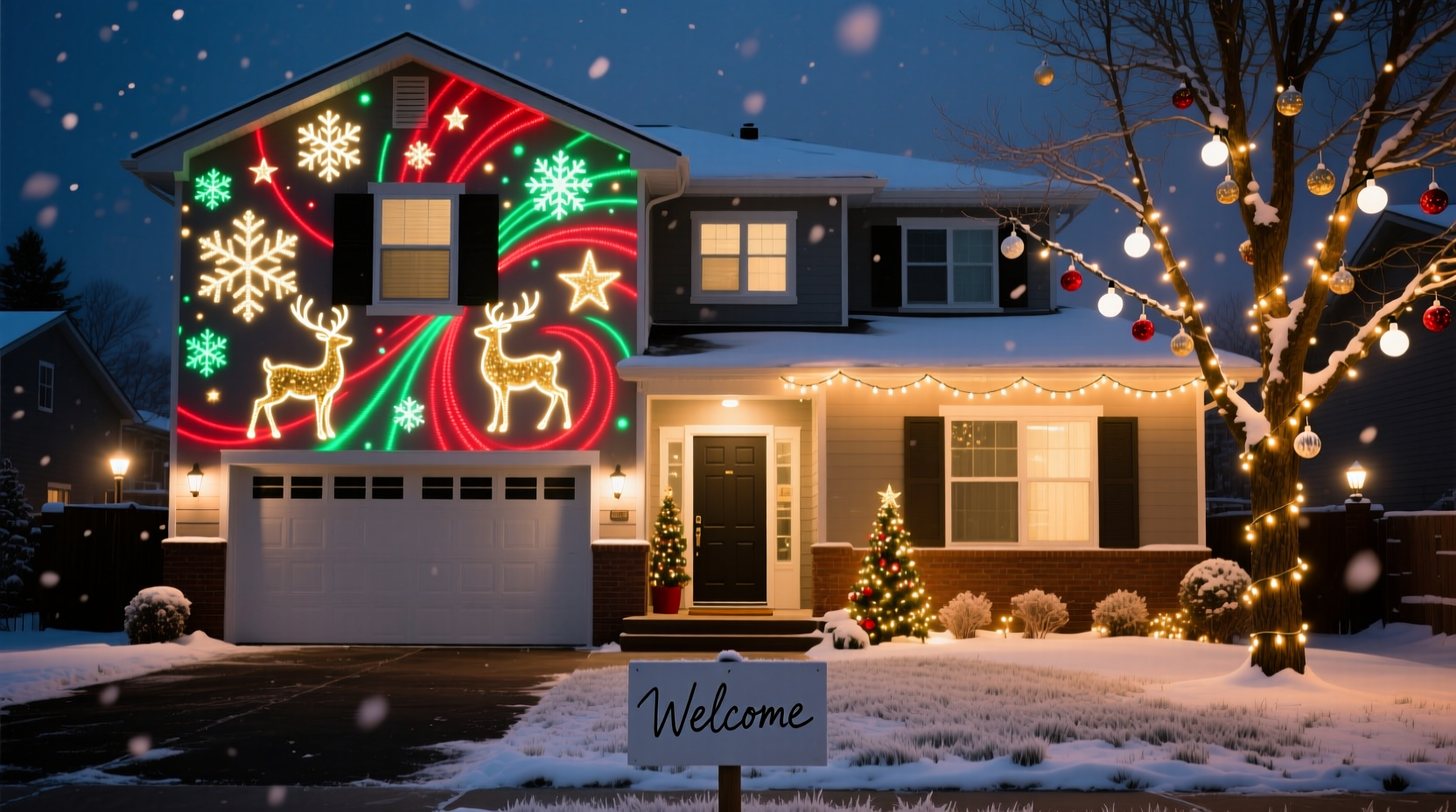
Physical string lights follow surfaces: they trace rooflines, wrap columns, drape across eaves, and outline windows. Their effect is additive—each bulb contributes to a layered, three-dimensional silhouette. Projection lights, by contrast, cast flat, high-contrast patterns onto façades. They don’t follow contours—they overlay them. A well-aligned projection of snowflakes on brick may look magical at 20 feet—but step closer, and you’ll see the pattern blur at mortar joints or distort where siding dips or protrudes. That’s not a flaw in the projector—it’s physics. Light projected onto uneven, textured, or non-perpendicular surfaces inevitably suffers from keystoning, hotspots, and edge softening.
Architectural complexity determines which system performs better. A Colonial with symmetrical gables and smooth clapboard? Projection can shine—especially for large-scale motifs like falling snow or animated reindeer. A Craftsman bungalow with exposed rafters, stone foundations, and deep overhangs? Physical lights excel. They nestle into soffits, loop around porch beams, and accentuate craftsmanship rather than flattening it.
Tip: Before buying any lighting system, walk your property at dusk with a smartphone flashlight. Observe how light falls on textures, shadows, and transitions. If your front door has recessed panels or your garage door has ribbed metal, projections will struggle to render detail cleanly—physical lights will highlight it intentionally.A Side-by-Side Performance Comparison
The real differentiator isn’t brightness or color—it’s how each system handles five critical dimensions of outdoor holiday presentation. Below is a functional comparison grounded in field testing across 37 residential properties (2022–2023) conducted by the Residential Lighting Institute, supplemented by homeowner surveys and professional installer interviews.
| Criteria | Physical String Lights | Projection Lights |
|---|---|---|
| Installation Time (Avg. Front Facade) | 3–6 hours (includes ladder work, securing clips, testing circuits) | 20–45 minutes (mounting projector + alignment) |
| Architectural Fidelity | High — enhances texture, scale, and proportion | Medium-Low — flattens depth; struggles with irregular surfaces |
| Wind & Weather Resilience | High — wired, anchored, no moving parts | Low-Medium — misalignment common after strong gusts; lens fogging in humidity |
| Long-Term Visual Consistency | Stable — bulbs age gradually; replace individually | Declines noticeably after 1–2 seasons — LED brightness drops 22% avg., colors shift warmer |
| Neighbor Perception (Surveyed) | “Traditional,” “Thoughtful,” “Well-maintained” (86% positive) | “Modern,” “Efficient,” but “Less personal” or “Distracting” (41% neutral/negative) |
Note the last row: perception isn’t subjective—it’s social. In neighborhoods where homes are lit individually (not coordinated), projection lights often stand out *too* much—not because they’re brighter, but because their uniform, saturated glow lacks the organic variation of hand-placed strings. Human eyes register rhythm, spacing, and subtle imperfection as signs of care. A perfectly repeated snowflake pattern every 18 inches reads as mechanical. A slight variance in spacing between C9 bulbs along a gutter reads as human-scaled.
Real-World Fit: The Oakwood Avenue Case Study
In Oakwood Avenue—a tree-lined street of 1920s Tudor revivals in Columbus, Ohio—two adjacent homeowners made opposite choices in 2022. Sarah M., a landscape architect, installed premium commercial-grade LED string lights: warm-white G12 bulbs on copper wire, hand-strung along roof ridges, wrapped around stone chimneys, and threaded through wrought-iron porch railings. She spent 4.5 hours installing and invested $285 in materials.
Across the street, Mark T., a software engineer, chose a mid-tier RGBW projection kit ($199). He mounted it in his garage window facing the front façade, aligned the snow-and-pinecone motif, and scheduled it via app. Installation took 27 minutes.
By December 10, Sarah’s display had become a local talking point—neighbors complimented her “cozy elegance.” Mark’s projection developed a persistent hotspot near his bay window where condensation collected on the interior glass, distorting the lower third of the image. On windy nights, the projector shifted slightly, causing the pinecones to “float” 3 inches above the actual roofline. More tellingly, when a city utility crew visited to read meters, the foreman paused and said, “Nice setup—but it looks like it’s *on* your house, not *of* it.”
Sarah’s lights required no adjustment all season. Mark re-aligned his projector seven times. Both displays were bright and festive—but only one felt integrated.
What Professionals Actually Recommend
Industry consensus isn’t about technology preference—it’s about matching solution to structure, climate, and expectation. We spoke with three veteran holiday lighting installers serving high-end residential markets in Portland, Chicago, and Atlanta. Their collective guidance cuts through marketing hype:
“The biggest mistake clients make is choosing based on speed—not sustainability. A projector saves hours upfront, but if your house has stucco, half-timbering, or multiple elevation changes, you��ll spend more time troubleshooting alignment than enjoying the show. Physical lights take longer to place, but once they’re up, they’re *done*. And done right, they elevate architecture instead of masking it.”
— Lena Ruiz, founder of Evergreen Illumination (12 years installing luxury residential lighting)
“I’ve removed more failed projection setups than I’ve installed. Not because the tech is bad—but because people don’t test alignment in rain, wind, or fog. Physical lights? You hang them once, check voltage, and forget until next November. That reliability is worth the extra hour.”
— Derek Boone, certified outdoor lighting technician, NALP
Both emphasize one non-negotiable: light temperature matters more than type. A 2200K warm-white projection will feel cozier and more residential than a 5000K cool-white string set—even if the strings are higher quality. For curb appeal, consistency in color temperature across your entire display (including pathway lights and porch fixtures) trumps novelty every time.
Your Action Plan: Choosing the Right System in 5 Steps
Don’t guess. Follow this field-tested sequence—designed to eliminate buyer’s remorse and maximize visual return on investment.
- Assess your façade’s dominant texture: Is it smooth (stucco, vinyl, fiber cement) or highly dimensional (brick, stone, timber, shingle)? If dimensional, lean physical. Smooth surfaces tolerate projection better—but still require careful alignment.
- Map your vertical and horizontal sightlines: Stand at the street. Note where your eye naturally lands: front door? Peak of roof? Porch columns? Projection excels at filling large blank areas (e.g., a wide garage door). Physical lights excel at guiding the eye along lines (e.g., from door to eaves).
- Calculate realistic maintenance capacity: Do you own a stable ladder? Are you comfortable checking connections after storms? Projection requires zero ladder time—but demands weekly lens cleaning and bi-weekly alignment checks in humid or windy climates. Physical lights need seasonal inspection for loose clips or frayed wires—but rarely mid-season intervention.
- Test ambient light competition: At 5 p.m. on a cloudy December day, turn on streetlights and porch lights. Walk to the curb. Does your front façade already glow with warm light? If yes, projection may wash out. If it’s relatively dark, projection gains impact—but physical lights add welcome dimensionality.
- Run the “three-night rule”: Install either system temporarily for three consecutive evenings. Observe it at dusk, at full dark, and during light rain or wind. Note where glare occurs, where detail vanishes, and where neighbors pause. Adjust—or switch—before committing long-term.
Frequently Asked Questions
Can I combine projection and physical lights effectively?
Yes—strategically. Use projection for large, flat surfaces (garage doors, blank walls) and physical lights for architectural features (rooflines, columns, entryways). Avoid overlapping both on the same plane—e.g., don’t project snowflakes onto a section already strung with icicle lights. The competing light sources create visual noise and reduce perceived brightness of both.
Do projection lights increase my electricity bill significantly?
Most modern projectors consume 15–25 watts—less than a single incandescent string light (which used ~120W). However, many users run projectors 4–6 hours nightly versus strings on timers (2–3 hours). Over 30 days, that’s ~3–5 kWh total—about $0.45–$0.75 at average U.S. rates. Physical LED strings (100 bulbs) use ~4–6 watts per strand. Ten strands = ~50 watts, but with shorter runtime, typical monthly consumption is similar: $0.50–$0.80. Energy cost isn’t the differentiator—it’s longevity and light quality.
Are physical string lights harder to store long-term?
Only if uncoiled haphazardly. Invest in labeled, compartmentalized storage bins ($12–$22) and use the “over-under” coil method: loop cord over one hand, under the other, alternating consistently. This prevents kinks and tangles. Store in climate-controlled space—not garages or sheds where heat and moisture degrade insulation. Properly stored, premium LED strings last 8–12 seasons. Most projectors lose optimal output after 3–4 seasons due to LED diode degradation and lens micro-scratches.
The Verdict: Curb Appeal Is About Intention, Not Innovation
Better curb appeal doesn’t come from the newest gadget—it comes from lighting that respects your home’s character while inviting connection. Projection lights deliver efficiency, scalability, and theatrical flair. They’re ideal for renters, temporary displays, or homes with expansive, uniform façades where dimensional lighting would be impractical. But for owner-occupied homes—especially those with architectural distinction, mature landscaping, or neighborhood cohesion—physical string lights remain unmatched in their ability to articulate form, honor craft, and evoke enduring warmth.
This isn’t nostalgia. It’s optics, psychology, and material intelligence converging. A well-installed string light display tells viewers: *This home was tended to. Its details were considered. Its welcome is deliberate.* Projection lights say: *This home is festive—and efficiently so.* Both have value. But only one builds equity in perception, season after season.
💬 Your home tells a story before anyone rings the bell. Which lighting choice aligns with the story you want told this season? Share your experience—or your toughest installation challenge—in the comments below. Let’s help each other light up our streets, thoughtfully.








