For decades, holiday lighting followed a simple rhythm: plug in, set the timer, and hope it holds through December. But as LED technology matured and home automation entered mainstream living rooms, a quiet revolution reshaped how we illuminate our homes during the holidays. Today’s choice isn’t just about “on” or “off”—it’s about choreography. It’s about syncing lights to music, fading warm white to cool blue at dusk, or triggering a cascade of color across your roofline only when motion is detected. At the heart of that evolution lies a fundamental decision: invest in a programmable controller—or rely on the familiar, tactile simplicity of a manual timer. This isn’t merely a question of convenience. It’s about creative agency, long-term adaptability, and whether your lights serve as static decoration or dynamic expression.
What Each System Actually Does (Beyond the Marketing)
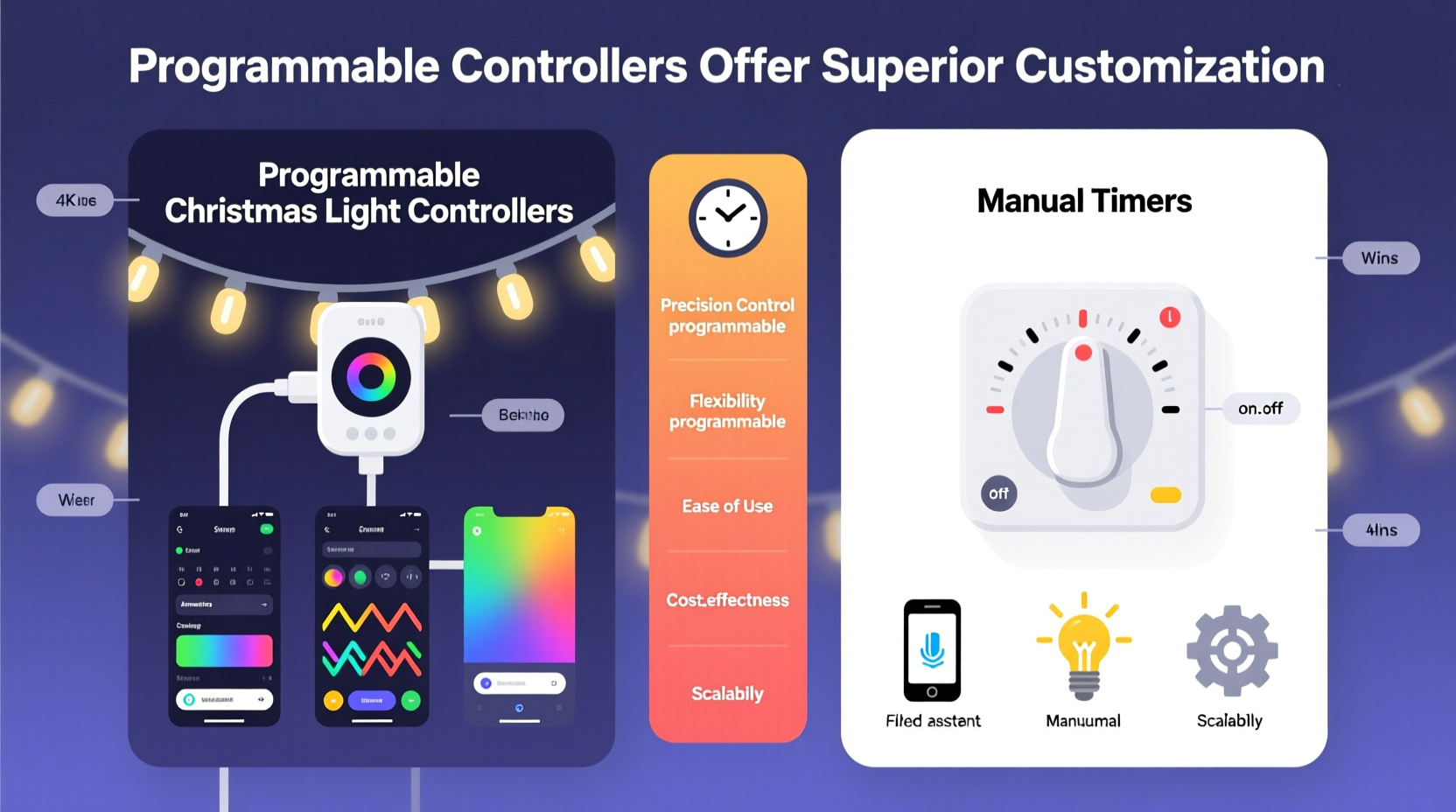
A manual timer is a mechanical or basic digital switch that turns power to connected lights on and off at preset intervals—typically two to four daily cycles, with fixed start/end times. Most models offer no variation in brightness, color, or sequencing. They operate independently of external conditions, and their programming remains unchanged unless physically adjusted. Their strength lies in predictability and zero learning curve: if you set it for 5 p.m. to 11 p.m., it will repeat that schedule every day until you change it—or the battery dies.
A programmable controller, by contrast, is a microprocessor-driven device designed for granular command over light behavior. It connects to strings (often via proprietary or DMX-compatible protocols), interprets user-defined sequences, and executes multi-layered instructions: timing, intensity, hue, saturation, transition speed, pattern repetition, synchronization points, and conditional logic (e.g., “if ambient light falls below 10 lux, activate warm mode”). Many integrate with smartphone apps, voice assistants, or home automation hubs like Home Assistant or Apple HomeKit—transforming holiday lighting into an extensible subsystem within a broader smart environment.
Tip: Before purchasing any programmable controller, verify compatibility with your light string type (e.g., WS2811, SK6812, 12V DC addressable) and confirm whether firmware updates are supported—older models may lack critical bug fixes or new effect libraries.Customization Depth: A Layer-by-Layer Comparison
Customization isn’t monolithic. It unfolds across five interdependent dimensions: scheduling precision, visual expression, environmental responsiveness, scalability, and future adaptability. Let’s examine how each system performs across them.
| Customization Dimension | Manual Timer | Programmable Controller |
|---|---|---|
| Scheduling Precision | Limited to fixed daily windows (e.g., “on at 5:00 PM, off at 11:00 PM”). No seasonal adjustment; no sunrise/sunset tracking. Cannot vary timing by day of week. | Dynamic scheduling: sunset-triggered activation, date-specific scenes (e.g., “Gingerbread House Mode” Dec 12–14), weekday/weekend differentiation, gradual ramp-up/down over 30+ minutes. |
| Visual Expression | None. Only binary power state. All lights behave identically—no color shifts, fades, chases, or strobes. | Full RGBW control per pixel; thousands of built-in effects; custom waveform creation; beat-synchronized audio reactive modes; user-defined gradients and palettes. |
| Environmental Responsiveness | Zero. Operates blindly regardless of weather, light levels, or occupancy. | Integrates with ambient light sensors, motion detectors, and weather APIs to auto-adjust brightness, switch to “storm mode” during high winds, or dim during full moon nights. |
| Scalability & Zoning | One timer = one circuit. To control front yard separately from porch, you need multiple timers—and multiple outlets. | Single controller can manage dozens of independent zones (e.g., roofline, tree, wreath, pathway) with unique schedules, effects, and intensities—all coordinated or isolated on demand. |
| Future Adaptability | Static. Hardware cannot evolve. If new lighting tech emerges (e.g., Li-Fi integrated strands), the timer remains obsolete for advanced use. | Firmware-upgradable. New effects, integrations (e.g., Matter support), and protocols can be added remotely—extending useful life by 5+ years. |
Real-World Tradeoffs: Reliability, Cost, and Learning Curve
Superior customization means little if the system fails under pressure—or alienates users who simply want festive cheer without coding. Consider these practical realities.
Manual timers excel in ruggedness and immediacy. With no software stack, no Wi-Fi dependency, and minimal electronics, they rarely malfunction. A $12 mechanical timer installed in 2015 likely still works flawlessly today. Setup takes under 60 seconds. There’s no app to update, no password to forget, no cloud service outage to contend with. For renters, apartment dwellers, or those managing multiple properties with limited technical bandwidth, this reliability carries tangible value.
Programmable controllers introduce complexity—but not uniformly. Entry-level models like the Twinkly Starter Kit or Lumenplay offer intuitive drag-and-drop interfaces and pre-built “light shows” requiring no technical knowledge. Mid-tier options (e.g., Falcon F16v3 or xLights-compatible controllers) open access to professional-grade sequencing but demand time investment: learning timeline-based editors, understanding channel mapping, and troubleshooting network configuration. The steepest tradeoff isn’t cost—it’s cognitive load. A $45 programmable controller may deliver 90% of desired customization for most users; a $220 pro unit adds only niche capabilities (e.g., 3D spatial mapping or SMPTE timecode sync) unlikely to benefit residential users.
“Most homeowners overestimate how much customization they’ll actually use—and underestimate how often they’ll abandon complex tools. Start with what solves *your* top three pain points: inconsistent timing, mismatched bulb colors, or neighbor complaints about late-night glare.” — Derek Lin, Lighting Systems Architect, HolidayLightingLab.com
A Mini Case Study: The Johnson Family’s Two-Year Evolution
The Johnsons live in Portland, Oregon—a city with dramatic seasonal light shifts and frequent rain. In 2022, they used three $8 manual timers: one for porch lights, one for the front tree, and one for roofline icicles. By December 10, all three had failed—two due to moisture ingress, one because the dial slipped after frost expansion. They reset them daily, often forgetting until neighbors texted: “Your lights just came on at 10 a.m. again!”
In 2023, they upgraded to a $69 Twinkly Pro controller managing 300 addressable bulbs across four zones. Using the app’s geolocation feature, lights now activate precisely at local sunset—shifting from soft amber at dusk to vibrant crimson by 7 p.m., then fading to gentle blue at midnight. When their toddler started waking at 6 a.m., they created a “Quiet Mode” schedule that keeps bedroom-facing lights off entirely before 4 p.m. During a December ice storm, they manually activated “Storm Mode,” reducing brightness by 70% to minimize reflection hazards on wet pavement—something impossible with their old timers.
Did they use every feature? No. They’ve never touched the audio-reactive settings. But solving those three core issues—timing inconsistency, safety concerns, and adaptive ambiance—transformed their experience from maintenance chore to joyful ritual. Their ROI wasn’t in flashy effects—it was in reclaimed time, reduced frustration, and lights that felt thoughtfully present—not just plugged in.
Which Solution Fits Your Needs? A Practical Decision Framework
Choosing isn’t about “better” in absolute terms—it’s about alignment with your goals, constraints, and tolerance for management. Use this step-by-step framework to clarify your path:
- Identify your primary pain point: Is it lights turning on too early? Bulbs staying on all night? Inability to match colors across displays? Or do you simply want something that “just works” with zero setup?
- Evaluate your lighting infrastructure: Are your strings basic incandescent or non-addressable LEDs? Then no programmable controller will add meaningful customization—you’d need to replace the lights first. If you already own addressable (RGB) strings, programmability becomes immediately viable.
- Assess your technical comfort: Can you confidently connect a device to Wi-Fi, install an app, and follow a 10-minute video tutorial? If yes, modern consumer controllers are accessible. If not, prioritize models with physical buttons and minimal app dependency (e.g., Light-O-Rama’s EasyLight series).
- Calculate realistic usage duration: Manual timers cost $8–$25 but last 2–4 years before mechanical wear or battery failure. Programmable controllers cost $45–$180 but last 5–8 years with firmware updates—and their functionality grows richer over time.
- Define “customization” for your context: For a small porch display, “customization” may mean “turns on at sunset.” For a 5,000-bulb neighborhood spectacle, it means “synchronized to a 12-minute musical score with 47 scene transitions.” Match the tool to the scale of intention.
FAQ: Addressing Common Concerns
Do programmable controllers increase fire risk compared to manual timers?
No—when used within manufacturer specifications. Both systems route power through identical UL-listed internal relays. Programmable controllers include additional safeguards: real-time current monitoring, automatic shutdown on overheating, and surge protection circuits. The greater fire risk stems from overloaded outlets or damaged cords—irrespective of controller type.
Can I mix manual timers and programmable controllers in one display?
Yes—and it’s often strategic. Use a manual timer to control non-addressable elements (e.g., classic C9 roofline or animated blow molds) while reserving the programmable controller for pixel-mapped sections (e.g., tree trunk wrap or window frames). Just ensure the manual timer’s “on” window encompasses the programmable controller’s active schedule.
Will my programmable controller become obsolete in two years?
Unlikely—if purchased from reputable brands with active developer communities (e.g., Twinkly, HolidayCoro, or xLights-supported hardware). These platforms release firmware updates annually and maintain backward compatibility for 5+ years. Avoid obscure brands with no update history or discontinued apps—those carry genuine obsolescence risk.
Conclusion: Customization Is About Intention, Not Just Capability
Manual timers deliver reliability through restraint. Programmable controllers deliver possibility through precision. Neither is inherently superior—but one aligns more closely with how you wish to engage with the season. If your ideal holiday lighting is a silent, consistent presence—warm, predictable, and unobtrusive—a manual timer remains elegant in its simplicity. But if you envision lights that breathe with your home, respond to the sky, evolve across December, and reflect your personal aesthetic with nuance, then programmability isn’t a luxury. It’s the necessary instrument for intentionality.
True customization isn’t measured in effect libraries or channel counts. It’s measured in moments: the gasp when your tree pulses gently as guests arrive, the calm knowing that lights dim automatically when fog rolls in, the pride of sharing a custom sequence you built yourself. That level of resonance doesn’t emerge from flipping a switch—it emerges from choosing tools that honor both your creativity and your capacity.
💬 What’s your biggest lighting challenge this season? Share your setup—manual, programmable, or hybrid—in the comments. Let’s troubleshoot, swap tips, and help each other light up the holidays with purpose.