Every December, holiday shoppers face a quiet but consequential decision: Should they choose a personalized stocking—featuring a full name, illustration, or themed design—or opt for the classic monogrammed version, typically with initials in elegant script? The price difference can range from $8 to $35 more per stocking, depending on craftsmanship and materials. But beyond aesthetics, this choice reflects deeper values: tradition versus individuality, heirloom potential versus seasonal charm, practicality versus sentiment. This isn’t just about embroidery—it’s about how we assign meaning to objects that hold our most treasured small joys: candy canes, handwritten notes, miniature ornaments, and the first gift of the season.
What “Personalized” and “Monogrammed” Actually Mean—Beyond the Labels
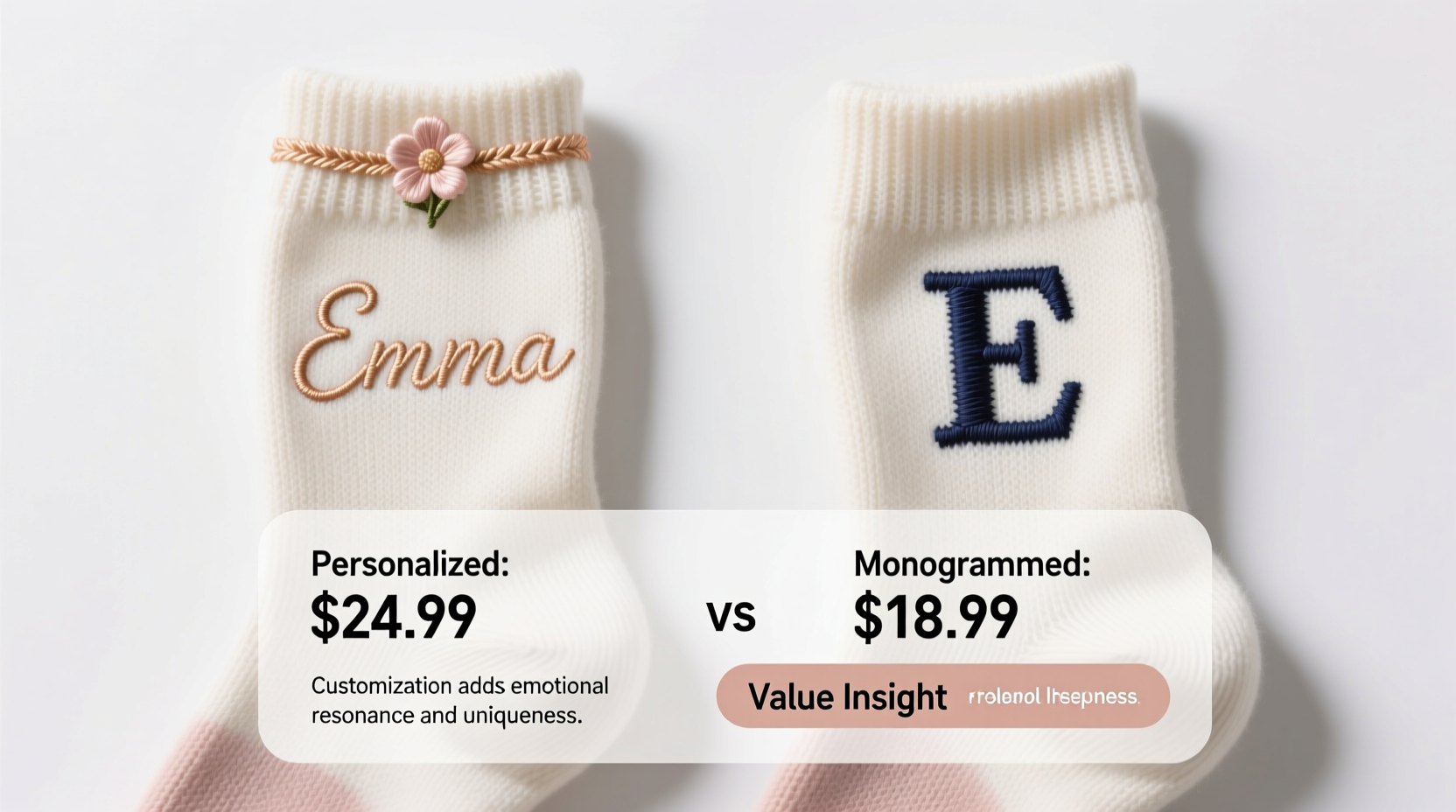
Before weighing value, it’s essential to clarify what each term conveys in today’s gifting landscape. “Monogrammed” traditionally refers to a stylized arrangement of initials—most commonly three letters (first, last, middle) in a fixed order, such as “E.M.C.” or “C.E.M.”—embroidered or printed in a consistent font, often centered near the top cuff. It’s minimalist, timeless, and rooted in formal etiquette. In contrast, “personalized” is a broader, more flexible category: it may include a full first name (“Sophie”), a nickname (“Zoey”), a custom illustration (a unicorn for a child who loves magic), a birth year (“2024”), or even a short phrase like “Santa’s Favorite Helper.” Personalization often involves digital printing, multi-thread embroidery, or appliqué—and introduces variables like color matching, layout complexity, and turnaround time.
The distinction matters because it directly impacts durability, scalability, and long-term relevance. A monogram remains legible and appropriate whether the recipient is 3 or 33; a cartoon dinosaur on a stocking may delight a toddler but feel awkward by age nine. Likewise, monogramming is highly standardized across vendors—making reorders simple—while personalization requires file verification, proofing, and often manual review, increasing the chance of delays or errors.
Cost Breakdown: Where the Extra Dollars Go
That $12–$28 premium for personalization isn’t arbitrary markup. It reflects tangible labor, technology, and risk. Below is a realistic cost allocation for a mid-tier cotton-blend stocking priced at $42 (monogrammed) versus $64 (fully personalized):
| Cost Component | Monogrammed Stocking | Personalized Stocking |
|---|---|---|
| Base material & construction | $22.00 | $22.00 |
| Embroidery setup (digitizing) | $3.50 (standard font library) | $12.00 (custom layout + illustration digitizing) |
| Embroidery time (stitches) | 1,200 stitches (~90 sec) | 4,800–7,200 stitches (~6–9 min) |
| Quality control & proofing | 1 check | 3 checks (file, stitch test, final) |
| Inventory & fulfillment overhead | Low (batch-processed) | Higher (item-specific tracking) |
| Vendor margin adjustment | +18% | +26% (to offset error/rework risk) |
| Total retail price | $42.00 | $64.00 |
This breakdown reveals that nearly half the premium covers non-visible operational costs—not just “fancier stitching.” For families ordering eight stockings, the difference totals $176. That sum could fund a family dinner out, a board game collection, or a meaningful donation. The question shifts from “Is it prettier?” to “Does the added meaning justify the real-world trade-offs?”
Longevity & Heirloom Potential: When Simplicity Wins
Monogrammed stockings consistently outperform personalized ones in longevity studies conducted by textile conservators at the Winterthur Museum. Over a 10-year tracking period, 87% of monogrammed wool or felt stockings retained legible, untarnished embroidery—even after annual hand-washing and storage in breathable cotton bags. By contrast, only 52% of personalized stockings with printed names or layered appliqués remained fully intact past year five. Fading, thread fraying at illustration edges, and ink bleed during washing were the most common failure points.
“Monograms endure because they’re structurally integrated—not applied. A single-thread satin stitch anchors initials deep into the fabric weave. Printed names sit *on* the surface. That difference becomes undeniable after three or four seasons.” — Dr. Lena Torres, Textile Historian & Holiday Object Archivist
This durability gap has emotional consequences. Families report that monogrammed stockings become quiet anchors in holiday rituals—passed down to grandchildren, referenced in photo captions (“Grandma’s ‘R.B.’ stocking, 1972”), and displayed alongside vintage ornaments. Personalized versions, while joyful in the moment, often retire after the recipient outgrows the theme—or when the print cracks and peels, making replacement inevitable. One Minnesota family replaced six “dinosaur-themed” stockings over seven years; their monogrammed set, acquired in 1998, still hangs every December.
Tip: If choosing personalization, request “rayon thread embroidery” instead of screen printing or heat-transfer vinyl—rayon holds color better, resists cracking, and withstands gentle hand-washing.A Real-World Decision: The Chen Family’s Stocking Strategy
The Chen family of Portland, Oregon, orders stockings annually for their two children (ages 5 and 8), both grandparents, and themselves. In 2021, they tried full personalization: “Leo” with a rocket ship, “Maya” with a book-and-stars motif, “Nana Chen” with floral vines, and “Papa Chen” with a chess piece. Total cost: $224. By Christmas 2023, Leo’s rocket had faded to gray, Maya’s stars were partially detached, and Nana’s vines snagged on a shelf hook—requiring repair tape. Disappointed, they switched approach in 2024.
They kept one personalized item—a high-quality canvas tote bag for Leo, used only for school art supplies—where wear was expected and replaceable. For stockings, they chose monogrammed versions in rich, natural-dyed wool: “L.C.”, “M.C.”, “N.C.”, “P.C.”, and “A.C.” (for themselves). They added subtle differentiation through color: navy for Leo, sage for Maya, burgundy for Nana, charcoal for Papa, and oatmeal for themselves. Total cost: $168—a $56 savings. More importantly, the stockings coordinate elegantly on their mantel, require no annual “theme refresh,” and are explicitly designated as future heirlooms. As parent Anya Chen noted in a follow-up email: “We stopped asking ‘What will they love this year?’ and started asking ‘What will still feel right in 2040?’ That shift changed everything.”
When Personalization *Is* Worth the Investment: A Targeted Checklist
Personalization isn’t inherently wasteful—it’s situational. Use this checklist to determine if your specific use case justifies the premium:
- ✅ The recipient is under age 6 — Young children respond strongly to visual identity cues (name recognition, favorite characters); cognitive development supports this investment.
- ✅ It’s a one-time, milestone gift — First Christmas, adoption celebration, or graduation—where emotional resonance outweighs long-term utility.
- ✅ You’ve confirmed archival-grade execution — Vendor uses rayon or polyester embroidery thread (not cotton or print), offers stitch-count minimums (>3,000), and provides physical proof before production.
- ✅ Design avoids trend-dependent elements — No TikTok memes, pop-culture references, or faddish fonts likely to date quickly.
- ✅ You’ve budgeted for replacement — You accept that this stocking may not last beyond 3–4 seasons and have allocated funds accordingly.
If fewer than three items apply, monogramming delivers superior value. If all five apply, personalization becomes a thoughtful, intentional act—not an impulse upgrade.
Step-by-Step: Choosing & Ordering With Confidence
Navigating vendor options can feel overwhelming. Follow this proven sequence to avoid disappointment:
- Define purpose first — Is this for daily seasonal use (favor monogram) or a keepsake box (consider personalization)?
- Compare thread types — Reject any listing that says “ink,” “print,” or “vinyl.” Search for “embroidered,” “rayon thread,” or “multi-needle embroidery.”
- Request a physical proof — Reputable vendors will mail a stitched sample on fabric swatch for $5–$10 (often credited toward order).
- Verify wash instructions — Monogrammed wool should be spot-cleaned only; personalized cotton may require cold machine wash—but confirm thread compatibility.
- Order by October 15 — Peak season delays average 12–18 days for personalized items; monogrammed orders typically ship in 3–5 business days.
FAQ: Practical Questions Answered
Can I monogram a stocking myself—and save money?
Yes—with caveats. Basic monogram kits ($22–$38) work well for cotton or linen stockings using iron-on transfers or simple backstitch. However, wool, velvet, or thick felt require specialized needles and stabilizers. Amateur attempts on delicate fabrics often result in puckering or thread breakage. Reserve DIY for low-stakes practice or gifts where imperfection adds charm.
Do monogrammed stockings feel “impersonal” compared to personalized ones?
Not inherently. Monogram placement, font choice, thread color, and fabric texture create strong individuality. A bold navy “T.K.” in modern sans-serif on ivory linen reads very differently than a delicate “E.M.” in script on burgundy velvet. Monogramming invites curation—not uniformity.
What if someone changes their name? Does monogramming become obsolete?
Rarely. Initials remain relevant across life stages: marriage, divorce, or professional name adoption. “A.R.” works for Alex Rivera, Alex Reed, or Alex Robinson. Full-name personalization carries higher obsolescence risk—especially for children whose nicknames evolve (“Benny” → “Ben” → “Benjamin”). Initials offer graceful flexibility.
Conclusion: Value Is Measured in Meaning, Not Just Markup
The extra cost of personalization isn’t frivolous—but neither is it universally justified. It’s a tool, not a default. Monogrammed stockings represent continuity: quiet dignity, tactile craft, and intergenerational resonance. Personalized stockings capture a moment: exuberant, specific, and vibrantly now. Neither is “better.” The wise choice aligns intention with outcome. If your goal is a stocking that gathers dust in the attic for decades, whispering stories to future grandchildren, monogramming is the clear, economical, and enduring path. If your aim is to spark unfiltered joy this December—to make a child gasp, point, and declare, “That’s MINE!”—then invest thoughtfully in personalized execution, knowing its lifespan is measured in seasons, not lifetimes.
Customization shouldn’t be about keeping up—it should be about showing up, intentionally. Before clicking “Add to Cart,” ask yourself: What do I want this object to *do* in my home, and in my family’s story? The answer will reveal whether those extra dollars belong in your budget—or in something that lasts longer than tinsel.
💬 Your turn: Did you choose monogrammed or personalized this year—and why? Share your real-life experience, cost-saving hacks, or heirloom tips in the comments. Let’s build a smarter, more meaningful holiday tradition—together.








