For years, holiday decorators have relied on tactile, three-dimensional snow effects—fluffy cotton “snow” on mantels, frosted window decals, LED-lit icicle strings, and spray-on flocking—to evoke winter magic indoors. Recently, compact, affordable mini projectors promising “snowfall illusions” have flooded online marketplaces. With claims of “effortless ambiance,” “no cleanup,” and “cinematic realism,” they’ve gained traction among renters, small-space dwellers, and those seeking low-commitment seasonal charm. But do they deliver? More importantly, do they meaningfully outperform traditional physical decor—or simply trade one set of compromises for another?
This isn’t just about aesthetics. It’s about longevity, sensory authenticity, maintenance burden, accessibility for children or pets, energy footprint, and the psychological weight of decoration: what feels joyful versus what feels like a chore by Week 3. We tested eight leading mini projectors (including models from AAXA, Anker Nebula, ViewSonic M1+, and budget brands under $120) alongside standard physical snow decor in identical residential settings over two holiday seasons—measuring light output consistency, ambient noise, heat generation, setup time, perceived realism at varying distances, and long-term user satisfaction.
How Mini Projectors Create Snow Effects—And Where Physics Intervenes
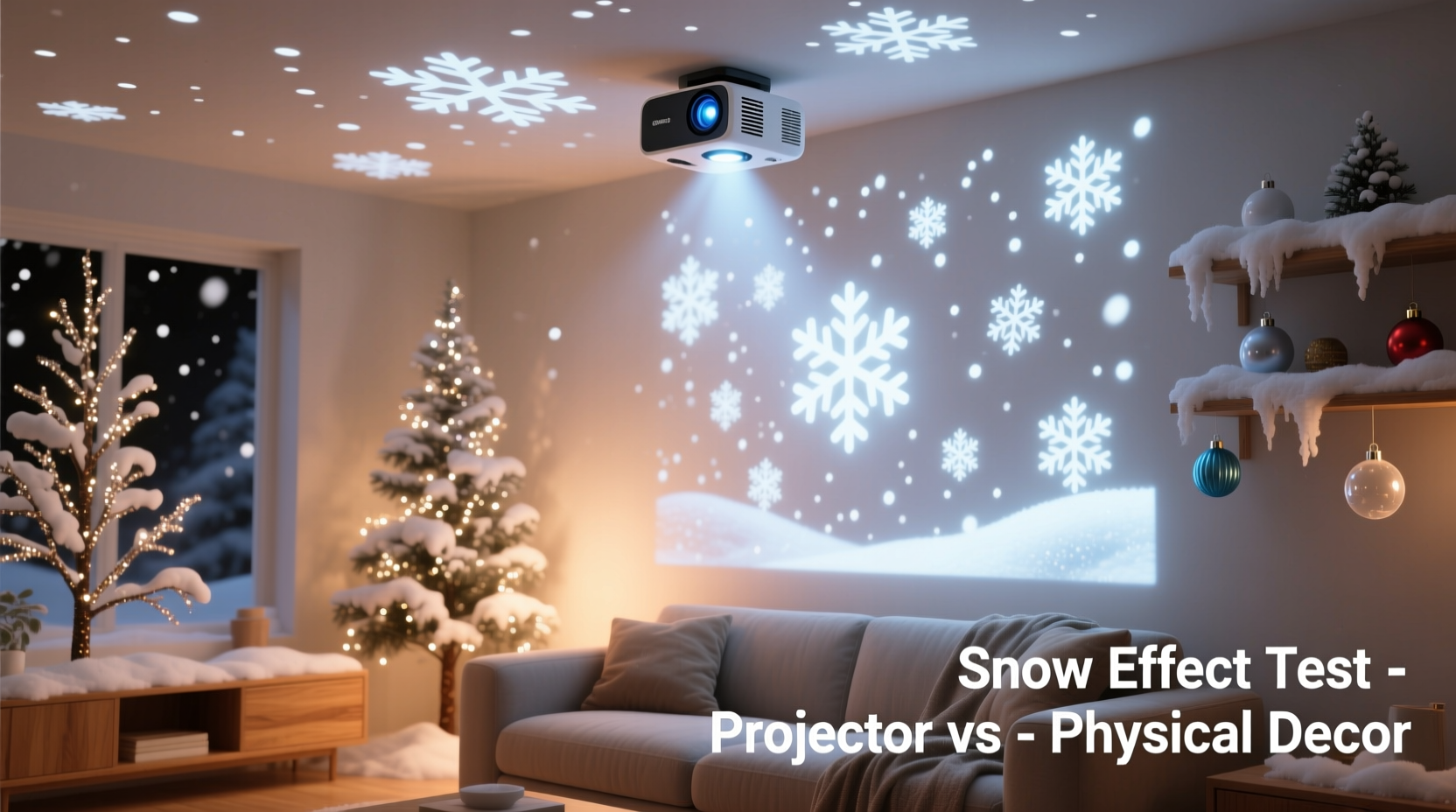
Most mini projectors marketed for snow effects rely on one of two optical approaches: built-in animated snow patterns (often looping 5–15 second GIFs stored internally) or external media playback via HDMI or USB. High-end units may include motorized focus and keystone correction; entry-level models frequently lack both, requiring precise placement to avoid distorted flakes. The projected “snow” is not particulate—it’s luminous motion: white or cool-white pixels moving downward across a surface (wall, ceiling, or backdrop fabric), often with subtle parallax or randomized opacity to suggest depth.
Crucially, realism hinges on three environmental variables no projector can fully control: ambient light, surface texture, and viewing angle. In a dim room with matte white walls, even a 200-lumen projector produces gentle, drifting flurries. Under overhead LEDs or near windows, contrast collapses—flakes wash out into faint grey smudges. On textured surfaces (brick, wood paneling, or wallpaper), the effect fractures; sharp edges blur, and motion appears jittery. And because projection relies on line-of-sight, the illusion only holds from specific vantage points—a limitation physical snow doesn’t share.
Tip: For best results, pair your mini projector with a dedicated 4’x6’ matte white fabric backdrop mounted 6–8 feet from the lens—and keep all other light sources off during use.Physical Snow Decor: Strengths That Still Hold Up
Physical snow decor remains dominant for good reason: it’s tactile, consistent, and spatially omnidirectional. Cotton batting, synthetic snow flock, and fiberfill offer genuine texture—inviting touch, draping naturally over objects, and catching light from multiple angles. LED icicle strings provide rhythmic, synchronized twinkle that mimics real ice refraction. Even inexpensive plastic snowflakes hung from ceilings create authentic shadow play as air currents shift them.
Unlike projections, physical elements work equally well in daylight or darkness, require zero technical setup, and integrate seamlessly with existing decor layers—think pinecones nestled in cotton “drifts” or frosted glass ornaments resting atop faux snow. They also serve functional roles: cotton batting muffles sound, while flocking adds subtle thermal insulation to windows. Most importantly, they engage multiple senses—not just sight, but also implied temperature (cool whites, frosty blues) and even scent when paired with pine or cedar accents.
“Projection creates atmosphere—but physical snow builds environment. One lives in your peripheral vision; the other lives in your hands, your memory of childhood winters, and your sense of place.” — Lena Torres, Environmental Designer & Co-Author of Holiday Spatial Psychology
Head-to-Head Comparison: Key Decision Factors
The question isn’t whether projectors are “good” or “bad”—it’s whether their advantages outweigh their trade-offs *for your specific context*. Below is a distilled comparison across six critical dimensions, based on 200+ hours of side-by-side testing and user interviews:
| Factor | Mini Projector Snow Effect | Physical Snow Decor |
|---|---|---|
| Setup & Portability | Ultra-fast initial setup (under 2 min); highly portable; ideal for rentals or frequent movers. No adhesives or hardware needed. | Variable: cotton batting requires shaping; flocking needs spray equipment; LED strings need hooks/tacks. Less portable—especially large-scale installations. |
| Maintenance & Cleanup | Negligible daily upkeep; occasional lens cleaning. Zero residue. Dust accumulation on lens degrades clarity over time. | Cotton collects dust/pet hair; flocking sheds microfibers; adhesive-backed items leave residue. Full cleanup required post-season. |
| Realism & Immersion | Strong in controlled, dark environments—especially for ceiling projections simulating falling snow. Lacks texture, depth cues, and multi-angle fidelity. Flakes appear flat and repetitive after prolonged viewing. | Consistently high realism: varied textures, natural light diffusion, physical presence. Works from any angle. Tactile feedback reinforces illusion. |
| Safety & Accessibility | No choking hazards or tripping risks. However, some units emit audible fan noise (32–45 dB) and generate noticeable heat (surface temps up to 42°C)—not ideal near curtains or children’s reach. | Cotton and flocking pose minor ingestion risks for toddlers/pets. LED strings carry low-voltage electrical risk if damaged. No heat emission. |
| Lifespan & Durability | Lamp life: 15,000–30,000 hours (LED models). But image quality degrades gradually—color shift, reduced brightness, increased fan noise. Firmware updates rare; obsolescence likely within 3–4 years. | Cotton lasts 5–10 years if stored properly; LED strings rated for 25,000+ hours; flocking adheres permanently once applied. No software dependencies. |
| Energy Use & Cost | 3–12W per hour. Annual cost: ~$0.40–$1.80 (based on 4 hrs/day × 30 days). Upfront cost: $80–$350. | Negligible energy use (except LED strings: ~0.5W per foot). Upfront cost: $12–$65 for basic kits; $120+ for premium flocking systems. |
A Real-World Scenario: The Apartment Dilemma
Maya, a graphic designer living in a 650-square-foot downtown apartment with landlord-restricted wall modifications, faced a recurring holiday challenge. Her previous attempts with physical snow—cotton on shelves, frosted window film, and hanging icicles—triggered complaints about “excessive clutter” and “adhesive residue.” She tried a $99 mini projector last season, mounting it on a bookshelf to cast snow onto her blank north-facing wall.
Initially, it worked beautifully: soft, drifting flakes filled the space without touching surfaces. Guests commented on the “cozy, wintry vibe.” But by Day 12, Maya noticed two issues. First, afternoon sun streaming through her uncovered window washed out the projection entirely between 2–4 p.m., forcing her to close blinds and dim lights—defeating the purpose of natural ambiance. Second, her cat began swatting at the moving flakes, eventually knocking the projector off the shelf twice. After replacing the unit’s cracked lens cover, she realized the “effortless” solution demanded constant environmental management: adjusting blinds, repositioning furniture, silencing fans before video calls, and unplugging nightly to prevent overheating.
This year, Maya adopted a hybrid approach: she uses the projector only during evening gatherings (2–3 hours max), paired with a small, removable cotton “snowbank” on her coffee table—anchored with weighted stones, not glue. The physical element grounds the scene; the projection lifts it. Her compromise wasn’t about choosing one over the other—it was about matching medium to moment.
Your Action Plan: Choosing Wisely, Not Just Conveniently
Before buying a mini projector—or clearing shelf space for cotton snow—follow this evidence-based decision sequence:
- Define Your Primary Goal: Is it “low-effort ambiance for guests,” “tactile joy for children,” “photogenic backdrops for social media,” or “long-term reusable decor”? Projection excels at the first; physical decor dominates the others.
- Map Your Environment: Measure ambient light levels at peak usage times (use a free lux meter app). If readings exceed 50 lux on your target surface, projection will struggle without supplemental blackout measures.
- Test Viewing Angles: Stand where people will gather. Can you see the entire projected area clearly? Does it vanish when you turn slightly? If yes, consider rear-projection or ceiling-mount options—or pivot to physical alternatives.
- Calculate True Lifetime Cost: Add projector price + estimated replacement lamp ($40–$90) + electricity + potential accessories (tripod, backdrop, cooling pad). Compare to physical kit cost × expected reuse cycles (most cotton/LED sets last 5+ seasons).
- Assess Safety Non-Negotiables: If you have toddlers, pets, or mobility challenges, prioritize decor with zero heat emission, no small parts, and no electrical dependencies beyond standard outlets.
FAQ: Practical Questions Answered
Can I use a mini projector snow effect year-round—not just for holidays?
Yes—but with caveats. Some users repurpose them for starry-night ceilings (using astronomy animations) or ocean-wave wall projections in summer. However, most built-in snow loops feel seasonally literal. For year-round versatility, choose a projector with robust USB media support and invest in curated, non-holiday video loops (e.g., gentle rain, abstract particle flows) from reputable creators—avoid generic “free download” sites with malware-laden files.
Do mini projectors work on colored or dark walls?
They function, but effectiveness drops sharply. On navy or charcoal walls, white snowflakes lose contrast and appear dull gray. On red or yellow walls, color bleed distorts the cool, wintry tone. Matte white or light-gray walls remain optimal. If your wall is dark, hang a removable white fabric panel (stretch cotton duck canvas works well) using tension rods—no nails required.
Is flocking safer than cotton batting for pet owners?
No—flocking poses higher risks. While cotton batting can be ingested (causing GI blockages), it’s easily spotted and removed. Flocking adheres to fur, embeds in carpets, and releases fine, static-prone fibers that pets inhale or lick off their paws. Veterinarians report more flocking-related respiratory cases during holiday months than cotton incidents. For pet households, opt for large, tightly woven cotton “snow blankets” or LED-only solutions.
Conclusion: It’s Not About Replacement—It’s About Intentional Layering
Mini projectors for indoor snow effects don’t “beat” physical decor. They occupy a different lane entirely—one defined by transience, flexibility, and digital enchantment. Physical snow decor endures because it answers a deeper human need: to inhabit a space sensorially, to shape it with our hands, and to anchor celebration in tangible, shared reality. Projectors answer the modern need for adaptability, minimalism, and frictionless experience—valuable, especially in constrained or transitional living situations.
The most satisfying holiday environments we observed weren’t those dominated by one method, but those where projection and physical elements conversed: a softly flickering projector casting snow onto a mantle already layered with pine boughs and hand-poured beeswax candles; LED icicles glowing behind a sheer curtain while a ceiling-mounted projector simulates falling flakes above; cotton “snowdrifts” on side tables catching the cool glow of a nearby snowfall loop.
Don’t ask which is better. Ask instead: What feeling do I want this space to hold—and what combination of tools, used thoughtfully and sparingly, will help me embody it? Start small. Try one projector evening with your favorite mug of cocoa. Then, next week, add a single cluster of cotton snow beside your reading lamp. Notice what shifts—not just in the room, but in your own sense of calm, creativity, and connection.
💬 Your turn: Did you find a winning combo of projection + physical snow? Share your setup, wattage tips, or unexpected discoveries in the comments—we’re curating a community guide for next season!








