Small-space living doesn’t mean compromising on hospitality—or aesthetics. In compact apartments, studio lofts, or even tight home offices, the bar cart has evolved from a nostalgic accent piece into a high-performance spatial solution. What sets today’s most effective versions apart isn’t just clever storage or sleek finishes—it’s integrated, purposeful LED lighting. When thoughtfully implemented, LED illumination transforms a bar cart from passive furniture into an active design element: highlighting glassware, guiding evening use, reinforcing room zoning, and adding layered warmth without heat or glare. Yet many buyers still treat lighting as an afterthought—tacking on strip lights haphazardly or choosing overly bright, cool-toned fixtures that clash with intimate ambiance. This article examines how to achieve genuine equilibrium between visual appeal and daily utility in LED-lit bar carts designed specifically for constrained footprints. We go beyond aesthetics to address wiring safety, light temperature psychology, modular adaptability, and real-world spatial logic—grounded in interior architecture principles and user behavior research.
Why LED Integration Matters More in Small Spaces
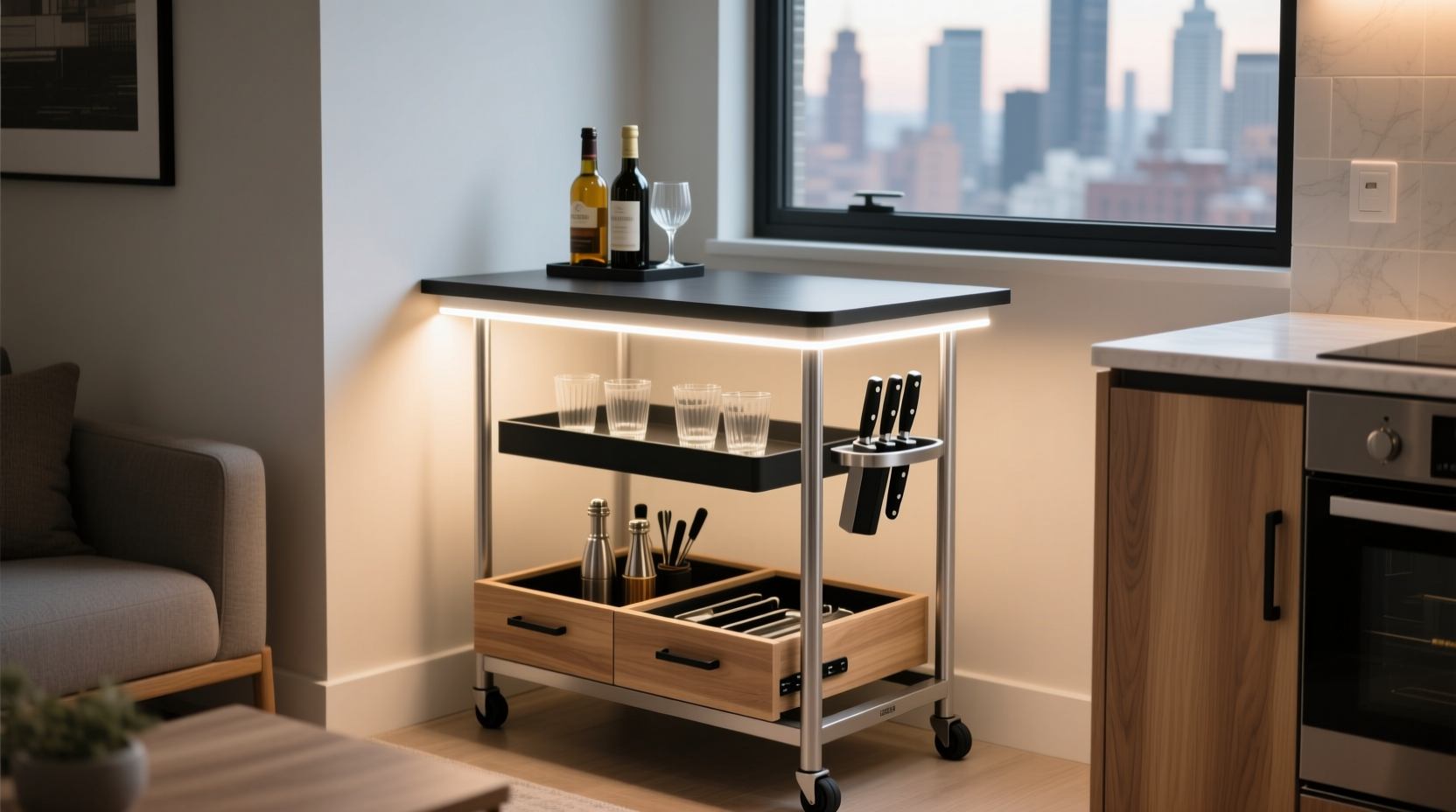
In rooms under 400 square feet, every surface competes for visual weight and functional priority. A traditional bar cart occupies 2–3 linear feet of floor space—a significant footprint when shared with a sofa, dining nook, or entryway console. Its value must therefore be multiplicative: it should serve as storage, display, prep surface, ambient light source, and aesthetic anchor—all simultaneously. LED lighting fulfills this by performing four distinct spatial roles:
- Task illumination: Low-profile under-shelf LEDs (2700K–3000K) cast soft, downward light ideal for pouring drinks or reading labels without shadows.
- Visual expansion: Backlit glass shelves or illuminated base panels create depth perception, making narrow carts feel less “flat” against walls.
- Atmospheric continuity: Warm-white LEDs (2700K) harmonize with existing ambient lighting (e.g., table lamps or recessed fixtures), avoiding the jarring contrast of cool-white task lights in living zones.
- Behavioral cueing: Dimmable, motion-activated LEDs signal “bar mode”—a subtle psychological trigger that invites interaction without demanding attention.
This multifunctionality is why LED integration isn’t decorative flair; it’s ergonomic infrastructure. As interior architect Lena Torres notes in her 2023 study on micro-living efficiency, “In sub-500 sq ft dwellings, furniture that performs only one function is functionally obsolete. Lighting must be embedded—not added.”
Key Design Criteria for Space-Smart LED Bar Carts
Selecting or customizing an LED-lit bar cart for tight quarters demands scrutiny beyond finish and price. Prioritize these five non-negotiable criteria:
- Depth-to-function ratio: Opt for carts ≤16 inches deep. Deeper units (18\"+) obstruct circulation in hallways or behind sofas. At 14–16\", you retain shelf capacity while preserving at least 36\" of clear walkway—a minimum per ADA-informed residential guidelines.
- Modular shelving: Fixed shelves limit adaptability. Look for carts with adjustable pins or tool-free height settings—so you can lower a shelf for wine bottles one week and raise it for tall cocktail shakers the next.
- Integrated power management: Avoid dangling cords. Choose models with built-in USB-C ports (for charging devices during gatherings) and low-voltage DC wiring routed internally. Battery-operated options are acceptable only if they offer ≥120 hours of runtime on a single charge—and include magnetic, tool-free battery access.
- Light diffusion quality: Harsh point-source LEDs create glare and hotspots. Insist on frosted acrylic diffusers, silicone edge-lit channels, or micro-perforated metal grilles that scatter light evenly across surfaces.
- Weight distribution engineering: LED components add mass. Verify the cart uses reinforced corner brackets, cross-bracing, and non-slip rubber feet—especially critical when loaded with glassware on upper shelves.
Lighting Specifications That Actually Work
Not all LED lighting is created equal—and generic “warm white” labels often mislead. Here’s what the numbers really mean for bar cart applications:
| Specification | Ideal Range | Why It Matters |
|---|---|---|
| Color Temperature (CCT) | 2700K–2900K | Matches candlelight and incandescent bulbs—creates inviting, relaxed mood. Avoid 3500K+, which reads clinical in social settings. |
| Color Rendering Index (CRI) | ≥90 | Accurately reveals true hues of spirits, garnishes, and glass textures. CRI <80 washes out amber whiskey tones and dulls citrus zest. |
| Luminance (nits) | 80–120 nits per shelf | Provides visibility without eye strain. >150 nits feels like a spotlight; <60 nits fades into background. |
| Dimming Protocol | Triac or 0–10V (not PWM-only) | Ensures flicker-free, silent dimming down to 5% brightness—critical for late-night use without disrupting sleep cycles. |
| IP Rating | IP44 minimum | Protects against splashes from mixing drinks or accidental spills. IP20 (common in cheap strips) offers zero moisture resistance. |
Real-world implication: A 2700K, CRI 92 LED strip mounted beneath a tempered glass shelf at 100 nits will make a bourbon bottle gleam with rich caramel depth while softly illuminating the rim of a coupe glass—without casting a shadow across your hand as you stir. That precision is unattainable with off-the-shelf warm-white tape lights rated only for “indoor decorative use.”
Mini Case Study: The Brooklyn Studio Transformation
Maria, a graphic designer living in a 380-square-foot Brooklyn studio, needed a bar solution that doubled as a workspace divider and evening lounge zone. Her original walnut cart—unlit, 20\" deep—blocked flow between her desk and kitchenette and collected dust under its opaque shelves.
She replaced it with a custom 14.5\"-deep steel-and-oak cart featuring three key LED upgrades:
- A 2700K, CRI 94 linear module recessed into the underside of the top shelf, aimed downward at a 15° angle to highlight glassware without glare.
- Edge-lit acrylic side panels (2900K) that emit a soft, upward glow—creating vertical rhythm and visually “lifting” the cart in her low-ceiling space.
- A motion-sensor switch mounted discreetly on the rear leg: lights activate at 30% brightness when she approaches after 7 p.m., ramping to 100% only when she opens the lower cabinet for ice.
Result: Maria regained 14 inches of walkway, reduced evening eye fatigue by eliminating overhead kitchen lights during cocktails, and reported guests consistently commenting on the “calm energy” of her space—despite its size. Crucially, the cart now anchors her room’s layout instead of interrupting it.
Step-by-Step: Installing LED Lighting on an Existing Cart
You don’t need to buy new. Retrofitting works—if done methodically:
- Evaluate structural integrity: Confirm shelves are solid (not particleboard with veneer) and can support adhesive-backed LED channels or screw-mounted brackets.
- Map light zones: Identify primary focus areas: under top shelf (for glass display), inside lower cabinet (for bottle access), and along base rail (for ambient floor wash). Avoid lighting middle shelves—they cause visual clutter.
- Select low-profile hardware: Use 3mm-thick, flexible LED strips with 3M VHB backing (not standard double-sided tape). For cabinets, choose magnetic channel kits with integrated diffusers.
- Route wiring invisibly: Drill ⅛\" holes through shelf supports to thread wires vertically. Conceal cables behind legs using braided nylon sleeves—not electrical tape.
- Test before final mounting: Power strips temporarily with a USB power bank. Adjust positioning until light falls precisely where needed—then secure permanently.
- Set dimming logic: Program controllers for scene-based output: 20% brightness for ambient mode, 70% for prep, 100% only when cabinet doors open (via reed switch).
“Good lighting on a bar cart doesn’t shout ‘look at me.’ It whispers ‘this is where the good stuff lives’—and makes finding it effortless.” — Javier Mendez, Lighting Designer & Co-Founder, Lumina Collective
Do’s and Don’ts for Small-Space Bar Cart Lighting
| Action | Do | Don’t |
|---|---|---|
| Placement | Mount LEDs 1–2 inches back from shelf front edge to avoid direct line-of-sight glare | Attach lights directly to shelf undersides facing straight down—creates harsh shadows on hands and bottles |
| Control | Use wall-mounted dimmers or app-controlled switches placed near common entry points (e.g., hallway door) | Rely solely on remote controls that get lost in couch cushions or under rugs |
| Cooling | Ensure at least ¼\" airflow gap behind LED strips—especially in enclosed cabinets | Seal LEDs inside fully enclosed wooden cabinets without ventilation—causes premature diode failure |
| Layering | Pair shelf LEDs with a single, focused puck light above the cart for vertical accent | Add multiple overlapping light sources (e.g., shelf + cabinet + base + overhead)—creates visual noise |
| Maintenance | Choose LEDs with ≥50,000-hour lifespans and replaceable drivers | Install non-serviceable, epoxy-coated strips that require full replacement after 18 months |
FAQ
Can I use battery-powered LED strips safely on a wooden bar cart?
Yes—if they’re UL-listed for indoor use and use lithium-iron-phosphate (LiFePO₄) batteries (not lithium-ion). LiFePO₄ cells operate cooler, resist thermal runaway, and maintain stable voltage over long discharge cycles—critical near flammable spirits. Always mount batteries externally on a metal bracket, not glued inside wood grain.
How do I prevent LED light from reflecting off glass bottles and causing glare?
Angle matters more than intensity. Mount LEDs at a 10–15° downward tilt (not perpendicular), and use frosted diffusers. Position bottles 2–3 inches back from the shelf edge so reflections fall onto the shelf surface—not your eyes. Matte-finish glassware also reduces specular reflection significantly.
Is it worth investing in smart LED controls for a small-space cart?
Only if you prioritize routine-driven usability. Voice or app control adds convenience for dimming during movie nights or scheduling “pre-party” light warm-up. However, for most users, a simple wall-mounted rotary dimmer delivers 95% of the benefit at 20% of the cost and complexity.
Conclusion
LED-lit bar carts for small spaces succeed not because they shine brighter—but because they shine smarter. They respect the physics of tight rooms: honoring clear pathways, minimizing visual competition, and responding to human rhythms rather than imposing rigid lighting schedules. The balance between style and functionality isn’t found in compromise—it’s engineered through deliberate choices: 2700K color temperature for warmth, IP44-rated fixtures for resilience, 14-inch depth for flow, and diffused luminance for comfort. When these elements align, the cart stops being furniture you own and becomes infrastructure you inhabit—supporting spontaneous gatherings, quiet evenings, and everything in between. Your space may be small, but your standards for intentionality shouldn’t shrink. Measure your doorway, sketch your traffic paths, test CCT samples against your favorite whiskey bottle, and choose light that serves you—not the other way around.
💬 Your turn: Share how you’ve solved bar storage in a compact space—or what lighting detail made the biggest difference. Real experiences help others navigate the same constraints. Comment below!