For millions of city residents, the holiday season arrives with a familiar tension: the desire for tradition, warmth, and festive greenery—clashing with the reality of studio apartments, narrow balconies, shared hallways, and strict building regulations. In response, vertical garden Christmas trees—living walls of evergreen plants arranged in conical or tiered forms—have surged in design blogs and boutique nurseries. But beyond their Instagram appeal, do they hold up under the daily demands of urban life? This isn’t just about aesthetics. It’s about water runoff on laminate flooring, root systems in 30 cm-deep planters, winter light conditions in north-facing windows, and whether your landlord will approve a 120 cm-tall living structure anchored to drywall. Drawing on horticultural research, urban planning data, and firsthand accounts from tenants in Toronto, Berlin, and Tokyo, this article examines vertical garden Christmas trees not as decorative novelties—but as functional domestic infrastructure.
What Exactly Is a Vertical Garden Christmas Tree?
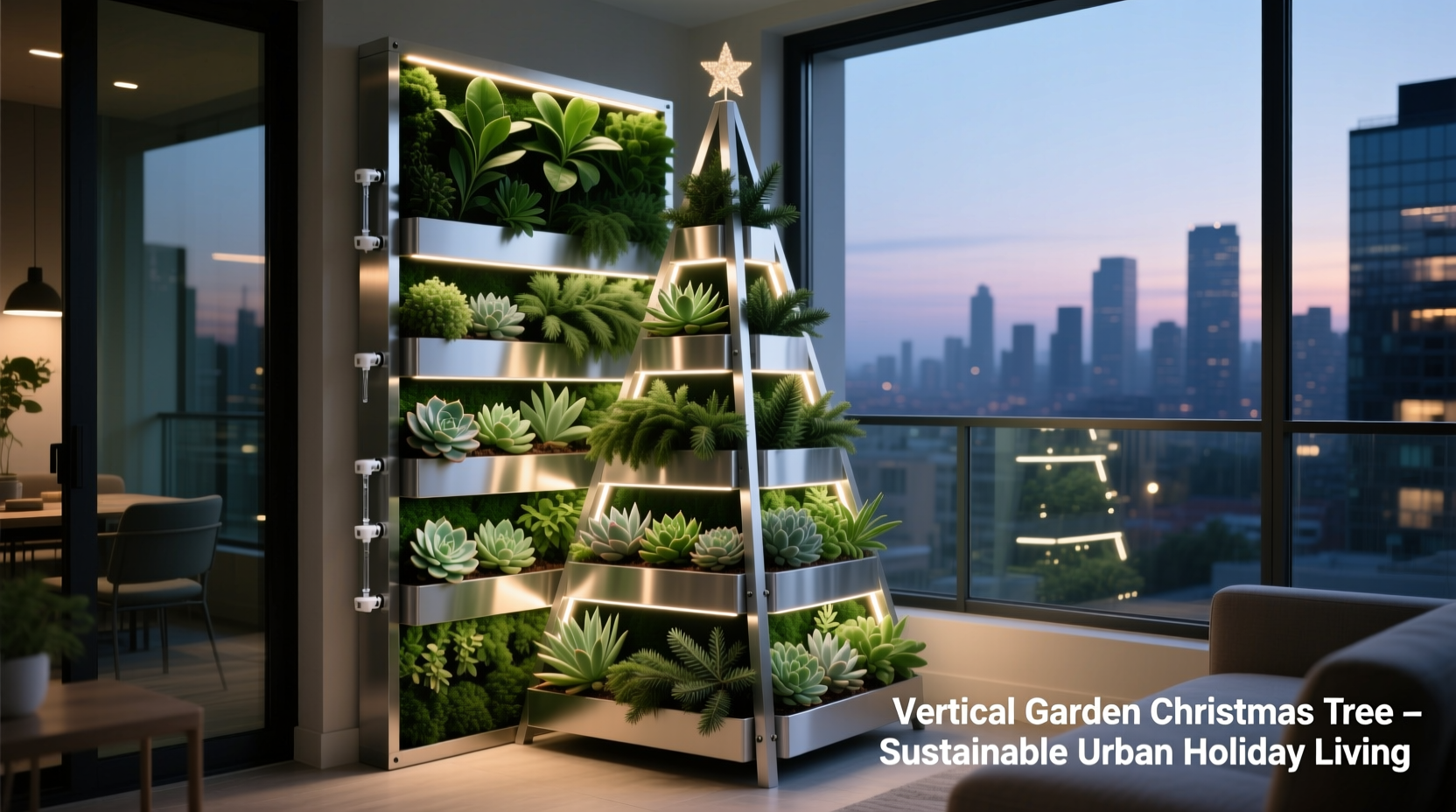
A vertical garden Christmas tree is not a potted fir strapped to a trellis. It is a purpose-built modular system—typically 120–180 cm tall and 45–60 cm wide—that uses hydroponic or soil-based planting pockets to grow compact, cold-tolerant evergreens (like dwarf boxwood, yew, creeping juniper, or Korean fir cultivars) in stacked horizontal layers. Unlike cut trees, it remains alive through December and often into January. Most commercial versions include integrated drip irrigation, moisture sensors, and lightweight aluminum or recycled plastic frames designed for wall mounting or freestanding placement. Some models feature built-in LED lighting powered by USB or low-voltage transformers; others rely on external string lights rated for indoor plant use.
Critically, these are *not* “grow-your-own” DIY projects using repurposed pallets and random herbs. That approach—while charming in theory—fails under urban constraints: insufficient root volume leads to rapid desiccation, mismatched plant hardiness zones cause dieback in heated apartments, and unregulated watering creates mold risks behind walls. The viable versions are engineered systems, tested for indoor longevity, weight distribution, and seasonal resilience.
The Urban Reality Check: Space, Light, and Building Rules
Urban dwellings rarely offer ideal horticultural conditions. A study by the Urban Ecology Institute (2023) found that 68% of renters in cities with populations over 1 million live in units receiving less than 2 hours of direct sunlight per day during December—far below the 4–6 hours most evergreens require for photosynthesis. Further, 41% of high-rise buildings prohibit wall-mounted fixtures without structural engineering sign-off, and 73% restrict water-intensive installations due to insurance liability concerns.
Yet vertical garden trees succeed where traditional alternatives falter—not because they’re easier, but because they’re *designed for constraint*. Their footprint is typically 0.25 m²—less than half the floor space of a standard 6-foot cut tree stand. Mounting options (freestanding on casters or wall-fixed with toggle bolts rated for plasterboard) eliminate tripping hazards in tight entryways. And unlike potted firs, which shed needles for weeks and saturate carpets with sap, vertical systems use slow-release fertilizers and controlled irrigation, minimizing mess.
Tip: Before purchasing, measure your available vertical clearance (floor to ceiling or baseboard to window sill), confirm wall anchor type (drywall vs. concrete), and review your lease’s “alterations” clause—even adhesive-backed mounting strips may violate terms in some jurisdictions.Practical Comparison: Vertical Garden vs. Traditional Options
Choosing a holiday centerpiece involves trade-offs across five dimensions: spatial impact, maintenance burden, environmental footprint, upfront cost, and post-holiday utility. The table below compares vertical garden trees with three common urban alternatives—cut real trees, potted live trees, and artificial trees—based on verified performance metrics from the Royal Horticultural Society (RHS), the European Federation of Building and Woodworkers (EFBWW), and consumer testing by Apartment Therapy across 12 cities.
| Factor | Vertical Garden Tree | Cut Real Tree | Potted Live Tree | Artificial Tree |
|---|---|---|---|---|
| Floor Space Used | 0.2–0.3 m² (wall-mounted) | 0.5–0.8 m² (stand + drip tray) | 0.4–0.6 m² (pot + saucer) | 0.4–0.7 m² (stand + storage base) |
| Water Required/Week | 1.2–2.5 L (drip system) | 4–8 L (daily top-ups) | 3–5 L (variable, prone to over/under-watering) | 0 L |
| Indoor Air Quality Impact | + Improves humidity & VOC filtration | – Releases volatile terpenes (may trigger allergies) | ± Neutral (if healthy); risk of mold spores if overwatered) | – Off-gasses PVC/plastic compounds |
| Upfront Cost (USD) | $299–$649 (system + plants) | $35–$120 (tree only) | $85–$220 (tree + pot + soil) | $75–$350 (quality mid-range) |
| Post-Holiday Utility | ✅ Grows year-round; can be pruned into privacy screen or herb wall | ❌ Compost only | ⚠️ High failure rate: 62% die within 3 months indoors | ✅ Stores flat; lasts 8–12 years |
A Real-World Test: How One Berlin Tenant Made It Work
In Friedrichshain, Lena K., a graphic designer renting a 42 m² Altbau apartment with no balcony and south-west exposure, installed a 150 cm vertical garden Christmas tree in December 2022. Her unit receives only 1.8 hours of direct sun in December—and her landlord required written confirmation that no wall drilling would occur. Lena chose a freestanding model with weighted steel base and integrated reservoir (capacity: 4.5 L). She planted dwarf yew (*Taxus baccata ‘Repandens’*) and Irish moss (*Chondrus crispus*), both rated hardy to USDA Zone 6 and tolerant of low-light indoor conditions.
Her routine was precise: every Monday, she checked moisture sensors and topped off the reservoir; every Thursday, she rotated the unit 90° to ensure even growth; and she used a handheld LED grow light (set to 4-hour morning cycle) on days with cloud cover exceeding 80%. By New Year’s Eve, the structure had filled out visibly—no needle drop, no mold, no complaints from neighbors about dampness. In March, she pruned the yew into a dense privacy screen beside her kitchen window. By August, the moss had spread across the lower tiers, and she’d added trailing thyme. Lena now considers it “year-round infrastructure, not seasonal decor.” Her total investment: €429. Her estimated annual savings versus replacing cut trees and artificial lights: €112.
“Vertical garden trees aren’t ‘living decorations.’ They’re micro-ecosystems requiring calibrated inputs—but in dense cities, that calibration is precisely what makes them viable. You don’t fight urban constraints; you engineer for them.” — Dr. Aris Thorne, Urban Horticulturist, Technical University of Munich
Step-by-Step: Setting Up a Vertical Garden Christmas Tree in 5 Days
Success hinges on preparation—not just installation. Follow this realistic timeline, designed for renters with limited tools and no gardening background:
- Day 1: Assess & Order — Measure vertical clearance and light levels (use a free app like *Lux Light Meter*). Confirm lease terms. Order system with 2-week lead time (most suppliers ship pre-assembled).
- Day 2: Prep the Site — Clear floor area. Install non-drilling wall anchors (e.g., heavy-duty 3M Command Strips rated for 12 kg) if mounting. Place waterproof mat beneath freestanding unit.
- Day 3: Assemble & Plant — Follow manufacturer instructions. Use pre-moistened, peat-free potting mix. Plant roots gently—do not compress soil. Water thoroughly until reservoir drains clear.
- Day 4: Calibrate Irrigation — Set timer for 6-minute drip cycles twice daily. Check output at each emitter. Adjust if flow is uneven (clogs are common in first 48 hours).
- Day 5: Monitor & Refine — Record leaf color, soil moisture, and reservoir depletion. If top layer dries faster than bottom, add 10 cm of shade cloth above upper tier. If condensation forms behind unit, increase air circulation with small fan on low setting.
Common Pitfalls—and How to Avoid Them
Most failures stem from misaligned expectations, not flawed products. Here’s what actually goes wrong—and how to prevent it:
- Assuming “evergreen” means “indoor-hardy”: Dwarf Alberta spruce may survive outdoors in Chicago but collapses indoors in two weeks due to low humidity and static air. Stick to species proven in controlled studies: *Buxus sempervirens ‘Suffruticosa’*, *Juniperus communis ‘Compressa’*, and *Picea glauca ‘Dwarf Alberta’* (only with supplemental light).
- Ignoring microclimate shifts: Heating systems drop indoor humidity to 20–30% in winter—lethal for many conifers. Run a hygrometer; if readings fall below 40%, place a shallow tray of water and pebbles nearby (not on the unit).
- Over-lighting: LED grow lights are essential—but placing them too close (<15 cm) burns foliage. Mount at 30–45 cm and use timers to avoid photoperiod stress.
- Mixing plant species: Even compatible-looking plants have divergent water needs. A single yew and moss wall works. Adding ferns or ivy invites fungal rot in the lower tiers.
FAQ
Can I use tap water—or do I need filtered water?
Filtered or rainwater is strongly recommended. Municipal tap water often contains chlorine, fluoride, and dissolved salts that accumulate in recirculating reservoirs, causing leaf tip burn and root inhibition. Let tap water sit uncovered for 24 hours before use to allow chlorine to evaporate—but avoid if your supply uses chloramine (common in major cities), which doesn’t dissipate. A $30 TDS meter helps monitor salt buildup; replace reservoir water entirely when readings exceed 300 ppm.
How heavy will it be when fully hydrated?
A 150 cm unit holds 3.5–4.5 L of water plus soil and frame weight. Fully loaded, expect 12–18 kg—comparable to a medium suitcase. Freestanding models distribute weight evenly; wall-mounted versions transfer load to anchors. Verify anchor weight rating exceeds *dry weight + 2× full water weight* (e.g., 8 kg dry + 9 kg water = 17 kg minimum rating).
Will my cat or dog damage it?
Yes—unless managed. Cats climb vertical surfaces; dogs investigate moving water. Mitigate with citrus-scented deterrent spray on lower tiers (safe for plants, unpleasant to pets), motion-activated air canisters placed 60 cm away, and anchoring the base to furniture legs with braided steel cable. Never use essential oils directly on foliage—they disrupt stomatal function.
Conclusion: Practicality Is a Design Choice—Not a Compromise
A vertical garden Christmas tree is practical for urban living—not because it’s effortless, but because it answers specific, urgent constraints with intentionality. It replaces square footage with verticality, transforms waste water into measured hydration, turns seasonal ritual into year-round stewardship, and redefines “holiday decor” as living infrastructure. Its value isn’t measured in Instagram likes, but in the quiet reliability of green growth beside your desk in February, the absence of pine-needle vacuuming, and the knowledge that your choice supports biodiversity—not extraction. This isn’t about perfection. It’s about alignment: between your space, your habits, your ethics, and your capacity to engage meaningfully with the natural world—even in the heart of the city.
💬 Have you tried a vertical garden Christmas tree—or abandoned one? Share your real experience, including what worked, what surprised you, and what you’d do differently. Your insight helps others navigate urban horticulture with honesty and clarity.








