Every holiday season, thousands of homeowners pull boxes of old lights from the attic, test a strand, and hang them—indoors or out—without checking the label. A strand marked “Indoor Use Only” might end up wrapped around the porch railing. One labeled “UL Listed for Outdoor Use” could be draped over a living room mantel. It seems harmless. It isn’t. Mixing indoor and outdoor-rated Christmas lights isn’t just a minor oversight—it’s a decision that can compromise electrical safety, violate building codes, invalidate warranties, and in rare but documented cases, ignite fire hazards. This isn’t about perfectionism or seasonal pedantry. It’s about understanding how design intent, environmental stressors, and material engineering intersect—and why those tiny UL markings on the plug or packaging carry real-world weight.
How Indoor and Outdoor Lights Are Engineered Differently
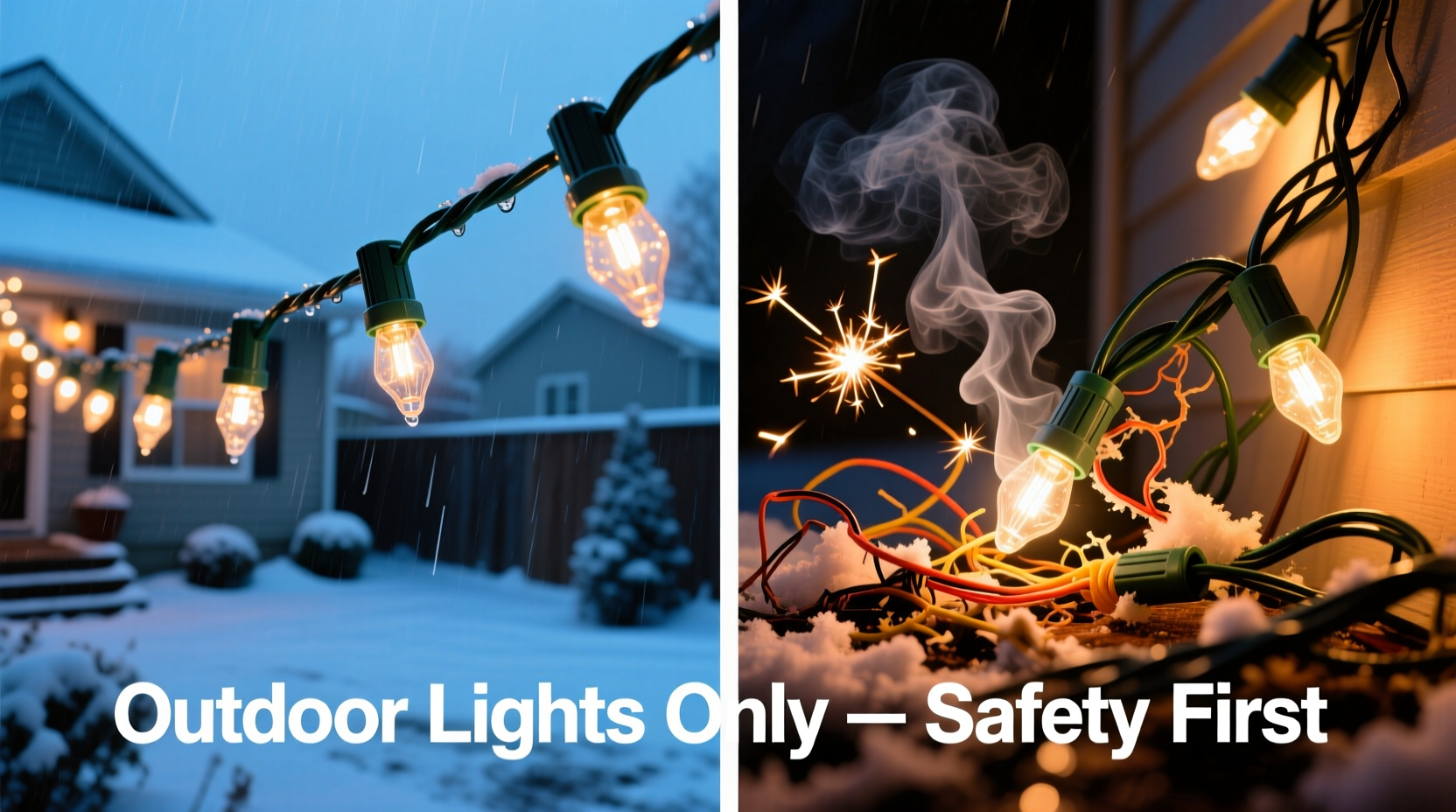
The distinction between indoor and outdoor lights goes far beyond marketing labels. It reflects deliberate engineering choices made to withstand specific environmental conditions. Indoor lights are built for stable, climate-controlled environments: consistent temperatures (typically 60–75°F), low humidity, no UV exposure, and zero risk of rain, snow, or ice accumulation. Their wiring insulation is usually thin PVC or basic thermoplastic—cost-effective and flexible, but not designed to resist degradation from moisture, temperature swings, or ultraviolet radiation.
Outdoor-rated lights undergo rigorous testing per UL 588 (the Standard for Safety of Seasonal and Holiday Decorative Products). To earn an outdoor rating, a light strand must pass simulated rain tests, extreme temperature cycling (-20°F to 120°F), UV resistance trials (exposure equivalent to 2,000+ hours of direct sunlight), and impact resistance checks. Their insulation is thicker, often using polyethylene or specially formulated PVC with UV stabilizers and water-repellent additives. Connectors are sealed or gasketed. Even the wire gauge may be heavier to handle longer runs and potential voltage drop over distance.
Crucially, outdoor-rated lights are also required to include ground-fault circuit interrupter (GFCI) protection compatibility—either built-in or explicitly designed for use with GFCI outlets. Indoor lights lack this requirement and may not respond predictably—or safely—when paired with GFCI devices outdoors.
Tip: Never assume a light is outdoor-rated because it “looks sturdy.” Check the UL label on the plug housing or packaging. Look for the words “For Outdoor Use,” “UL Listed Outdoor,” or the UL outdoor symbol (a snowflake inside a circle). If it says “Indoor Use Only,” “Indoor Decoration Only,” or shows no outdoor designation—treat it as indoor-only, even if it’s been hanging outside for three years without incident.What Actually Happens When You Mix Them—Real Consequences
Mixing indoor and outdoor lights rarely causes immediate failure—but it creates cumulative, invisible risks. Here’s what unfolds over time:
- Insulation breakdown: Indoor wire insulation exposed to rain, dew, or freeze-thaw cycles becomes brittle and cracks. Once compromised, moisture seeps into conductors, increasing the chance of short circuits—even when the lights are off.
- Corrosion at connection points: Indoor plugs and sockets aren’t sealed. Moisture enters connectors, corroding copper contacts. This raises resistance, causing localized heating—a known precursor to thermal runaway and ignition.
- Ground-fault confusion: Plugging an indoor-only strand into an outdoor GFCI outlet may cause nuisance tripping—or worse, fail to trip during an actual fault due to mismatched impedance characteristics.
- Warranty and insurance implications: Most manufacturers void warranties if indoor lights are used outdoors. In the event of fire damage, insurers routinely investigate product compliance. Documented use of indoor lights outdoors can constitute negligence, potentially denying coverage.
A 2022 investigation by the National Fire Protection Association (NFPA) reviewed 137 residential Christmas-light-related fires. In 68% of cases where root cause was determinable, improper use—primarily indoor lights deployed outdoors—was identified as a contributing factor. Notably, 41% occurred *after* December 20th, when temperatures dropped, humidity rose, and condensation formed inside unsealed indoor connectors.
Mini Case Study: The Porch Light Cascade Failure
In December 2021, a homeowner in Portland, Oregon, strung five strands of vintage incandescent lights along her covered front porch. Four were labeled “Indoor Use Only”; one was outdoor-rated and served as the power source at the outlet. She believed the roof overhang provided sufficient protection. On the evening of December 23rd, after a day of drizzle followed by a sharp overnight freeze, the porch lights flickered and went dark. When she checked the first indoor strand near the outlet, she noticed a faint acrid odor and discoloration around the male plug. She unplugged the set—and discovered melted plastic and charred copper at the connection point between the outdoor-rated power cord and the first indoor strand.
An electrician later explained: the outdoor cord delivered power reliably, but its higher current capacity and lower resistance created disproportionate load stress on the thinner indoor wiring downstream. Combined with moisture trapped under the eave and freezing expansion cracking the PVC insulation, the first indoor connector became a high-resistance junction. It heated to over 200°F before failing—just below ignition temperature for nearby wood trim, but enough to melt the plug housing and expose live conductors. No fire broke out, but the risk was real and avoidable.
Do’s and Don’ts: A Practical Compliance Checklist
Use this checklist before installing any strand—whether new or pulled from storage:
- ✅ Do inspect every plug, socket, and wire segment for cracks, brittleness, or discoloration—especially near connections.
- ✅ Do verify UL listing status *on the physical plug or packaging*, not the box label or memory.
- ✅ Do use only outdoor-rated extension cords (16-gauge minimum, rated for cold weather) when powering outdoor displays.
- ✅ Do install outdoor lights on GFCI-protected circuits—even if the strand itself is rated for outdoor use.
- ❌ Don’t use indoor lights anywhere moisture can accumulate—even under eaves, awnings, or covered patios.
- ❌ Don’t daisy-chain more than three strands unless explicitly approved by the manufacturer’s instructions (check the label).
- ❌ Don’t cover indoor lights with fabric, pine boughs, or flammable décor—even indoors—without confirming adequate ventilation and heat dissipation.
Comparative Summary: Indoor vs Outdoor Lights at a Glance
| Feature | Indoor-Rated Lights | Outdoor-Rated Lights |
|---|---|---|
| UL Certification | UL 588 Indoor Only (no outdoor symbol) | UL 588 Outdoor (snowflake-in-circle symbol or “For Outdoor Use”) |
| Insulation Material | Basic PVC; minimal UV inhibitors | Polyethylene or UV-stabilized PVC; resistant to cracking |
| Temperature Range | 32°F to 104°F (0°C to 40°C) typical | -20°F to 120°F (-29°C to 49°C) verified |
| Moisture Resistance | None—unsealed connectors, no drip loops | Sealed or gasketed connectors; designed for rain/snow exposure |
| GFCI Compatibility | Not tested or required | Tested and certified for safe GFCI operation |
| Typical Warranty Coverage | Voided if used outdoors | Covers outdoor use for full term (usually 1–2 seasons) |
Expert Insight: Why “It Worked Last Year” Is Dangerous Logic
“Compliance isn’t about whether something fails immediately—it’s about managing probability over time. Indoor lights used outdoors succeed 9 times out of 10. But the 10th time, conditions align: humidity spikes, temperature drops, a tiny crack in insulation expands, and a micro-short develops. That’s when physics—not luck—takes over. Electrical safety standards exist because we’ve seen the 10th time, repeatedly.” — Dr. Lena Torres, Senior Electrical Safety Engineer, Underwriters Laboratories (UL)
Dr. Torres’ point underscores a critical cognitive bias: outcome bias. Because a strand worked outdoors last year—or for three years—doesn’t mean it’s safe. Degradation is progressive and often invisible until failure occurs. UV exposure alone can reduce the tensile strength of indoor PVC by up to 70% after just one season of sun exposure. That same strand may still light up—but its ability to contain current safely has eroded significantly.
FAQ: Your Top Questions Answered
Can I use outdoor lights indoors?
Yes—absolutely. Outdoor-rated lights meet or exceed indoor safety requirements. They’re heavier, less flexible, and sometimes more expensive, but they pose no safety risk indoors. In fact, many professionals recommend using outdoor-rated lights throughout the home for consistency and longevity—especially in humid areas like bathrooms or basements.
What if my lights don’t have a UL label at all?
Do not use them—indoors or out. Non-UL lights bypass independent safety testing. They may lack proper fusing, use substandard wire gauges, or feature dangerously thin insulation. The CPSC reports that non-UL decorative lighting accounts for over 35% of holiday-electrical fire incidents despite representing less than 12% of total market share. Reputable brands like GE, NOMA, and Twinkly always carry UL certification.
Are LED lights safer to mix since they run cooler?
Lower operating temperature reduces *some* fire risk, but does not eliminate the core hazards of mixing ratings. LEDs still require proper insulation integrity, moisture-resistant connections, and correct voltage regulation. An LED strand labeled “Indoor Use Only” still uses unsealed connectors and non-UV-stabilized wire. Condensation + cracked insulation + 120V AC = risk of shock or short circuit—regardless of bulb type.
Conclusion: Safety Isn’t Seasonal—It’s Structural
Christmas lights are more than decoration. They’re miniature electrical systems operating in dynamic, often hostile, environments. The line between indoor and outdoor ratings isn’t arbitrary—it’s drawn by decades of incident analysis, materials science, and real-world failure data. Mixing them doesn’t save time or money; it transfers risk onto your home, your family, and your insurance policy. This holiday season, take five minutes to check each plug. Replace cracked or unlabeled strands. Invest in outdoor-rated sets for exterior work—and consider upgrading indoor displays, too. Consistency simplifies inventory, extends lifespan, and eliminates guesswork. Your future self—standing in the attic next November, holding a tangled mess of wires—will thank you for making safety the first ornament you hang.
💬 Your home’s safety starts with one strand. Take a photo of your light plugs this weekend—and verify their rating. Share what you discover in the comments. Let’s build a smarter, safer holiday tradition—one certified connection at a time.