Lighting a historic home for the holidays is more than decoration—it’s stewardship. When done thoughtfully, string lights can deepen appreciation for craftsmanship, draw attention to original details lost to time, and invite neighbors to see familiar facades with fresh eyes. But when applied carelessly—draped haphazardly over cornices, stapled into woodwork, or strung across fragile ironwork—they risk physical damage, visual clutter, and even community backlash. Historic preservation isn’t about freezing buildings in amber; it’s about honoring intention, material honesty, and contextual harmony. That includes how we illuminate them during the season. This guide distills decades of preservation practice, municipal lighting ordinances, and hands-on experience from architects, conservators, and historic district commissions into actionable, respectful strategies.
Why “Respectful” Lighting Matters More Than Ever
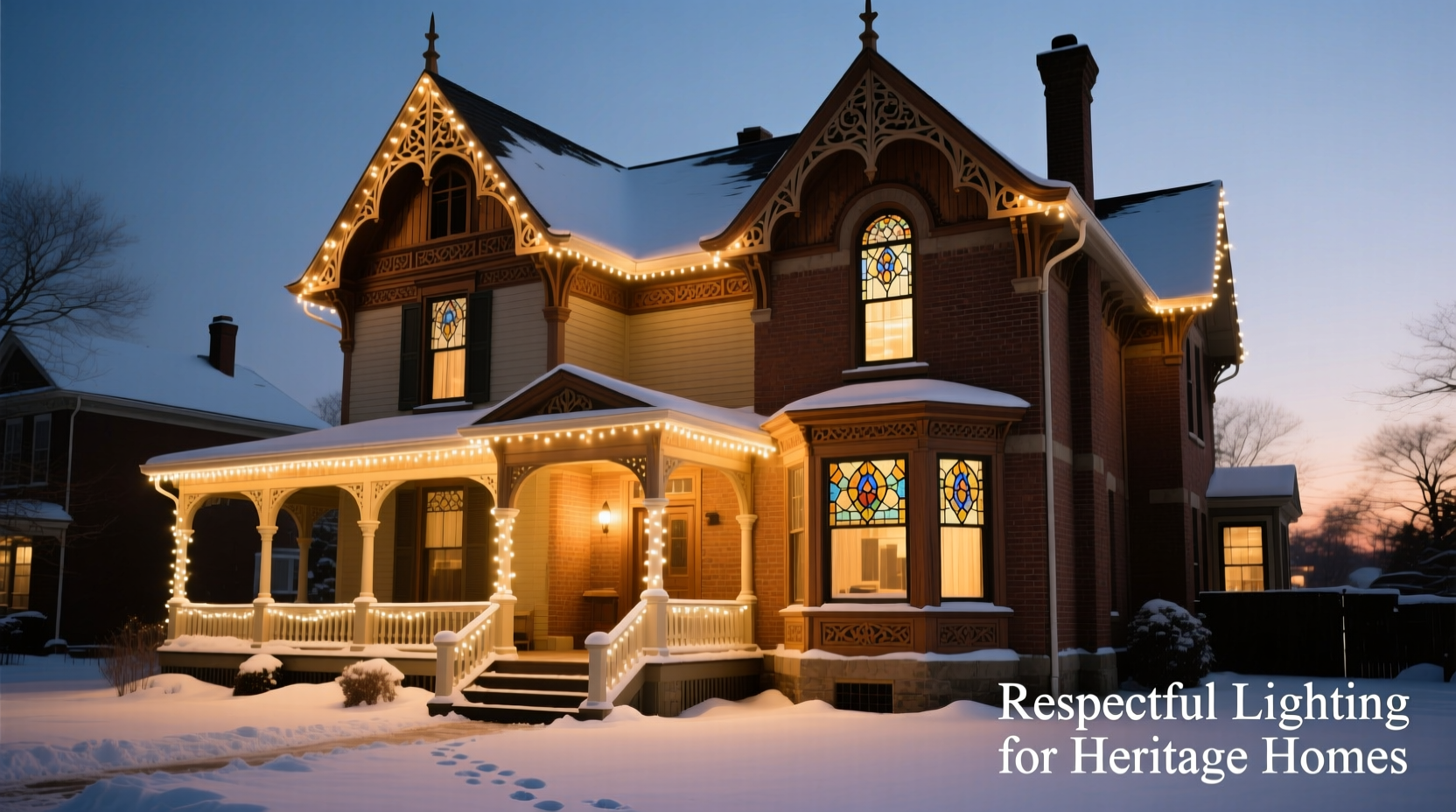
Historic homes are not backdrops—they’re layered records of craft, economy, and cultural values. A Federal-style doorway in Salem, MA, speaks to 18th-century joinery precision. The pressed-metal cornice on a Queen Anne cottage in Denver reflects turn-of-the-century industrial ingenuity. When lights obscure, overwhelm, or physically stress these elements, they mute that narrative. Worse, improper installation can cause lasting harm: staples driven into softwood trim split grain; adhesive-backed clips degrade paint layers; heat from incandescent bulbs accelerates deterioration of historic plaster or stained glass nearby. Municipalities increasingly enforce lighting guidelines—especially in local historic districts—and many homeowners’ associations now require pre-approval for exterior lighting plans. Respectful lighting begins with humility: recognizing that the building’s architecture—not the holiday display—is the primary subject.
“Lighting should reveal, not replace. If your lights make people say ‘What beautiful lights!’ before they notice the corbelled brickwork or the hand-carved bargeboard, you’ve missed the point.” — Dr. Lena Torres, Architectural Historian & Former Chair, National Trust Preservation Committee
Core Principles for Architectural Highlighting
Respectful lighting rests on three interlocking principles: reversibility, proportionality, and intentionality. Reversibility means no permanent alterations—no nails, screws, or adhesives that leave marks or compromise substrates. Proportionality ensures light scale matches the feature: delicate rosettes deserve micro-LEDs, not 12-mm C9 bulbs. Intentionality demands purpose behind every strand: each light should serve a clear architectural goal—tracing a roofline, outlining a bay window, or defining a porch column—not simply filling space.
Tip: Before purchasing a single bulb, walk around your home at dusk with a notebook. Sketch key features you want to emphasize (e.g., “dentil course above second-floor windows,” “original wrought-iron cresting”) and note their dimensions, materials, and condition. This becomes your lighting blueprint.Step-by-Step: Installing Lights Without Compromise
- Assess & Document: Inspect all surfaces where lights will contact the building. Note loose paint, cracked mortar, corroded metal, or deteriorated wood. Photograph and document conditions—this protects you if issues arise later and informs conservation decisions.
- Select Appropriate Hardware: Use only non-penetrating, low-impact fasteners: plastic clip hangers designed for gutters or fascia; magnetic mounts for wrought iron or steel railings; or removable, low-tack painter’s tape for smooth masonry or stable stucco. Avoid staples, nails, hot glue, or duct tape entirely.
- Choose Light Type & Scale: Opt for warm-white (2200K–2700K) LEDs with high CRI (>90) to render historic materials authentically. For fine details (e.g., carved brackets, finials), use 2.5-mm or 3-mm micro-LEDs. For broad outlines (rooflines, window perimeters), 5-mm or M5 bulbs offer clarity without glare. Never mix bulb types or color temperatures on one façade.
- Map the Path: Lay strands loosely along intended routes *before* securing. Adjust spacing so bulbs align with architectural rhythms: e.g., place one bulb at each corner of a pediment, or space lights evenly between dentils—not randomly. Trim excess cord cleanly; avoid coiling surplus wire visibly.
- Test & Refine: Power on after full installation—but at dusk, not midday. Observe from multiple vantage points: sidewalk, street, adjacent property. Does the light enhance the feature or flatten it? Does it create harsh shadows that obscure texture? Adjust density, height, or angle until the architecture remains legible and dignified.
Do’s and Don’ts: A Preservationist’s Lighting Checklist
| Action | Do | Don’t |
|---|---|---|
| Gutters & Cornices | Use gutter clips with rubberized grips; position lights just inside the lip to follow the profile. | Staple directly into wood gutters or force clips into corroded metal. |
| Windows & Doors | Outline frames with consistent spacing; stop 2 inches short of corners to avoid visual “cutting off” of moldings. | Drape lights over sash cords, wrap around historic hardware, or cover leaded-glass borders. |
| Porch Columns & Railings | Wrap columns vertically with evenly spaced loops; use magnetic clips on cast-iron balusters. | Tighten wraps so tightly they compress historic paint or gouge wood grain. |
| Rooflines & Dormers | Trace ridges with single-strand micro-LEDs; secure with discreet roof clips rated for historic slate or clay tile. | Drape heavy cords over fragile finials or attach to deteriorating cedar shingles. |
| General Practice | Use timers set to 4–6 hours nightly; unplug during rain, wind >25 mph, or freeze-thaw cycles. | Leave lights up past January 15th or install permanent wiring without permitting. |
Mini Case Study: The 1892 Stick-Style Cottage in Oak Park, IL
When the Henderson family purchased their 1892 Stick-style cottage—a National Register-listed property with intricate diagonal bracing, patterned shingle gables, and original stained-glass transoms—they wanted to celebrate its craftsmanship without violating village preservation guidelines. Their first attempt used standard C7 bulbs wrapped tightly around corner posts, obscuring the distinctive “X-brace” motifs. After consulting with the Oak Park Historic Preservation Commission, they redesigned their approach: They switched to 3-mm warm-white micro-LEDs, mounted with magnetic clips on the iron porch railing and reversible gutter hooks. Instead of outlining the entire gable, they placed individual bulbs precisely at each intersection of the decorative stickwork—12 points total—creating a subtle “constellation” effect that drew the eye to the structural artistry. For the stained-glass transom, they installed a single, low-lumen LED puck light *inside* the entry vestibule, aimed upward to gently backlight the glass from within—revealing color and detail without external fixtures. Neighbors reported noticing architectural details they’d walked past for years. The village cited the installation as a model for sensitive seasonal lighting in its 2023 Preservation Newsletter.
Choosing Materials That Honor History
The choice of light source and cord matters as much as placement. Incandescent bulbs generate unnecessary heat and consume disproportionate energy—both ethically questionable for historic structures where efficiency upgrades are often constrained by material compatibility. Modern LEDs solve this, but not all are equal. Avoid cool-white LEDs (5000K+), which cast a clinical, anachronistic glare that flattens texture and washes out warm historic materials like brick, terra cotta, or weathered wood. Prioritize UL-listed, commercial-grade LED strings with insulated, flexible PVC or rubberized cord—never brittle, thin-jacketed consumer-grade wire prone to cracking in cold. For homes with original gaslight-era fixtures, consider integrating compatible LED retrofit bulbs into existing sconces or lanterns instead of adding new strings; this honors the building’s lighting history while modernizing function.
FAQ: Practical Questions from Homeowners
Can I use battery-powered lights to avoid electrical concerns?
Yes—with caveats. Battery-operated micro-LEDs are ideal for fragile or inaccessible features (e.g., high finials, delicate dormer brackets) where running cord is impractical. However, verify battery life (many last only 2–4 weeks on continuous use) and ensure enclosures are rated for outdoor temperature swings. Replace batteries weekly during peak season to prevent leakage, which can corrode historic metal or stain masonry.
My home has original wooden gutters. How do I attach lights safely?
Avoid clips that clamp or screw. Instead, use soft, wide-loop fabric ties (like archival-quality cotton tape) knotted loosely around the gutter’s outer edge, then thread lights through the loop. Or, for minimal contact, rest lightweight micro-LED strands *inside* the gutter channel itself—positioned near the front lip so light spills downward onto the façade, not upward into the gutter. Never weight down or compress historic wood.
Do historic district commissions really review holiday lighting?
In over 70% of certified local historic districts (per 2022 National Alliance of Preservation Commissions survey), yes—especially for properties visible from public rights-of-way. Most require only a simple notification form, not formal review. But failing to comply can result in removal orders or fines. Check your district’s website or call the preservation officer early—many offer free pre-submission consultations.
Conclusion: Lighting as an Act of Care
Using Christmas lights to highlight architectural features on a historic home is never merely decorative. It’s a quiet act of advocacy—choosing to spotlight the skill of long-gone carpenters, the vision of forgotten designers, and the resilience of materials that have weathered generations. It asks us to slow down, observe closely, and intervene with restraint. When lights trace a hand-tooled cornice with reverence, when they pause at the curve of an original iron scroll, when they glow warmly—not brightly—against century-old brick, they don’t just mark the season. They affirm continuity. They say: *This matters. This endures. This deserves our attention, and our care.* Start small this year: pick one feature—the front door surround, a single bay window, the line where roof meets wall—and illuminate it with intention. Document what works. Share your approach with neighbors. And remember: the most powerful light isn’t the brightest—it’s the one that helps others truly see.
💬 Have you lit a historic home with architectural sensitivity? Share your technique, challenge, or photo-free description in the comments—we’ll feature thoughtful insights in next month’s community roundup.








