Feathered finches, hand-dyed velvet poinsettias, vintage ostrich plume baubles—these ornaments aren’t just decorations; they’re heirlooms, art objects, and tactile expressions of holiday intention. Unlike glass or ceramic ornaments, feathered and velvet pieces possess fragile structural integrity and surface chemistry that reacts unpredictably to pressure, humidity, light, and contact. A single misstep in storage—stacking, folding, or even storing near wool sweaters—can result in irreversible flattening, pigment migration, fiber loss, or static-induced clumping. Yet most families rely on repurposed shoeboxes or crumpled tissue paper, unaware that these common “solutions” accelerate deterioration. This guide distills decades of textile conservation practice, museum archival standards, and hands-on experience from professional ornament restorers into actionable, seasonally intelligent protocols. No assumptions. No shortcuts. Just methods proven to preserve dimension, texture, and chromatic fidelity year after year.
Why Feathered and Velvet Ornaments Demand Specialized Storage
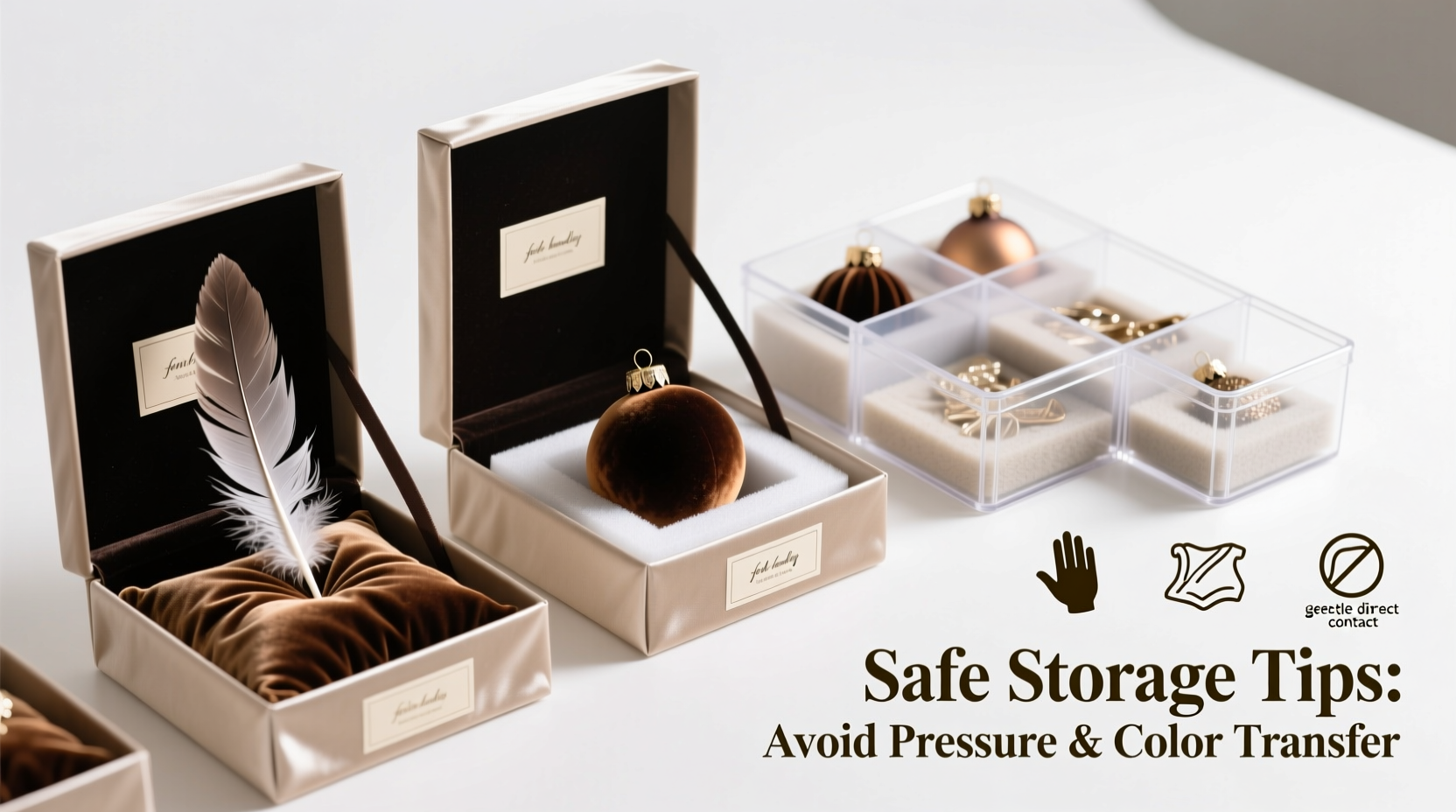
Feathers and velvet share a deceptive fragility. Feathers are keratin-based filaments with microscopic barbules that interlock for loft and shape—pressure disrupts this architecture permanently. Velvet is a cut-pile fabric: thousands of upright fibers anchored to a backing. When compressed, those fibers bend, mat, and lose their directional nap—and unlike wool or cotton, velvet rarely rebounds. Worse, both materials are highly susceptible to color transfer. Vintage velvet often uses fugitive dyes (especially deep burgundies, emeralds, and indigos) that bleed when exposed to moisture, heat, or friction. Feathers dyed with natural pigments or low-grade aniline dyes behave similarly. Add environmental triggers—fluctuating humidity causing fiber swelling, residual oils from handling attracting dust, or ambient light fading organic dyes—and the cumulative risk multiplies.
“Feathers and velvet ornaments should be treated like textile artifacts—not seasonal decor. Their degradation is rarely sudden; it’s a slow cascade of micro-damage: crushed barbules, matted pile, migrated dye particles embedding into adjacent surfaces. Prevention begins the moment the tree comes down.” — Dr. Lena Torres, Textile Conservator, Winterthur Museum & Library
Step-by-Step Pre-Storage Preparation Protocol
Skipping preparation is the most common cause of post-storage damage. Cleaning, drying, and stabilizing must happen *before* packing—not as an afterthought.
- Surface Dust Removal: Use a soft-bristled makeup brush (natural goat hair preferred) or a battery-powered museum-grade air blower set to lowest airflow. Never vacuum—even with a brush attachment—as suction pulls and tangles fine feathers and abrades velvet pile.
- Spot-Cleaning Only: For soiled areas, lightly dab (never rub) with a cotton swab dampened with distilled water. For stubborn grime on velvet, use a clean, dry velvet brush stroked *with* the nap. Never apply solvents, alcohol, or commercial cleaners—they strip natural waxes and dissolve dyes.
- Drying: Lay ornaments flat on acid-free blotting paper in a well-ventilated, dark room for 48 hours. Avoid radiators, sunlight, or fans—rapid drying causes feather brittleness and velvet shrinkage.
- Static Control: Lightly mist the *inside* of storage containers (not the ornaments) with anti-static spray formulated for textiles (e.g., Static Guard Fabric Spray, diluted 1:3 with distilled water). Let dry fully before use. Static attracts dust and causes feather clumping.
- Labeling: Use archival Pigma Micron pens (acid-free, waterproof) to write on acid-free kraft labels. Attach labels to container lids—not directly to ornaments or their wires.
Optimal Storage Materials: What Works (and What Destroys)
The right container isn’t about aesthetics—it’s about microclimate control, physical support, and chemical neutrality. Below is a comparison of common options versus conservation-grade alternatives:
| Material/Container | Why It’s Suitable | Risk Factors |
|---|---|---|
| Acid-free corrugated boxes (12\"x12\"x6\") | Provides rigid structure, prevents stacking pressure, pH-neutral, breathable | Must be lined with unbleached muslin or acid-free tissue—bare cardboard absorbs moisture and sheds lignin |
| Plastic storage bins with gasket seals | Blocks dust and pests; ideal for basements/garages if climate-controlled | Traps moisture unless silica gel is used; avoid PVC or polystyrene—off-gasses acidic compounds |
| Custom-cut foam inserts (polyethylene, not polyurethane) | Craddles ornaments individually; eliminates movement; inert and non-abrasive | Polyurethane foam yellows and emits acetic acid—never use for velvet or feathers |
| Repurposed egg cartons (paperboard) | Free, compartmentalized, breathable | Often contain optical brighteners and lignin; test with pH strips—discard if below pH 7.5 |
| Cloth gift bags or scarves | Soft, breathable, reusable | Only if 100% cotton or silk—no synthetics (static), no wool (moisture absorption), no dyes (color transfer) |
Never use: newspaper (acidic ink bleeds), plastic bags (traps condensation), bubble wrap (static + abrasion), or cardboard boxes labeled “recycled” (often high in lignin and metal contaminants).
Assembly-Line Storage Method for Mixed Collections
Most households own a mix of feathered birds, velvet flowers, tinsel-wrapped spheres, and delicate wire frames. Storing them together risks cross-contamination. Follow this sequence to isolate vulnerabilities:
- Sort by Material Type: Group all feathered items (birds, angels, peacocks), then all velvet items (roses, berries, stars), then mixed-media pieces (feather + velvet combinations).
- Individual Wrapping: Wrap each ornament in unbleached, undyed muslin (not tissue—too thin) folded into a loose pouch. Secure with cotton twill tape (no elastic or rubber bands). Muslin allows breathability while blocking direct contact.
- Layered Box Assembly:
- Line box bottom with ¼\" acid-free foam sheet.
- Place wrapped ornaments upright (feathers pointing up, velvet faces vertical) with 1.5\" spacing between each.
- Fill gaps with shredded acid-free paper (not newspaper) or polyester batting scraps.
- Add second foam layer; repeat until box is ¾ full.
- Top with final foam sheet and lid.
- Vertical Orientation Rule: Store all boxes upright (like books on a shelf), never stacked horizontally. Horizontal stacking applies downward pressure that flattens velvet pile and compresses feather barbules over time—even in rigid boxes.
- Climate Buffering: Place one unit of silica gel desiccant (rechargeable type) inside each sealed box. Replace every 6 months. Maintain 40–50% relative humidity—use a hygrometer to verify.
Real-World Case Study: The 1948 Velvet Rose Collection
In 2021, conservator Maya Chen was commissioned to restore a set of 12 hand-sewn velvet roses, crafted by a Philadelphia seamstress for her daughter’s first Christmas. Stored since 1972 in a cedar chest with lavender sachets, the roses arrived flattened, with burgundy dye bleeding onto adjacent white satin ribbons. Initial assessment revealed two culprits: cedar oil had plasticized the velvet backing, making fibers brittle, and the sachets introduced moisture fluctuations that activated dye migration. Chen’s restoration involved gentle steam-fluffing (using a textile-specific steamer at 100°C, held 12\" away), followed by stabilization in custom acrylic display mounts. For long-term storage, she replaced the cedar chest with an acid-free box lined with inert polyethylene foam, added silica gel, and mandated vertical orientation. Three years later, the client reported zero further fading or pile loss—and confirmed the roses retained their original dimensional depth. The lesson? Even “natural” storage environments (cedar, herbs, wool blankets) carry hidden chemical risks for sensitive textiles.
Do’s and Don’ts Quick Reference Checklist
- ✅ Do handle ornaments only with clean, dry, 100% cotton gloves.
- ✅ Do store in climate-stable spaces (avoid attics, garages, or exterior closets).
- ✅ Do inspect stored ornaments every 6 months for signs of mold, insect activity, or dye migration.
- ✅ Do rotate display pieces annually—prevents prolonged light exposure on any single item.
- ❌ Don’t hang ornaments by their hooks for storage—wire tension stretches delicate loops and crushes feather bases.
- ❌ Don’t use scented sachets, mothballs, or essential oil diffusers near storage areas—volatile organics degrade keratin and dye bonds.
- ❌ Don’t fold velvet ornaments or crease feather stems—permanent memory sets in within hours.
- ❌ Don’t store near heat sources (furnaces, water heaters) or fluorescent lighting—both accelerate dye fading.
FAQ: Addressing Common Concerns
Can I use tissue paper instead of muslin for wrapping?
No—standard tissue paper is acidic (pH 4.5–5.5), contains lignin, and often includes optical brighteners that fluoresce under UV light and degrade dyes. If muslin is unavailable, use only archival-grade, buffered, pH-neutral tissue (tested to ISO 11108 standards). Even then, muslin remains superior for breathability and static resistance.
My velvet ornament has a white “bloom” after storage—what is it?
This is likely “bloom” or “frosting”—a migration of plasticizers from low-quality backing fabric or adhesive. It appears as a hazy, chalky film and indicates the velvet’s internal chemistry is destabilizing. Gently brush *with* the nap using a soft velvet brush. If persistent, consult a textile conservator—do not attempt solvent cleaning.
How often should I replace silica gel desiccant?
Every 6 months, regardless of visible saturation. Desiccant loses efficacy gradually and may reach equilibrium with ambient humidity. Rechargeable silica gel (blue-to-pink indicator type) should be baked at 220°F for 2 hours to reactivate. Always cool completely before placing in storage boxes.
Conclusion: Preserve the Magic, Not Just the Memory
Delicate feathered and velvet ornaments represent more than decoration—they embody craftsmanship, personal history, and sensory joy. Their fragility isn’t a limitation; it’s an invitation to engage more thoughtfully with the objects we cherish. Proper storage isn’t about perfectionism—it’s about consistency, respect for material science, and recognizing that preservation begins not when damage appears, but in the quiet moments after the season ends. You don’t need a museum budget to implement these methods. Acid-free boxes cost less than $15 online. Muslin is reusable for decades. Silica gel is a one-time investment. What matters is starting now—with this year’s ornaments—so next December, your velvet poinsettias bloom with the same depth, your feathered cardinals hold their proud posture, and your hands move with confidence, not caution. The magic of the season lives not just in glitter and light, but in the quiet integrity of what endures.
💬 Your experience matters. Have you revived a flattened velvet ornament or stabilized faded feathers? Share your technique in the comments—your insight could help another collector preserve their family’s holiday legacy.








