Connecting multiple strands of incandescent holiday lights is a common holiday tradition—but it’s also one of the most frequent causes of residential circuit overloads, tripped breakers, and even fire hazards. Unlike modern LED strings, incandescent lights draw significantly more current: a typical 100-bulb strand consumes 40–60 watts, translating to 0.33–0.5 amps at 120 volts. Chain three or four together on a standard 15-amp household circuit, and you’re already flirting with 80–90% of capacity—before adding refrigerators, microwaves, or space heaters to the same circuit.
This isn’t theoretical risk. According to the U.S. Consumer Product Safety Commission (CPSC), decorative lighting accounts for an estimated 7,900 home fires annually—nearly half involving extension cords or overloaded outlets. Yet most homeowners assume “if it plugs in, it’s safe.” That assumption fails when physics, wiring standards, and thermal limits collide. This article details exactly how to expand your light display beyond three strands—safely, legally, and sustainably—using proven electrical principles, not guesswork.
Why Incandescent Strings Are Especially Risky
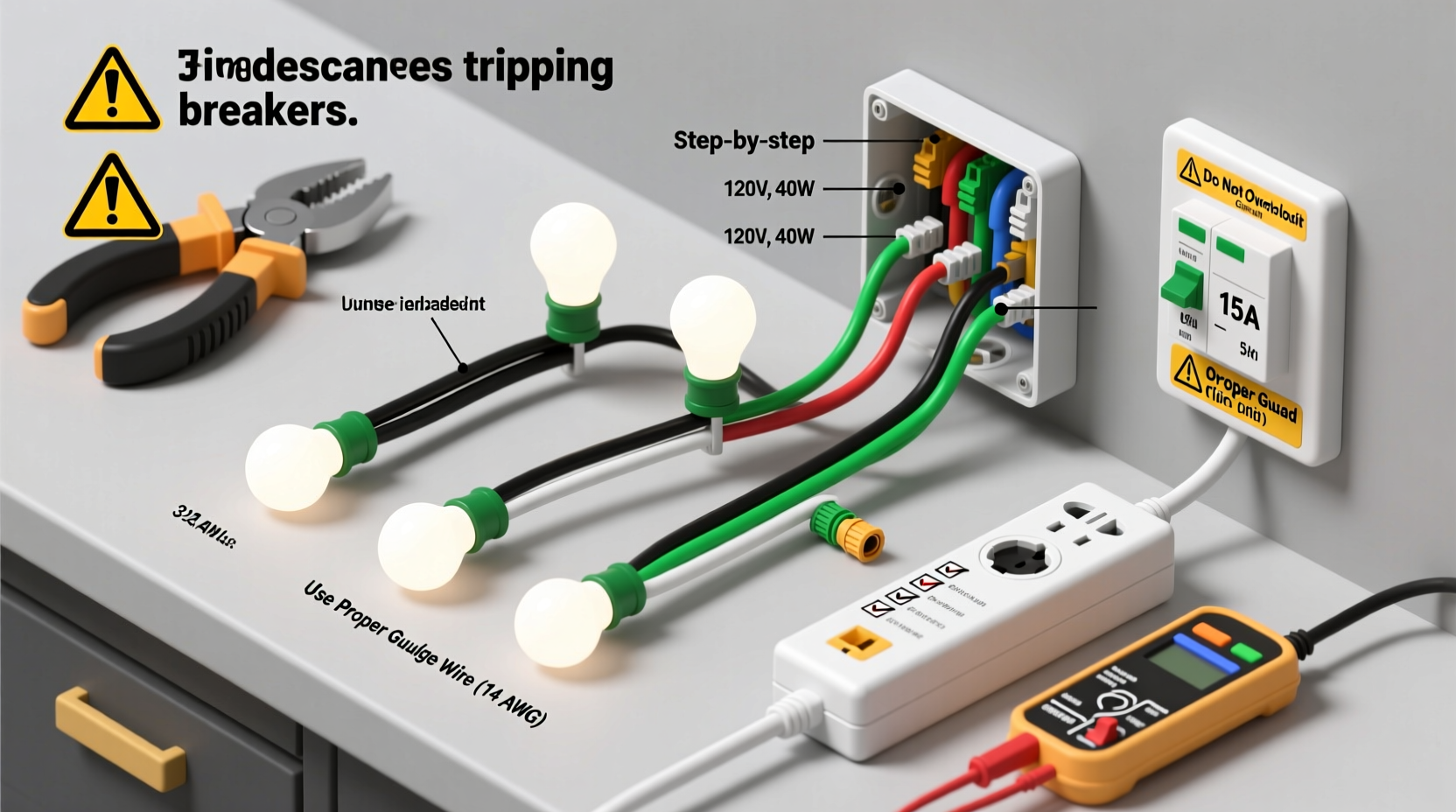
Incandescent bulbs convert only about 5% of electrical energy into visible light; the rest becomes heat. That heat accumulates inside sockets, wire insulation, and junction boxes. When multiple strands are daisy-chained, resistance increases along the line—not linearly, but exponentially due to voltage drop and cumulative heat buildup. A 50-foot run of 16-gauge lamp cord carrying 3.5 amps may see a 3–4 volt drop at the far end, causing bulbs to dim and draw *more* current to compensate—a dangerous feedback loop.
Manufacturers’ “maximum connectable” labels (e.g., “connect up to 3 sets”) aren’t arbitrary marketing—they reflect rigorous UL testing under worst-case ambient temperatures (up to 40°C/104°F) and continuous operation (8+ hours). Exceeding those limits voids UL listing and violates National Electrical Code (NEC) Article 400.5(A), which prohibits overloading flexible cords beyond their ampacity ratings.
Tip: Never rely on outlet strip “power ratings” alone. A 15-amp power strip rated for 1800W doesn’t guarantee safety if its internal wiring, terminals, or thermal cutoffs aren’t designed for sustained incandescent loads.Step-by-Step: Calculating Your Safe Load Capacity
Safety begins with measurement—not estimation. Follow this sequence before plugging in a single strand:
- Identify your circuit’s amperage. Locate your home’s breaker panel. Standard bedroom/living room circuits are usually 15-amp; kitchens and garages often use 20-amp. Confirm by checking the breaker label (e.g., “15A” or “20A”).
- Determine existing load on that circuit. Walk through every outlet, light fixture, and hardwired device (e.g., ceiling fan, doorbell transformer) powered by that breaker. Add their wattages (check labels or use a plug-in power meter). Example: 2 lamps (60W each) + ceiling fan (75W) + TV (120W) = 315W → 2.6 amps used.
- Calculate remaining capacity. For a 15-amp circuit: 15 × 0.8 = 12 amps max continuous load (NEC 210.20(A) requires 80% derating for continuous loads >3 hours). Subtract existing load: 12 − 2.6 = 9.4 amps available.
- Measure actual strand draw. Use a clamp meter or Kill-A-Watt meter. Don’t trust packaging—aged bulbs, voltage fluctuations, or dirty sockets increase draw. A “40W” strand may pull 48W after five seasons.
- Apply the 80% rule per outlet. A standard duplex receptacle is rated for 15 amps, but NEC 210.21(B)(3) limits total cord-and-plug-connected load to 12 amps (1440W) per outlet—even if two strands plug into one device.
Example calculation: You have 9.4 amps available. Each incandescent strand draws 0.42 amps (50W ÷ 120V). 9.4 ÷ 0.42 = 22.3 — meaning you *could* theoretically run 22 strands. But that ignores heat, voltage drop, and physical cord limitations. Real-world safe maximum? 12–14 strands—distributed across *multiple outlets* on the *same circuit*, never daisy-chained.
Do’s and Don’ts: Wiring Incandescent Lights Safely
| Action | Do | Don’t |
|---|---|---|
| Cord Management | Use 14-gauge or heavier outdoor-rated extension cords (e.g., SJOOW) for runs over 25 feet. Keep cords untangled and off hot surfaces (roofs, vents). | Use indoor-rated or 18-gauge “light-duty” cords—even for temporary use. Never run cords under rugs or carpet. |
| Outlet Strategy | Plug no more than two strands directly into one outlet. Use a heavy-duty, 15-amp-rated power strip with individual circuit breakers and thermal protection (UL 1449 certified). | Daisy-chain more than three strands end-to-end. Never plug a power strip into another power strip (“daisy-chaining outlets”). |
| Strand Compatibility | Only connect strands with identical voltage, bulb count, and base type (e.g., E12 candelabra). Verify both are UL-listed for “outdoor use” and “series connection.” | Mix old and new strands—or incandescent with LED strings—on the same circuit leg. Different resistances cause uneven current distribution. |
| Thermal Monitoring | Check plug heads and first 12 inches of each strand every 30 minutes during first 2 hours of use. If warm to touch (>110°F), unplug immediately. | Leave lights unattended overnight or while sleeping. Never cover strands with fabric, snow, or insulation. |
Real-World Case Study: The Elm Street Holiday Overload
In December 2022, a homeowner in Portland, Oregon, installed 17 strands of vintage C7 incandescent lights on his front porch and roofline. He used a single 15-amp circuit shared with two porch lights and a garage door opener. His plan: daisy-chain 5 strands to one outlet, 4 to another, and 8 to a third—each via 50-foot 16-gauge extension cords. Within 90 minutes, the breaker tripped repeatedly. An electrician discovered the root cause wasn’t just overload—it was voltage drop combined with undersized cords.
The 50-foot 16-gauge cords had 0.124 ohms/ft resistance. At 0.45 amps per strand, the first cord in the 5-strand chain carried 2.25 amps, generating 0.28W of heat *just in the cord*. By the fifth strand, voltage dropped to 108V—causing bulbs to glow dimmer and draw 12% more current to maintain filament temperature. The plug head reached 135°F, degrading insulation. The solution? The electrician re-routed three dedicated 12-gauge circuits from the panel (one per porch zone), installed GFCI-protected outdoor outlets every 12 feet, and limited each outlet to two strands using 14-gauge SJOOW cords. No trips occurred over 48 days of continuous operation.
“Most ‘tripped breaker’ calls during holidays aren’t about too many lights—it’s about too much resistance in the path between the panel and the last bulb. Every connection point, every foot of undersized cord, every corroded socket adds resistance—and resistance creates heat, which creates failure.” — Carlos Mendez, Master Electrician & NEC Code Trainer, IBEW Local 1245
Practical Solutions for Expanding Beyond Three Strands
When you need more coverage—say, wrapping a large tree, outlining a two-story house, or lighting a long driveway—you must shift from daisy-chaining to distributed loading. Here’s how professionals do it:
1. Use Multi-Outlet “Hub” Adapters (Not Power Strips)
Install UL-listed, weatherproof outlet hubs (e.g., “Christmas Light Hub” models) that split one outlet into 4–6 individually fused ports. These contain 3-amp thermal fuses per port—so if one strand shorts or overheats, only that port shuts down. Mount them near light clusters (e.g., at tree base or eave corners) and run short 10–15 ft cords to each strand. This eliminates daisy-chain resistance and isolates faults.
2. Tap Into Dedicated Circuits
Many homes have underused 20-amp circuits: garage freezers (often on their own circuit), attic HVAC controls, or unfinished basement outlets. Temporarily repurpose one *only* for lights—after verifying no other loads are active. A 20-amp circuit supports up to 16 amps continuous (1920W), allowing 32–40 incandescent strands if properly distributed.
3. Install a Temporary Subpanel (For Large Displays)
For displays exceeding 50 strands, licensed electricians sometimes install a surface-mounted 6-circuit subpanel fed by a 30-amp double-pole breaker. Each 15-amp circuit powers 8–10 strands via dedicated GFCI outlets. Total cost: $350–$600, but eliminates all tripping and enables precise load balancing. Not DIY—but pays for itself in bulb longevity and insurance peace of mind.
4. Hybrid Lighting: Strategic LED Replacement
You don’t need to abandon incandescents entirely. Replace *non-focal* strands—like ground outlines, fence lines, or background rooflines—with warm-white LEDs (2700K). A 100-LED string uses just 4.8W (0.04A) vs. 50W for incandescent. Keep incandescents only where warmth and sparkle matter most: wreaths, mantels, or centerpiece trees. This reduces total load by 60–80% while preserving ambiance.
FAQ: Critical Questions Answered
Can I use a 20-amp outlet with 15-amp light strands?
Yes—but only if the circuit breaker is 20-amp *and* all wiring (including outlets and switches) is rated for 20 amps (12-gauge copper minimum). Never replace a 15-amp outlet with a 20-amp one on 14-gauge wire—that creates a fire hazard. The outlet rating must match the circuit’s weakest link.
Why do some strands say “connect up to 21 sets” while others say “3 sets”?
It depends on wire gauge and bulb wattage. Strands with 18-gauge wire and 2.5W bulbs (common in newer “energy-saving” incandescents) may allow more connections. Older 100-bulb C7 strands with 16-gauge wire and 5W bulbs are limited to 3–5 sets. Always verify the label on *your specific model*—never assume based on appearance.
Will a surge protector prevent breaker trips?
No. Surge protectors guard against voltage spikes (lightning, grid switching), not overcurrent. Tripping is caused by excess amperage, which only a circuit breaker or thermal fuse can interrupt. Some high-end power strips include overcurrent protection—but they’re rare and expensive. Rely on proper load calculation, not “protection” marketing.
Conclusion: Light Boldly, Wire Responsibly
Safety isn’t the enemy of celebration—it’s the foundation that lets joy last. Connecting more than three strands of incandescent lights isn’t forbidden; it’s a task requiring respect for physics, adherence to code, and thoughtful planning. You now know how to calculate your true capacity, recognize thermal red flags, distribute loads intelligently, and choose hardware that performs—not just promises. You understand why that warm plug isn’t “normal,” why daisy-chaining fails under load, and how a single 14-gauge cord can make the difference between a dazzling display and a midnight breaker trip.
Start tonight: unplug everything. Grab a notebook and your breaker panel map. Measure one strand’s actual draw. Sketch your outlet layout. Then build outward—not by adding more plugs to one socket, but by expanding your infrastructure with intention. Your lights will shine brighter, last longer, and most importantly, keep your home, family, and neighbors safe. Because the most beautiful holiday light isn’t the brightest one on the block—it’s the one that stays lit, safely, all season long.
💬 Share your safe lighting setup! Did you solve a tripping issue with a creative wiring solution? Post your real-world tip in the comments—help fellow homeowners light up their holidays without the hazards.