For many homeowners, the living room is both the heart of daily life and the stage for hospitality. It’s where toddlers stack blocks, teenagers do homework, grandparents sip tea, and guests gather for celebrations. Yet beneath that warmth often lies a quiet tension: how to store alcohol responsibly—safely out of children’s reach, discreetly aligned with family values—while maintaining a cohesive, welcoming aesthetic. A visible bar cart or open shelving with bottles invites curiosity, temptation, or unintended access. Conversely, a bulky, obvious “liquor cabinet” can clash with modern interiors or signal an overemphasis on drinking in a space meant for connection. The solution isn’t elimination—it’s intelligent integration. Disguising a liquor cabinet isn’t about deception; it’s about thoughtful design that prioritizes safety, style, and lived-in authenticity.
Why Disguise Matters: Safety, Sensibility, and Style
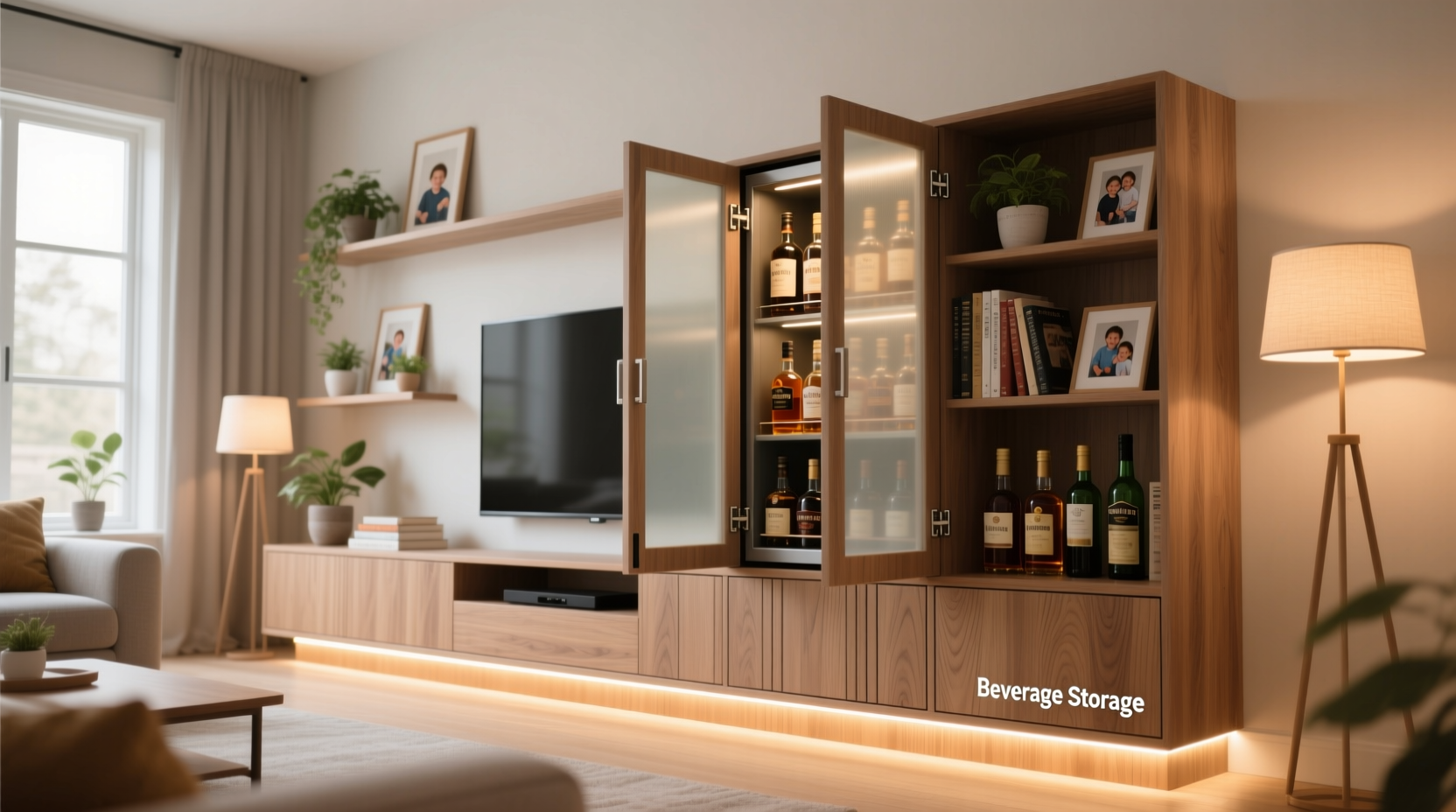
Childproofing isn’t just about locks and latches—it begins with environmental design. According to the American Academy of Pediatrics, unintentional poisoning remains among the top five causes of injury-related death for children under six, with household medications and alcohol accounting for nearly 40% of cases in that age group. A cabinet that looks like ordinary furniture reduces visual cues that might spark exploration. Equally important is social intentionality: in homes where alcohol is consumed moderately and respectfully, its presence shouldn’t dominate the room’s narrative. A well-disguised storage solution supports boundaries—keeping bottles secure while affirming that the living room belongs first to conversation, comfort, and shared moments—not to beverage display.
Tip: Prioritize dual-layer security: physical concealment (e.g., hidden doors) + mechanical locking (e.g., magnetic catches with child-resistant latches). Visual discretion alone is never sufficient for true safety.Five Proven Disguise Strategies (With Real-World Execution)
Effective disguise balances invisibility with accessibility—for adults. Below are five approaches validated by interior designers specializing in multi-generational homes, each with implementation notes and material considerations.
1. The Bookcase Cabinet
A floor-to-ceiling bookshelf with a concealed lower section is one of the most versatile and widely adopted solutions. The upper two-thirds display books, framed photos, and decorative objects; the lower third houses bottles behind a false back panel or recessed door. Designers recommend using full-depth shelves (12–14 inches) so the false panel doesn’t protrude, and installing soft-close hinges to prevent slamming near small children.
2. The Media Console Hybrid
Modern media consoles often feature deep, closed compartments ideal for bottle storage. By selecting a unit with at least one wide, shallow drawer (18–22 inches wide, 6–8 inches deep), you create space for decanters, glasses, and mixers—without needing vertical height. Add removable felt-lined dividers to keep bottles upright and prevent clinking. Bonus: integrate USB charging ports and cable management into the same unit for seamless tech-and-taste functionality.
3. The Armoire Reimagined
Traditional armoires—with their tall, narrow profiles and hinged doors—are naturally suited to liquor storage. Update them by replacing ornate hardware with minimalist brushed-nickel pulls, lining interior shelves with dark velvet or cork to dampen noise and protect labels, and adding LED strip lighting (motion-activated or remote-controlled) inside for easy nighttime access without turning on overhead lights.
4. The Banquette Bench Storage
In open-plan living-dining areas, built-in banquettes offer unobtrusive, high-capacity storage. A 72-inch bench with lift-up seating reveals a deep cavity—perfect for storing wine crates, cocktail tools, and even a compact ice bucket. Choose upholstery in durable, stain-resistant performance fabric (e.g., Crypton or Revolution) and add a discreet push-latch mechanism so the lid opens only when pressed firmly—a subtle but effective child deterrent.
5. The Wall-Mounted Panel System
For minimalist or rental-friendly spaces, wall-mounted panels offer zero-floorprint concealment. Install a custom-sized MDF or walnut veneer panel (at least 1.25 inches thick) over a standard base cabinet or wall niche. Use rare-earth magnet systems or concealed pivot hinges for silent, flush operation. Finish the panel to match adjacent walls or millwork—paint it the same color, apply matching wallpaper, or even install a small shelf above it to suggest it’s purely architectural.
Step-by-Step: Building Your Disguised Cabinet (DIY-Friendly Version)
This sequence assumes moderate DIY skill and focuses on adapting an existing IKEA BESTÅ or PAX unit—two of the most customizable, affordable, and structurally sound bases available. Total time: one weekend.
- Select & prep the unit: Choose a BESTÅ frame (74x15x77 cm recommended) with matching doors. Remove all internal shelves and hardware.
- Add structural reinforcement: Screw ¾-inch plywood backing to the rear panel to support weight and prevent bowing. Line interior sides with ¼-inch cork sheeting for vibration dampening.
- Install dual-security access: Mount a magnetic catch with a 15-lb holding force on the door edge. Behind it, add a secondary latch: a simple hook-and-eye system requiring two-step release (pull down, then swing open).
- Design the interior layout: Use adjustable shelf pins to create three zones: bottom (for heavy bottles, 8–10 inches tall), middle (for decanters and shakers, 6 inches), top (for glassware, 5 inches). Line each shelf with non-slip silicone matting.
- Final disguise: Paint the exterior doors to match your wall color using Benjamin Moore Aura Matte (zero-VOC, scrubbable). Replace handles with flat, recessed brass pulls that blend into the door’s edge profile.
Do’s and Don’ts: What Designers Wish Clients Knew
| Action | Do | Don’t |
|---|---|---|
| Placement | Locate cabinet at least 36 inches from playmats, cribs, or low furniture children use to climb | Install near staircases, windows, or high-traffic walkways where doors could swing into paths |
| Materials | Use solid wood, MDF with melamine coating, or real-wood veneer—durable, repairable, and non-toxic | Choose particleboard without edge banding or laminates with visible seams (child fingers can pry them open) |
| Lighting | Use warm-white (2700K) LED puck lights with motion sensors—no switches within toddler reach | Install exposed bulbs, pull cords, or battery-powered lights with accessible compartments |
| Contents | Store only sealed, labeled bottles; keep open mixers (tonic, juice) in the refrigerator—not the cabinet | Leave half-empty bottles, cocktail garnishes, or bar tools (knives, citrus zesters) inside the cabinet |
| Maintenance | Wipe interior monthly with vinegar-water solution (1:3) to prevent mold in humid climates | Use bleach-based cleaners or aerosol sprays that degrade seals and damage wood finishes |
Mini Case Study: The Portland Family Living Room
Sarah and Mark, parents of a three-year-old and a seven-year-old, renovated their 1920s bungalow living room to balance heritage charm and contemporary practicality. Their original oak breakfront was beautiful—but too transparent. They collaborated with local designer Lena Torres to transform it into a “library cabinet”: the upper glass doors remained (now fitted with UV-filtering film to protect books), while the lower section was rebuilt with a false drawer front. Inside, a sliding track holds two tiers of bottles; a recessed handle—only visible when viewed at a 45-degree angle—opens the compartment. Crucially, the entire unit sits on custom steel legs raised 4 inches off the floor, eliminating toe-knocking hazards and allowing easy vacuuming underneath. Six months post-installation, Sarah reports: “Our son asks for ‘the book drawer’ when he wants to help tidy up—and has no idea what’s behind it. Guests compliment the craftsmanship, not the contents.”
“Disguise succeeds when it serves behavior—not just aesthetics. If the cabinet feels like a natural part of the room’s rhythm, people stop noticing it entirely. That’s when safety becomes effortless.” — Lena Torres, Certified Interior Designer (NKBA), specializing in family-centric residential spaces
FAQ
Can I use a vintage secretary desk as a disguised liquor cabinet?
Yes—with critical modifications. Vintage desks often have thin backs, weak hinges, and outdated locks. Retrofit with reinforced plywood backing, replace brittle plastic latches with keyed cam locks (e.g., Schlage B560), and line drawers with anti-slip rubber matting. Avoid units with lead-based paint unless professionally abated; test with an EPA-certified kit first.
Is it safe to store liquor in a cabinet near a heating vent or radiator?
No. Heat accelerates oxidation in spirits and wine, degrading flavor and aroma within weeks. Temperatures above 75°F (24°C) also weaken corks and compromise seal integrity. Position cabinets away from direct heat sources, south-facing windows, and HVAC ducts. Ideal ambient temperature: 55–70°F (13–21°C) with stable humidity (40–60%).
What’s the best way to label bottles discreetly for adult identification?
Avoid external labels that draw attention. Instead, use a small, engraved brass tag affixed to the bottle’s neck with archival wax seal (non-toxic, removable). Or maintain a digital inventory via QR code printed on the cabinet’s interior door—scannable only by household members with the password-protected app.
Conclusion
Disguising a liquor cabinet is less about hiding something and more about honoring the layered reality of modern family life: the desire for hospitality and the duty of protection, the love of design and the need for function, the appreciation of ritual and the commitment to responsibility. When done well, the solution disappears—not into secrecy, but into seamlessness. It becomes the bookshelf that sparks conversation, the bench where kids build forts, the console that anchors the room without demanding attention. There’s quiet dignity in choosing intention over display, safety over spectacle, and integration over isolation. Your living room doesn’t need to announce what’s inside to feel complete. It only needs to hold what matters—with grace, care, and unwavering thoughtfulness.
💬 Your turn: Have you transformed a piece of furniture into a clever, family-safe storage solution? Share your approach, materials used, or a lesson learned in the comments—we’ll feature standout ideas in next month’s reader spotlight!