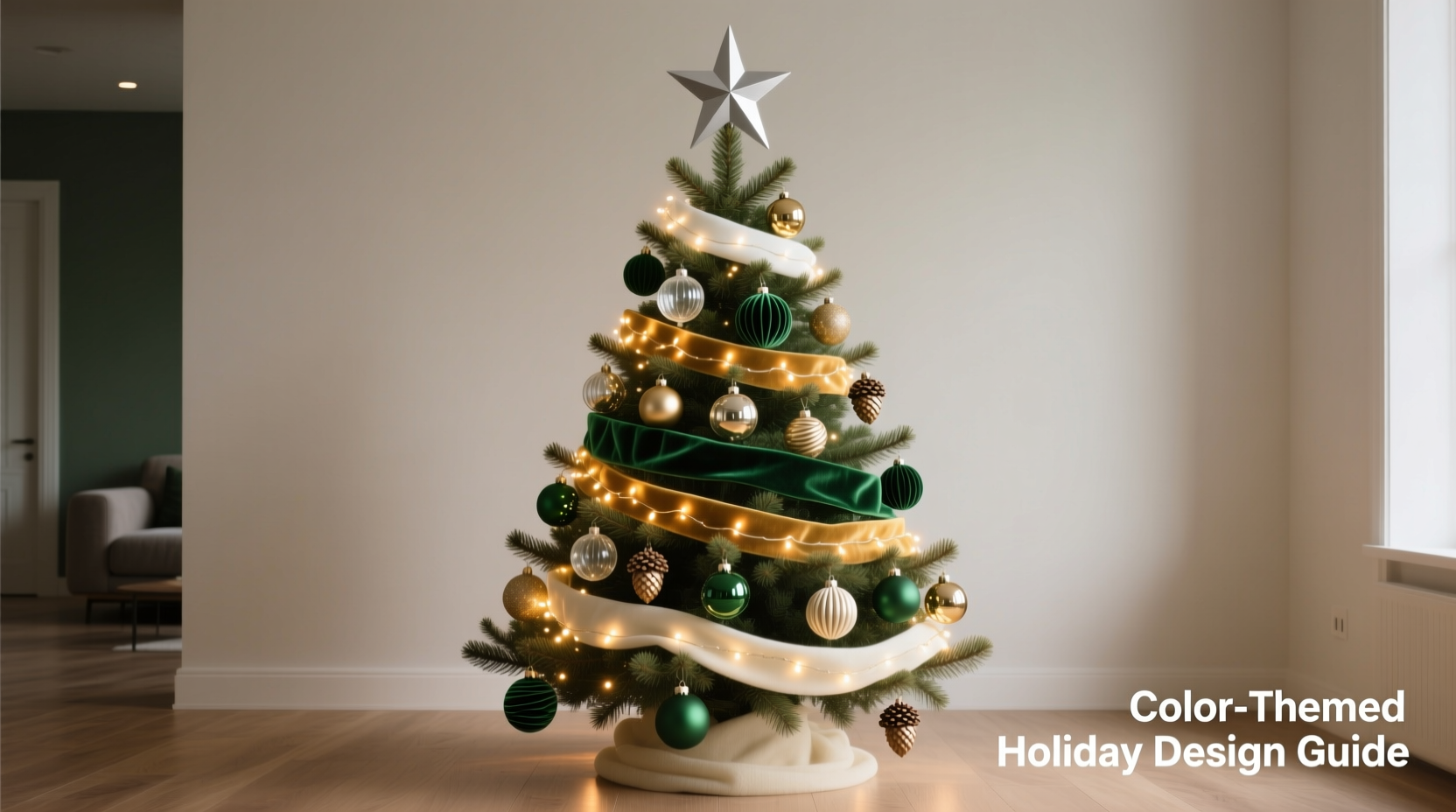
A color-themed Christmas tree transcends tradition—it becomes a curated expression of style, seasonality, and intention. Unlike the nostalgic charm of mixed red-and-green or the nostalgic sparkle of classic multicolor, a single-palette tree commands attention through harmony: every ornament, light, ribbon, and textural element working in concert. Done well, it feels both modern and timeless; executed without planning, it risks looking sparse, repetitive, or unintentionally monotonous. The difference lies not in budget or scale—but in strategy. This guide distills proven methods used by professional holiday stylists, interior designers, and experienced decorators into a practical, actionable framework. No vague suggestions—just precise decisions about color theory, material balance, light layering, and visual rhythm.
1. Choose Your Palette with Purpose (Not Just Preference)
Selecting a theme begins not with “what do I love?” but “what story does this tree tell?” A palette must serve function *and* feeling. Deep emerald and charcoal gray evoke forest stillness and quiet luxury; blush pink, ivory, and brushed gold whisper vintage romance; navy, silver, and frosted white suggest winter’s crisp elegance. Avoid starting with a single ornament or light string—begin instead with a base color that anchors the entire scheme: the dominant hue should make up 50–60% of your visual weight.
Use the 60-30-10 rule as your structural compass:
- 60% Dominant color: Appears in large-scale elements—tree skirt, primary ornament shapes (balls, large picks), and wrapping ribbon.
- 30% Secondary color: Adds contrast and depth—smaller ornaments, garland accents, light cord covers, or textured picks (e.g., velvet bows).
- 10% Accent color: Provides focal punctuation—metallic finishes (copper, antique brass), matte black details, or a single unexpected tone like burnt sienna in an otherwise cool palette.
This ratio prevents visual fatigue and ensures cohesion without sacrificing dimension. For example, a “Midnight Frost” theme might use 60% deep navy (velvet balls, satin ribbon), 30% frosted silver (glass icicles, mercury glass ornaments), and 10% antique brass (ornament hooks, star finial).
Tip: Test your palette before buying anything—print swatches of your chosen colors on cardstock, arrange them around a plain green branch or white paper, and observe how they interact under your room’s natural and artificial light. Warm bulbs enhance golds and creams; cool LEDs lift silvers and blues.2. Layer Lights Strategically—Not Just Abundantly
Lights are the tree’s circulatory system: they carry warmth, define shape, and unify disparate elements. Most people over-light vertically and under-light horizontally—resulting in a top-heavy, flat appearance. Professional trees use three distinct light layers:
- Foundation layer (innermost): Warm-white mini LED string lights wrapped tightly around inner branches—200–300 lights for a 7-foot tree. These illuminate from within, casting soft shadows and preventing dark voids.
- Mid-layer (structural): Slightly larger bulbs (e.g., G40 or C7) in your dominant or secondary color—strung along major branch lines to emphasize silhouette and volume. Space evenly: one bulb per 4–6 inches of branch length.
- Accent layer (outermost): Specialty lights only where needed—fiber-optic twigs for snow-dusted effect, battery-operated flickering candles tucked into clusters, or colored micro-lights (e.g., amber for a cognac-and-cream theme) placed exclusively inside clear glass ornaments.
Crucially, avoid mixing color temperatures unless intentional. A 2700K warm-white foundation paired with 4000K cool-white accents creates visual dissonance—even if both are “white.” Stick to one Kelvin rating across all white-based lights, and use colored lights strictly as accents—not substitutes.
For color-themed trees, consider these lighting pairings:
| Theme | Foundation Light | Mid-Layer Light | Accent Light Use |
|---|---|---|---|
| Ember & Clay | Warm-white (2700K) | Amber LED bulbs | Mini copper-wire lights woven into dried orange slices |
| Ivory & Graphite | Soft-white (3000K) | Matte graphite-coated filament bulbs | Clear fairy lights inside smoked-glass orbs |
| Sea Glass & Mist | Cool-white (4000K) | Light aqua LED mini-lights | Fiber optics threaded through sea-grass garlands |
3. Ornaments: Curate Texture, Scale, and Finish—Not Just Color
Ornaments are where most themed trees fail—not because of poor color choices, but because of texture collapse. A tree covered solely in glossy glass balls, even in perfect palette alignment, reads as flat and synthetic. Depth emerges from deliberate contrast: matte against shine, rough against smooth, organic against geometric.
Build your ornament collection using this five-category framework (aim for at least three categories represented):
- Sphere anchors: 3–5 sizes of round ornaments in your dominant color—matte ceramic, crackled glass, or velvet-finish plastic. These establish rhythm and repetition.
- Textural accents: Items with tactile distinction—dried citrus wheels, cinnamon sticks wired into bundles, hand-thrown stoneware pears, or wool-felt stars.
- Reflective elements: Mercury glass, mirrored acrylic, or polished brass—not for shine alone, but to bounce light from your layered strings into shadowed zones.
- Linear forms: Pick-style ornaments (wooden birch, brushed aluminum), slender icicles, or beaded strands that draw the eye upward and reinforce verticality.
- Natural inclusions: Unpainted pinecones, preserved eucalyptus sprigs, or bleached magnolia leaves—these add organic warmth and prevent sterility.
Spacing matters more than quantity. Hang ornaments in trios: one large (3–4\"), one medium (2–2.5\"), one small (1–1.5\")—all within a 6-inch radius. Rotate placement so no two identical ornaments face the same direction. And never hang ornaments solely on outer tips; pull 30% of them 4–6 inches inward toward the trunk to create dimensional fullness.
“Color harmony is necessary—but texture harmony is non-negotiable. A single matte ceramic ball amid ten glossy spheres will feel like a mistake. Match finish intent as rigorously as hue.” — Lena Torres, Lead Stylist at Evergreen Collective, featured in Architectural Digest Holiday Edition 2023
4. The Step-by-Step Assembly Timeline (90 Minutes Max)
Timing prevents decision fatigue and ensures balanced distribution. Follow this sequence—no skipping steps, no rearranging mid-process:
- Prep (10 min): Fluff tree branches from bottom up. Plug in and test all light strings separately. Sort ornaments into labeled bins by category (spheres, picks, texture, etc.). Lay out tree skirt, ribbon, and finial.
- Foundation lights (15 min): Starting at the trunk base, wrap warm-white mini-lights tightly around inner branches. Work upward in spirals, stepping back every 2 feet to check density. Aim for even spacing—no clumps or gaps.
- Mid-layer lights (10 min): String larger bulbs along main branch arms, focusing on horizontal and diagonal lines that define the tree’s silhouette. Secure with floral wire, not clips, for clean anchoring.
- Ornament placement (35 min): Begin at the bottom third. Place sphere anchors first—large to small, rotating angles. Then insert textural and linear pieces in the same zone. Move upward in 18-inch bands. Leave top 12 inches bare until step 5.
- Ribbon, garland & finial (10 min): Drape wide satin or velvet ribbon in loose, asymmetrical loops—never tight spirals. Tuck in natural elements or small picks where ribbon meets branch. Top with finial matching your accent color (e.g., brushed brass star for navy-silver theme).
This sequence ensures lights support ornaments—not compete with them—and prevents last-minute overcrowding at the base.
5. Real-World Application: The “Sage & Smoke” Tree Case Study
In Portland, Oregon, interior designer Maya Chen transformed a client’s open-concept living room with a “Sage & Smoke” tree for a December wedding photoshoot. The space featured charcoal walls, oak floors, and minimalist furniture—so the tree needed grounding presence without visual noise.
Her execution followed strict parameters: 60% matte sage-green ceramic balls (in three sizes), 30% smoke-gray mercury glass ornaments (including tear-drop and oval shapes), and 10% unlacquered brass finial + wire-wrapped dried lavender sprigs. She rejected traditional white lights—instead using 2700K warm-white foundation lights and mid-layer Edison-style bulbs with smoked glass housings. Ribbon was 3-inch wide linen in heather gray, draped in gentle, gravity-led cascades—not uniform loops.
The result? A tree that felt simultaneously earthy and refined, photographing flawlessly against the charcoal wall while adding warmth to the cool-toned room. Crucially, guests consistently described it as “calming,” not “cold”—proof that palette discipline, when paired with intentional texture and light temperature control, achieves emotional resonance.
FAQ
Can I mix metallic finishes within one theme?
Yes—but with hierarchy. Choose one dominant metal (e.g., brass) for 80% of metallic elements, then use a second (e.g., matte black iron) strictly for structural items like ornament hooks or finial hardware. Never equalize two shiny metals (brass + chrome) side-by-side—they vibrate visually and fracture cohesion.
What if my tree is artificial and has built-in lights?
Replace them. Integrated lights rarely offer the Kelvin control, dimmability, or layering flexibility needed for a true color theme. Remove the built-in set entirely and rewire with your curated strings. It takes 20 minutes and pays dividends in ambiance and authenticity.
How do I store themed ornaments to preserve color and finish?
Store by category—not by color—in acid-free tissue-lined boxes. Separate matte and glossy pieces with parchment paper to prevent transfer. Include silica gel packs to inhibit tarnish on metals and moisture damage on textiles. Label each box with palette name and year acquired—this builds a sustainable, evolving collection.
Conclusion
A color-themed Christmas tree is not decoration—it’s curation. It asks you to slow down, choose deliberately, and honor the power of restraint. You don’t need rare finds or extravagant spending. You need clarity of vision, respect for material contrast, and the patience to layer light before hanging a single ornament. When executed with this level of intention, your tree becomes more than seasonal decor: it’s a quiet declaration of taste, a tactile pause in a hurried season, and a legacy piece your family will remember not for its glitter—but for its grace.
Start small this year. Commit to one palette. Source just five key ornaments that embody your dominant, secondary, and accent intentions. Wrap your lights with care—not speed. Watch how light moves through texture. Notice how a single matte sphere changes the energy of a cluster of glass. That awareness is where magic begins.
💬 Your turn—share your palette choice and one intentional detail you’ll prioritize this season. Tag a friend who needs permission to simplify their tree. Let’s fill the holidays with meaning, not just mass.