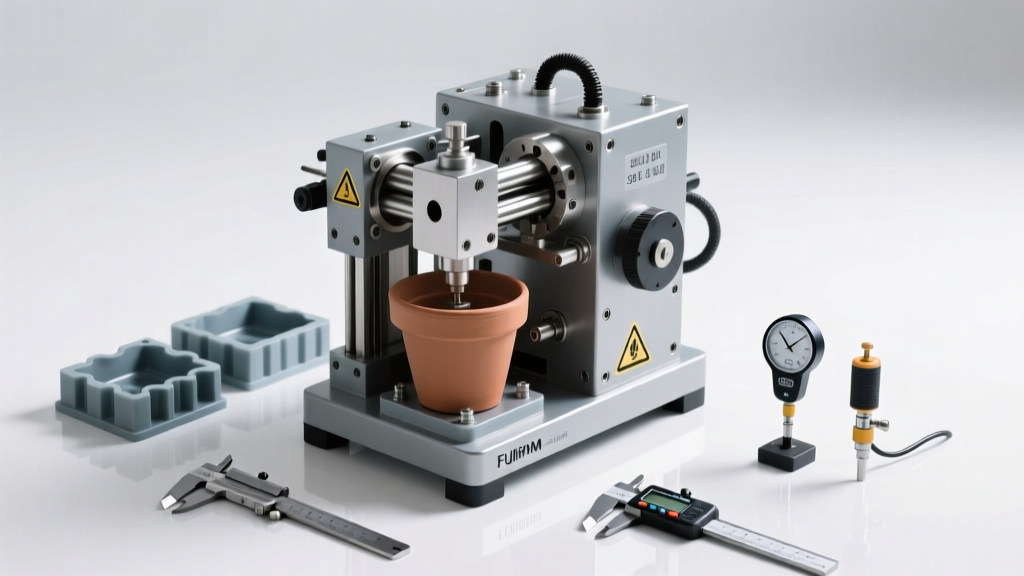
Melamine tableware remains one of the most commercially resilient segments in the global kitchenware industry—valued at over $2.4 billion in 2023 and projected to grow at 5.7% CAGR through 2030. Yet behind every stack of durable, glossy plates and bowls lies a critical decision point: the machine that produces them. Choosing the wrong melamine tableware making machine doesn’t just mean slower output or higher maintenance—it can compromise food-grade compliance, increase reject rates by 12–18%, and erode profit margins before your first production shift ends. This guide cuts through marketing claims and regional supplier variations to deliver actionable, engineer-vetted criteria for evaluating machines—not as catalog items, but as long-term operational assets.
1. Understand the Core Production Process—and Where Machines Diverge
Melamine tableware manufacturing is deceptively simple on paper: melamine-formaldehyde resin powder is compressed under heat and pressure into molds, then cooled, trimmed, and inspected. But the execution reveals sharp technical divides. Machines fall into three functional tiers:
- Manual hydraulic presses: Operator-dependent cycle timing, basic temperature control (±15°C), no integrated ejection or demolding assistance. Suitable only for micro-factories (<500 pieces/day) producing low-complexity items like round plates.
- Semi-automatic servo-hydraulic systems: Programmable PLC controllers, dual-zone heating, auto-ejection, and preset mold change protocols. Output ranges from 1,200–3,500 pieces/day with consistent surface gloss and dimensional accuracy (±0.15 mm).
- Fully automatic inline lines: Integrated feeding, compression, cooling, trimming, stacking, and vision-based defect detection. Throughput exceeds 6,000 pieces/day with <0.8% scrap rate and full traceability per batch.
The key insight isn’t “more automation = better.” It’s alignment between machine capability and your actual production profile—including product mix complexity, labor availability, and quality certification requirements (e.g., FDA 21 CFR 177.1470, EU 10/2011). A factory in Vietnam supplying European retailers cannot rely on manual presses—even if initial cost is 60% lower—because inconsistent dwell time leads to formaldehyde migration above 2.5 mg/dm², triggering automatic customs rejection.
Tip: Before requesting quotations, map your top 5 best-selling SKUs by diameter, depth, and rim complexity. Machines optimized for shallow salad bowls often underperform on deep soup bowls due to uneven pressure distribution across curved molds.2. Evaluate Critical Technical Specifications—Beyond Brochure Claims
Manufacturers routinely highlight maximum pressure (e.g., “1,000 tons”) or heating area—but these numbers are meaningless without context. What matters is how consistently those parameters are delivered *across the entire mold surface*, over sustained operation, and under real-world ambient conditions.
| Specification | What to Verify (Not Just Accept) | Why It Matters |
|---|---|---|
| Heating Uniformity | Request thermal imaging report showing surface temp variance across heated platen at operating temperature (target: ≤±3°C) | Non-uniform heating causes warping, gloss inconsistency, and micro-cracking—especially in large-diameter items (>28 cm) |
| Pressure Stability | Ask for pressure decay test data: % drop over 30-second dwell time at rated load | Drop >5% indicates hydraulic leakage or accumulator fatigue—directly linked to incomplete polymer cross-linking and post-mold shrinkage |
| Cooling Cycle Time | Confirm measured cooling duration *with mold installed* (not empty platen), including water inlet temp (25°C max) and flow rate (L/min) | Under-cooled parts deform during ejection; excessive cycle time kills throughput—every 5 seconds saved adds ~140 units/day at 2-shift operation |
| Mold Change Time | Observe live demo: time from last part removal to first stable production run with new mold set | Factories running 3+ SKU families daily lose 11–17 hours/week on inefficient changeovers—fully automatic quick-clamp systems reduce this to <90 seconds |
Always insist on third-party verification reports—not internal lab sheets—for ISO 9001-certified suppliers. One Tier-2 manufacturer in Guangdong was found to list “±2°C heating uniformity” based on single-point thermocouple readings, while independent testing revealed ±11°C variance at mold corners.
3. Safety, Compliance, and Long-Term Operational Cost
A melamine press operates at up to 180°C and 350 bar. Safety isn’t optional—it’s foundational to uptime and insurance viability. Look beyond CE or CCC marks. Validate:
- Presence of dual-channel light curtains with <60ms response time (per EN ISO 13857)
- Emergency stop redundancy: physical mushroom button + software-triggered hydraulic dump
- Exhaust ventilation integration for formaldehyde vapor capture (mandatory for EPA Tier II compliance)
- Resin feed system with anti-static grounding and explosion-proof motors (IECEx Zone 21 certified)
Operational cost is where many buyers miscalculate. A machine priced at $120,000 may consume 42 kW/h versus a competitor’s 28 kW/h model—adding $18,700/year in electricity alone (at $0.12/kWh, two shifts). More critically, bearing life in the main ram assembly varies from 18 months (low-grade Chinese steel) to 6+ years (Japanese NSK or SKF bearings with proper preload calibration). Factor in service labor: OEM technicians charge $120–$180/hour, but local technicians trained on specific hydraulics may not exist outside major industrial zones.
“Buyers who focus solely on purchase price ignore the true TCO—Total Cost of Ownership. In our 2022 benchmark of 47 melamine factories, machines with validated energy efficiency and modular hydraulics achieved 3.2x higher OEE (Overall Equipment Effectiveness) over five years than budget-tier units.” — Dr. Lin Wei, Senior Process Engineer, Asia Plastics Manufacturing Institute
4. Real-World Selection Timeline: From Inquiry to First Stable Batch
Selecting a machine isn’t linear—it’s iterative. Follow this field-tested sequence:
- Week 1–2: Define your non-negotiables: minimum output (pieces/day), required certifications (FDA/EU/SGS), and labor skill ceiling (e.g., “operators have no PLC experience”). Document all current pain points—rejects, downtime causes, mold damage frequency.
- Week 3: Shortlist 3–4 vendors using verified criteria: minimum 5 years in melamine-specific machinery, ≥3 client references in your target export region, and in-house R&D team (not just assembly partners).
- Week 4–5: Conduct virtual factory audits. Request live camera feeds of their test line running *your exact SKU specs*. Measure cycle consistency across 50 consecutive cycles—not just peak performance.
- Week 6: Negotiate contractual clauses: 90-day performance warranty tied to measurable KPIs (e.g., “scrap rate ≤1.2% on standard 26 cm plate”), mandatory spare parts list with lead times, and onsite commissioning by certified engineer—not distributor staff.
- Week 7–12: Install, calibrate, and validate. Run 3 production batches with your own resin and molds. Reject acceptance until all 12 QC checkpoints (including formaldehyde migration test per ASTM D5118) pass.
This timeline prevents the common trap of accepting “good enough” during installation—where 72% of early failures originate, according to the International Melamine Association’s 2023 Failure Mode Report.
5. Mini Case Study: How a Malaysian Exporter Avoided $220,000 in Annual Losses
In 2021, Selangor Tableware Sdn Bhd supplied melamine sets to Australian supermarkets under strict “zero visible blemish” policy. Their aging 630-ton manual press produced 1,800 pieces/day but generated 9.4% visual rejects—mostly micro-pitting on rim surfaces and inconsistent gloss. Initial vendor proposals focused on upgrading to a “high-end” semi-auto press ($98,000), promising 4.5% rejects.
Instead, engineering lead Aisha Tan insisted on root-cause analysis. Her team discovered the issue wasn’t pressure or heat—it was mold surface degradation from abrasive resin fillers and insufficient platen parallelism (0.18 mm deviation). They selected a mid-tier servo-hydraulic press ($132,000) with precision-ground platens (parallelism ≤0.03 mm), integrated mold cleaning nozzles, and closed-loop pressure compensation. Rejects dropped to 0.9%. More importantly, mold life extended from 45,000 to 112,000 cycles—saving $220,000 annually in mold replacement and regrinding costs. The ROI period? 14 months.
6. FAQ: Practical Questions from Factory Managers
Can I use the same machine for both melamine and urea-formaldehyde tableware?
No. Melamine resin requires higher compression temperatures (145–165°C) and longer dwell times (45–90 seconds) than urea (125–135°C, 25–45 sec). Using one machine for both accelerates thermal fatigue in heating elements and compromises cross-linking integrity in melamine—increasing formaldehyde leaching risk. Dedicated machines are non-negotiable for certified production.
How important is resin pre-heating capability?
Critical for consistency. Unheated resin entering a hot mold causes localized steam pockets, leading to blistering and pinholes. Machines with integrated resin pre-heaters (maintaining 35–45°C) reduce surface defects by 31–44%, per a 2023 study across 12 Thai factories. Skip this feature only if your resin supplier guarantees moisture content <0.12%—rare outside premium Japanese grades.
Do I need IoT connectivity for a small-scale operation?
Yes—if you plan to scale or export. Remote monitoring (cycle time, temp/pressure logs, alarm history) is now required for BRCGS and SQF certification audits. Even small units benefit: one Philippines-based unit reduced unplanned downtime by 68% after installing basic cloud telemetry—because vibration anomalies were flagged 17 hours before bearing failure.
Conclusion
Choosing a melamine tableware making machine is less about selecting hardware and more about committing to a production philosophy: consistency over speed, precision over power, longevity over upfront savings. The best machines don’t shout—they deliver silent, repeatable excellence: identical gloss levels across 10,000 bowls, zero dimensional drift over 30 days, and seamless transitions between SKUs without recalibration. They turn resin powder into trusted tableware—not just inventory. Your choice today shapes product reputation, regulatory standing, and margin resilience for the next decade. Don’t settle for “it works.” Demand “it endures.”
💬 Have you upgraded your melamine line recently? Share your biggest lesson—whether it was mold alignment, resin compatibility, or training hurdles—in the comments. Your real-world insight helps others avoid costly missteps.