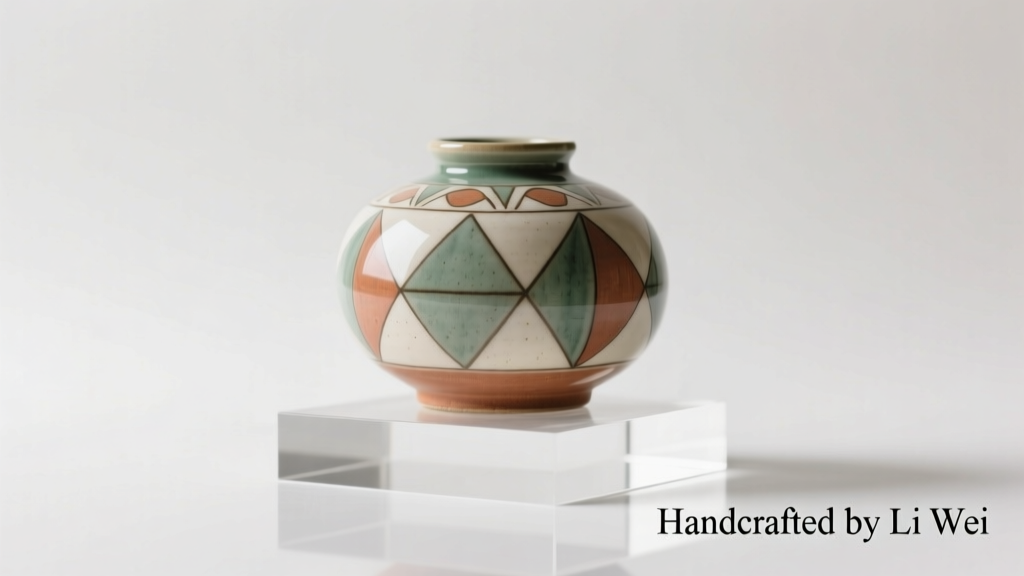
Antique vase sets occupy a rare intersection of artistry, history, and domestic elegance. Unlike mass-produced decor, a thoughtfully chosen set—whether a pair of Qing dynasty famille rose porcelain vases or a matched Art Deco glass ensemble—carries layered meaning: the hand of the maker, the taste of its original owner, and the quiet resonance of time. Yet acquiring such pieces demands more than aesthetic instinct. It requires discernment grounded in material science, historical context, and market awareness. Missteps are common: overpaying for reproductions, overlooking structural flaws masked by patina, or misattributing origin due to superficial stylistic similarities. This guide distills decades of curatorial practice, dealer experience, and conservation insight into actionable criteria—not theory, but field-tested judgment calls you can apply before clicking “Buy Now” or stepping into an auction preview room.
1. Verify Authenticity Before Assessing Beauty
Authenticity is the non-negotiable foundation. A vase set may be visually stunning, but if it’s a 20th-century studio reproduction passed off as 18th-century Meissen—or worse, a factory-made “antique-style” import—it holds neither historical weight nor long-term value. Begin with three forensic checks:
- Maker’s marks and signatures: Examine bases under magnification. Genuine Chinese porcelain from the Kangxi period (1662–1722) bears reign marks in underglaze blue, often slightly irregular in stroke. European porcelain like Royal Copenhagen uses specific backstamps that evolved in precise ways—e.g., the “three wavy lines” mark appeared only between 1939 and 1969. Beware of “ghost marks”: clean, crisp reproductions stamped onto unmarked blanks.
- Material analysis: Glass and porcelain behave differently under age. Genuine antique glass (e.g., Bohemian cut crystal from 1880–1910) shows subtle internal striations and a soft, warm ring when tapped gently—not the sharp, brittle chime of modern lead-free glass. Porcelain bodies should feel dense and cool; lightweight, chalky-feeling pieces are likely later earthenware or composite resin.
- Patina consistency: True age reveals itself in uniform wear—not just on high points, but in recessed areas where dust and handling naturally accumulate. Look for faint discoloration inside necks or along interior rims. If wear appears scrubbed, bleached, or suspiciously localized (e.g., only on one vase in a pair), it suggests recent restoration or deliberate aging.
2. Decode the Era: Style, Technique, and Cultural Context
Antique vase sets are not interchangeable. A Victorian majolica set (1850–1900) served as bold, colorful centerpieces in parlors filled with heavy drapery and gaslight; its thick glaze and molded botanical motifs were engineered for durability and visual impact in low-light interiors. In contrast, a Japanese Satsuma set (late Edo to Meiji, c. 1860–1920) features fine crackle glaze and intricate hand-painted scenes meant for contemplative viewing in quieter, more refined spaces. Understanding era-specific intent prevents mismatched acquisitions.
| Era & Origin | Key Identifying Features | Common Pitfalls |
|---|---|---|
| Chinese Qing Dynasty (1644–1912) | Fine, translucent porcelain body; precise cobalt blue underglaze painting; reign marks in seal script; famille rose palette (pink, green, yellow) introduced c. 1720 | Misreading apocryphal marks; confusing Kangxi-era “blue and white” with later, looser 19th-c. copies |
| French Art Nouveau (1890–1910) | Organic forms (lilies, dragonflies); iridescent glazes (Daum, Gallé); acid-etched or cameo-carved glass; signature etched on base | Confusing genuine Gallé cameo work (layered glass carved through) with surface-painted imitations |
| American Brilliant Cut Glass (1876–1917) | Deep, precise geometric cutting (starbursts, hobnails); no color—pure optical clarity; sharp, unforgiving edges; often signed “T.G. Hawkes” or “Duncan & Miller” | Overlooking chips or polishing scratches—these pieces are fragile and rarely survive unscathed |
| English Victorian Majolica (1850–1900) | Heavy, opaque earthenware; vibrant lead glazes (turquoise, manganese purple); molded relief (shells, grapes, ferns); often unmarked or bearing factory stamps like “Mintons” | Assuming all majolica is valuable—common patterns (e.g., simple leaf borders) hold modest value vs. rare figural pieces |
“Style without substance is decoration. A true antique vase set tells a story in its clay, its glaze, its wear—and that story begins with knowing *when* and *where* it was made.” — Dr. Linh Nguyen, Senior Curator, Asian Arts Division, Metropolitan Museum of Art
3. Condition Assessment: Beyond Surface Scratches
Condition determines both safety and longevity. A hairline crack may seem minor until temperature shifts cause it to propagate; an unstable glaze may powder away during cleaning. Prioritize structural integrity over cosmetic perfection. Use this hierarchy:
- Stability: Hold each vase gently at the base and neck. Gently twist—no movement should occur. Tap lightly with a fingernail: a dull thud indicates a hidden crack; a clear, sustained ring signals soundness.
- Glaze integrity: Run a fingertip over surfaces. Genuine crazing (fine, web-like cracks in glaze) is acceptable and expected in older porcelain—but check if it’s confined to the glaze layer. If your nail catches or lifts tiny flakes, the glaze is detaching—a sign of chemical degradation or poor firing.
- Restoration transparency: Any repair must be disclosed. Professional restoration (e.g., Japanese kintsugi using urushi lacquer and gold) adds historical narrative. But epoxy fills, mismatched paint, or visible seams drastically reduce value and risk further damage. Ask for restoration documentation.
- Base integrity: The foot rim bears the most stress. Inspect for chips, grinding, or uneven wear. A professionally re-ground base (smooth, concentric rings) is acceptable; jagged, asymmetrical wear suggests careless handling or display on unstable surfaces.
4. The Provenance Principle: Why Ownership History Matters
Provenance—the documented chain of ownership—is the single strongest validator of authenticity and context. A vase set once owned by a noted collector (e.g., J.P. Morgan’s Chinese porcelain collection), exhibited in a museum (with loan records), or included in a scholarly catalogue raisonné carries inherent credibility. More practically, it provides clues about care: a set from a climate-controlled London townhouse is likelier to retain stable glaze than one stored in a humid Florida attic for 40 years.
Real-world example: Sarah Chen, a design historian in Portland, acquired a pair of celadon-glazed vases attributed to 12th-century Song dynasty kilns. Initial excitement dimmed when she discovered their 1970s auction record listing them as “Southern Song style”—a red flag. Further research revealed they’d been purchased from a Paris dealer known for commissioning high-end reproductions in Jingdezhen. Without that paper trail, she might have paid five figures for pieces with no historical lineage. Instead, she redirected her budget toward a documented 19th-century Yixing teapot set with clear family provenance—and far greater cultural resonance.
5. Ethical Acquisition & Market Realities
The antique market faces serious ethical challenges: looted artifacts, undocumented excavations, and export restrictions. Reputable dealers adhere to the 1970 UNESCO Convention and national laws (e.g., China’s 1982 Cultural Relics Protection Law). Always request written provenance statements and verify export licenses for items leaving their country of origin. Avoid sellers who offer vague assurances like “it’s been in my family for generations” without documentation.
Price reflects more than rarity. A scarce 17th-century Dutch Delft set may command less than a common but exceptionally preserved 1920s Lalique set because Lalique’s market has robust collector infrastructure—authenticated databases, active forums, and consistent auction results. Use these benchmarks:
- Auction archives: Search past sales on Christie’s, Sotheby’s, and Skinner—not just final prices, but buyer premiums, condition reports, and lot notes. Note how similar items performed across multiple seasons.
- Dealer consistency: Compare pricing across three reputable specialists (e.g., one focused on Asian ceramics, one on European glass, one on American decorative arts). Wild discrepancies signal either undervaluation or inflated expectations.
- Functional realism: If the set includes stoppers, lids, or matching stands, confirm they’re original and fit precisely. Mismatched accessories erode value by 30–60%.
Step-by-Step Acquisition Checklist
Follow this sequence before committing to any purchase:
- Identify your purpose: Is this for display, investment, or functional use? Investment-grade pieces demand stricter provenance; display pieces prioritize visual harmony.
- Define non-negotiables: Set hard limits: maximum age (e.g., pre-1920), minimum condition (no cracks, no restoration), required documentation (export license, prior auction record).
- Pre-screen digitally: Use high-resolution images to check base marks, glaze texture, and symmetry. Zoom on joins and rims.
- Request condition report: Demand a written, dated report from the seller detailing all flaws—even minor ones—and specifying restoration methods used.
- Verify shipping protocol: Insist on museum-grade crating (custom-cut foam, double-walled boxes, climate-stable packing). Refuse “standard parcel post” for fragile antiques.
FAQ
How do I know if a “pair” is truly matched?
True matching goes beyond size and shape. Examine the glaze thickness under side lighting—identical flow patterns indicate simultaneous firing. Check base marks: identical placement, depth, and tooling marks confirm shared production. Mismatched pairs (e.g., vases made months apart) often show subtle variations in clay tone or pigment saturation.
Are antique vase sets safe for daily use?
Rarely. Most antique glazes contain lead or cadmium, leaching into liquids over time. Even non-toxic porcelain risks thermal shock—pouring hot water into a cold 18th-century vase can cause instant fracture. Reserve them for dry display only. If functionality is essential, seek modern reproductions using food-safe, oven-proof materials.
Can I insure an antique vase set?
Yes—but standard homeowner policies exclude antiques above certain values. You’ll need a scheduled personal property endorsement. Insurers require professional appraisals (dated within 2 years), high-res photos, and provenance documents. Factor appraisal costs (typically $150–$300 per item) into your acquisition budget.
Conclusion
Choosing the best antique vase set isn’t about chasing the oldest or most expensive piece—it’s about finding the set whose history resonates with your own values, whose craftsmanship rewards slow looking, and whose condition promises decades of quiet presence in your space. It’s the difference between owning an object and stewarding a fragment of human ingenuity. Every decision—from verifying a reign mark to reading an auction catalogue footnote—builds confidence that transcends trend. These vases won’t shout for attention; they’ll deepen in meaning the longer you live with them. Start small: acquire one well-vetted piece, study it daily, learn its language of glaze and form. Then, let that knowledge guide your next choice—not the algorithm, not the auction hype, but your own cultivated eye. Your home doesn’t need more decor. It needs heirlooms that earn their place.
💬 Have you uncovered a meaningful antique vase set? Share your discovery story, verification process, or display tips below—we’ll feature thoughtful contributions in our monthly collector spotlight.