Ambient lighting beneath a Christmas tree transforms the holiday centerpiece from festive to ethereal — casting soft, upward-facing light that warms the room, highlights ornaments, and creates depth where shadows once dominated. Unlike traditional tree lights that draw attention upward, under-tree lighting works quietly: it lifts the visual weight of the trunk, illuminates gifts without glare, and adds cinematic dimension to your entire display. Yet many skip this layer entirely, assuming it’s too complex, unsafe, or unnecessary. In reality, it’s one of the most impactful, low-effort upgrades you can make — provided you understand the principles of light diffusion, circuit load, and spatial safety. This guide walks through every practical decision: from choosing between LED strips and puck lights, to hiding wires under rugs, calculating safe wattage for indoor use, and avoiding common pitfalls that lead to flickering, overheating, or tripped breakers.
Why Under-Tree Lighting Matters Beyond Aesthetics
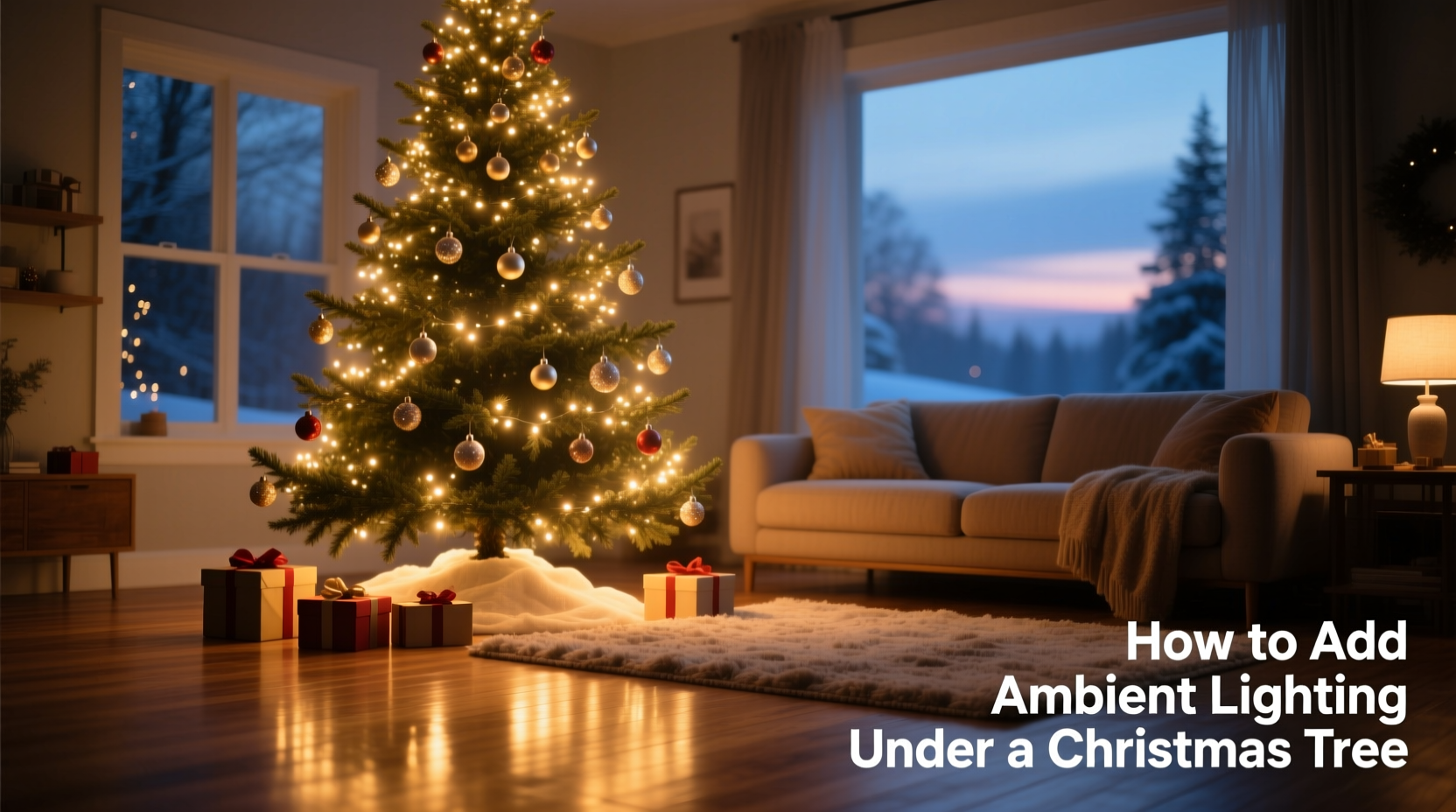
Lighting beneath the tree serves three functional roles rarely discussed in seasonal decor blogs. First, it solves the “dark base” problem: even well-lit trees cast dense shadows at their base, making wrapped presents appear flat and diminishing the illusion of abundance. Second, it improves spatial perception — especially in open-plan living areas — by anchoring the tree visually to the floor rather than letting it float in mid-air. Third, and most importantly, it enhances safety. Ambient uplighting reduces eye strain when guests approach the tree at night, minimizes tripping hazards near gift piles, and eliminates the need to fumble for floor lamps or overhead switches during late-night gift exchanges.
Interior lighting designer Lena Torres, who has consulted on holiday installations for museums and luxury retail spaces for over 14 years, confirms this layered approach:
“A tree lit only from within is like a portrait with no background — technically correct but emotionally incomplete. The glow beneath isn’t decorative filler; it’s visual grounding. It tells the eye where the object ends and the space begins.” — Lena Torres, Principal Lighting Designer, Lumina Studio
Choosing the Right Light Source: Strips, Pucks, or Ropes?
Not all under-tree lighting delivers the same quality of ambient glow. Brightness, color temperature, beam angle, and physical profile determine whether light appears soft and enveloping or harsh and directional. Below is a comparison of the three most viable options for residential use:
| Light Type | Best For | Color Temp Range | Key Limitation | Installation Effort |
|---|---|---|---|---|
| Adhesive LED Strip Lights (300–600 LEDs/m) | Even, seamless glow around full tree base; ideal for carpet or hard floors | 2700K–3000K (warm white), dimmable | Requires clean, dry surface for adhesive; not repositionable after first application | Low — peel-and-stick, plug-in power supply |
| Low-Profile LED Puck Lights (3–5W each) | Modular control; works well on uneven surfaces or under tree skirts with gaps | 2200K–2700K (amber to warm white); some models offer CCT switching | Visible hardware; requires spacing to avoid hotspots | Moderate — needs mounting (adhesive pads or small screws) and wire management |
| Flexible LED Rope Lights (with diffuser jacket) | Traditional aesthetic; easy to coil or drape; good for renters (no adhesive) | 2700K only (standard); limited dimming compatibility | Less uniform output; prone to visible “dots” if low-density; higher heat retention | Low-Moderate — requires securing with clips or weights, separate power adapter |
For most homes, high-density, warm-white LED strip lights (with 3M VHB tape backing and a 24V DC power supply) deliver the most consistent ambient effect. They emit light across their entire length rather than from discrete points, eliminating the “string-of-pearls” look that distracts from the glow. Crucially, they run cool — surface temperatures rarely exceed 35°C (95°F) even after 12 hours — making them safe near fabric tree skirts, paper-wrapped gifts, and wooden stands.
Tip: Never use standard 120V AC fairy lights or incandescent rope lights under the tree — their exposed wiring, higher operating temperatures (up to 80°C), and lack of UL listing for floor-level use pose real fire and shock risks.A Step-by-Step Installation Guide (Under 45 Minutes)
Follow this sequence precisely — skipping steps increases risk of voltage drop, inconsistent brightness, or accidental disconnection. All materials listed are widely available at hardware stores or online retailers with UL/ETL certification.
- Measure and Plan: Use a flexible tape measure to record the circumference of your tree stand base (not the widest branch span). Add 12 inches for overlap and slack. Note the distance from the nearest grounded outlet — factor in 3 feet of extra cord for routing under furniture or along baseboards.
- Select & Test Power Supply: Match voltage (e.g., 24V) and amperage. Calculate total draw: multiply strip length (in meters) × watts per meter (e.g., 14.4 W/m). Choose a power supply rated at least 20% above that total. Test it independently before attaching lights.
- Clean & Dry Surface: Wipe the floor area with isopropyl alcohol. Let dry fully. Dust or residue prevents adhesive bonding — leading to peeling within days.
- Apply Strip Lights: Peel backing gradually (no more than 12 inches at a time). Press firmly with a soft cloth while applying — do not stretch the strip. Butt ends tightly; avoid gaps. For circular coverage, cut only at marked scissor icons (never mid-LED).
- Route & Conceal Wiring: Run the DC cable under baseboards using adhesive cable clips, or tuck beneath area rugs with non-slip pads. Never staple, nail, or tape directly to flooring — heat buildup degrades insulation.
- Connect & Dim: Plug into power supply, then into outlet. Use an inline dimmer switch (compatible with 24V DC) placed within easy reach — not behind furniture. Adjust to 60–75% brightness for optimal ambient effect; full brightness creates glare, not glow.
Real-World Case Study: The Peterson Living Room Upgrade
The Petersons live in a 1920s bungalow with hardwood floors, tall ceilings, and a 7.5-foot Fraser fir. Each year, their tree looked “bright but lonely” — ornaments sparkled, but the base vanished into shadow, and evening photos always showed a dark void beneath the branches. They tried battery-operated tea lights (too dim, died in 2 nights), then cheap RGB strips (flickered, overheated, and melted adhesive on day 3). On recommendation from their electrician, they upgraded to 5-meter, 600-LED/m, 24V warm-white strips with aluminum heat-dissipating backing. They installed them in a double-loop configuration — one ring just outside the tree stand, another 10 inches outward — creating gentle radial diffusion. A programmable timer now activates the lights 30 minutes before sunset and dims gradually after midnight. Result? Guests consistently comment on the “floating forest” effect. More practically, their toddler no longer trips over gift boxes in the dark, and family photos now capture rich tonal gradation from floor to treetop — without post-processing.
Do’s and Don’ts: Safety, Longevity, and Visual Integrity
Under-tree lighting sits at the intersection of electrical safety, material compatibility, and design intention. These guidelines prevent failures before they happen:
- Do use only UL/ETL-listed components — including power supplies, dimmers, and extension cords rated for continuous indoor use.
- Do install a GFCI-protected outlet or plug into a GFCI adapter if your home lacks updated circuits — especially important near wood stands that may retain moisture.
- Do inspect all connections daily for warmth. If the power supply or strip feels warm to the touch (beyond mild warmth), unplug immediately and check for overloaded circuits or damaged insulation.
- Don’t place lights directly against flammable materials like dried pine needles, cardboard gift boxes, or untreated burlap skirts — maintain at least 2 inches of air gap.
- Don’t daisy-chain more than two 5-meter strips on a single 24V power supply unless explicitly rated for extended loads — voltage drop causes dimming at the far end and premature LED failure.
- Don’t use Bluetooth or Wi-Fi-enabled controllers under the tree — radio interference from routers, microwaves, and smart speakers can cause erratic behavior and reset issues.
FAQ: Practical Questions Answered
Can I use under-tree lighting with a pre-lit tree?
Yes — and it’s highly recommended. Pre-lit trees focus illumination inward and upward, leaving the lower third underlit. Adding ambient base lighting balances the visual weight and prevents the “top-heavy” appearance common with artificial trees. Just ensure your under-tree lights operate on a separate circuit or dimmer so you can adjust intensity independently.
How do I hide the power cord without tripping hazards or unsightly loops?
Use flat, low-profile cord covers (available in wood-grain, black, or white) that mount directly to baseboards with removable adhesive. For rugs, choose non-slip rug pads with built-in cord channels — these hold cables flat beneath the rug edge while preventing shifting. Never rely on tape alone; it loses adhesion quickly and leaves residue.
Will ambient lighting increase my electricity bill noticeably?
No. A typical 5-meter warm-white LED strip consumes ~72 watts total — less than a single 75W incandescent bulb. Running it 8 hours nightly for 30 days adds approximately $0.22 to your bill (at $0.13/kWh). Even with a second loop or four puck lights, total draw remains under 100 watts.
Conclusion: Your Tree Deserves That Final Layer of Thoughtful Light
Ambient lighting under the Christmas tree isn’t about extravagance — it’s about intentionality. It reflects the care you put into every other detail: the curated ornament palette, the scent of pine and cinnamon, the careful placement of stockings. When done right, it doesn’t shout for attention; it invites quiet appreciation. It turns a seasonal decoration into a living element of your home’s atmosphere — one that glows with warmth, safety, and quiet sophistication. You don’t need specialty tools or electrician certification to achieve this. What you do need is the right information, the right components, and the willingness to treat lighting as part of your home’s architecture — not just its decoration. Start with one strand. Measure twice. Conceal thoughtfully. Dim intentionally. Then step back and feel the difference that upward light makes — not just to your tree, but to the way your whole space holds the season.
💬 Have you added under-tree lighting this year? Share your setup, challenges, or favorite product in the comments — your experience could help someone else create their most memorable holiday glow yet.