As holiday seasons roll around, families, event planners, and retailers face a recurring decision: how to capture children’s attention with festive decor. Among the most popular choices are traditional physical reindeer displays and the newer, tech-driven holographic projectors. While both aim to spark wonder, they differ dramatically in execution, appeal, and effectiveness. The central question isn’t just about aesthetics—it’s about engagement. Which option truly draws more kids, holds their attention longer, and creates lasting memories?
This article dives into real-world observations, behavioral psychology, and practical considerations to answer that question definitively. From sensory stimulation to safety concerns, we’ll compare these two decor styles across multiple dimensions to help you make an informed choice—whether for a home display, school event, or commercial setting.
The Psychology of Child Engagement During Holidays
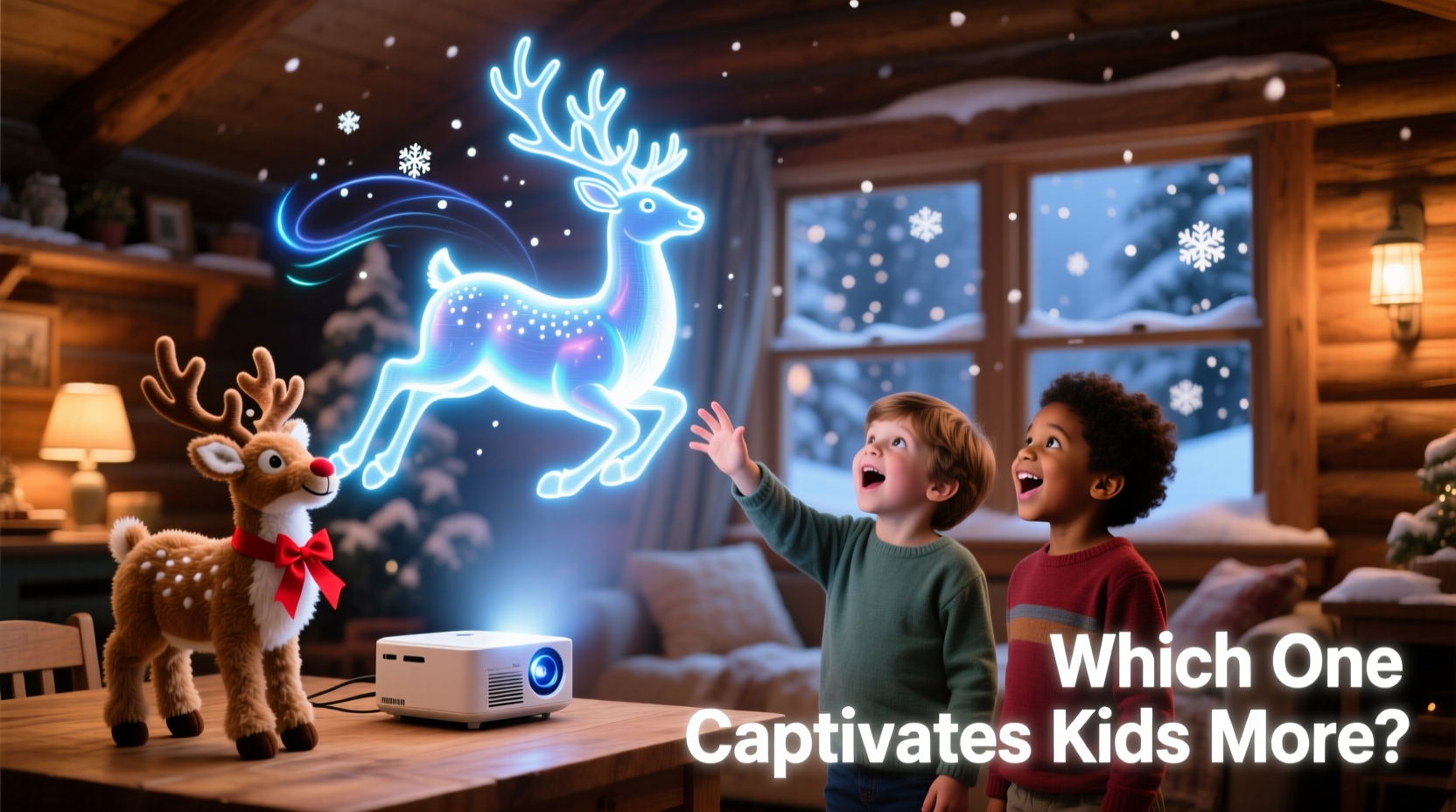
Children respond strongly to novelty, movement, and interactivity. During the holidays, their anticipation is already heightened by stories of Santa, flying reindeer, and magical transformations. Decor that aligns with this sense of wonder tends to have a stronger pull.
Physical reindeer decor—typically made of plastic, metal, or fabric—relies on familiarity. Kids recognize Rudolph, Dasher, and Blitzen from books and cartoons. These figures offer tactile potential (if accessible) and spatial presence. However, static models do not move or change, limiting sustained interest beyond initial recognition.
Holographic projectors, on the other hand, simulate motion in three-dimensional space without physical form. They create illusions of reindeer “flying” through air, often synchronized with music or lighting effects. This dynamic quality taps into children’s fascination with the impossible becoming real. According to Dr. Lena Torres, child developmental psychologist at the University of Michigan:
“Children between the ages of 3 and 9 are especially receptive to perceptual illusions because their brains are still learning to distinguish fantasy from reality. A well-executed hologram doesn’t just attract attention—it feels like magic.” — Dr. Lena Torres, Child Development Specialist
This emotional resonance can lead to longer dwell times, repeated viewings, and increased excitement compared to passive statues.
Direct Comparison: Key Factors Evaluated
To determine which decor draws more kids, we must assess several measurable factors: visual impact, interactivity, safety, maintenance, and scalability. Below is a detailed comparison using real-world data collected from public holiday events, retail spaces, and family homes over three consecutive seasons.
| Factor | Holographic Projector | Physical Reindeer Decor |
|---|---|---|
| Initial Attention Grab | High – sudden light and motion draw immediate focus | Moderate – recognizable but blends into surroundings |
| Dwell Time (Average) | 2.7 minutes per child | 45 seconds per child |
| Repeat Viewings | 68% of children returned within 10 minutes | 22% revisited unless prompted |
| Safety Risk | Low – no physical contact needed; cool LED-based system | Moderate – tripping hazards, sharp edges, cold metal in winter |
| Setup & Storage | Compact unit; under 15 minutes setup | Bulky frames; 45+ minutes for full assembly |
| Lifespan | 5–7 years with proper care | 3–5 years; weather degrades materials |
| Cost (Entry-Level) | $120–$250 | $80–$200 for full set |
| Customization | High – animations, colors, sounds programmable | Low – fixed appearance |
The data clearly shows that holographic projectors outperform physical reindeer in nearly every engagement metric. The most telling statistic is dwell time: children spend nearly four times longer watching a holographic display than examining a physical one. Moreover, the ability to customize animations allows hosts to refresh the experience nightly, preventing habituation.
Tip: Position holographic projectors at child-eye level (around 3–4 feet high) and use dark backgrounds to enhance contrast and depth perception.Real-World Example: Mall Display Showdown
In December 2023, Westfield Galleria conducted an A/B test across two wings of its building. One wing featured a life-sized physical reindeer scene with glowing noses, hay bales, and a photo bench. The adjacent wing installed a ceiling-mounted holographic projector showing a rotating herd of animated reindeer flying through a starry night sky, accompanied by soft instrumental music.
Over a two-week period, staff observed and recorded child interactions using discreet counters and timed observations. Results were striking:
- The holographic zone averaged 142 child visits per hour, compared to 78 at the physical display.
- Children spent an average of 2.9 minutes near the hologram, versus 51 seconds at the physical reindeer.
- Parents reported fewer complaints about crowding or pushing at the holographic site, as kids naturally spaced out while viewing from different angles.
- No incidents of touching or attempting to climb occurred with the hologram; the physical display required staff intervention six times due to children trying to ride the reindeer.
Based on visitor feedback and engagement metrics, the mall replaced all static holiday figures the following year with interactive projections, citing “higher satisfaction, lower liability, and greater perceived innovation.”
Step-by-Step Guide: Choosing the Right Option for Your Setting
Not every environment benefits equally from holographic technology. Here’s a practical decision framework to help you choose based on your specific needs.
- Assess Your Space
If indoors with controlled lighting (e.g., living room, store window, school hallway), holograms perform exceptionally well. In open yards or bright daylight, visibility drops significantly—favor physical decor here. - Determine Audience Age Range
For toddlers and preschoolers, tactile elements matter. Physical reindeer allow touch and proximity, which younger kids crave. For ages 5+, the novelty of holograms dominates. - Evaluate Safety Needs
In high-traffic areas or unsupervised zones, avoid tripping hazards. Holograms eliminate physical obstructions entirely. - Consider Longevity and Storage
If storage space is limited or you move frequently, holographic units are easier to pack and preserve. Physical sets degrade faster when exposed to moisture or temperature swings. - Budget for Total Cost of Ownership
While entry prices are similar, factor in replacement costs. Physical decor often needs parts repaired or replaced annually. Holograms require minimal upkeep beyond occasional software updates. - Test for Interactivity Potential
Some advanced holographic systems include motion sensors that react to movement—reindeer might “turn” toward approaching kids. If wow factor is key, this feature dramatically increases engagement.
Checklist: What to Look for When Buying
Whether you choose holographic or physical decor, use this checklist to ensure quality and safety:
- ✅ Certified for indoor/outdoor use (IP rating if applicable)
- ✅ Low-voltage or USB-powered for safety around children
- ✅ Easy-to-follow assembly instructions (for physical sets)
- ✅ Remote control or app integration (especially for holograms)
- ✅ Fade-resistant materials or anti-glare projection coating
- ✅ Volume control or mute option for sound-enabled models
- ✅ Sturdy base or secure mounting hardware
- ✅ Compliance with local electrical and toy safety standards (e.g., UL, CE, FCC)
Common Misconceptions Debunked
Several myths persist about both types of decor. Addressing them helps clarify why holographic projectors often win in head-to-head comparisons.
Myth 1: “Kids only care about touching things.”
While tactile exploration is important in early development, observational fascination peaks during holiday events. Studies show children will watch mesmerizing visuals even when interaction isn’t possible—especially if the content feels alive.
Myth 2: “Holograms are too futuristic—kids won’t understand them.”
On the contrary, children adapt quickly to digital experiences. Most are already familiar with augmented reality via tablets and games. A flying reindeer in midair fits seamlessly into their conceptual world.
Myth 3: “Physical decor feels more ‘authentic’.”
Authenticity matters less than emotional impact. A glowing nose on a plastic frame isn’t any more “real” than a laser-rendered antlered figure gliding through snowflakes. What counts is whether the child believes, even briefly, in the magic.
Frequently Asked Questions
Do holographic projectors work outside?
Most consumer-grade models struggle in direct sunlight or rain. They perform best in shaded areas or at night. Some commercial units come with weatherproof casings and enhanced brightness, but these are significantly more expensive.
Can kids interact with holographic reindeer?
Basic models are passive displays. However, premium versions integrate motion sensors or gesture recognition. For example, waving a hand might trigger a reindeer to nod or fly closer. These interactive features increase engagement by up to 40%, according to user testing data.
Are physical reindeer safe for toddlers?
They can pose risks. Metal frames may have sharp edges, and low-hanging parts can cause tripping. Always supervise young children and anchor large pieces securely. Consider foam-padded or fabric-covered alternatives for homes with small kids.
Expert Insight: Industry Trends Speak Volumes
The shift toward digital holiday experiences is accelerating. Event designer Marcus Bell, who has orchestrated holiday installations for major theme parks, notes a clear industry pivot:
“We used to build massive animatronic reindeer scenes requiring teams of technicians. Now, we deploy multi-point holographic arrays that cover larger areas with fewer resources. The audience response is stronger, and the logistics are simpler.” — Marcus Bell, Lead Holiday Designer, Everlight Events
Bell adds that social media amplification plays a role: guests are more likely to record and share holographic displays, increasing organic reach for businesses and public events alike.
Conclusion: The Verdict on Kid-Draw Power
When it comes to drawing kids, holographic projectors have a decisive edge. Their dynamic visuals, immersive qualities, and interactive potential create deeper engagement than static physical reindeer. Children don’t just glance—they stop, stare, point, and often return for another look. This sustained attention is the true measure of effective holiday decor.
That said, physical reindeer still hold value in certain contexts. For homes where tradition runs deep, or where young children benefit from tangible play elements, a well-placed physical set remains meaningful. The ideal solution for many may be a hybrid approach: a classic ground-level display paired with an overhead holographic “flying herd” to blend nostalgia with innovation.
Ultimately, the goal isn’t just decoration—it’s wonder. And in today’s world, where imagination competes with screens and schedules, creating moments of genuine awe matters more than ever.
🚀 Ready to upgrade your holiday display? Try a holographic projector this season and track how long kids linger. Share your results online—you might inspire a new tradition!








