As the holiday season approaches, homes across neighborhoods come alive with twinkling Christmas lights. Among the most popular choices is warm white lighting—prized for its cozy, inviting glow reminiscent of candlelight or traditional incandescent bulbs. Yet many homeowners notice something curious: the same string of warm white LEDs that looked golden and soft during dusk appears noticeably cooler, even slightly blue-tinted, by midnight. This phenomenon isn’t a defect in the lights—it’s a perceptual shift rooted in human biology, ambient lighting conditions, and the science of color temperature.
Understanding why warm white lights seem to change tone at night helps not only in selecting better lighting but also in designing displays that maintain their intended mood throughout the evening. The effect stems from a combination of physiological adaptation, environmental contrast, and the limitations of how we perceive color under low-light conditions.
The Science Behind Color Temperature
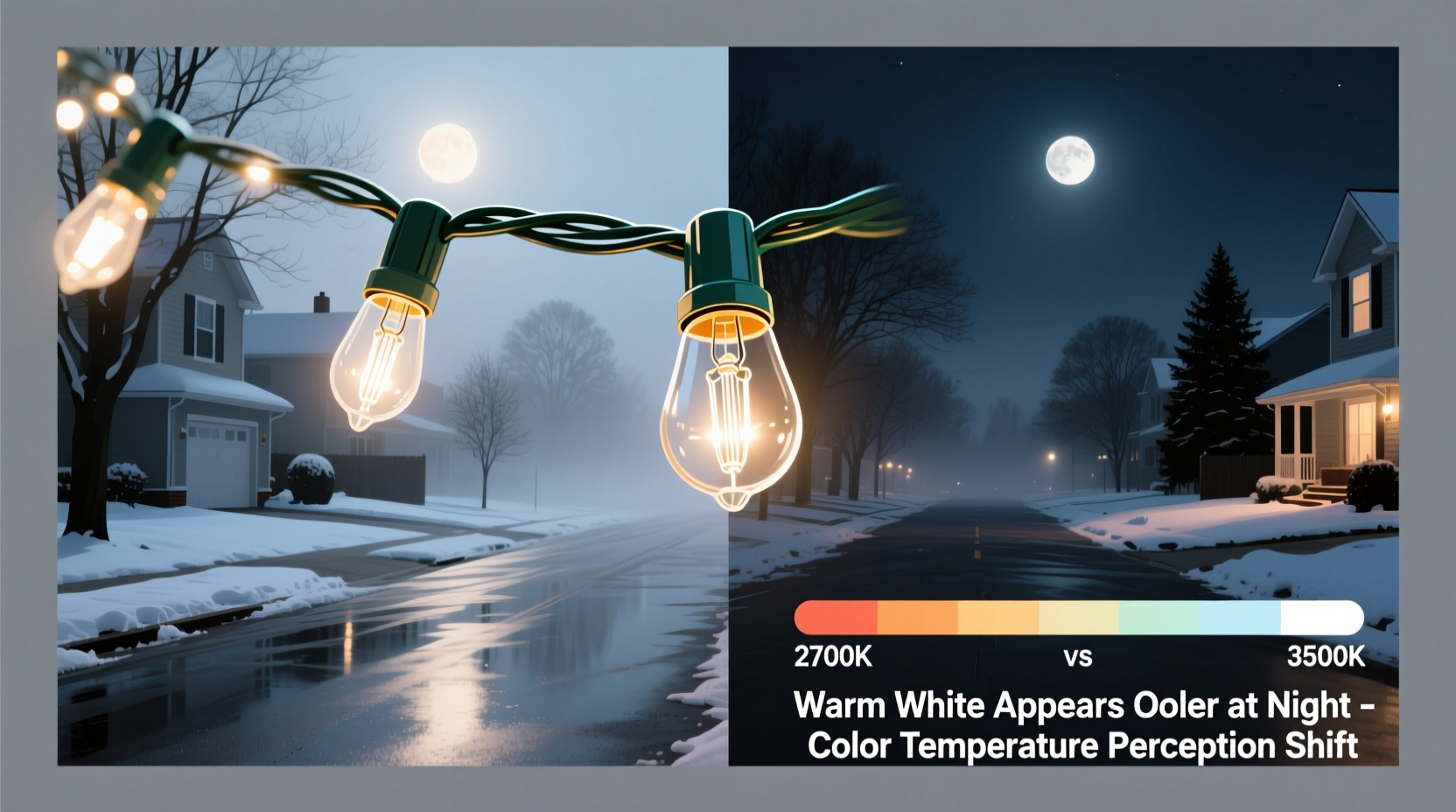
Color temperature is measured in Kelvin (K) and describes the hue of light emitted by a source. Lower values indicate warmer tones—reds, oranges, and yellows—while higher values represent cooler tones—blues and whites.
- Warm White: Typically ranges from 2700K to 3000K. Mimics the soft glow of sunset or candlelight.
- Natural White: Around 4000K. Balanced, neutral appearance.
- Cool White/Daylight: 5000K and above. Resembles midday sunlight, often perceived as stark or clinical.
While these temperatures are fixed for LED bulbs, our eyes don’t interpret them consistently across different environments. What reads as “warm” on a packaging label may not feel equally warm when viewed against a dark winter sky at 10 PM.
Tip: When choosing Christmas lights, consider not just the labeled color temperature but also the surrounding environment where they’ll be seen after full darkness sets in.How Human Vision Changes at Night
The human eye uses two types of photoreceptor cells: cones and rods. Cones handle color vision and function best in bright light. Rods, more sensitive in dim conditions, dominate night vision—but they cannot detect color well.
As daylight fades, your eyes transition from photopic (cone-dominated) vision to scotopic (rod-dominated) vision. During this shift, known as the mesopic phase, color perception becomes less accurate. Warm tones—especially subtle reds and ambers—become harder to distinguish, while blues and greens remain relatively visible.
“Under low-light conditions, the eye's sensitivity shifts toward shorter wavelengths. A 3000K light may subjectively appear closer to 4000K simply because the red components are no longer being processed effectively.” — Dr. Lena Torres, Vision Scientist, University of Colorado Boulder
This explains why a string of warm white lights might look richly golden on the porch at 5:30 PM but take on a paler, almost silvery quality by 9:30 PM. The actual light output hasn’t changed—the brain’s interpretation of it has.
Environmental Contrast and Sky Glow
Ambient surroundings play a critical role in perceived warmth. During twilight, residual natural light in the sky provides a soft blue backdrop. As full darkness falls, especially in rural areas with minimal artificial lighting, the absence of ambient fill makes any artificial light stand out more sharply.
In urban and suburban settings, streetlights and building illumination contribute to a base level of background light. Most modern outdoor lighting uses LEDs in the 4000K–5000K range, creating a persistent cool-toned ambient field. When warm white Christmas lights are placed within this environment, the contrast enhances their relative warmth—making them appear richer than they would in total darkness.
Conversely, in areas with little ambient light, there’s no competing warmth to anchor perception. Without visual reference points, the brain struggles to calibrate what “warm” means, leading to an illusion of coolness—even if the lights emit the same spectrum all night long.
Real Example: The Suburban Porch Display
Consider Sarah, who installed new 2700K LED icicle lights along her eaves. At 6 PM, with the sky still glowing faintly blue and nearby lampposts just turning on, the lights looked exactly as advertised: golden and festive. Her neighbors complimented the \"cozy, vintage feel.\"
By 10 PM, however, Sarah noticed the display seemed flatter, less vibrant. She asked her husband if the lights had changed. He agreed—they now looked “a bit too white,” lacking the initial charm. There was no malfunction. Instead, full darkness had eliminated the ambient sky glow, and the surrounding sodium-vapor yard lights (which emit a narrow orange spectrum) failed to provide balancing warmth. With fewer warm cues in the environment, the brain downplayed the red end of the spectrum in the Christmas lights, making them appear cooler by comparison.
LED Quality and Spectral Output Variability
Not all warm white LEDs are created equal. While they may share the same Kelvin rating, the actual spectral power distribution—the balance of wavelengths emitted—can vary significantly between manufacturers.
Cheap LED strings often use phosphor-coated blue diodes to simulate warm white light. This method produces a spike in blue light that’s then partially converted to yellow, resulting in a spectrum with noticeable gaps. These imbalances become more apparent under dark-adapted vision, where missing red frequencies make the light feel “thin” or unnatural.
In contrast, high-quality warm white LEDs use multi-phosphor blends or even RGB mixing to create a fuller, more continuous spectrum—closer to incandescent light. These retain their warmth better at night because they stimulate the eye’s red-sensitive cones more effectively, even in low light.
| Feature | Budget Warm White LEDs | Premium Warm White LEDs |
|---|---|---|
| Spectral Quality | Narrow, spiky output | Broad, continuous spectrum |
| Red Light Emission | Weak, inconsistent | Strong, balanced |
| Nighttime Appearance | Tends to look cooler | Maintains warmth |
| Lifespan & Efficiency | Lower efficiency, shorter life | Higher efficiency, longer life |
| Price Range (per 100-light strand) | $5–$10 | $15–$25 |
Strategies to Maintain Perceived Warmth After Dark
To ensure your warm white lights stay visually warm throughout the evening, consider both technical selection and placement strategy.
Step-by-Step Guide: Optimizing Warm White Light Displays
- Evaluate Your Environment: Walk around your property at night. Note existing light sources—streetlights, porch lamps, neighbor’s displays. Identify whether the ambient field is warm (orange-hued) or cool (blue-white).
- Select Lights with High CRI: Choose LED strings labeled with CRI > 90. These render colors more accurately and preserve warmth in low-light conditions.
- Use Layered Lighting: Combine warm white Christmas lights with additional warm-toned accent lighting (e.g., 2700K pathway lights or lanterns) to reinforce the perception of warmth.
- Avoid Over-Mixing Colors: If using multiple light colors, keep cool white or multicolor sections separate from warm white zones. Mixing them can desaturate the warmth through contrast.
- Test at Different Times: Install a test strand and observe it at dusk, twilight, and full darkness. Adjust placement or replace if the warmth diminishes too much.
- Shield or Diffuse Lights: Use diffuser sleeves or place lights behind translucent materials (like frosted glass globes or fabric-covered frames) to soften harshness and enhance perceived warmth.
Checklist: Choosing Long-Lasting, Visually Consistent Warm White Lights
- ☑ Color temperature between 2700K and 3000K
- ☑ CRI (Color Rendering Index) of 90 or higher
- ☑ Full-spectrum or multi-phosphor LED technology
- ☑ UL-listed for outdoor use
- ☑ Dimmable option for adjusting intensity at night
- ☑ Positive reviews mentioning “consistent color at night”
Frequently Asked Questions
Do warm white Christmas lights actually change color at night?
No, the physical color temperature of the light does not change. However, your eyes’ ability to perceive warm tones diminishes in low light, making the same lights appear cooler than they did earlier in the evening.
Can I fix the cool appearance without replacing the lights?
Yes. Try adding supplemental warm lighting nearby, such as 2700K landscape spots or window candles. You can also drape sheer amber-toned fabric loosely over sections to subtly warm the glow. Using a dimmer to slightly reduce brightness may also help, as lower intensity can enhance the perception of warmth.
Why do some warm white lights look orange while others look yellow-white?
Differences in manufacturing lead to variation in spectral output. Two 3000K strings from different brands may have different proportions of red, green, and blue light. This is why real-world testing matters more than relying solely on Kelvin ratings.
Conclusion: Designing for Perception, Not Just Specifications
The illusion that warm white Christmas lights turn cooler at night reveals an important truth: lighting design isn’t just about technical specs—it’s about human experience. A 2700K label guarantees nothing about emotional impact once the sun goes down. What feels warm in a store aisle may feel flat on a moonless December night.
By understanding the interplay between biology, environment, and LED quality, you can create holiday lighting that stays true to its intended mood from first switch-on to midnight glow. Invest in high-CRI LEDs, consider your ambient context, and test under real nighttime conditions. When done right, warm white lighting doesn’t just illuminate—it welcomes, comforts, and transforms a winter night into something magical.
💬 Have you noticed your Christmas lights changing tone at night? Share your observations or tips in the comments—your experience could help others perfect their holiday glow!








