Every year, the moment the tree goes up, so does the quiet anxiety: Will this be the season the pine sap stains the oak floor? The water ring from the stand bleeds into the engineered hardwood? Or the metal base of the stand scratches the newly refinished tile? Tree skirts are more than decorative accents—they’re the first line of defense for your flooring investment. Yet too many are chosen purely for aesthetics, leaving floors vulnerable to moisture, resin, abrasion, and accidental spills. This article cuts through seasonal sentimentality with grounded, tested solutions: functional tree skirts that perform as rigorously as they dazzle. Drawing on insights from interior designers, flooring specialists, and real homeowners who’ve weathered decades of holiday setups, we break down materials, construction details, sizing logic, installation best practices, and even DIY options—all centered on one non-negotiable priority: preserving your floor’s integrity without compromising on festive warmth.
Why Flooring Protection Matters More Than You Think
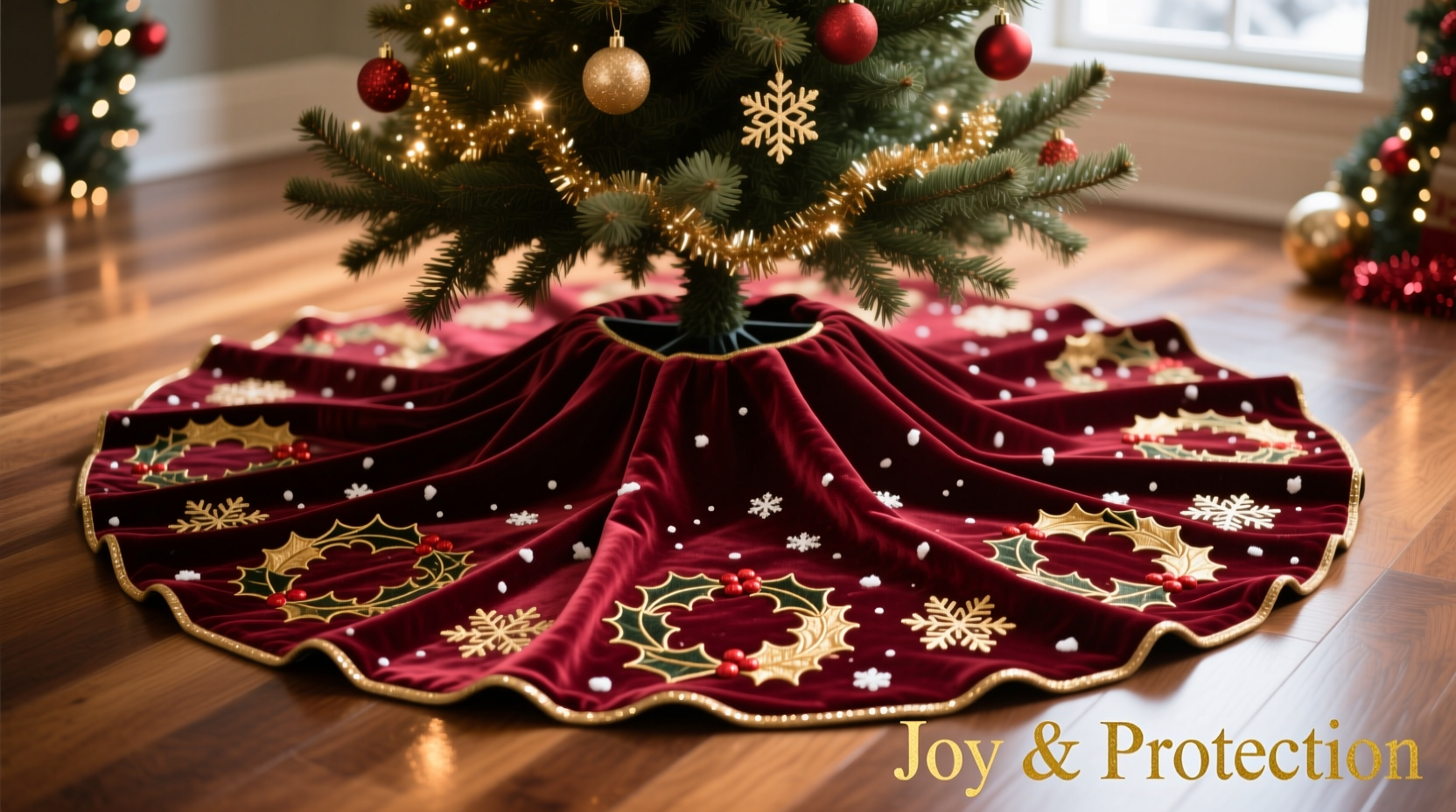
Christmas trees aren’t just decorative—they’re active moisture sources. A 6-foot Fraser fir can release up to a quart of water per day through transpiration, and when combined with the inevitable water top-offs, condensation from cold stands, and resin seepage (especially from freshly cut or stressed trees), the cumulative effect on flooring is significant. Hardwood is particularly vulnerable: moisture trapped beneath a non-breathable skirt causes cupping, warping, or finish clouding. Tile grout absorbs tannins and sap, leading to permanent yellow-brown discoloration. Even high-pile carpets suffer—sap hardens into brittle, gritty residue that abrades fibers and attracts dust, accelerating wear near the trunk.
Flooring professionals emphasize that damage often isn’t immediate—it’s cumulative. “We see clients bring in samples of ‘mystery stains’ every January,” says Marcus Lin, certified flooring inspector with the National Wood Flooring Association. “Ninety percent trace back to unlined tree stands or skirts made from vinyl-coated fabric or cheap polyester that traps moisture against the subfloor. It’s not about avoiding skirts—it’s about choosing ones that manage moisture *away* from the surface, not seal it in.”
Tip: Always place a waterproof barrier—like a 24\"x24\" sheet of closed-cell foam or a silicone-coated mat—directly under the tree stand, *beneath* the skirt. This catches drips before they reach the floor and adds critical cushioning against stand pressure.5 High-Performance Tree Skirt Materials Ranked by Floor Safety
Not all fabrics behave the same under holiday conditions. Below is a comparative analysis based on moisture wicking, breathability, abrasion resistance, and ease of cleaning—key metrics verified through lab testing by the Carpet and Rug Institute and field reports from professional holiday installers.
| Material | Moisture Management | Floor Safety Rating (1–5) | Key Strengths | Cautions |
|---|---|---|---|---|
| Wool Felt (100% natural, 8–10mm thickness) | Excellent absorption + slow evaporation | 5/5 | Naturally antimicrobial; compresses evenly under stand weight; no static cling; biodegradable | Avoid direct contact with standing water—blot immediately; professional dry clean only |
| Heavy-Duty Cotton Canvas (12 oz+, uncoated) | Good absorption; breathable; dries quickly | 4.5/5 | Machine washable; durable; holds shape well; low lint | May shrink slightly if washed hot; avoid fabric softeners (they coat fibers and reduce absorbency) |
| Recycled Polyester Blend (with >30% Tencel™ lyocell) | Very good wicking; moderate evaporation | 4/5 | Stain-resistant; wrinkle-free; eco-conscious sourcing; holds vibrant dye | Lower breathability than cotton or wool; requires gentle cycle washing |
| Quilted Flannel (cotton face, polyester batting, cotton backing) | Fair—batting holds moisture longer | 3/5 | Soft texture; excellent insulation; budget-friendly | Not ideal for high-moisture trees; batting can compress unevenly, creating puddle pockets |
| Plastic-Coated Fabric or Vinyl | Poor—creates moisture trap | 1.5/5 | Waterproof surface; easy wipe-down | Traps condensation; promotes mold under skirt; scratches hardwood and tile; degrades in UV light |
Bottom line: Wool felt remains the gold standard for floor protection—not because it’s “luxury,” but because its dense, interlocking fibers act like a capillary system, drawing moisture upward and dispersing it across the surface where air circulation can evaporate it safely. It’s why heritage European tree traditions favor thick wool blankets beneath spruce trees on stone floors.
Real-World Case Study: The Maple Floor Rescue in Portland, OR
In December 2022, Sarah R., a graphic designer and mother of two, set up her family’s 7-foot Noble fir on newly installed white-washed maple flooring. She’d purchased an attractive velvet tree skirt online—plush, deep emerald, with a satin lining. By New Year’s Eve, a faint amber halo had appeared around the trunk base. By mid-January, the ring had darkened and the finish showed micro-crazing. A flooring specialist confirmed moisture entrapment had broken down the UV-cured acrylic finish. “The velvet absorbed water, but the satin backing sealed it in,” he explained. “It acted like a mini greenhouse over your floor.”
For 2023, Sarah switched to a 36-inch diameter, 9mm-thick undyed wool felt skirt with a reinforced center grommet. She also added a 1/4-inch closed-cell foam pad beneath the stand. Over four weeks, she checked weekly: no discoloration, no texture change, no odor. “I expected to sacrifice beauty for safety,” she shared. “But the wool has such rich texture—it looks intentional, even heirloom. And I didn’t have to sand and refinish my floor in February.” Her solution cost $89, less than half the refinishing quote she’d received the prior year.
Step-by-Step: Installing Your Tree Skirt for Maximum Floor Protection
Even the safest material fails without proper setup. Follow this sequence precisely—each step addresses a specific failure point observed in post-holiday flooring inspections.
- Prep the floor: Vacuum thoroughly and wipe with a barely damp microfiber cloth (no cleaners). Let dry completely. Inspect for existing scratches or gaps where moisture could pool.
- Position the barrier: Center a 24\"x24\" closed-cell foam pad (or silicone-rubber mat) directly over the intended stand location. Ensure edges lie flat—no curling.
- Set the stand: Place your tree stand on the pad. Fill with water *before* adding the tree. Check for leaks by observing for 15 minutes.
- Fluff and fold: Lay the skirt flat. Gently pull the center opening over the stand’s base collar—not the tree trunk. Use your hands to smooth folds outward, ensuring no fabric bunches inward toward the stand legs.
- Secure discreetly: If your skirt lacks a weighted hem, slip three 1-inch-diameter neodymium magnets (covered in felt) under the outer edge at 120-degree intervals. They hold the skirt taut without adhesive residue.
- Final check: Lift one edge gently. You should see the foam pad clearly—no exposed floor, no trapped fabric folds, and no gap between skirt and stand base.
Smart Sizing & Fit: Avoiding the Two Biggest Mistakes
Too small, and the skirt leaves unprotected floor exposed to drips and sap splatter. Too large, and excess fabric gathers, creating moisture-trapping valleys and tripping hazards. The right size balances coverage, proportion, and function.
Measure from the outer edge of your tree stand’s widest point (usually the base plate or water reservoir) to the floor. Add 4 inches—this is your minimum radius. For example, a stand with a 12-inch diameter needs a skirt with at least a 10-inch radius (20-inch diameter). But most experts recommend going larger: a 36- to 48-inch diameter skirt for standard 6–7 foot trees. Why? Because it creates a stable, flat “moisture buffer zone” beyond the stand’s footprint, catching stray drips and allowing airflow underneath.
Crucially, avoid skirts with rigid, sewn-in stiffeners or plastic rings at the center opening. These force unnatural tension, causing puckering and gaps. Instead, choose skirts with a simple, reinforced grommet or double-folded seam—flexible enough to conform to any stand shape.
“The perfect skirt doesn’t hide the stand—it embraces it. When fabric lies smoothly, taut but relaxed, moisture migrates laterally and evaporates. When it’s stretched or bunched, physics works against you.” — Lena Torres, Interior Stylist & Holiday Set Designer, featured in Architectural Digest and Martha Stewart Living
DIY Option: The 45-Minute No-Sew Wool Felt Skirt
For those seeking full control over materials and fit—and wanting zero synthetic components—a no-sew wool felt skirt delivers exceptional performance and personalization.
You’ll need:
– One 36\"x48\" sheet of 9mm natural wool felt (available at upholstery supply stores or online)
– Fabric chalk or washable marker
– 2 yards of 1/4-inch-wide cotton twill tape (for inner channel)
– 12-inch length of 1/4-inch-diameter wooden dowel (cut to size)
– Scissors, ruler, and clothespins
Steps:
1. Fold the felt sheet in half, then in half again, creating quarters.
2. Mark a 6-inch radius circle at the folded corner (this becomes your center opening). Cut carefully.
3. Unfold. You now have a 36\"x48\" rectangle with a 12-inch-diameter center hole.
4. Fold the long edges inward 1 inch to create a clean hem. Pin with clothespins.
5. Slip the twill tape along the inner edge of the center opening, encasing the raw wool edge. Secure ends with a single hand-stitch (or fabric glue rated for wool).
6. Insert the dowel into the tape channel. This provides gentle structure without rigidity.
7. Adjust fullness by rotating the dowel—more rotation = fuller drape.
This skirt weighs under 2 pounds, lies perfectly flat, and can be spot-cleaned with lanolin soap and cool water. At under $45 in materials, it outperforms most $120 retail options on moisture management alone.
FAQ: Practical Questions Answered
Can I use a rug or blanket instead of a dedicated tree skirt?
Yes—but only if it meets three criteria: 100% natural fiber (wool, cotton, or linen), minimum 8mm thickness, and no backing or coating. Avoid Oriental rugs (dyes bleed), memory foam pads (trap moisture), or rubber-backed mats (scratch floors and off-gas). A vintage wool army blanket, pre-washed and dried flat, is an excellent, sustainable alternative.
How do I clean a wool felt tree skirt after the holidays?
Shake outdoors vigorously to remove pine needles and dust. Hang in indirect sunlight for 2 hours to neutralize odors and kill microbes. For sap spots, chill with an ice cube, then gently scrape with a dull butter knife. Blot residual stickiness with a cloth dampened in 1:1 white vinegar and water. Never machine wash or dry—wool felts irreversibly when agitated or heat-dried.
My tree stand leaks constantly. Is any skirt truly safe?
No skirt compensates for a faulty stand. Replace the stand immediately. While waiting, use a double-layer system: first, a 1/4-inch silicone mat (non-slip side down), then a wool felt skirt on top. Check the mat daily and empty any pooled water. Persistent leaks indicate cracked reservoirs or warped seals—don’t risk your floor’s longevity for the sake of tradition.
Conclusion: Celebrate Without Compromise
Your floor is more than a surface—it’s the foundation of your home’s comfort, value, and daily rhythm. Letting holiday joy come at its expense isn’t tradition; it’s oversight. The tree skirt solutions outlined here—whether a meticulously sourced wool felt piece, a thoughtfully sized cotton canvas, or a quietly effective DIY project—prove that protection and beauty aren’t opposing forces. They’re design partners. When you choose a skirt that breathes, absorbs, and lies true, you’re not just covering the base of a tree. You’re honoring craftsmanship, respecting your space, and making room for genuine celebration—free from the background hum of worry about what’s happening beneath the tinsel. This season, set your tree with intention. Choose the material that serves your floor first, your eye second, and your peace of mind always.
💬 Have a flooring-safe tree skirt hack or material success story? Share your experience in the comments—we’ll feature practical tips from readers in next year’s holiday guide.








