
Folding a Christmas tree skirt may seem like a minor seasonal chore, but for those who value heirloom décor, fabric integrity, and long-term preservation, the method used makes all the difference. Tree skirts—especially those with delicate pleats, embroidery, or layered fabrics—are prone to creasing, warping, or distortion when folded incorrectly. The debate between using a video tutorial versus written instructions for mastering the proper folding technique is more than just about preference; it’s about effectiveness, accuracy, and consistency in protecting your holiday investment.
While both formats have merit, understanding their strengths and limitations helps ensure that your tree skirt retains its original structure year after year. This article explores how each medium supports proper folding, evaluates real-world outcomes, and provides actionable guidance for preserving pleats and maintaining shape through thoughtful storage practices.
The Importance of Preserving Pleats and Shape
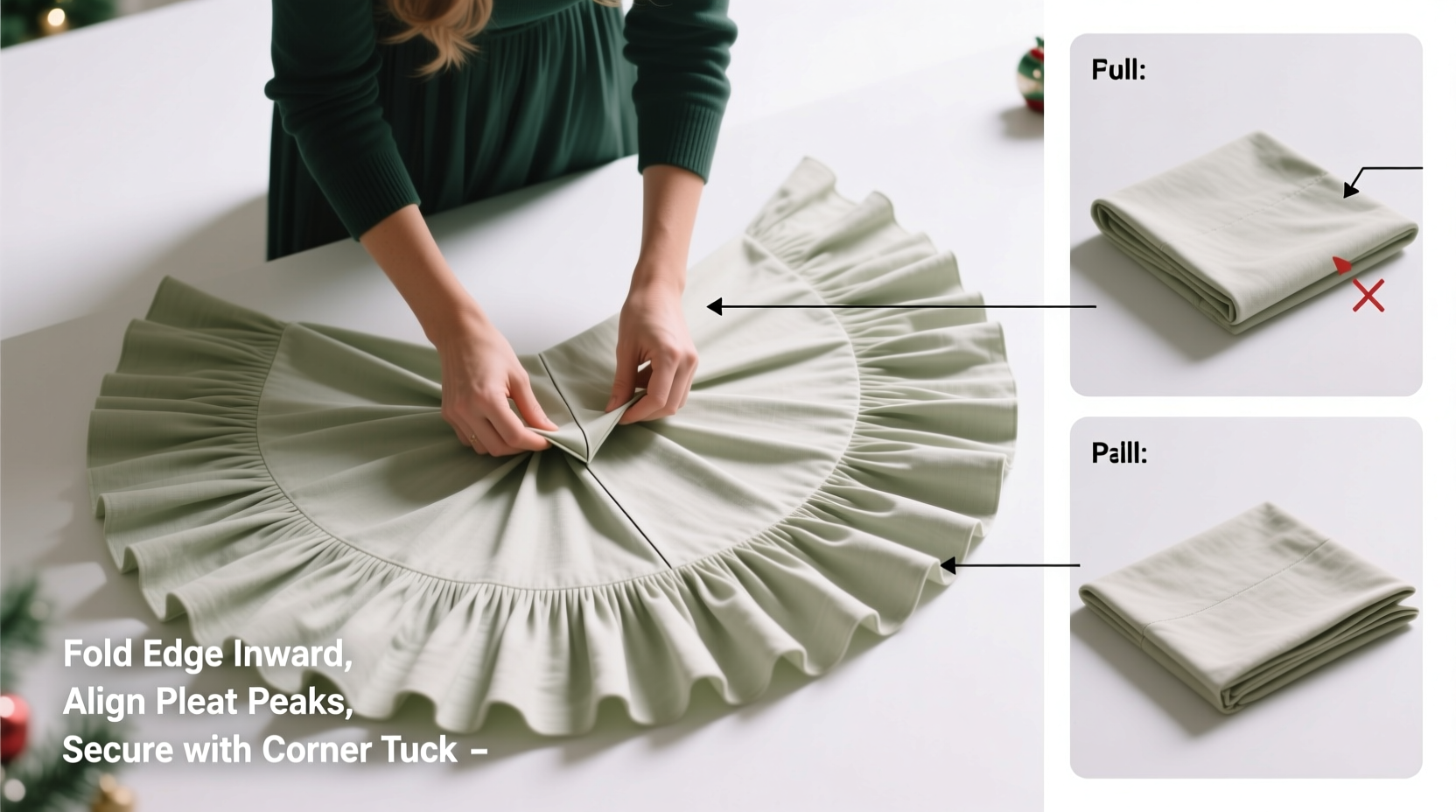
Pleated Christmas tree skirts are designed not only for visual appeal but also for functional draping around the base of a tree. These pleats create volume, symmetry, and elegance, often mimicking professional décor seen in magazines or boutique displays. However, once crushed or misfolded, they rarely return to their original form without steaming or re-pressing—processes that carry risks of scorching, shrinkage, or color bleeding.
Preserving the three-dimensional structure of a pleated skirt begins at takedown time. Rushing the process or stuffing the skirt into an undersized bin leads to permanent damage. According to textile conservator Lydia Monroe, “Fabrics with structured folds behave much like architectural forms—once compromised, restoration requires specialized knowledge and tools.”
“Pleats are memory folds. If you break that memory by forcing the fabric into tight spaces, you’re essentially erasing the design intent.” — Lydia Monroe, Textile Preservation Specialist
This principle underscores why choosing the right instructional format—video or text—is critical. One offers dynamic visualization; the other provides precision and repeatability.
Video Tutorials: Visual Learning with Real-Time Feedback
Video tutorials have become the go-to resource for many DIYers and home organizers. When it comes to folding intricate items like pleated tree skirts, videos offer undeniable advantages:
- Motion clarity: Viewers can see hand placement, fabric manipulation, and directional folding in real time.
- Spatial awareness: Demonstrations show how much space to leave between folds and how to rotate the skirt incrementally.
- Speed control: Most platforms allow playback at reduced speeds, enabling users to follow along frame by frame.
- Error correction: Creators often include common mistakes and recovery steps within the same video.
A well-produced video will start with the skirt laid flat on a clean surface, demonstrate quarter-folding while supporting pleat alignment, and end with secure bundling using acid-free tissue paper. Some even incorporate slow-motion replays of tricky transitions, such as tucking inner layers without distorting outer pleats.
Tip: When watching a folding video, pause after each step and replicate it immediately—don’t wait until the end. Muscle memory builds best through repetition.However, video tutorials come with drawbacks. They require stable internet access, may lack searchable keywords (making it hard to jump to specific steps), and depend heavily on the creator’s skill level. A poorly lit or shaky recording can obscure crucial details, leading to misinterpretation. Moreover, if the video doesn’t match your skirt’s size or pleat direction, applying the technique becomes guesswork.
Written Instructions: Precision, Reference, and Control
Well-crafted written instructions provide a different kind of clarity—one rooted in structure and detail. Unlike videos, they allow readers to absorb information at their own pace, refer back to earlier steps, and cross-check terminology. For meticulous individuals who prefer planning before acting, this format is ideal.
A high-quality written guide includes:
- Clear definitions of terms (e.g., “accordion fold,” “bias alignment”)
- Sequential numbering for unambiguous progression
- Material-specific notes (e.g., velvet vs. cotton sateen)
- Storage recommendations integrated into each phase
Consider this excerpt from a professionally written care manual:
Step 3: Begin at the northernmost point of the skirt. Gently lift and fold one-quarter inward toward the center, ensuring that vertical pleats remain parallel and do not twist. Support the weight of the fabric with your non-dominant hand to prevent sagging.
The specificity here eliminates ambiguity. There’s no question about orientation (“northernmost”), direction (“inward toward the center”), or hand positioning (“support with non-dominant hand”). Such precision is difficult to convey fully in video, where verbal cues might be mumbled or obscured by background noise.
Additionally, written instructions integrate seamlessly into printed care cards stored with holiday décor. You won’t need Wi-Fi or a device to retrieve them next season.
Comparative Analysis: Video vs. Written for Pleat Preservation
| Criteria | Video Tutorial | Written Instructions |
|---|---|---|
| Visual Demonstration | ✅ Excellent – shows motion and hand technique | ❌ Limited – relies on reader imagination |
| Searchability | ❌ Poor – must scrub timeline to find steps | ✅ High – keyword search and numbered sections |
| Accuracy & Detail | ⚠️ Variable – depends on narrator clarity | ✅ Consistent – standardized language |
| Accessibility | ⚠️ Requires device and internet | ✅ Works offline, printable |
| Error Prevention | ✅ Often includes mistake recovery | ✅ Allows review before execution |
| Long-Term Usability | ���️ Link rot possible; platform changes | ✅ Permanent if archived digitally or printed |
Neither format wins outright. Instead, the optimal approach combines both: use a video to grasp the overall flow and spatial logic, then switch to written instructions for precise execution and future reference.
Step-by-Step Folding Technique That Preserves Pleats
Whether following video or text, the actual folding process should adhere to conservation-grade standards. Below is a tested method suitable for most pleated tree skirts, regardless of diameter or fabric type.
- Prepare a clean, flat surface larger than the skirt’s diameter. Avoid carpeted areas that generate static or trap lint.
- Lay the skirt face-up, aligning any central motif (like a monogram or appliqué) to the top position.
- Smooth gently from center outward using palms—never fingers—to avoid snagging threads.
- Fold in quarters carefully: Bring one side across to meet the opposite, keeping pleats aligned vertically. Repeat perpendicularly.
- Insert acid-free tissue paper between each layer to prevent friction and wick moisture.
- Roll loosely (not fold again) from one straight edge to the other, forming a cylinder. Rolling minimizes crease formation compared to repeated folding.
- Place in a breathable cotton storage bag labeled with year and contents. Never use plastic bins—they trap humidity and encourage mildew.
Real Example: The Heirloom Velvet Skirt Recovery
In suburban Connecticut, Martha K. inherited a 1950s velvet tree skirt from her grandmother. The deep crimson fabric featured hand-stitched box pleats spaced evenly around a satin medallion. After two years of haphazard folding—learned from a fast-paced YouTube clip—the pleats had begun to lean and flatten.
Determined to restore it, she sought a museum-level solution. She found a detailed written guide published by a historical textile society, which emphasized rolling over folding and included diagrams of internal support structures. Using the guide, she refolded the skirt with tissue paper inserts and stored it in a custom-made archival tube.
Last Christmas, the skirt looked nearly new. “I wish I’d read the manual first,” she said. “The video made it look easy, but it skipped the part about interlayer protection.”
Her experience illustrates a broader truth: emotional attachment often drives quick action, but lasting preservation demands patience and reliable information.
Expert Insight: Why Format Influences Longevity
Dr. Alan Pierce, curator at the National Holiday Heritage Archive, emphasizes that instruction delivery affects user behavior more than we realize.
“The medium shapes the message. A video gives confidence through demonstration, but confidence without precision leads to overconfidence. Written instructions force engagement with detail—measuring, reading, thinking—which results in better outcomes for delicate textiles.” — Dr. Alan Pierce, Curator of Decorative Arts
He recommends institutions pair both formats: host a video walkthrough alongside a downloadable PDF guide with schematics and material notes. This dual-channel strategy ensures accessibility while safeguarding accuracy.
Checklist: Year-End Tree Skirt Storage Routine
Follow this checklist annually to maintain your tree skirt’s condition:
- □ Remove all pins, clips, or tacks before folding
- □ Vacuum gently with a brush attachment to remove dust
- □ Inspect for stains or insect activity
- □ Treat spots immediately with pH-neutral cleaner
- □ Choose between folding or rolling based on pleat type
- □ Insert acid-free tissue between layers
- □ Store in a breathable container away from basements and attics
- □ Label container with contents and date
- □ Check condition mid-year if storing in climate-variable spaces
Frequently Asked Questions
Can I hang my tree skirt instead of folding it?
Hanging is generally not recommended for pleated skirts. Gravity pulls down on the fabric over months, causing pleats to stretch out of alignment. Hanging works only for lightweight, non-pleated skirts made of stable weaves like canvas or polyester blend—and even then, use padded hangers to avoid shoulder marks.
Is rolling better than folding for pleated fabrics?
Yes, in most cases. Rolling distributes pressure evenly and avoids sharp creases that weaken fibers. It’s especially effective for skirts with continuous pleating. Reserve folding for small, stiffened skirts with defined panels.
How do I fix crushed pleats from last season?
Use a garment steamer held 6–8 inches from the fabric. Do not press directly. Allow steam to relax the fibers, then gently reshape each pleat by hand. Let dry completely before restyling or storing. For valuable heirlooms, consult a textile restorer.
Conclusion: Choose Wisdom Over Convenience
When it comes to preserving the beauty and structure of a pleated Christmas tree skirt, the choice between video tutorials and written instructions shouldn’t be binary. Each has strengths: video teaches movement and rhythm; text delivers precision and permanence. The wisest approach uses both—watch once to understand, then rely on clear, step-by-step writing to execute flawlessly.
Your tree skirt is more than décor—it’s a seasonal heirloom, a centerpiece of tradition, and a reflection of care. How you store it speaks volumes about how much you value it. Take the time this year to fold it properly, protect its pleats, and ensure it graces your holidays for decades to come.
🚀 Ready to preserve your holiday memories? Print this guide, save it to your holiday folder, and commit to a mindful takedown this January. Share your success story with others—because great traditions are meant to be passed down, perfectly preserved.








