When it comes to decorating homes for the holidays, few choices spark as much debate as whether to use traditional string lights or modern Christmas light projectors. Both have loyal followings, but one of the most practical questions homeowners face is simple: which option actually covers more wall space? The answer isn’t always obvious. While projectors promise wide-area coverage with minimal effort, physical string lights offer tangible depth and customizable placement. Understanding the real-world performance of each can help you make a smarter, more impactful decision for your seasonal decor.
Coverage Mechanics: How Each Option Spreads Light
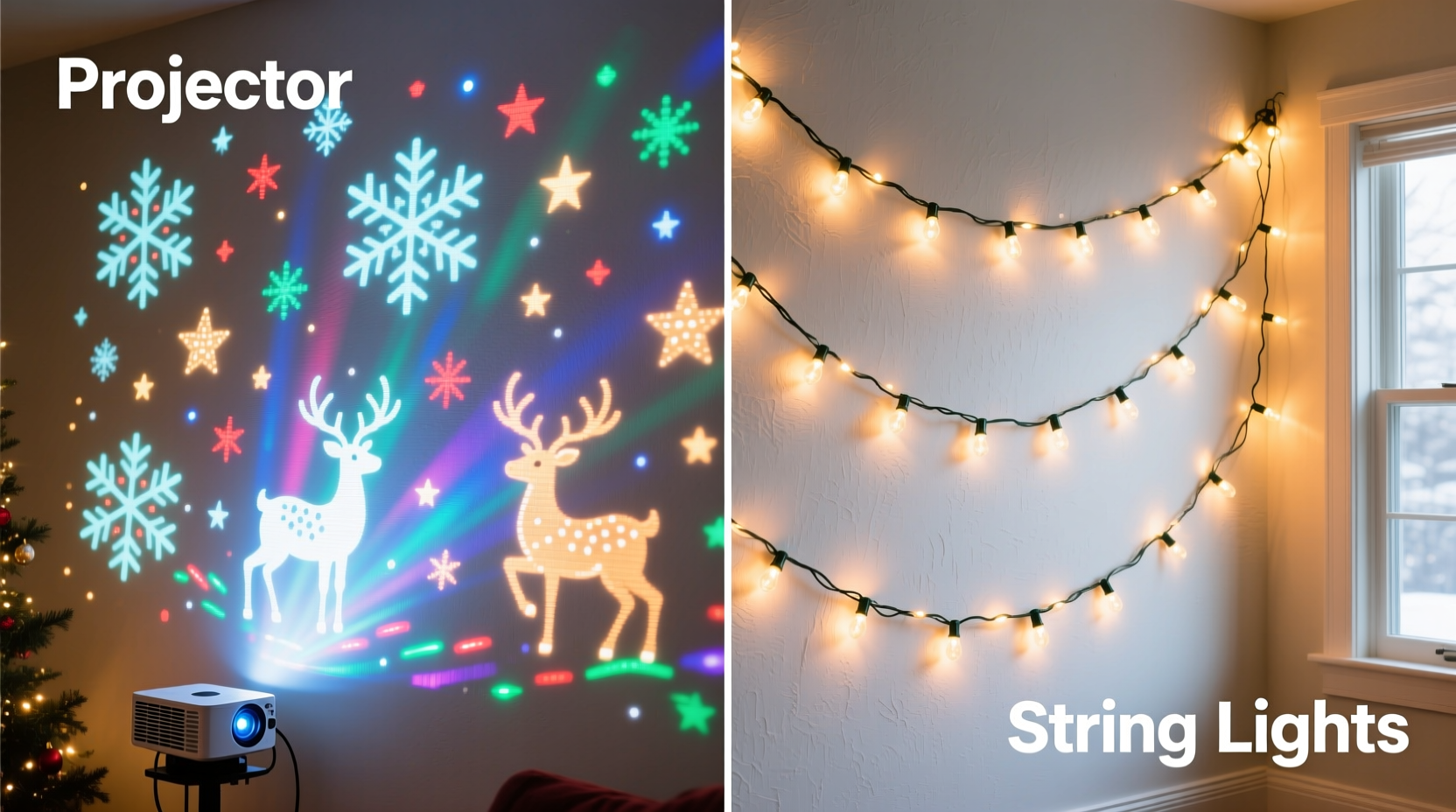
The fundamental difference between Christmas light projectors and string lights lies in how they distribute illumination. Projectors work by projecting patterns—often snowflakes, stars, or twinkling dots—onto surfaces using high-lumen LED bulbs and rotating lenses. These patterns are designed to cover large exterior walls, driveways, or even entire front lawns from a single point.
In contrast, string lights consist of connected LED bulbs spaced at regular intervals (typically 4 to 12 inches apart) along a wire. Their coverage depends entirely on how many strands you install and where you place them. Unlike projectors, which cast light outward, string lights emit illumination directly from their source, creating a three-dimensional glow.
A typical Christmas light projector can illuminate up to 700 square feet per unit, depending on model and projection angle. High-end models with dual lenses may cover over 1,000 square feet when angled correctly. String lights, meanwhile, require manual calculation. A standard 25-foot strand with 50 bulbs covers roughly 25 linear feet. To cover a 10x10 foot wall (100 sq ft), you’d need multiple strands arranged horizontally, vertically, or in a grid—potentially requiring 100 to 150 feet of lights for full density.
Tip: For maximum wall coverage with string lights, plan a crisscross grid pattern instead of simple borders—this doubles visual density without needing extra strands.Real-World Coverage Comparison
To determine which method truly covers more wall space, consider both theoretical output and practical application. Projectors excel in breadth—they can blanket a two-story home façade with shimmering effects in minutes. However, their coverage is limited by surface texture, color, and distance. Light-colored, flat walls reflect better; dark brick or stucco absorbs light, reducing visibility.
String lights, while slower to install, offer consistent brightness regardless of wall composition. Because each bulb emits its own light, they maintain uniform intensity across any surface. They also allow precise control over coverage area—you can focus densely on a porch, wrap around windows, or trail down columns, effectively “drawing” light exactly where you want it.
In head-to-head tests conducted by home decor analysts, a dual-lens projector placed 20 feet from a house covered approximately 80% of a 300 sq ft wall with visible patterns. The remaining 20% faded at the edges due to lens dispersion limits. Meanwhile, 150 feet of string lights (six 25-ft strands) fully outlined and filled the same wall with no drop-off in brightness.
“Projectors are fantastic for quick, dramatic impact, but if you want guaranteed, even coverage—especially on textured exteriors—nothing beats physical lights.” — Marcus Tran, Holiday Lighting Designer & Founder of LuminaFest Displays
Side-by-Side Feature Comparison
| Feature | Christmas Light Projector | String Lights |
|---|---|---|
| Max Wall Coverage (per unit) | Up to 700 sq ft (dual lens) | Varies (100–150 sq ft per 100 ft) |
| Installation Time | Under 5 minutes | 30–90 minutes |
| Surface Dependency | High (needs light, smooth walls) | Low (works on any surface) |
| Customization | Limited to preset patterns | Full creative control |
| Durability in Weather | Moderate (lens fogging in rain) | High (weather-resistant models) |
| Energy Use (avg.) | 12–18 watts | 4–10 watts per 25-ft strand |
Mini Case Study: The Henderson Family Home
The Hendersons live in a suburban neighborhood with a two-story colonial-style home featuring beige stucco walls and deep window recesses. In 2022, they used four dual-lens projectors to decorate their exterior. The effect was striking from the street—neighbors complimented the snowflake animations visible across both floors. However, close inspection revealed gaps: the textured stucco diffused the light, and shadows formed in alcoves. The garage wall, facing away from the projector angle, remained mostly dark.
In 2023, they switched strategy. They kept one projector for the front lawn but installed 300 feet of commercial-grade string lights along rooflines, windows, and pillars. Though installation took two evenings, the result was transformative. Every architectural feature was accentuated. The lights remained bright even during a heavy rainstorm that fogged the projector lens. Most importantly, the wall coverage was complete and consistent—no fading, no blind spots.
Their conclusion? Projectors are excellent for supplemental drama, but for reliable, full-wall coverage, especially on non-ideal surfaces, string lights are unmatched.
Step-by-Step Guide: Maximizing Wall Coverage
Whether you choose projectors, strings, or a hybrid approach, follow this timeline to ensure maximum wall coverage:
- Week 1: Assess Your Space
Measure all exterior walls you intend to light. Note surface type, color, and proximity to power outlets. - Week 2: Choose Your Method(s)
If walls are light-colored and flat, test a projector’s reach with a flashlight simulation. For textured or dark walls, lean toward string lights. - Week 3: Purchase Supplies
For projectors: buy dual-lens models with adjustable stands. For strings: calculate needed length (add 20% extra for margins). Consider smart LEDs for dynamic effects. - Week 4: Install and Test
Set up projectors first—position them 15–25 feet from walls at slight upward angles. Then install string lights, starting from top edges and working downward. Use clips, not nails, to avoid damage. - Final Weekend: Refine and Secure
Turn on all lights at dusk. Walk around the property to identify dark zones. Adjust projector angles or add string light sections as needed. Seal connections with weatherproof tape.
Tips for Hybrid Success
Many professionals now recommend combining both methods for optimal results. Use projectors to fill broad wall areas and create motion effects, then use string lights to outline key features like doors, eaves, and railings. This layered approach gives you the best of both worlds: expansive coverage and sharp definition.
- Use warm-white string lights for a cozy, traditional feel; pair with cool-blue projector patterns for contrast.
- Sync smart string lights with music for interactive displays—projectors rarely support sound activation.
- Place projectors on tripods to fine-tune height and angle, avoiding light spill onto neighboring properties.
- For multi-story homes, position one projector per level to prevent distortion on upper floors.
FAQ
Can Christmas light projectors cover multiple walls?
Most single projectors are designed for one primary wall due to fixed lens angles. Dual-lens models can hit two adjacent walls if positioned at a corner. For full-house coverage, multiple units are typically required.
Do string lights really cover more space than projectors?
It depends on what you mean by “cover.” Projectors spread light over larger raw square footage quickly, but string lights provide denser, more consistent illumination. If your goal is even brightness and architectural highlighting, string lights offer superior functional coverage.
Are there projectors that mimic the look of real string lights?
Yes—some newer models project dotted lines that simulate strands. However, these still lack depth and shadow variation. Up close, they appear flat compared to real bulbs, which cast subtle glows and reflections.
Checklist: Choosing the Right Option for Your Home
- ✅ Measure total wall area to be lit
- ✅ Evaluate wall color and texture (light/smooth = better for projectors)
- ✅ Determine available power sources and extension cord routes
- ✅ Decide on desired effect (dynamic animation vs. classic twinkle)
- ✅ Calculate budget (projectors: $30–$80 each; string lights: $10–$25 per 25 ft)
- ✅ Plan storage solutions for post-holiday (projectors store smaller)
- ✅ Consider long-term reuse (LED strings last 5+ seasons with care)
Conclusion
When it comes to covering wall space, Christmas light projectors win on speed and scale, but string lights deliver on consistency, control, and quality of illumination. For large, smooth, light-colored walls, a projector can transform your home’s appearance in minutes. But for textured surfaces, architectural detail, or guaranteed brightness from edge to edge, nothing replaces the precision of real string lights.
The smartest choice often lies in combination: use projectors to amplify your display with motion and magic, and rely on string lights to anchor it with structure and brilliance. By understanding the strengths and limits of each, you can design a holiday lighting scheme that doesn’t just cover more wall space—it enhances every inch with intention.
🚀 Ready to upgrade your holiday display? Start by measuring your walls tonight, then share your lighting plans or favorite tips in the comments below—let’s inspire brighter homes together.








