Every November, millions of homeowners pull out last year’s string lights—some still coiled in dusty boxes, others neatly stored in plastic bins—and begin draping them across porches, railings, and tree branches. But a quiet, often overlooked question lingers: Are these lights actually rated for the outdoors? The answer isn’t just about brightness or aesthetics—it’s about insulation integrity, moisture resistance, temperature tolerance, and fundamental electrical safety. Using indoor-rated lights outside isn’t merely “cutting corners.” It’s introducing a cascade of failure points that can compromise wiring, invite corrosion, trigger short circuits, and—in worst-case scenarios—pose fire or electrocution hazards. This isn’t theoretical. Real incidents occur every holiday season, documented by the U.S. Consumer Product Safety Commission (CPSC) and local fire departments alike.
Why Indoor Lights Aren’t Built for Outdoor Conditions
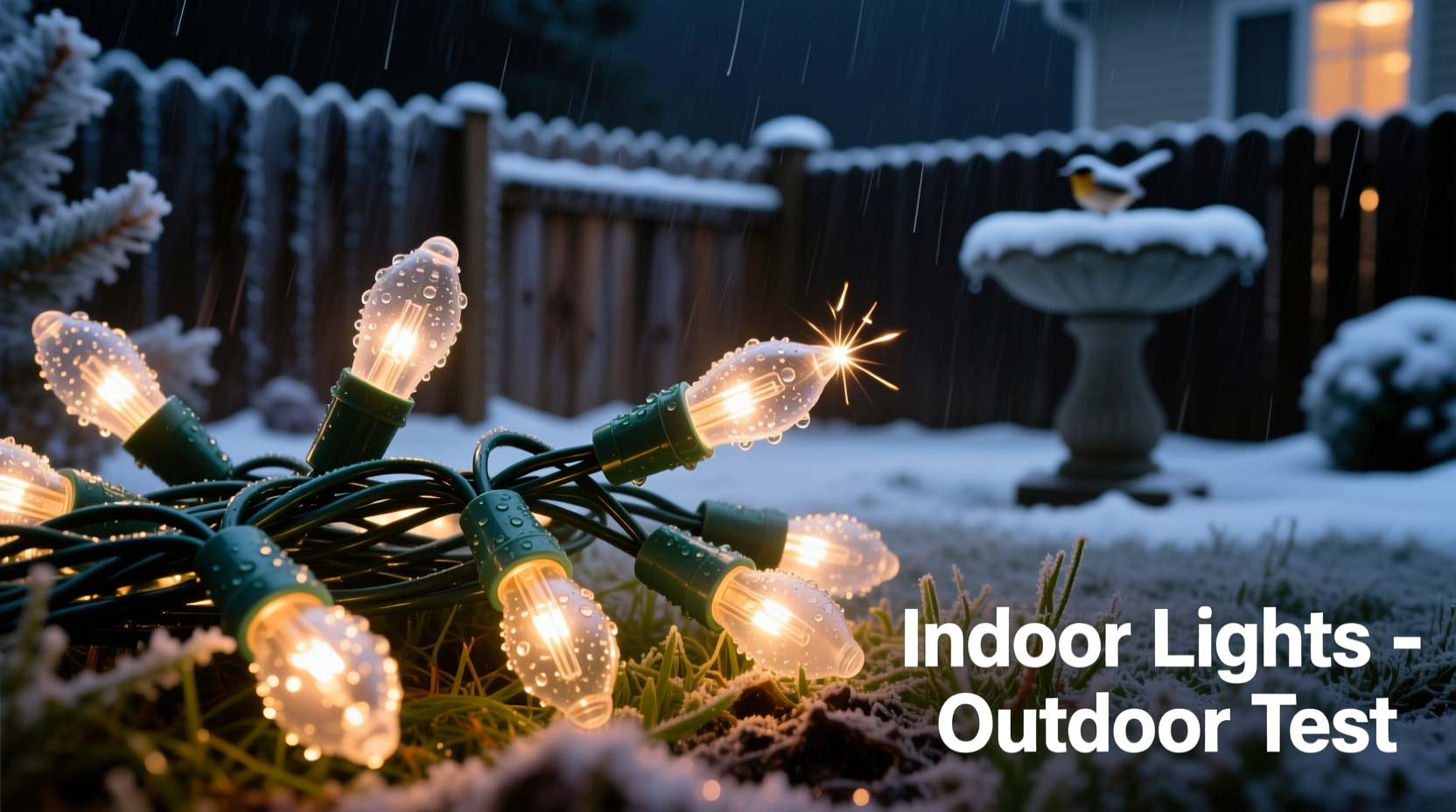
Indoor Christmas lights are engineered for controlled environments: stable temperatures between 60–80°F, low humidity, no UV exposure, and zero risk of rain, snow, or ice accumulation. Their construction reflects those constraints. The wire insulation is typically thin PVC—sufficient to prevent accidental contact indoors but not designed to resist UV degradation, freeze-thaw cycling, or prolonged moisture immersion. Solder joints and bulb bases lack conformal coating or silicone sealing. Even the plug housing is often made from brittle, non-weatherized plastic that becomes porous or cracks after months of cold exposure.
When placed outside, indoor lights face four simultaneous stressors:
- Moisture ingress: Rain, dew, and condensation seep into unsealed sockets and junctions, creating conductive paths between live wires and ground.
- Temperature extremes: Below-freezing temps embrittle PVC insulation; rapid warming causes microfractures. Heat buildup from incandescent bulbs compounds this in enclosed fixtures.
- UV radiation: Sunlight breaks down plasticizers in PVC over time, causing cracking, discoloration, and loss of dielectric strength.
- Mechanical stress: Wind, foot traffic, or accidental snagging easily dislodge poorly secured indoor plugs or snap fragile wire jackets.
These aren’t hypothetical concerns. In 2022, the CPSC reported over 13,000 home fires linked to decorative lighting—nearly 40% involving improper placement or use of non-rated equipment. Most occurred during December, with a disproportionate number tied to lights labeled “indoor use only” installed on exterior structures.
How to Tell Indoor vs. Outdoor Lights at a Glance
You don’t need a multimeter or UL certification database to spot the difference. Reputable manufacturers embed clear visual and physical cues. Here’s what to check before hanging a single strand:
Tip: Never rely solely on packaging claims—inspect the actual cord, plug, and socket labels. If the cord lacks a “UL Listed” mark followed by “Outdoor” or “Wet Location,” assume it’s indoor-only—even if the box says otherwise.| Feature | Indoor Lights | Outdoor Lights |
|---|---|---|
| UL Listing Mark | “UL Listed” only—or missing entirely. May say “Indoor Use Only” in small print. | “UL Listed” + explicit “Outdoor” or “Wet Location” designation. Often includes a water-drop icon. |
| Cord Texture & Thickness | Thin, smooth, flexible PVC. Easily kinked or dented with fingernail pressure. | Thicker, ribbed, or textured jacket. Feels rubbery or thermoplastic elastomer (TPE)—resists bending and holds shape. |
| Plug Housing | Hard, glossy plastic. Gaps visible between plug blades and body. No gasket or seal ring. | Matte-finish, slightly flexible plastic. Sealed blade slots. Often features a rubber gasket or molded-in O-ring. |
| Bulb Base | Plain metal or plastic base. No visible sealant around glass-to-base junction. | Silicone or epoxy sealant visible as a translucent ring where bulb meets socket. Base may be wider or contoured. |
| Labeling on Cord | No markings—or only “120V AC” and wattage. | Printed text: “For Outdoor Use,” “Wet Location Rated,” or “UL 588 Certified.” May include temperature range (e.g., “-25°C to 60°C”). |
Note: LED mini lights blur the line somewhat—many modern LED strands are dual-rated. But dual rating must be explicitly stated on the cord itself, not just the box. Never assume.
A Real-World Example: What Happens When You Ignore the Label
In December 2021, Sarah M., a homeowner in Portland, Oregon, strung her favorite vintage-style incandescent lights along her covered front porch railing. She’d used them indoors for five years and assumed the roof overhang would protect them. By mid-December, overnight temperatures dropped below freezing, and light rain mixed with fog created persistent condensation. On the 17th, she noticed flickering in the third section. By the 19th, two bulbs stayed dark, and the plug felt warm to the touch. On the 20th, while adjusting a strand, she received a mild shock—enough to jolt her hand back. She unplugged the set immediately and called an electrician.
The inspection revealed cracked insulation near a socket where moisture had pooled, corroded copper strands inside the wire, and a compromised ground path. The electrician confirmed the lights were clearly marked “Indoor Use Only” on the cord—yet the damage was already done. Replacement cost: $120 for new outdoor-rated LEDs and $85 for the safety inspection. More importantly, Sarah realized she’d been one faulty ground away from a Class A fire hazard. Her takeaway? “I thought ‘covered porch’ meant ‘safe.’ I didn’t know moisture could wick up the cord like a straw—even under a roof.”
Expert Insight: What Electrical Standards Actually Require
UL Standard 588—the benchmark for seasonal decorative lighting—mandates strict performance thresholds for outdoor-rated products. These aren’t marketing claims; they’re laboratory-tested requirements. As explained by James Lin, Senior Electrical Safety Engineer at Underwriters Laboratories:
“The ‘Wet Location’ rating isn’t optional—it’s binary. To earn it, a light set must survive 168 hours submerged in 1-meter-deep water, pass high-potential dielectric testing at 2,000 volts, and maintain insulation resistance above 2 megohms after UV exposure equivalent to three years of direct sun. Indoor lights undergo none of this. They’re tested only for dry, room-temperature operation. Using them outside violates the product’s certified design envelope—and voids any liability coverage if failure occurs.” — James Lin, UL Senior Electrical Safety Engineer
This distinction matters legally and practically. Homeowners’ insurance policies routinely exclude damage caused by “use of equipment contrary to manufacturer instructions.” If indoor lights ignite a gutter fire that spreads to your roof, your claim may be denied—not because of negligence, but because the root cause violated the listed use case.
A Step-by-Step Safety Verification & Installation Guide
Before installing any lights outdoors, follow this field-proven sequence. It takes less than five minutes—and prevents costly, dangerous oversights.
- Unbox and inspect every component: Look for the UL “Outdoor” or “Wet Location” mark directly on the cord—not just the box or instruction sheet.
- Check plug integrity: Insert a finger into the plug’s blade slots. If you feel gaps, air movement, or loose fit, discard it. Outdoor plugs should feel tight and sealed.
- Test continuity and grounding (if using a multimeter): Set to continuity mode. Touch one probe to the round ground pin, the other to the metal screw shell of a bulb socket. You should hear a beep—confirming a continuous ground path.
- Verify outlet protection: Plug into a GFCI-protected outdoor outlet. If the GFCI trips immediately, the set has a ground fault and must be replaced.
- Secure connections properly: Use waterproof wire nuts (not standard ones) for splices. Wrap all connections in self-fusing silicone tape—not duct tape or electrical tape—then cover with a weatherproof junction box if exposed.
- Inspect weekly: Look for cracked insulation, milky bulb bases (sign of moisture), warm plugs, or inconsistent brightness—especially after rain or freeze events.
What to Do If You’ve Already Used Indoor Lights Outside
If you’ve hung indoor lights outside and haven’t experienced issues yet—don’t wait for warning signs. Proactive mitigation is essential:
- Immediately unplug and remove them from all outdoor locations—even covered ones.
- Do not attempt to “waterproof” them with spray-on sealants, tape, or shrink tubing. These create false security and can trap moisture against hot components.
- Inspect each strand carefully: Look for whitish powder (corrosion) on sockets, stiffness or cracking in the cord, or discoloration near plug ends. Discard anything showing these signs—do not reuse.
- Replace with certified outdoor lights: Choose LED sets rated for wet locations. They draw less power, run cooler, and last longer—offsetting the higher upfront cost within two seasons.
Frequently Asked Questions
Can I use indoor lights on a covered patio or porch?
No—coverage does not equal protection. Dew forms overnight even under roofs. Humidity remains high. Airborne salt (in coastal areas) or pollen accelerates corrosion. Covered areas still qualify as “damp locations” per NEC Article 410, requiring at least damp-location rating—and most indoor lights have none.
What’s the difference between “damp location” and “wet location” rated lights?
Damp-location lights tolerate high humidity and incidental moisture (e.g., under eaves or in screened porches) but cannot withstand direct rain or submersion. Wet-location lights meet stricter UL 588 requirements: they’re sealed against direct water exposure, including rain, snow, and hose-down cleaning. For any exterior application—including covered areas in rainy climates—wet-location rating is the only safe choice.
Are battery-operated indoor lights safer to use outside?
Not necessarily. While they eliminate shock risk, most battery-powered indoor lights lack UV-stabilized plastics and moisture-sealed electronics. Batteries themselves degrade faster in cold, and corroded terminals can leak. Only use battery lights explicitly rated for outdoor use—with IP65 or higher ingress protection ratings.
Conclusion: Safety Isn’t Seasonal—It’s Structural
Christmas lights are more than decoration. They’re electrical devices operating at full household voltage, strung across vulnerable points of your home—gutters, railings, trees, and entryways. Choosing indoor lights for outdoor use isn’t frugality—it’s deferring risk. Every compromised socket, every cracked insulator, every ungrounded connection multiplies the chance of failure when conditions shift: a sudden frost, a windstorm, a forgotten timer left on overnight. The right lights don’t cost more to buy—they cost less to own. They last longer, perform more reliably, and carry the quiet confidence of compliance with national safety standards. This holiday season, hang your lights with intention—not assumption. Verify the rating. Respect the label. Prioritize the people who’ll walk beneath them, open the door beside them, and gather in their glow. That warmth should come from joy—not from a circuit overload.
💬 Have you encountered indoor lights failing outdoors—or successfully upgraded to outdoor-rated sets? Share your experience, brand recommendations, or installation tips in the comments. Your insight helps others celebrate safely.








