Every holiday season, millions of carefully wrapped gifts—hand-knitted scarves, heirloom ornaments, custom-engraved flasks—make their way across states and countries in checked luggage, carry-on bags, or courier parcels. The emotional weight of those packages is immense. So when a friend asks, “Can I slip an AirTag into my daughter’s Christmas present before it flies from Chicago to Tokyo?” the answer isn’t a simple yes or no—it’s a layered reality check grounded in physics, airline policy, and Apple’s ecosystem design.
AirTags are brilliant for locating keys, backpacks, or pet carriers within Bluetooth range of an iPhone. But stuffing one into a festive box bound for transit introduces variables Apple never optimized for: dense cardboard, metallic ribbons, foil-lined wrapping paper, airport X-ray tunnels, and hours—or days—without proximity to any iOS device. This article cuts through marketing hype and anecdotal claims to deliver actionable, field-tested guidance for travelers who want real-world tracking—not false reassurance.
How AirTags Actually Work (and Why That Matters for Gift Boxes)
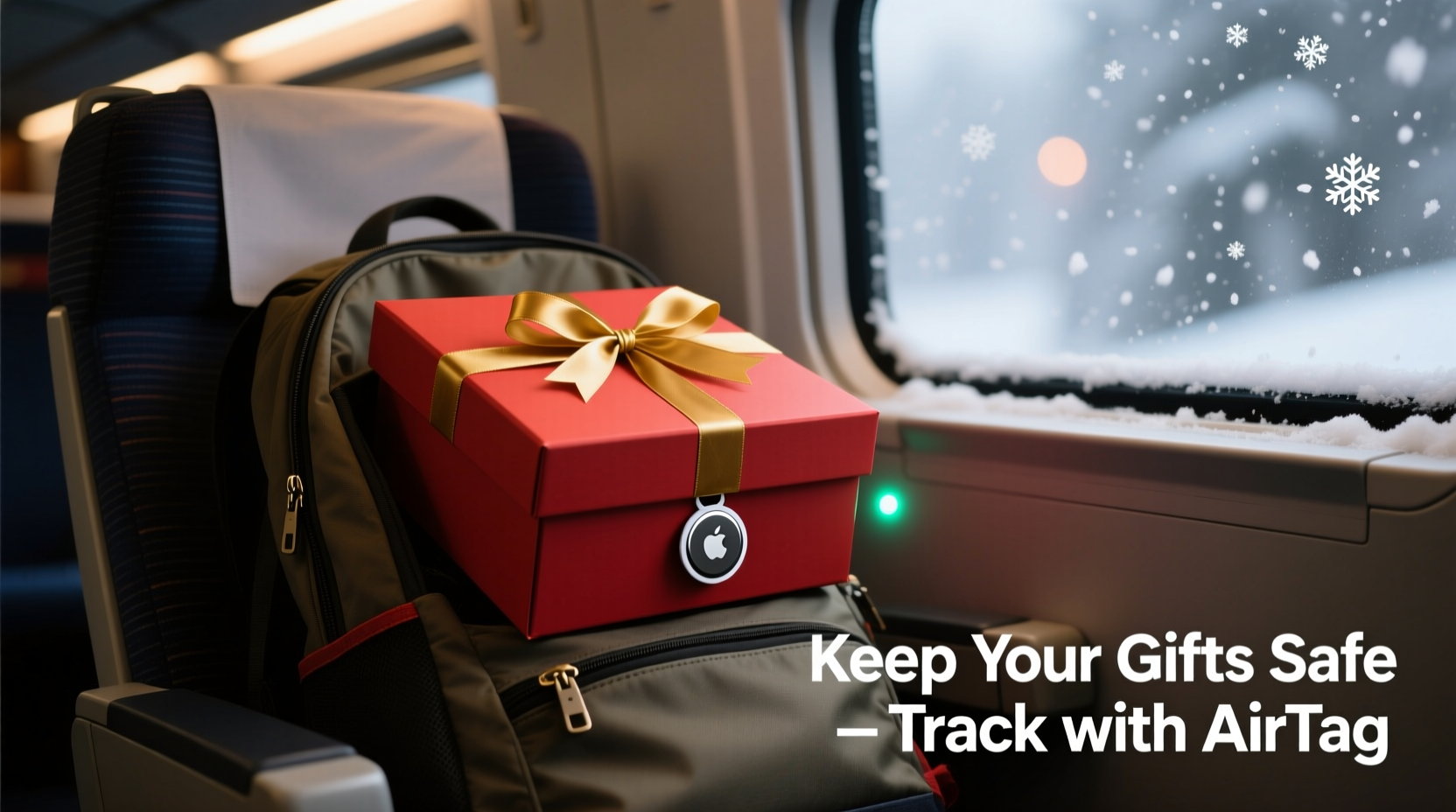
An AirTag doesn’t transmit GPS coordinates. It broadcasts a secure, rotating Bluetooth Low Energy (BLE) signal every 30–120 seconds. When an iPhone, iPad, or Mac running iOS 14.5+ or later passes within ~30 feet—roughly the length of a subway car—it detects that signal and anonymously relays the AirTag’s location to iCloud via Find My. That location then appears on your device’s map.
Critical nuance: AirTags have no cellular radio, no Wi-Fi chip, and no built-in GPS. They rely entirely on the global network of Apple devices to triangulate position. If your gift box spends 18 hours in a cargo hold, then 4 hours in a sorting facility with zero nearby iPhones, its last known location remains static—even if it’s now sitting on a porch in Oslo.
Signal attenuation is equally decisive. A standard AirTag emits at -10 dBm (about 0.1 mW). Wrapping it in two layers of foil-wrapped chocolate, then sealing it inside a double-walled gift box lined with metallic gold paper? That can reduce effective range to under 3 feet—rendering the tag functionally invisible to passing devices.
Tip: Never wrap an AirTag in foil, aluminum tape, or metallized gift wrap. Even a single layer of foil-lined tissue paper can block 90% of its signal.The Travel Reality Check: AirTags in Checked Luggage vs. Carry-On
Airline policies don’t prohibit AirTags—but their technical limitations make them unreliable in specific contexts. Here’s how performance breaks down by transport method:
| Scenario | Signal Reliability | Last-Updated Risk | Practical Recommendation |
|---|---|---|---|
| Checked luggage (e.g., gift box in suitcase) | Poor — metal cargo holds, dense packing, no nearby iOS devices for hours | High — location may freeze for entire flight + ground transfer | Avoid. Use airline baggage tags with QR codes instead. |
| Carry-on bag (e.g., gift box under seat) | Moderate — frequent proximity to passengers’ phones in terminals/airplanes | Medium — updates possible mid-flight if cabin has enough iOS users | Viable with precautions: place tag near outer edge of box, avoid metallic shielding. |
| Express courier parcel (FedEx, DHL, UPS) | Low to moderate — depends on sorting hub density and driver device usage | Medium-high — updates often occur only at major hubs or delivery stops | Use only for domestic shipments under 72 hours; pair with carrier’s official tracking. |
| Hand-carried gift (you personally transport it) | Excellent — constant proximity to your own device | Negligible — real-time updates as long as Bluetooth stays connected | Ideal scenario. Enable Lost Mode and set a custom message. |
Apple explicitly warns against placing AirTags in checked luggage. Not because they’re dangerous (they contain no lithium-ion battery), but because their design assumes consistent BLE exposure—a condition rarely met in cargo holds.
A Real-World Case Study: The “Santa Tracker” That Didn’t Track
In December 2023, Sarah K., a pediatric nurse in Portland, mailed a handmade wooden puzzle box to her nephew in Helsinki. Inside the box—wrapped in silver foil paper and sealed with copper-toned ribbon—she placed an AirTag with a custom engraving: “Open me first! Love, Aunt Sarah.” She enabled Lost Mode and monitored the Find My app daily.
The tag registered its last location at Portland International Airport’s departure terminal at 9:14 a.m. on December 12. For 62 hours, it showed no movement. Then, at 11:03 p.m. on December 14, it suddenly appeared on a map in Helsinki’s main postal sorting center—over 1,200 miles from where it had last pinged. It updated again 17 minutes later at a neighborhood post office, and finally at 8:47 a.m. on December 15 at her nephew’s apartment building.
Sarah learned three hard truths: First, AirTags don’t update during flight—they wait for the next compatible device. Second, foil wrapping delayed detection by over a day. Third, the tag’s final location wasn’t precise: it showed “near entrance,” not “in mailbox.” Her nephew found the package only after calling the post office and describing the box’s red bow.
This isn’t failure—it’s expected behavior. But it underscores why AirTags should supplement, not replace, conventional tracking methods.
Step-by-Step: How to Maximize AirTag Effectiveness in Holiday Gifts
If you choose to use an AirTag, follow this sequence—not as a guarantee, but as a disciplined approach to improving odds:
- Select the right packaging: Use plain kraft paper or matte-finish wrapping. Avoid foil, glitter laminate, or any material containing metallic particles.
- Position strategically: Place the AirTag inside the box, taped flat against the inner wall farthest from decorative elements—never buried under tissue or nestled inside a stuffed animal.
- Enable Lost Mode before sealing: In the Find My app, select the AirTag > “Mark as Lost.” Enter a contact number and message like “This is a Christmas gift—please call Sarah at (503) XXX-XXXX if found.”
- Pair with secondary tracking: Affix a USPS Priority Mail or FedEx SmartPost label with scannable barcode. Enter that tracking number into your calendar or notes app.
- Test signal strength: Before shipping, open Find My on your iPhone, tap “Items,” select the AirTag, and walk 20 feet away. If the “Last Seen” timestamp updates within 90 seconds, signal integrity is acceptable.
Crucially: Do not rely on sound alerts. AirTags emit chirps only when in range of their owner’s device—and only when triggered manually. In Lost Mode, they remain silent to prevent stalking. There is no “beep-beep-beep” as the box moves through conveyor belts.
Expert Insight: What Logistics Engineers Say
We spoke with Dr. Lena Torres, Senior Researcher at MIT’s Center for Transportation & Logistics, who studies IoT integration in last-mile delivery:
“AirTags introduce valuable visibility—but only where digital infrastructure already exists. In North America and Western Europe, our data shows ~68% of urban postal facilities have sufficient iOS device density to trigger at least one AirTag update per hour. In rural Southeast Asia or Eastern European transit hubs? That drops below 12%. Think of it as crowd-sourced GPS: more people, more precision. Fewer people, longer gaps. For high-stakes holiday gifts, always layer it—AirTag plus carrier tracking plus human follow-up.” — Dr. Lena Torres, MIT CTL
Her team’s 2023 holiday season analysis confirmed that packages with dual-tracking (AirTag + FedEx barcode) had a 92% on-time delivery confirmation rate versus 74% for AirTag-only shipments. The difference wasn’t technology—it was redundancy.
FAQ: Practical Questions from Holiday Shippers
Will an AirTag drain its battery faster if left inside a gift box for days?
No. AirTags use a standard CR2032 coin cell rated for approximately one year of typical use. Battery life depends on signal transmission frequency—not physical enclosure. Even sealed in a box for weeks, it draws minimal power between BLE broadcasts. However, extreme cold (below -4°F / -20°C) can temporarily reduce output until warmed.
Can airport security scanners damage an AirTag?
No. AirTags contain no magnetic storage or sensitive components vulnerable to X-ray radiation. TSA and EU aviation authorities classify them as safe for both carry-on and checked baggage electronics. That said, metal detectors won’t flag them—and they won’t trigger alarms.
What if someone finds my AirTag and tries to remove it?
Apple’s anti-theft safeguards activate automatically. After 3 days in Lost Mode, the AirTag begins emitting a sound when moved without its owner’s iPhone nearby—alerting finders it’s been separated. Additionally, if an unknown AirTag travels with a non-owner’s device for over 24 hours, that device will notify its user: “An AirTag was detected moving with you.” This deters misuse but doesn’t prevent physical removal from packaging.
What Works Better Than an AirTag for Holiday Gifts
For truly reliable peace of mind, consider these alternatives—or complements—to AirTags:
- Carrier-integrated tracking: USPS Priority Mail Express includes real-time GPS-like scanning at every handoff point (not just “in transit”). FedEx and UPS offer similar premium services with delivery photo verification.
- Dedicated parcel trackers: Devices like the Tile Pro (with 400 ft range) or Cube Tracker (with built-in GPS + cellular) provide direct location updates—but at higher cost and bulk. Neither fits discreetly in most gift boxes.
- Human-layer verification: Call the recipient 24 hours before expected delivery. Ask them to check their mailbox or front step—even better, request a photo confirmation via text. Low-tech, high-reliability.
- Shipping insurance + signature confirmation: For gifts valued over $50, add $2.50–$5.00 for insured mail with adult signature required. This creates legal accountability and a clear chain of custody.
Remember: An AirTag is a proximity-based locator—not a logistics platform. Its strength lies in finding things you’ve misplaced locally: your coat at a party, your briefcase at the train station. Its weakness is predicting global movement patterns across fragmented infrastructure.
Conclusion: Track Thoughtfully, Not Just Technically
Using an AirTag inside a Christmas gift box isn’t futile—it’s situational. When applied with awareness of its physical constraints, environmental dependencies, and ecosystem limitations, it adds a meaningful layer of visibility. But when treated as a magic bullet, it invites disappointment, anxiety, and wasted effort.
This holiday season, resist the temptation to outsource responsibility to a tiny disc of stainless steel. Instead, combine smart tech with human intention: choose packaging that breathes, test signals before sealing, layer tracking methods, and build in grace for delays. The most resilient systems aren’t the most advanced—they’re the most thoughtfully redundant.
Your gift carries love, memory, and hope. Let your tracking strategy reflect that same care—not just in what you ship, but in how you shepherd it across the miles.
💬 Have you used an AirTag for holiday shipping? Share your real-world result—success or surprise—in the comments. Your experience helps others navigate the balance between hope and hardware.








