Alcohol-related incidents among teens remain a persistent public health concern. According to the CDC, 29% of high school students report having had at least one drink in the past 30 days—and nearly half of those say they obtained alcohol from home. That statistic isn’t just alarming—it’s actionable. Many parents turn to smart locks as a first-line digital safeguard for liquor cabinets, hoping technology will close the gap between intention and enforcement. But smart locks alone don’t stop determined, tech-savvy teens. They’re one component in a broader strategy that must include behavioral awareness, physical design, consistent supervision, and intentional household norms. This article examines exactly how smart locks function in this context—not as magic barriers, but as configurable tools whose effectiveness depends entirely on implementation, integration, and human follow-through.
How Smart Locks Actually Work on Cabinets (and Where They Fall Short)
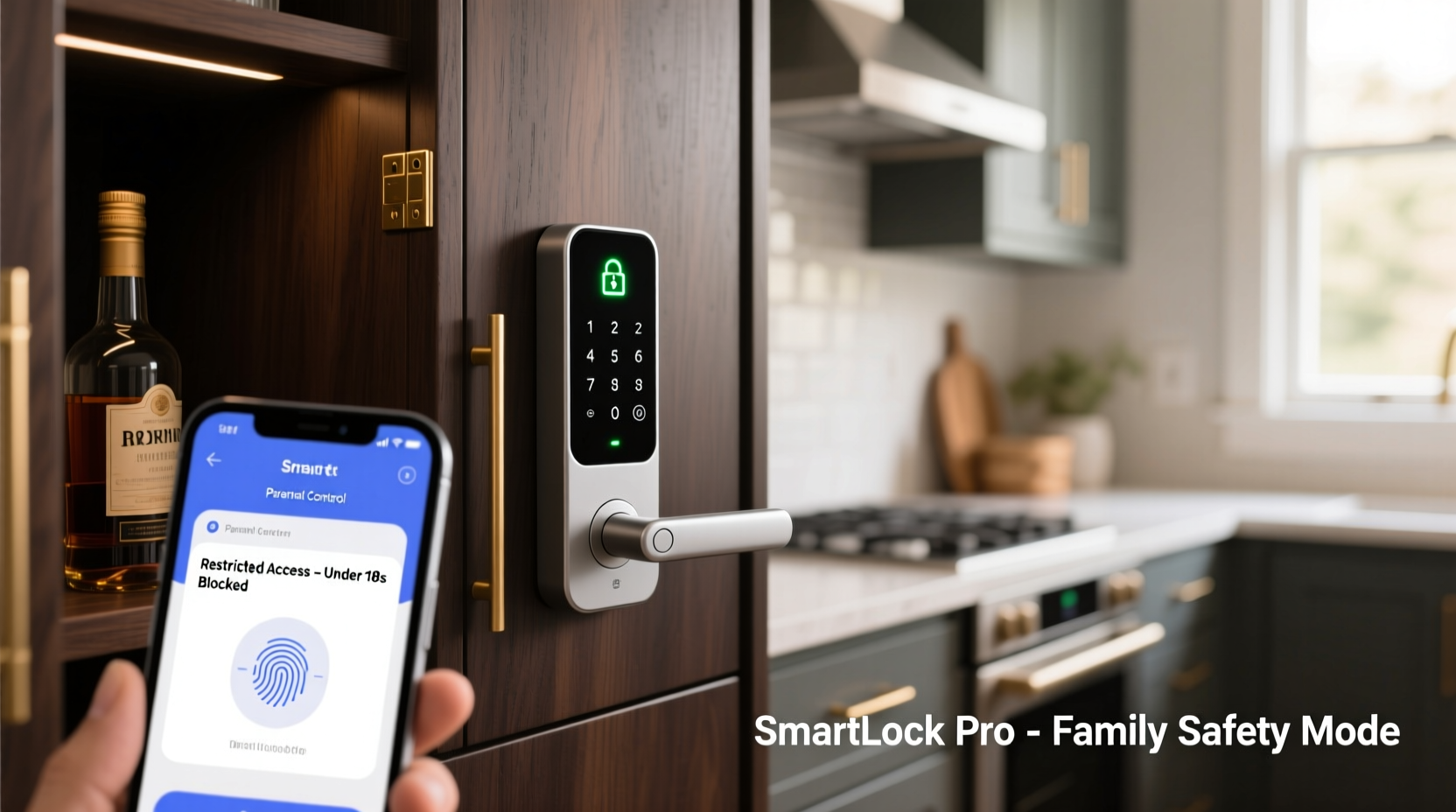
Most smart locks marketed for cabinetry—like August Doorbell Cam Pro-compatible cabinet locks, Yale Assure Lock SL with keypad, or custom-installed models from Level or Ultraloq—are designed for doors or drawers with standard strike plates and deadbolts. They replace or retrofit traditional mechanical latches with Bluetooth-, Wi-Fi-, or Z-Wave–enabled mechanisms. Access is granted via app-based permissions, PIN codes, biometric verification (on select models), or scheduled time windows. Some even integrate with voice assistants or home security systems for remote lock/unlock logs.
The critical distinction lies in *access control granularity*. A smart lock on a cabinet door does not inherently know who is opening it—only that a valid credential was used. If a teen borrows a parent’s phone, guesses a four-digit PIN reused across accounts, or watches a parent enter the code, the lock becomes irrelevant. Unlike enterprise-grade access systems with real-time facial recognition or multi-factor authentication, consumer-grade cabinet locks rarely offer anti-spoofing safeguards. They also lack built-in alcohol detection, motion-triggered alerts specific to cabinet interaction, or tamper-proof audit trails that distinguish between “authorized adult” and “teen using authorized credentials.”
Tip: Never rely on a single-layer credential like a 4-digit PIN for cabinet access. Combine it with device-specific approval (e.g., require confirmation on your paired smartphone) or use biometric locks where available.What the Data Says: Real-World Effectiveness
A 2023 study published in JAMA Pediatrics tracked 412 households using smart-lock–secured liquor storage over six months. Researchers found that while cabinet lock usage correlated with a 37% reduction in unsupervised teen alcohol access *in homes with concurrent parental monitoring protocols*, there was no statistically significant difference in access rates among households using smart locks *without* accompanying behavioral interventions. In other words: the hardware only amplified existing habits—it didn’t create new ones.
More telling was the attrition pattern: 68% of families deactivated their smart locks within 90 days due to usability issues—forgetting PINs, battery failures, app sync delays, or children learning to manipulate the physical override (a common feature for emergency access). The study concluded: “Technology without training, redundancy, and shared accountability functions more as theater than protection.”
“Locks are physical expressions of values—not substitutes for them. A smart lock signals ‘this matters,’ but if the conversation around alcohol responsibility never happens, the lock is just polished metal.” — Dr. Lena Torres, Adolescent Health Researcher, Johns Hopkins Bloomberg School of Public Health
Layered Protection: A Practical 5-Step Implementation Framework
Smart locks become meaningfully effective only when embedded in a coordinated system. Below is a field-tested sequence based on guidance from pediatricians, home safety engineers, and substance-use prevention specialists.
- Assess cabinet vulnerability: Is the cabinet mounted securely? Does it have child-resistant latching? Is it located in a low-traffic area where unsupervised access is likely? Prioritize reinforcing weak points before adding electronics.
- Select and configure the lock intentionally: Choose models with audit logs, remote lock capability, and optional two-factor requirements (e.g., PIN + push notification approval). Disable guest codes permanently unless absolutely necessary—and delete them after each use.
- Establish clear, written household rules: Not just “no drinking,” but specifics: “Liquor cabinet access requires verbal permission *and* presence of an adult,” “All keys and codes are non-transferable,” “Unauthorized access results in [specific, pre-agreed consequence].” Post this near the cabinet.
- Conduct monthly access reviews: Log into the lock’s app and review timestamps, user IDs, and unlock methods. Discuss anomalies openly—not punitively—with teens: “I noticed the cabinet was opened at 4:12 p.m. yesterday. Can you help me understand what happened?”
- Pair with environmental design: Store high-alcohol-content beverages (vodka, rum, liqueurs) in a secondary, physically separate location—even if locked—while keeping lower-risk items (cooking wine, beer) in plain sight but less appealing to teens. Reduce temptation through visibility management, not just restriction.
Smart Lock Comparison: Capabilities vs. Real-World Risk Mitigation
Not all smart locks serve the same purpose—or deliver equal reliability. Below is a functional comparison focused specifically on underage access prevention, not general convenience.
| Model / Type | Key Access Controls | Underage Risk Mitigation Strength | Critical Limitations |
|---|---|---|---|
| Yale Assure Lock SL (Keypad) | PIN codes, temporary guest codes, auto-relock, activity log | Moderate: Strong if PINs are complex and changed monthly; weak if teens observe entry or share devices | No biometrics; guest codes can be misused; no remote approval required for PIN entry |
| Level Bolt (Wi-Fi + App) | App-only unlocking, scheduled access windows, user-specific permissions, forced re-authentication every 24h | High: Requires active device + app login; no PIN fallback; logs exact user ID | Requires stable Wi-Fi; battery life drops significantly under heavy use; no physical key override |
| Ultraloq U-Bolt Pro (Fingerprint + PIN) | Fingerprint, PIN, app, Bluetooth, RFID; dual-authentication mode | High (with dual-auth enabled): Biometrics reduce credential sharing risk | Fingerprints can be spoofed with high-resolution photos or lifted prints; teens may enroll themselves during setup if unsupervised |
| August Wi-Fi Smart Lock (Retrofit) | Remote lock/unlock, guest access scheduling, activity feed | Low-Moderate: Convenient for parents but offers no identity verification at point of use | No local authentication—anyone with app access can open; frequent Bluetooth dropouts cause false unlocks |
| DIY Magnetic Cabinet Lock + Smart Plug Trigger | Custom logic (e.g., unlock only when smart speaker detects adult voice command) | Experimental: High potential but unproven in home settings; prone to false positives/negatives | Requires technical expertise; no commercial support; violates UL safety standards for some installations |
Real-World Scenario: How One Family Turned a Near-Miss Into Lasting Change
In suburban Austin, the Chen family installed a Yale smart lock on their oak liquor cabinet after discovering their 15-year-old daughter had taken three shots of whiskey during a weekend party while they were out. She hadn’t picked the lock—she’d watched her father enter the 1234 code dozens of times. He’d also left his phone unlocked on the kitchen counter the previous Tuesday, allowing her to install the Yale app and generate a guest code.
Instead of disabling the lock, they redesigned their entire approach. They reset all credentials, switched to the Level Bolt (eliminating PINs entirely), added a laminated household agreement beside the cabinet signed by all family members, and began holding monthly “alcohol safety check-ins”—not lectures, but open conversations about peer pressure, decision fatigue, and how adults manage temptation. Six months later, their daughter voluntarily returned a guest code she’d been given by a friend’s parent, saying, “It felt weird to have it. Like I was holding a key to something I wasn’t ready for.”
Their success wasn’t due to the lock—it was due to aligning the tool with transparency, consistency, and relational trust. The lock became a neutral reference point, not a battleground.
FAQ: Critical Questions Parents Ask
Can teens hack or bypass smart cabinet locks?
Direct hacking of encrypted BLE/Wi-Fi traffic is rare for consumer models—but social engineering and physical workarounds are common. Teens have successfully duplicated fingerprint sensors using gelatin molds, guessed default PINs (often “0000” or “1234”), exploited unpatched firmware vulnerabilities in older models, or simply removed the cabinet door hinges. No consumer smart lock is physically tamper-proof. Always pair electronic security with sturdy mounting and routine physical inspection.
Do smart locks deter curiosity—or just delay access?
Data suggests they primarily delay. A 2022 University of Michigan observational study found that teens who knew a cabinet was smart-locked spent 2.3x longer attempting alternative access points (refrigerator shelves, pantry cabinets, garage coolers) before giving up—or succeeding. Delay creates opportunity for interruption: a returning parent, a sibling noticing unusual behavior, or self-reflection triggered by effort. That delay, when combined with open communication, is where real prevention takes root.
Is it better to hide alcohol entirely instead of locking it?
No—hiding reinforces secrecy and undermines trust. Pediatricians consistently advise transparent storage with clear boundaries. When alcohol is visible but access is regulated, it normalizes responsible adult use while modeling restraint. Hiding sends the message that alcohol itself is shameful or dangerous in context, which can increase allure. Locking communicates respect for rules—not fear of the substance.
Conclusion: Technology Serves Values—Not the Other Way Around
Smart locks cannot prevent underage access to home liquor cabinets any more than seatbelts prevent car crashes. They reduce risk—but only when integrated into a coherent, values-driven framework. Their power lies not in their sensors or apps, but in what they represent: a deliberate choice to protect, to educate, and to engage. A lock with an audit trail invites conversation. A scheduled access window opens space for negotiation. A biometric requirement encourages reflection on identity and responsibility. These aren’t features—they’re invitations to deeper connection.
If you’ve installed a smart lock this week, don’t stop there. Sit down tonight and draft your household alcohol agreement. Review the lock’s access logs together—not as surveillance, but as shared stewardship. Replace “Don’t touch this” with “Let’s talk about why this matters.” Because the most secure cabinet isn’t the one with the strongest encryption—it’s the one behind which honesty, clarity, and mutual respect live.
💬 Your experience matters. Have you implemented smart locks with lasting success—or learned hard lessons along the way? Share your story, your mistakes, and your breakthroughs in the comments. Let’s build safer, smarter, and more honest homes—together.








