Festive seasons bring joy, decorations, and new opportunities to experiment with technology in creative ways. One growing trend is flying indoor drones beneath twinkling lights and around elaborately decorated Christmas trees. While the idea of capturing aerial footage of holiday cheer or simply enjoying a flight through a winter wonderland sounds exciting, it raises an important question: can indoor drones fly safely around a decorated Christmas tree?
The short answer is yes—but only under carefully controlled conditions. Flying a drone near a Christmas tree involves navigating tight spaces, avoiding fragile ornaments, managing light reflections, and ensuring no fire hazards arise from heat or electrical contact. Done improperly, the results can range from broken baubles to damaged electronics or even safety risks.
This article explores the realities of indoor drone flight near decorated trees, offering practical advice, technical considerations, and real-world scenarios to help you make informed decisions—whether you're a hobbyist, parent, or content creator aiming to capture the magic of the season.
Understanding Indoor Drones and Their Capabilities
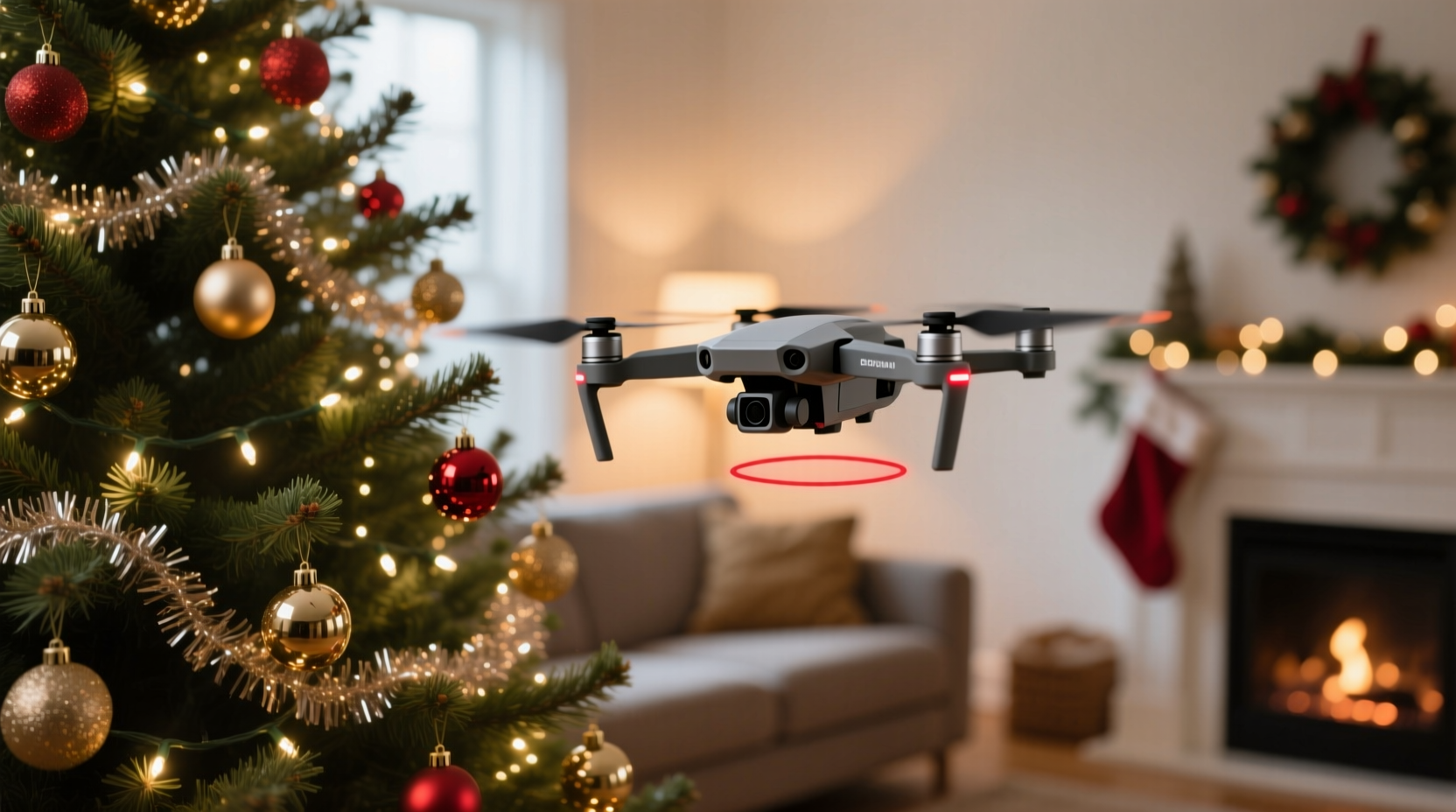
Indoor drones differ significantly from their outdoor counterparts. Designed for close-quarters operation, they are typically smaller, lighter, and equipped with advanced stabilization systems such as GPS-free positioning (using optical flow sensors), obstacle avoidance, and altitude hold features. These technologies allow them to hover steadily in enclosed environments without relying on satellite signals.
Popular models like the DJI Mini series (when flown indoors), Ryze Tello, and Eachine E58 are commonly used in homes due to their compact size and responsive controls. However, even the most agile drones face challenges when navigating around densely decorated trees filled with dangling ornaments, tinsel strands, and unpredictable light patterns.
The proximity of branches, reflective surfaces, and low ambient lighting during evening displays can interfere with sensor accuracy. Infrared and ultrasonic sensors may misread distances when faced with shiny balls or glass icicles, while downward-facing cameras struggle on patterned carpets or dark skirts that obscure visual tracking.
“Flying near highly reflective or chaotic visual environments introduces significant risk—even for drones with advanced navigation systems.” — Dr. Lena Peterson, Robotics Engineer at MIT Media Lab
Key Risks When Flying Near a Decorated Tree
Despite technological advancements, several hazards must be considered before launching any drone near a Christmas tree:
- Physical Obstruction: Ornaments hang at varying heights and often swing unexpectedly. A slight breeze from rotor wash can set them into motion, increasing collision chances.
- Tinsel and Garlands: Metallic tinsel is particularly dangerous—it can wrap around propellers instantly, leading to motor burnout or uncontrolled descent.
- Heat and Electronics: Although rare, overheating batteries or malfunctioning circuits could pose a fire risk if a drone crashes into dry foliage or near string lights.
- Light Interference: Blinking LEDs and mirrored ornaments create confusing inputs for optical sensors, potentially causing drift or sudden movements.
- Pet and Child Safety: Sudden noise or movement might startle family members or pets nearby, leading to accidental interference or panic reactions.
Step-by-Step Guide to Safe Indoor Drone Flight Around a Christmas Tree
If you’re determined to attempt a flight, follow this structured approach to minimize risks and maximize success:
- Assess the Environment
Measure clearance around the tree. Ensure at least 3 feet of open space on all sides and 6 feet of vertical clearance from ceiling fixtures. - Remove High-Risk Decorations
Take down tinsel, dangling ribbons, lightweight foam snowflakes, and anything that dangles below 18 inches from branches. - Dim or Disable Flashing Lights
Turn off blinking modes on string lights. Use steady white or warm-toned illumination to reduce visual noise for sensors. - Pre-Flight Calibration
Power on the drone on a flat surface away from magnetic interference. Allow full calibration of gyroscope and compass (if applicable). - Begin with Manual Hover Testing
Launch the drone five feet away from the tree. Practice basic maneuvers—ascend, descend, rotate—before approaching closer. - Approach Slowly at Mid-Level
Gradually move toward the tree at a height between 3–5 feet—below most ornament clusters but above skirt level. - Maintain Visual Line of Sight
Do not rely solely on FPV (first-person view) if using goggles. Keep eyes on the physical drone at all times. - Limited Flight Duration
Restrict sessions to 3–5 minutes per attempt. Motors generate heat; confined spaces reduce cooling efficiency. - Land Immediately After Anomaly
If the drone wobbles, vibrates, or veers unexpectedly, land it immediately—even if far from the tree. - Inspect Post-Flight
Check props, motors, and frame for signs of impact or debris entanglement after each session.
Comparison: Safe vs. Risky Practices
| Practice | Safe Approach | Risky Behavior |
|---|---|---|
| Ornament Type | Dense, non-reflective wooden or fabric ornaments placed securely inward | Glass balls, mirrors, or metallic stars hanging outward on flexible hooks |
| Lighting | Steady LED strings with diffused brightness | Blinking multicolor lights or strobe effects near canopy |
| Drone Size | Micro or nano-class (under 250g), brushless motors | Larger drones (>500g) with high thrust output |
| Flight Mode | Attitude mode with manual control, low speed setting enabled | Aerobatic flips, rapid acceleration, or autonomous pathing |
| Supervision | Adult operator only, bystanders kept at safe distance | Children operating or playing nearby during flight |
Real Example: A Holiday Vlog Gone Awry
Consider the case of Mark T., a lifestyle vlogger based in Portland, who attempted to film a “magical drone journey” through his living room during a family gathering. His setup included a fully decorated 7-foot tree adorned with vintage glass ornaments, silver tinsel, and programmable rainbow lights.
Using a mid-tier indoor drone with obstacle detection, he launched from across the room. Initially stable, the drone began drifting left upon nearing the tree—likely due to infrared reflection confusion from mirrored ornaments. Before he could react, one propeller clipped a strand of tinsel. The material wrapped tightly around the motor shaft within seconds, causing immediate imbalance. The drone spun sideways, struck a lower branch, and fell onto the tree skirt, sparking briefly as the battery scraped against a metal ornament base.
No injuries occurred, but two heirloom ornaments shattered, the drone required motor replacement, and the family decided to ban future flights. Mark later shared: “I underestimated how much those little details—like tinsel and blinking lights—could disrupt everything. Next year, I’ll use a camera on a stick.”
This scenario underscores that even experienced users can miscalculate environmental variables when sentiment overrides caution.
Expert Recommendations and Precautions
Safety experts and drone manufacturers consistently advise restraint when operating near delicate or combustible materials. According to the Academy of Model Aeronautics (AMA), indoor recreational flying should prioritize containment zones and emergency readiness—even in seemingly harmless settings.
“Just because a drone *can* fly somewhere doesn’t mean it *should*. The combination of flammable materials, fragile items, and emotional value makes Christmas trees high-consequence obstacles.” — Robert Kim, AMA Safety Coordinator
Additionally, lithium-polymer (LiPo) batteries—common in drones—pose thermal runaway risks if punctured or stressed. Though modern drones include protection circuits, a crash into sharp pine branches or metal hooks could compromise the casing. For this reason, many insurers exclude damage caused by drones in home policies unless explicitly declared.
Practical Tips for Safer Operation
Tip: Use soft propeller guards—they add minimal weight and can prevent minor scrapes from turning into full crashes. Tip: Charge your drone battery fully beforehand and avoid flying below 30% capacity indoors—low power affects responsiveness. Tip: Record practice flights in empty rooms first. Learn how your drone reacts to carpet colors, ceiling fans, and furniture edges.Checklist: Preparing for a Tree-Near Flight
- ✅ Remove all tinsel, ribbons, and loose decorative threads
- ✅ Secure ornaments deep within branches, not on outer tips
- ✅ Turn off blinking light modes; use steady illumination
- ✅ Confirm drone firmware is up to date
- ✅ Install propeller guards if available
- ✅ Clear surrounding area of people, pets, and breakables
- ✅ Perform ground-level hover test before advancing
- ✅ Keep a fire extinguisher or baking soda nearby (for LiPo incidents)
- ✅ Limit flight time to under 5 minutes per session
- ✅ Have spare props and tools ready in case of damage
Frequently Asked Questions
Can I fly a drone under warranty-damaging conditions near my tree?
Most consumer drone warranties do not cover physical damage from collisions, especially those involving user-controlled environments. Flying near fragile objects like Christmas trees is generally considered user risk, so damages would likely not be covered.
Are there drones specifically designed for indoor holiday use?
While no drones are marketed exclusively for Christmas tree navigation, some nano-drones like the Blade Nano QX or UDI UFO RC are built for tight indoor spaces and come with full protective shrouds. These are better suited than larger models for cautious exploration near decorations.
Is it safe to let children fly drones near the tree?
No. Even supervised, children lack the reflexes and spatial awareness needed to prevent accidents in complex environments. The combination of excitement, noise, and moving targets increases error rates dramatically. Reserve such activities for open, clear areas away from valuable items.
Conclusion: Balancing Wonder and Responsibility
Flying an indoor drone around a decorated Christmas tree sits at the intersection of technology and tradition—a blend of innovation and nostalgia. While possible with meticulous preparation, it demands respect for both engineering limits and seasonal sensibilities.
The safest approach combines smart planning, selective decoration adjustments, and disciplined piloting. If your goal is cinematic footage, consider alternatives: mounting a small action camera on a telescoping pole, using time-lapse photography, or creating digital animations instead.
But if you choose to fly, do so thoughtfully. Protect your loved ones, preserve irreplaceable ornaments, and honor the spirit of the season by prioritizing joy over spectacle. With care, even a brief, well-executed flight can become a cherished memory—without becoming a holiday hazard.
🚀 Ready to try indoor drone flying this season? Start with an empty room, review the checklist, and share your experience—safely. Your insights could help others celebrate smarter.








