When it comes to decorating your home for the holidays, choosing the right Christmas lights is more than just a matter of aesthetics—it’s about impact, ambiance, and appropriateness for your space. Among the most common options are C9 and C6 bulbs, both widely used for outdoor displays. While they may appear similar at first glance, their differences in size, brightness, spacing, and visual effect can significantly influence how your home looks during the festive season. Understanding these distinctions ensures you select a lighting style that enhances your architecture without overwhelming it—or worse, fading into the background.
Understanding C9 and C6 Bulb Sizes
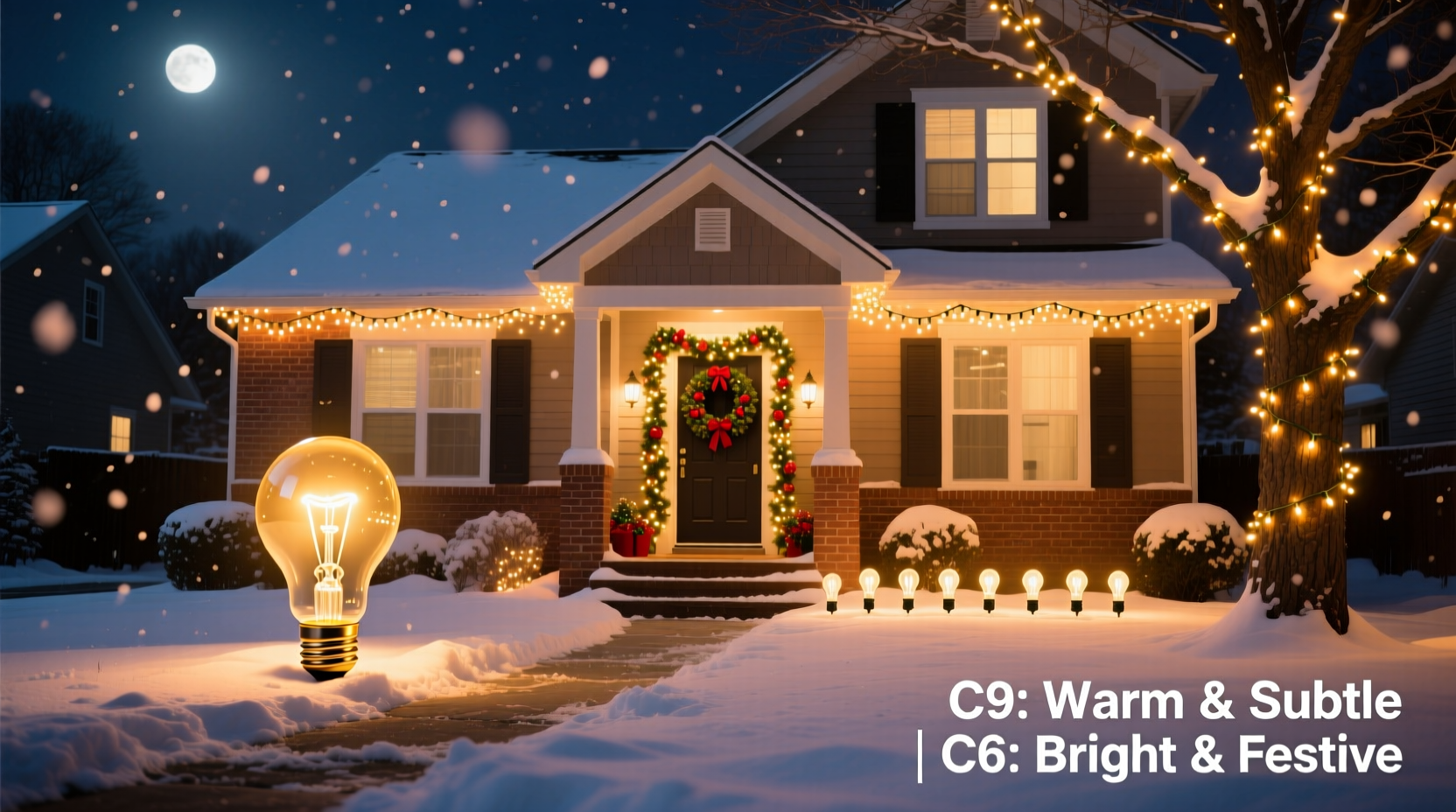
The “C” in C9 and C6 stands for “conical,” referring to the bulb’s shape. The number indicates the diameter in eighths of an inch. This means a C9 bulb is 9/8 inches (1.125 inches) wide, while a C6 is 6/8 inches (0.75 inches) across. That difference might seem minor, but it has real-world implications for visibility, light output, and installation density.
C9 bulbs are larger and project a bold, vintage look often seen on commercial buildings, large homes, or public holiday displays. Their size allows them to house higher-wattage filaments, producing more lumens per bulb. In contrast, C6 bulbs are smaller and more delicate, offering a refined, evenly spaced appearance ideal for homes with moderate architectural detail or where subtlety is preferred.
Because of their size, C9s require greater spacing—typically 12 inches apart on a string—while C6s are commonly spaced every 6 inches. This spacing affects not only the total number of strings needed but also the continuity of light along rooflines, trees, and railings.
Tip: Measure your roofline and key display areas before purchasing lights. Knowing linear footage helps determine how many C9 or C6 strings you’ll need based on spacing.Brightness Comparison: Lumens, Wattage, and Visual Impact
Brightness is one of the most critical factors when selecting outdoor Christmas lights. Too dim, and your display gets lost in the night. Too bright, and it becomes garish or intrusive to neighbors. C9 and C6 bulbs differ substantially in this regard.
A standard incandescent C9 bulb produces around 20–30 lumens and consumes about 7 watts. Because they’re larger, they can accommodate brighter filaments and are often used in commercial-grade applications. When strung across expansive surfaces like two-story homes or large porches, C9s deliver a commanding glow visible from the street.
C6 bulbs, being smaller, typically emit 8–12 lumens and use about 3.5 watts each. While individually less bright, their tighter spacing compensates by creating a denser, more continuous line of light. This makes them excellent for wrapping columns, outlining windows, or accenting eaves where uniformity matters more than raw power.
With the rise of LED technology, both sizes now come in energy-efficient versions. LED C9s can produce up to 80 lumens per bulb while using only 0.7 watts, making them far brighter and more efficient than their incandescent counterparts. Similarly, LED C6s reach 20–30 lumens on just 0.5 watts. This advancement blurs the traditional brightness gap, allowing homeowners to choose style over power consumption.
“The shift to LED has redefined what we expect from decorative lighting. You can now get C9-level brightness with C6-sized bulbs, giving designers more flexibility.” — Marcus Tran, Lighting Designer & Holiday Display Consultant
Choosing Based on Home Size and Architectural Style
Your home’s scale and design should guide your choice between C9 and C6 lights. A mismatch can result in a display that feels either underwhelming or excessive.
Large Homes (3,000+ sq ft): Homes with expansive facades, multiple gables, or tall entryways benefit from the bold presence of C9 bulbs. Their larger size maintains visual weight across long spans, preventing the lights from looking sparse. For example, a colonial-style home with a prominent front porch and second-floor balcony gains elegance and grandeur when outlined with warm white C9s.
Medium Homes (1,500–3,000 sq ft): These homes often strike a balance between detail and openness. C6 bulbs work exceptionally well here, especially when used to highlight specific features like window trim, shutters, or dormers. If you prefer a more dramatic look, C9s can still be effective—particularly if limited to rooflines or main entry points.
Small Homes or Townhouses (under 1,500 sq ft): On compact structures, C9s can dominate the facade, drawing attention away from architectural charm. C6 bulbs offer a proportional, polished finish that complements rather than overwhelms. Their finer scale matches the intimacy of smaller spaces.
Architectural details also play a role. Craftsman bungalows with exposed beams and stone foundations suit the warmth of C6 strings, while modern homes with clean lines often pair well with cool white or multicolor C9s for contrast.
Installation Practicalities: String Length, Power, and Maintenance
Beyond appearance, practical considerations influence whether C9 or C6 lights are better suited to your setup.
- String Length and Coverage: Standard C9 strings are usually 25 feet with 25 bulbs (12\" spacing). C6 strings of the same length carry about 50 bulbs due to closer spacing. This means fewer C9 strings are needed for long runs, reducing connection points and potential failure zones.
- Power Load: Incandescent C9s draw more power—up to 175 watts per string—requiring dedicated circuits. C6 strings consume roughly half that. LEDs reduce load significantly: LED C9 strings use ~17.5 watts, and C6s even less (~12.5 watts), allowing longer daisy-chained runs.
- Durability: Larger C9 bulbs are more resistant to wind and weather due to their weight and sturdier bases. However, their size makes them slightly more prone to breakage during handling. C6s are lighter and easier to coil for storage but may require more careful placement in high-wind areas.
- Replacement and Repair: Individual C9 bulbs are easier to replace due to size, but finding exact color matches can be harder. C6 replacement bulbs are smaller and sometimes sold in packs specific to the string model.
Comparison Table: C9 vs C6 Christmas Lights
| Feature | C9 Lights | C6 Lights |
|---|---|---|
| Bulb Diameter | 1.125 inches (9/8\") | 0.75 inches (6/8\") |
| Typical Spacing | 12 inches | 6 inches |
| Lumens (Incandescent) | 20–30 per bulb | 8–12 per bulb |
| Lumens (LED) | 60–80 per bulb | 20–30 per bulb |
| Wattage (Incandescent) | ~7 per bulb | ~3.5 per bulb |
| Wattage (LED) | ~0.7 per bulb | ~0.5 per bulb |
| Bulbs per 25-Foot String | 25 | 50 |
| Best For | Large homes, rooflines, bold displays | Medium/small homes, detailed trim, subtle accents |
| Energy Efficiency | Moderate (incandescent), High (LED) | Good (incandescent), Very High (LED) |
Real Example: Two Homes, Two Choices
Consider two neighboring homes on the same street. One is a 4,200-square-foot Tudor revival with steep gables and a wraparound porch. The owner chooses warm white LED C9 lights for the roofline, eaves, and front columns. The result is a majestic, inviting glow that dominates the block without appearing flashy. The brightness cuts through winter fog, and the large bulbs echo the home’s historic character.
The other home is a 1,400-square-foot ranch with clean lines and minimal trim. The homeowner selects cool white LED C6 lights to outline windows and define the front walkway. The tighter spacing creates a crisp, modern look that enhances the architecture without overpowering it. Neighbors comment on the tasteful restraint, noting how the display feels festive yet unobtrusive.
This contrast illustrates how matching bulb size and brightness to home scale leads to more satisfying results. Neither choice is objectively better—their success lies in context.
Step-by-Step Guide: Choosing the Right Lights for Your Home
- Measure Key Areas: Use a tape measure or laser tool to calculate the linear feet of rooflines, porches, trees, and railings you plan to light.
- Assess Your Home’s Scale: Stand across the street and evaluate your home’s footprint. Does it command attention or blend in? This helps determine whether bold (C9) or refined (C6) lighting fits better.
- Determine Desired Effect: Do you want a dramatic statement or a soft ambient glow? Brightness and spacing contribute directly to mood.
- Check Electrical Capacity: Review your outdoor outlets and circuit breakers. If using incandescent lights, avoid overloading. Opt for LED to minimize power draw.
- Choose Between LED and Incandescent: LED is recommended for longevity, efficiency, and safety. It also offers color consistency and cooler operation.
- Purchase and Test: Buy one string of your chosen type and install it temporarily. View it at dusk and night to confirm brightness and color temperature.
- Install and Secure: Use insulated clips (not nails or staples) to attach strings. Avoid sharp bends and ensure connections are elevated and protected from moisture.
Frequently Asked Questions
Can I mix C9 and C6 lights on the same house?
Yes, but with caution. Mixing sizes can create a disjointed look if not done intentionally. A common approach is using C9s on primary rooflines for impact and C6s on secondary features like windows or fences for detail. Stick to the same color temperature (e.g., all warm white) to maintain cohesion.
Are C9 lights too bright for residential use?
Traditional incandescent C9s can be quite bright, but LED versions allow dimming and warmer color options, making them suitable for homes. If concerned about glare, opt for frosted or opaque bulbs instead of clear ones, and avoid placing them at eye level near sidewalks or driveways.
Which is more cost-effective: C9 or C6?
Upfront, C6 strings are often cheaper per foot due to lower material costs. However, long-term value favors LED versions of either type because of energy savings and lifespan (often 25,000+ hours). While C9s may require fewer strings, C6s provide denser coverage, so total cost depends on your layout and goals.
Final Checklist Before You Hang Lights
- ✅ Measured all installation areas
- ✅ Chose between C9 and C6 based on home size and style
- ✅ Decided on LED or incandescent (LED strongly recommended)
- ✅ Selected consistent color temperature (warm white, cool white, or multicolor)
- ✅ Verified outlet access and circuit capacity
- ✅ Purchased appropriate clips and fasteners
- ✅ Tested one string before full installation
Conclusion: Illuminate with Intention
Selecting between C9 and C6 Christmas lights isn’t just about preference—it’s about harmony. The right choice enhances your home’s character, respects your neighborhood context, and brings joy without excess. Whether you opt for the bold presence of C9s or the elegant precision of C6s, let intention guide your decision. Consider scale, brightness, and installation practicality not as limitations, but as tools to craft a display that feels personal and polished.
As holiday traditions evolve, so do our tools. With modern LEDs, you no longer have to sacrifice brightness for efficiency or size for subtlety. Take the time this season to assess your space, plan thoughtfully, and hang lights that reflect both your home and your heart.
💬 What’s your go-to Christmas light setup? Share your experience with C9 or C6 bulbs and help others find the perfect brightness for their home!








