A well-styled bar cart is more than a functional storage piece—it’s a curated expression of personal taste, rhythm, and intentionality. When boho’s organic soul meets modern design’s clean geometry, the result isn’t a stylistic tug-of-war; it’s a grounded, layered, and deeply human aesthetic. The challenge lies not in choosing one over the other, but in finding the quiet harmony where rattan coexists with matte black metal, where terracotta mugs rest beside minimalist glassware, and where texture speaks as clearly as line. This isn’t about trend-matching or surface-level layering. It’s about building a bar cart that feels both effortlessly lived-in and thoughtfully composed—where every object has presence, purpose, and permission to belong.
1. Anchor with a Dual-Purpose Cart Frame
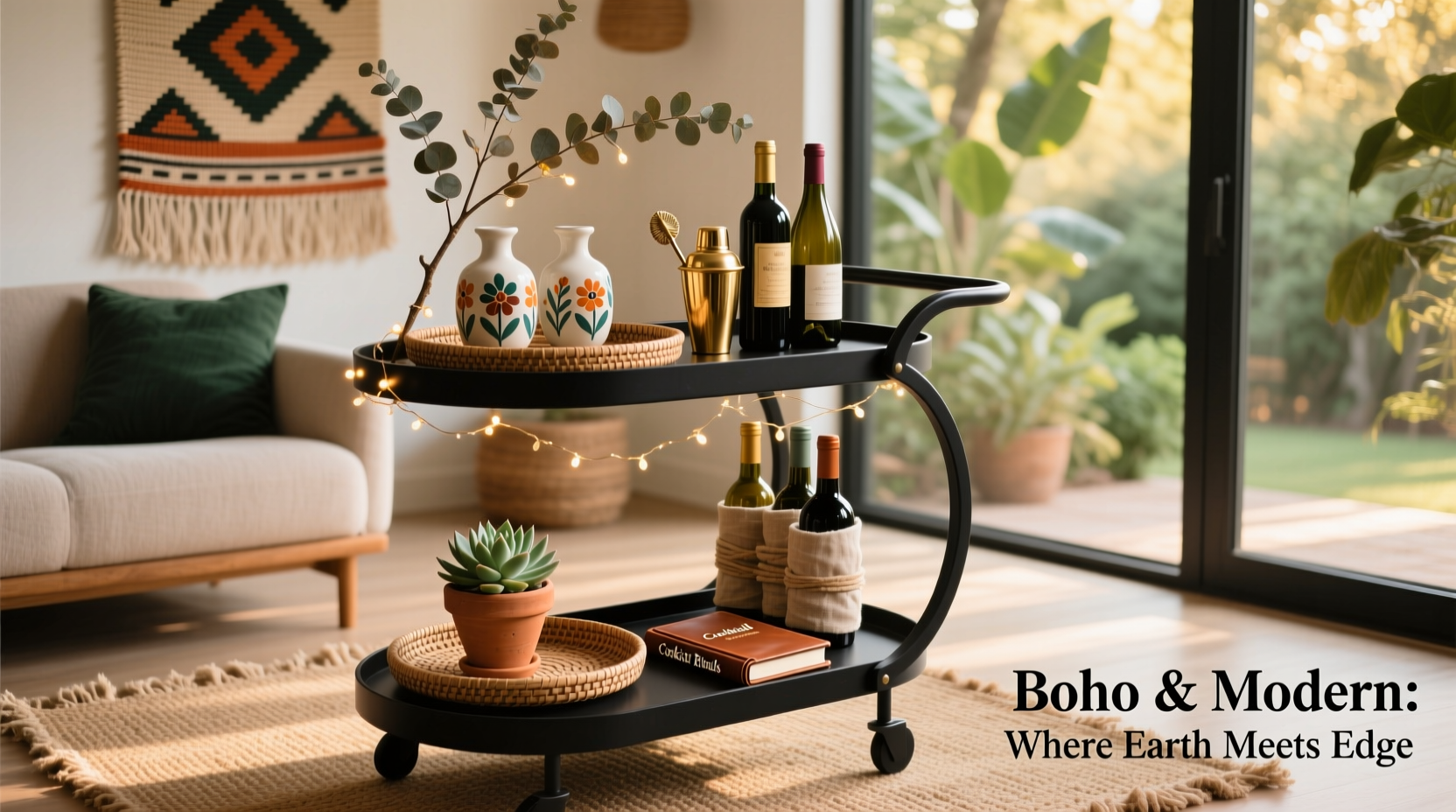
The foundation of any successful fusion bar cart is its frame—not just its shape, but its material language and structural honesty. A cart that tries to be “boho-chic” with ornate iron scrollwork or “ultra-modern” with glossy acrylic will struggle to hold both sensibilities. Instead, seek frames that speak *both* dialects simultaneously: matte black steel with visible weld marks (modern integrity) paired with a reclaimed teak or walnut lower shelf (boho warmth); or powder-coated brass-finish tubing with an open, airy silhouette (modern lightness) supporting woven seagrass baskets (boho tactility). Avoid fully enclosed cabinets or overly ornamental bases—they mute dialogue between styles.
Tip: Test cohesion by placing your cart in natural light for 15 minutes. If shadows feel harsh and angular *or* if the piece visually recedes into the background, it lacks the balanced presence needed for this blend.Material pairing matters more than finish alone. A brushed nickel frame reads cooler and more modern, while oil-rubbed bronze adds warmth and age—ideal for bridging the gap. The key is consistency: if your frame is matte black steel, keep hardware (wheels, shelf supports) in the same finish. Inconsistency fractures the visual narrative before you’ve added a single bottle.
2. Curate a Layered Color & Texture Palette (Not a Formula)
Boho leans into earthy saturation—terracotta, sage, ochre, deep indigo—while modern favors restrained neutrals: warm greys, oatmeal, charcoal, and crisp white. Merging them requires moving beyond “add one beige vase and one macramé hanger.” Think in terms of tonal families and tactile contrast.
Start with a base trio: one dominant neutral (e.g., warm grey linen napkins), one grounding earth tone (e.g., unglazed ceramic coupe glasses in rust), and one subtle accent (e.g., matte black cocktail shaker). Then introduce texture deliberately: a hand-thrown stoneware pitcher (boho irregularity) beside a geometric brass ice bucket (modern precision); a fringed cotton bar towel draped loosely over the edge (boho softness) against a smooth, seamless marble coaster set (modern refinement).
| Element | Boho-Aligned Choice | Modern-Aligned Choice | Harmonizing Bridge Choice |
|---|---|---|---|
| Glassware | Hand-blown amber tumblers with slight bubbles | Crystal-clear, ultra-thin stemmed coupes | Matte-frosted lowball glasses with subtle ribbing |
| Bar Tools | Wood-handled muddler, woven leather jigger strap | Sleek stainless-steel Boston shaker, magnetic bar spoon | Brushed brass double jigger with weighted base + walnut handle muddler |
| Storage | Woven seagrass canisters, clay apothecary jars | Clear acrylic spice rack, powder-coated steel tins | Matte black ceramic lidded jars with cork stoppers, smoked glass decanters |
This approach avoids pastiche. It creates resonance—not because elements “match,” but because they share underlying values: authenticity of material, respect for craft, and absence of unnecessary ornament.
3. Build Intentional Visual Rhythm (The 3-5-7 Rule)
Clutter kills fusion. Boho’s abundance and modern’s minimalism collide most painfully in visual noise. The antidote is rhythm—not symmetry, not strict balance, but a deliberate cadence of repetition, variation, and pause. Use the 3-5-7 rule as a compositional guide:
- Three anchor objects: Your largest, most structurally significant items—e.g., a tall decanter, a medium ceramic pitcher, and a compact bar tray. These establish height, weight, and focal points.
- Five mid-scale elements: Items that connect anchors—e.g., three bottles (two spirits, one mixer), a small plant in a textured pot, and a stack of two books on mixology or global flavors.
- Seven micro-textures or accents: Small, high-tactile details—e.g., a linen napkin folded with raw edges, a single dried eucalyptus sprig, a brass stirrer resting diagonally across a glass, a ceramic citrus reamer, a vintage matchbox, a tiny abalone shell, and a hand-poured soy candle in an unglazed vessel.
Rhythm emerges when these groupings relate spatially: anchors create vertical lines; mid-scale items flow horizontally between them; micro-accent points draw the eye diagonally across the plane. Leave at least 40% of shelf space visibly empty—negative space is where modern clarity breathes, and where boho’s sense of ease settles.
4. Real-World Integration: The Portland Loft Case Study
Maya, a graphic designer in Portland, transformed her open-concept loft’s awkward corner into a functional, expressive bar cart zone. Her space featured floor-to-ceiling windows (modern), exposed Douglas fir beams (boho warmth), and concrete floors (industrial-modern). Her initial attempt—a rattan cart overflowing with colorful glassware and trailing pothos—felt chaotic beside her streamlined sofa. Her second try—a stark white acrylic cart with monochrome glassware—felt sterile and disconnected from the wood grain and natural light.
She pivoted using the principles above. She sourced a two-tier matte black steel cart with open shelving and casters. On the top tier, she placed a smoke-grey glass decanter (modern form), a hand-thrown speckled stoneware mixing bowl (boho texture), and a slim brass pour spout. Below, she arranged three bottles (rye, vermouth, ginger beer) in staggered heights, flanked by a small fiddle-leaf fig in a ribbed terracotta pot and a stack of two books: The Art of the Cocktail and Botanical Bartending. She added micro-accent points: a folded oat-colored linen napkin, a single dried lavender stem tucked beside the decanter, and a matte black ceramic citrus squeezer angled precisely at 30 degrees.
The result? A cart that felt anchored, calm, and full of quiet personality. Guests consistently commented on how “intentional” it looked—not staged, but considered. Maya noted, “It stopped being something I *had to style* and became something I *naturally added to*, like putting a new book on a shelf or watering a plant.”
“True fusion design happens when the objects on your bar cart tell a story about *how you live*, not about which trend you’re following. The most compelling carts reflect daily rituals—morning espresso, evening spritz, shared laughter—not Pinterest boards.” — Lena Torres, Interior Designer & Founder of Hearth Studio
5. Practical Styling Checklist & Step-by-Step Refresh
Styling shouldn’t require an interior designer or a weekend retreat. Use this actionable checklist and timeline to build or refresh your cart in under 90 minutes—without decision fatigue.
Prep (5 minutes)
- Clear the cart completely. Wipe shelves with a damp microfiber cloth.
- Gather all bar tools, glassware, bottles, and decorative objects in one place.
- Remove anything you haven’t used in the last 6 weeks—or doesn’t spark genuine delight.
Build (30 minutes)
- Anchor: Place your three largest items on the top shelf—vary heights, but keep base widths proportional (e.g., tall decanter + medium pitcher + compact tray).
- Flow: Arrange five mid-scale items across both tiers, ensuring at least one element visually connects top and bottom (e.g., a trailing vine, a long-handled bar spoon resting across shelves).
- Texture: Add seven micro-accent points. Prioritize touch: rough clay, cool metal, soft linen, smooth glass. No two adjacent items should share the same primary texture.
Refine (10 minutes)
- Step back 6 feet. Does your eye land on one clear focal point? If not, remove the most visually busy item.
- Check lighting: Are reflective surfaces (glass, metal) creating distracting glare? Reposition or swap for matte alternatives.
- Test function: Can you easily reach the shaker without moving the decanter? Can you slide out a napkin without disturbing the stack?
Maintain (Ongoing)
Tip: Dedicate 90 seconds each morning to “reset”: straighten napkins, wipe spills, adjust one plant stem. Consistent micro-adjustments prevent visual entropy far more effectively than monthly deep cleans.6. FAQ: Addressing Common Fusion Frustrations
How do I avoid my bar cart looking like a thrift store dump or a showroom display?
It comes down to editing and hierarchy. Thrift-store chaos happens when every object competes for attention equally. Showroom sterility occurs when nothing bears evidence of use or warmth. Solve both by applying the 3-5-7 rhythm—and then adding *one* “lived-in” detail: a slightly off-kilter fold in a napkin, a faint watermark on a coaster, a single lemon wedge resting beside the juicer. Imperfection signals authenticity.
Can I use plants? Which ones work best for this blend?
Absolutely—but choose species that embody both aesthetics. Avoid delicate florals (too fussy) or rigid succulents (too clinical). Opt for textural, architectural plants: a small fiddle-leaf fig (broad, organic leaves + strong central stem), a trailing string of pearls (soft drape + sculptural beads), or a compact snake plant in a handmade ceramic pot (modern form + boho vessel). Keep pots matte, unglazed, or raw-finish—never glossy or plastic.
What’s the biggest mistake people make when trying to blend these styles?
Using “boho” as shorthand for “busy” and “modern” as shorthand for “bare.” True fusion rejects both extremes. Boho, at its best, is about mindful accumulation—each object chosen for meaning or craft. Modern, at its core, is about clarity of purpose—not emptiness. Your cart succeeds when every item answers two questions: “Does this serve a function?” and “Does this bring me quiet joy?” If either answer is “no,” it doesn’t belong—even if it’s perfectly on-trend.
Conclusion: Style With Conviction, Not Compromise
Your bar cart isn’t a compromise between boho and modern. It’s a declaration that warmth and clarity aren’t opposites—they’re complementary forces. That texture needs structure to resonate, and structure needs texture to feel human. When you choose a hand-thrown mug alongside a precision-engineered jigger, you’re not balancing trends—you’re honoring craftsmanship across eras and intentions. When you leave space between objects, you’re not practicing restraint; you’re making room for conversation, for pause, for the clink of ice and the murmur of guests. This aesthetic endures because it reflects real life: layered, evolving, grounded in substance, and quietly confident in its own rhythm.
Don’t wait for the “perfect” cart, the “right” season, or a complete overhaul. Start tonight. Pull out your current cart—or a simple tray. Remove three things that don’t spark calm or utility. Add one object that embodies both warmth and precision: perhaps a walnut-handled bar spoon, a matte ceramic coaster, or a single sprig of rosemary in a small copper cup. Notice how that small edit shifts the energy. Then build from there—not toward an ideal image, but toward a space that feels unmistakably, unapologetically yours.
💬 Your turn: Share one object on your bar cart that bridges boho and modern—and tell us *why* it works. Real stories inspire real change. Drop your insight in the comments below.








