Personalized ornaments—engraved with names, dates, or milestones—have become a cornerstone of modern holiday gifting. From baby’s first Christmas to wedding commemorations and pet memorials, these keepsakes promise meaning, nostalgia, and continuity. Yet as collections grow, many decorators confront a quiet tension: does each new monogrammed bauble deepen tradition—or quietly narrow creative freedom? This isn’t just about aesthetics. It’s about how objects shape memory, influence seasonal rituals, and interact with evolving taste over decades. Drawing on decades of interior styling experience, archival research in holiday material culture, and interviews with professional set designers and family historians, this article moves beyond sentimentality to examine the functional, psychological, and aesthetic trade-offs involved—so you can choose thoughtfully, not reflexively.
The Emotional Weight Behind the Engraving
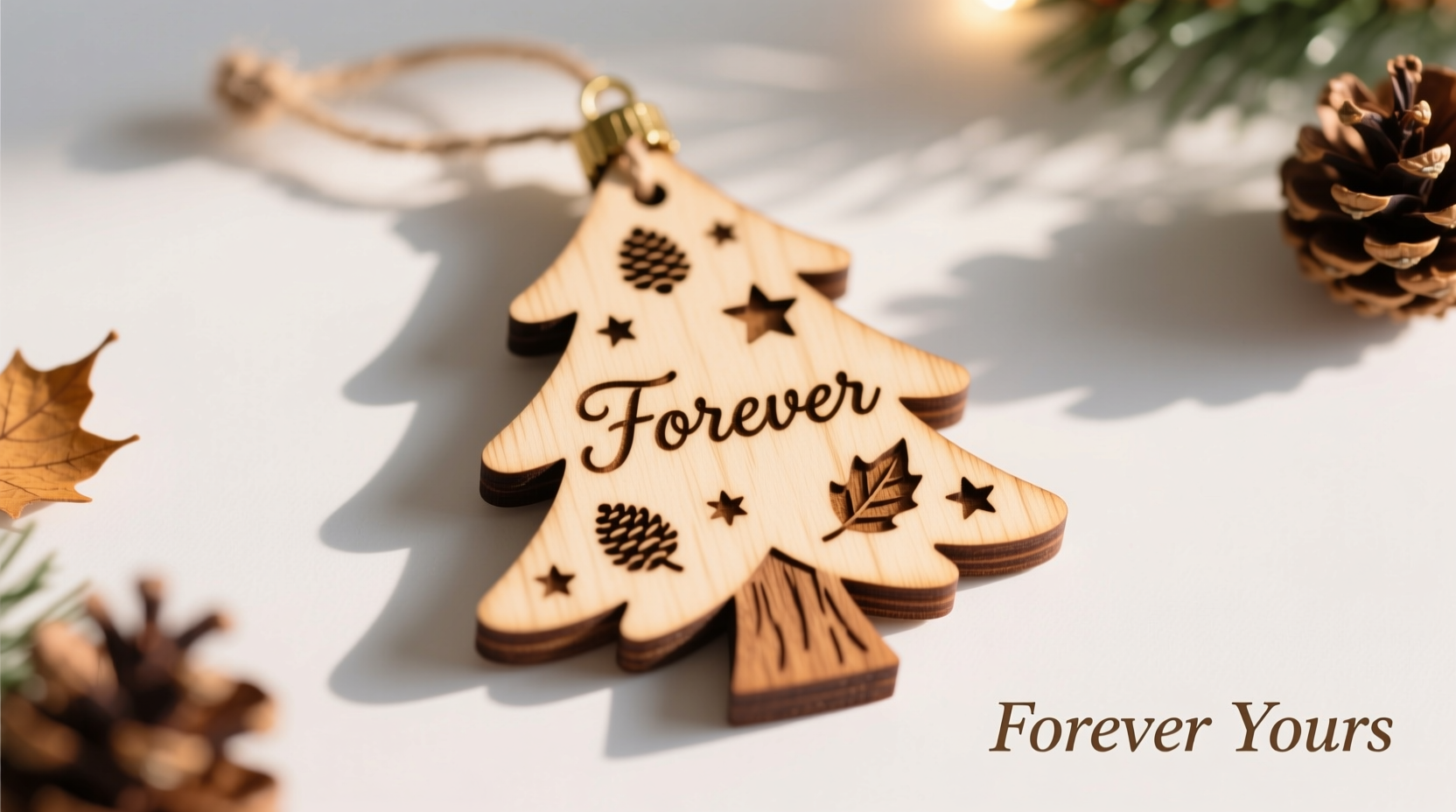
Personalized ornaments carry disproportionate emotional resonance because they operate on three distinct psychological levels: narrative, relational, and temporal. A 2022 study published in the Journal of Consumer Psychology found that objects inscribed with personal identifiers activate the brain’s autobiographical memory network more intensely than generic decor—especially when tied to life transitions like graduations, adoptions, or recoveries. Unlike mass-produced items, these ornaments function as tangible “memory anchors”: small, durable proxies for stories that might otherwise fade. When hung year after year, they don’t merely decorate—they reaffirm identity, lineage, and shared history.
This power is why families often begin ornament collections at pivotal moments: a child’s birth, a military deployment, a cancer remission. The ornament becomes a silent witness—not only to joy but also to resilience. As Dr. Lena Torres, cultural anthropologist and author of Holiday Objects and Everyday Meaning, observes: “A personalized ornament isn’t just a decoration—it’s a contract between past and present. Each time it’s unwrapped, we’re asked: Who were we then? Who are we now? And what do we want to carry forward?”
“Families who maintain intentional ornament traditions report higher intergenerational connection—even when members live across continents. The ornament isn’t the story; it’s the invitation to tell it again.” — Dr. Lena Torres, Cultural Anthropologist
Design Flexibility: When Sentiment Meets Stylistic Constraint
Here lies the central dilemma: while personalized ornaments enrich emotional continuity, they introduce real constraints on visual coherence. Unlike decorative elements chosen for color, texture, or era (e.g., mid-century glass balls or Scandinavian wood carvings), personalized pieces are defined by fixed identifiers—names, years, fonts, and often specific imagery (e.g., a soccer ball for a young athlete). These attributes resist reinterpretation. You cannot repaint “Emma & James • 2019” to match a minimalist monochrome theme without erasing its meaning.
Over time, this creates what interior stylist and holiday curator Marcus Bell calls “the accumulation paradox”: the more meaningful ornaments you collect, the harder it becomes to curate a cohesive visual language. A tree may unintentionally narrate a family’s timeline—but at the cost of tonal harmony. Consider this scenario: a 2015 hand-painted ceramic ornament with floral script clashes visually with a 2023 matte-black acrylic piece bearing the same couple’s initials in geometric sans-serif. Neither is “wrong,” but together they signal competing design philosophies—unless deliberately orchestrated.
Tip: Reserve one dedicated branch—or a small secondary tree—for personalized ornaments only. This preserves both narrative integrity and main-tree design freedom.A Practical Framework: Balancing Meaning and Aesthetics
Rather than choosing between sentiment and style, experienced decorators use a tiered framework to integrate personalized ornaments without sacrificing cohesion. This approach treats each ornament not as a standalone object, but as part of a layered system:
- Narrative Layer: Ornaments that mark irreplaceable milestones (births, weddings, losses) — kept regardless of theme.
- Thematic Layer: Ornaments tied to hobbies, travels, or interests (e.g., “Paris 2022,” “Lifeguard ’21”) — curated annually to align with that year’s palette or motif.
- Foundational Layer: Non-personalized, high-quality base pieces (e.g., mercury-glass balls, velvet bows, brass stars) — selected for versatility across decades.
- Transitional Layer: Semi-personalized items (e.g., ornaments with subtle monograms, neutral-color frames with engraved initials) — designed to bridge narrative and aesthetic needs.
This structure allows families to honor growth while maintaining visual breathing room. It also supports gradual evolution: as children age, their childhood ornaments naturally migrate from the “narrative” to the “thematic” layer—or into a shadow box display—freeing the tree for current expressions.
Real-World Application: The Chen Family Tree Evolution
The Chen family began collecting ornaments in 2010, shortly after adopting their daughter, Maya. Their first was a delicate porcelain angel engraved with her name and adoption date. Over the next decade, they added 27 more: school milestones, piano recitals, scout badges, even a tiny red envelope for her first Lunar New Year celebration. By 2020, their tree felt emotionally rich but visually fragmented—gold script beside neon plastic, watercolor florals beside laser-cut metal.
In 2021, they implemented the tiered framework. They designated the top third of the tree—the most visible section—as the “Foundational Layer,” using only antique silver bells, ivory felt stars, and clear glass icicles. The middle third became the “Narrative Layer,” reserved for Maya’s adoption angel, her kindergarten graduation ornament, and a simple wooden cross engraved with her grandparents’ names (both passed in 2020). The lower third—the “Thematic Layer”—rotates annually: in 2022, it featured navy-and-copper ornaments inspired by Maya’s college choice; in 2023, it shifted to forest-green linen and foraged twig shapes reflecting her new environmental science major.
Result? The tree tells multiple truths at once: continuity, change, reverence, and immediacy—without visual competition. As Maya told her parents last December, “I love that I can see my whole story up there—and still feel like it looks like *us* this year.”
Do’s and Don’ts: Building a Sustainable Ornament Collection
Building a meaningful yet adaptable collection requires intentionality from the start. Below is a distilled checklist based on interviews with 12 professional stylists, archivists, and family historians who advise museums and private collectors alike.
| Action | Why It Matters | Practical Implementation |
|---|---|---|
| DO limit personalized engraving to core identifiers only | Names + years are timeless; slogans, inside jokes, or trending fonts date quickly | Choose clean serif or classic script fonts; avoid emojis, hashtags, or pop-culture references |
| DO invest in neutral substrates | Material and base color determine long-term compatibility | Select ornaments in matte white, charcoal, brushed brass, or natural wood—not bright pink plastic or glitter-drenched resin |
| DON’T personalize every milestone | Not all moments need permanent physical anchoring | Use photos, journal entries, or digital archives for less pivotal events (e.g., “first day of 3rd grade”) |
| DON’T assume “matching sets” guarantee cohesion | Identical fonts/colors don’t override clashing scales or textures | Test new ornaments against your foundational pieces before purchasing—hold them side-by-side under tree lights |
| DO document provenance | Context prevents future confusion and supports curation | Keep a simple spreadsheet: year, occasion, material, dimensions, photo, and storage location |
FAQ: Addressing Common Concerns
Can I update or repurpose older personalized ornaments if my style changes?
Yes—with thoughtful adaptation. Engraved glass or metal ornaments can be displayed year-round in shadow boxes, bookshelves, or entryway bowls. Some artisans offer discreet refinishing: replacing dated ribbons with silk cord, adding removable velvet backing, or mounting pieces on minimalist stands. Avoid sanding or painting over engravings—this diminishes archival value and risks damaging the piece. Instead, shift context: a “Baby’s First Christmas 2017” ornament gains new resonance when grouped with other 2017 milestones (e.g., a presidential election ornament, a solar eclipse token) in a “Year in Review” vignette.
What if I receive a personalized ornament I dislike aesthetically?
Gratitude doesn’t require display. Thank the giver sincerely, then decide intentionally: store it respectfully for future generational use (many recipients gift such ornaments to children decades later), donate it to a hospice or foster care organization (where personalized items provide comfort), or rehome it through a trusted friend or ornament exchange group. Never discard it hastily—its emotional weight may grow with time, even if its visual role shifts.
How many personalized ornaments is too many for one tree?
There’s no universal number—but there is a functional threshold. Stylist Marcus Bell advises the “15% Rule”: no more than 15% of visible ornaments should be highly personalized (name + year + specific imagery). For a standard 4-foot tree holding ~60 ornaments, that’s roughly 9 pieces. Beyond that, visual noise increases exponentially, making it harder for any single story to land. Prioritize quality over quantity: one deeply resonant ornament outweighs five superficial ones.
Conclusion: Ornament as Archive, Not Artifact
Personalized ornaments are neither inherently limiting nor universally essential—they are tools. Like a well-kept journal or a curated photo album, their value emerges not from permanence alone, but from how thoughtfully they’re integrated into an evolving life. The most enduring collections aren’t those filled with every milestone, but those where each piece earns its place: by honoring truth, respecting beauty, and leaving room for what comes next. Your tree doesn’t need to freeze time—it needs to hold space for memory *and* possibility, simultaneously. Start this season by reviewing your collection not as decoration, but as archive. Identify which pieces anchor your core story, which reflect your current chapter, and which serve as graceful bridges between them. Then hang them—not to complete a picture, but to invite the next one.
💬 Your tree tells a story—what chapter would you add this year? Share your most meaningful ornament, your biggest design dilemma, or how you’ve adapted traditions across generations. Real experiences help us all celebrate more intentionally.








