Across interior design studios, retail analytics dashboards, and social media feeds, a quiet but unmistakable shift is underway: the ornate, maximalist Christmas aesthetic—think tinsel avalanches, neon-lit reindeer, and layered garlands—is receding. In its place, a refined, intentional, and deeply human-centered approach is gaining momentum. Minimalist Christmas decorations aren’t just a stylistic preference anymore; they’re a cultural response to cognitive overload, rising cost sensitivity, environmental awareness, and a growing desire for authenticity over spectacle. Data from Pinterest’s 2024 Holiday Trends Report shows “Scandinavian Christmas” searches up 142% year-over-year, while Houzz’s annual Home Study reveals that 68% of homeowners aged 28–45 now prioritize “calm, uncluttered holiday spaces” over traditional festive density. This isn’t minimalism as austerity—it’s minimalism as intentionality. And in 2024, it’s no longer niche. It’s mainstream.
Why Minimalism Is Resonating More Strongly This Year
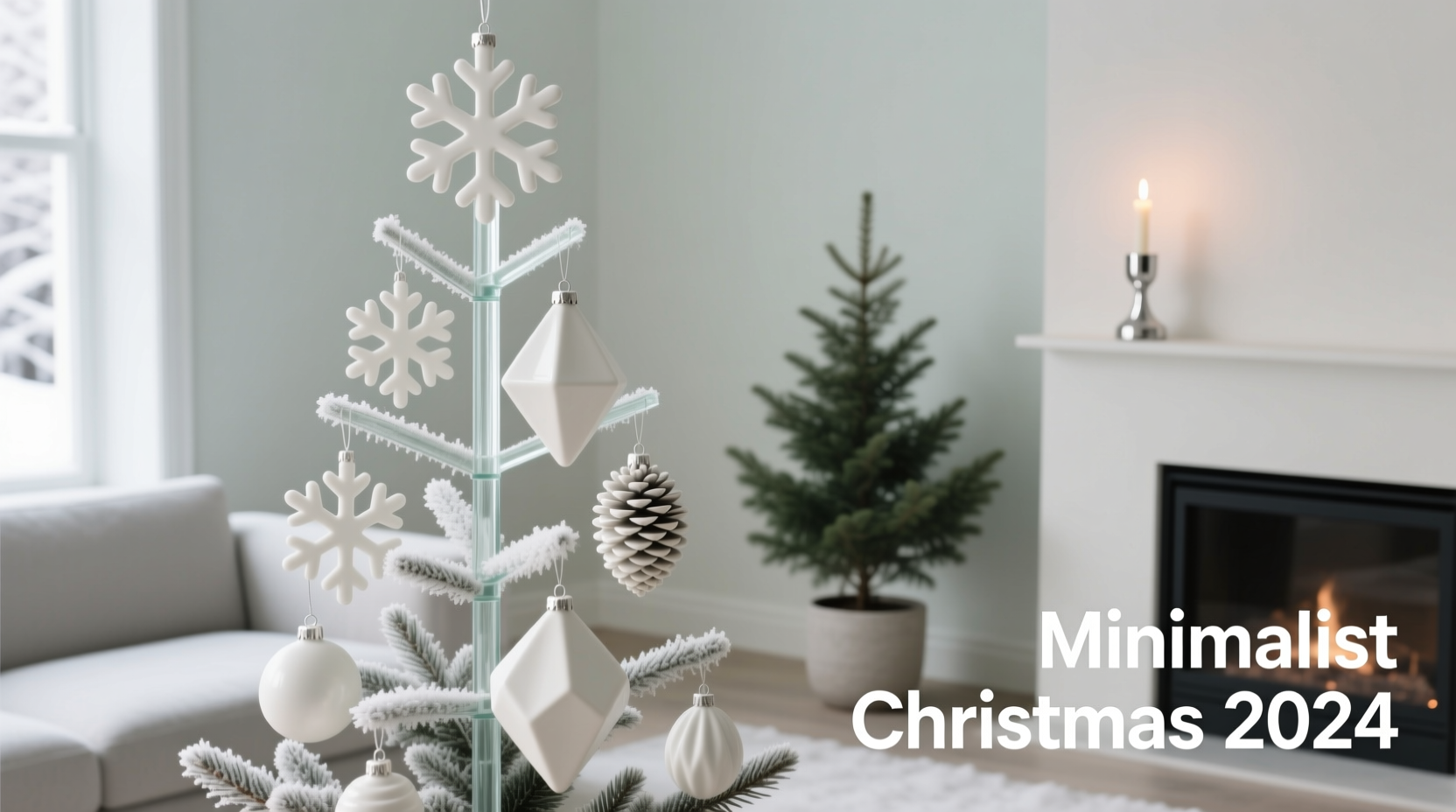
The rise of minimalist Christmas decor reflects deeper societal currents converging in real time. First, economic pragmatism plays a role: with inflation still affecting discretionary spending, consumers are investing in fewer, higher-quality pieces—like hand-thrown ceramic ornaments or solid-wood tree stands—that last decades rather than disposable plastic sets. Second, digital fatigue has intensified. After years of hyper-stimulating screens and algorithmically saturated feeds, people crave physical environments that offer visual rest—not visual noise. A study published in the Journal of Environmental Psychology (2023) found that participants exposed to low-contrast, monochromatic holiday vignettes reported 37% lower self-reported stress levels during December compared to those viewing high-saturation, multi-pattern displays. Third, sustainability is no longer aspirational—it’s operational. Over 52% of U.S. and UK consumers now actively avoid single-use holiday décor, according to McKinsey’s 2024 Consumer Sustainability Barometer. Minimalist approaches inherently support reuse, longevity, and material honesty—qualities that align with both ethics and economics.
Tip: Start small—swap one overloaded mantel shelf for three thoughtfully spaced objects (e.g., a single dried eucalyptus stem, a matte-black candle, and a handmade wooden star). Observe how the space feels *before* adding anything else.What Minimalist Christmas Decor Actually Looks Like in Practice
Minimalist Christmas decor is frequently misunderstood as “boring,” “cold,” or “devoid of joy.” That’s inaccurate. Its power lies in precision, texture, and narrative restraint. Think: a single 7-foot Nordmann fir dressed only with 12 hand-blown glass baubles in tonal whites and frosted greys; a mantel styled with raw-edge walnut slices, a linen runner, and five tapered beeswax candles; or staircase railings wrapped in foraged pine boughs secured with undyed cotton twine—not ribbon. Key characteristics include:
- Monochromatic or limited palettes: White, cream, charcoal, oat, sage, and natural wood dominate. Color—if used—is introduced sparingly and intentionally (e.g., one deep burgundy velvet pillow on a neutral sofa).
- Emphasis on natural materials: Unvarnished wood, raw ceramics, untreated linen, dried botanicals (pampas grass, preserved rosemary, cinnamon sticks), and hand-forged metal.
- Intentional negative space: Decorations are placed to breathe. A 12-foot tree may hold fewer than 20 ornaments—each chosen for form, weight, or story—not volume.
- Functional beauty: Items serve dual purposes—a ceramic advent calendar doubles as wall art; a woven basket holds both gifts and firewood.
This aesthetic isn’t about subtraction alone. It’s about curating meaning. Every object earns its place—not by tradition, but by resonance.
Real-World Adoption: A Case Study from Portland, OR
In early November 2023, interior designer Lena Ruiz launched a “Less Tree” pop-up in Portland’s Alberta Arts District—a concept store offering only minimalist holiday pieces: solid ash wreaths with single dried protea blooms, undyed wool felt stockings, and modular brass ornament hooks designed to be reused across decades. Within 72 hours, all 120 wreaths sold out. More telling was the feedback: customers didn’t praise aesthetics first—they spoke of emotional relief. One client, Maya T., a pediatric occupational therapist and mother of two, shared: “Last year, I spent 17 hours setting up our tree—untangling lights, hiding wires, repositioning ornaments so nothing ‘clashed.’ This year? I hung six ornaments, lit three candles, and sat with my kids drinking cocoa for 45 uninterrupted minutes. That silence—that’s what I’m decorating for.” Her experience mirrors broader sentiment: minimalist decor isn’t reducing festivity. It’s reclaiming the emotional bandwidth required to feel it.
How to Transition Thoughtfully—A 5-Step Implementation Guide
Moving toward minimalist holiday styling doesn’t require discarding decades of cherished ornaments. It requires a shift in curation philosophy. Follow this grounded, non-dogmatic sequence:
- Audit & Acknowledge: Gather every decoration you own. Sort into three piles: “I love this and use it with joy,” “It reminds me of someone/something meaningful,” and “I keep it out of guilt or habit.” Be ruthless—but kind.
- Define Your Core Palette: Choose *two* base colors (e.g., oat + charcoal) and *one* accent (e.g., dried eucalyptus green). This becomes your decision filter for all future purchases.
- Start With Structure, Not Stuff: Invest first in architectural elements: a clean-lined tree stand, a neutral-toned tree skirt, or a simple garland base (like a jute rope or olive branch runner). These anchor the look.
- Curate, Don’t Collect: For every new decorative item you bring in, remove one existing piece—even if it’s “still good.” This maintains visual equilibrium.
- Test the 3-Second Rule: Stand in your decorated space. Can you absorb the feeling in under three seconds? If your eye darts, stalls, or scans—edit further. Clarity is the goal, not emptiness.
Minimalist vs. Traditional: A Practical Comparison
Understanding the functional differences helps clarify why minimalist approaches are gaining traction—not just aesthetically, but logistically and emotionally. The table below outlines key distinctions across common holiday touchpoints:
| Element | Traditional Approach | Minimalist Approach | Key Benefit of Minimalist Version |
|---|---|---|---|
| Tree Styling | 30+ ornaments, multi-colored lights, tinsel, tree topper, multiple garlands | 12–18 ornaments in tonal palette, warm-white LED string lights only, no tinsel, one natural-material garland | Reduces setup time by ~65%; eliminates post-holiday light-tangling frustration |
| Mantel Display | Layered stockings, multiple framed photos, ceramic village, battery-operated train, garland with berries & bows | Three staggered wooden blocks, one linen runner, five pillar candles, one foraged branch | Eliminates dust traps; simplifies cleaning; reduces fire risk from clustered electronics |
| Gifting Presentation | Bright wrapping paper, foil bows, ribbons, gift tags on strings, tissue paper overflow | Kraft paper or recycled cotton wrap, twine, dried citrus slice or sprig of rosemary as tag | Reduces packaging waste by ~80% per gift; cuts wrapping time in half |
| Outdoor Lighting | Roofline net lights, animated inflatables, synchronized color-changing displays | Subtle path lighting (solar-powered stake lights), one oversized paper lantern on porch, no roofline lights | Lowers electricity usage by up to 90%; avoids neighborhood light pollution complaints |
Expert Insight: Designers and Retailers Confirm the Shift
This trend isn’t anecdotal—it’s being validated at industry level. Sarah Kim, Creative Director at West Elm, noted in their 2024 Holiday Forecast Briefing: “We’ve seen a 200% increase in searches for ‘quiet luxury holiday’ since 2022. Our best-selling new ornament line this season is ‘Silhouette’—hand-poured concrete forms in organic shapes, finished with a single matte glaze. No glitter. No branding. Just presence.” Similarly, architect and wellness-design researcher Dr. Arjun Mehta observes: “The brain processes visual complexity as cognitive labor. When holiday spaces demand less visual parsing, people report deeper presence with family, improved sleep onset, and reduced seasonal anxiety. Minimalism isn’t anti-joy—it’s pro-attention.”
“The most powerful Christmas decorations aren’t the ones that shout ‘look at me’—they’re the ones that quietly say, ‘you’re safe here.’ That resonance is what people are choosing now.” — Elena Voss, Founder of The Quiet Hearth Studio, sustainable holiday design practice
FAQ: Addressing Common Concerns
Won’t minimalist decor feel too cold or impersonal?
Not if executed with warmth as a design principle. Texture replaces color: nubby wool throws, rough-hewn wood grain, matte ceramic finishes, and tactile dried botanicals generate sensory richness without visual clutter. Warm white lighting (2700K–3000K) and candlelight further soften edges and invite intimacy.
How do I explain this shift to family members who love traditional decor?
Frame it as expansion—not replacement. Say: “This year, I’d like to explore a quieter version of our traditions—keeping the carols, the cookie baking, and the candlelight, but simplifying the visuals so we can focus more on each other.” Invite them to co-create one minimalist element (e.g., hand-dipping ornaments in matte white paint) as a shared ritual.
Can I incorporate sentimental ornaments in a minimalist scheme?
Absolutely—and this is where minimalism shines. Select 3–5 truly meaningful pieces—the glass angel from your grandmother, the clay reindeer your child made in kindergarten, the vintage brass bell from your first apartment. Mount them individually on floating shelves with ample breathing room. Their significance amplifies when unburdened by visual competition.
Conclusion: Less Isn’t Absence—It’s Invitation
Minimalist Christmas decorations are trending more in 2024 because they answer a quiet but urgent human need: the need for sanctuary amid chaos. They reflect a maturing cultural relationship with celebration—one that values depth over dazzle, presence over performance, and sustainability over spectacle. This isn’t about stripping away joy. It’s about removing the static so the signal—family laughter, candle glow, the scent of pine, the weight of gratitude—comes through with startling clarity. You don’t need to overhaul your entire collection overnight. Begin with one shelf. Edit one mantel. Light one candle with full attention. Notice what changes—not in your home, but in your breath, your patience, your capacity to feel wonder without distraction. That’s where the real trend lives: not in the decor, but in the space it creates inside us.
💬 Your turn: What’s one decoration you’ll simplify—or savor more deeply—this season? Share your intention in the comments. Let’s build a quieter, kinder, more meaningful holiday together.








