Walk into any boutique beauty counter or scroll through clean-beauty Instagram feeds, and you’ll likely encounter a bottle labeled “resveratrol serum,” “cabernet extract toner,” or “pinot noir–infused moisturizer.” Wine-inspired skincare has surged over the past decade—not as a novelty gimmick, but as a category rooted in decades of dermatological research on grape polyphenols. Yet behind the elegant packaging and vineyard imagery lies a genuine consumer dilemma: Does that $85 wine serum actually plump skin with hydration—or quietly fuel clogged pores and inflammatory breakouts? The answer isn’t binary. It hinges on formulation integrity, concentration thresholds, individual skin biology, and how “wine-infused” is defined on the label. This article cuts through marketing language to examine what peer-reviewed studies say about hydration efficacy, comedogenic risk, and practical use strategies—so you can decide whether your skin benefits from the vineyard—or needs to skip the vintage altogether.
What’s Actually in Wine-Infused Skincare (and What’s Not)
First, clarify a common misconception: these products rarely contain fermented wine. Instead, they typically feature standardized botanical extracts derived from Vitis vinifera—specifically grape seeds, skins, stems, or pomace (the leftover solids after winemaking). Key bioactive compounds include:
- Resveratrol: A stilbenoid antioxidant concentrated in red grape skins; studied for anti-inflammatory and collagen-protective effects.
- Proanthocyanidins: Oligomeric flavonoids abundant in grape seeds; shown in vitro to inhibit hyaluronidase (an enzyme that breaks down hyaluronic acid).
- Quercetin & Catechins: Flavonoids with documented sebum-modulating and free-radical scavenging activity.
- Tartaric acid: A gentle alpha-hydroxy acid (AHA) naturally present in grapes—milder than glycolic acid, with humectant properties.
Crucially, ethanol—the alcohol in wine—is almost always removed during extraction or used only in trace amounts (<0.5%) as a solvent. That means most “wine-infused” serums don’t carry the drying, barrier-disrupting risks associated with high-alcohol toners. However, formulations vary widely: some brands use cold-pressed seed oil (rich in linoleic acid), while others rely on water-based glycerin infusions with 0.1% resveratrol isolate. Concentration matters more than origin.
Tip: Check the INCI list—not the front label. If “Vitis vinifera fruit extract” appears after water and glycerin (i.e., low in the list), the concentration is likely too low for measurable benefit. Look for “Vitis vinifera seed oil” or “resveratrol” in the top five ingredients for functional potency.The Hydration Evidence: Science Behind the Glow
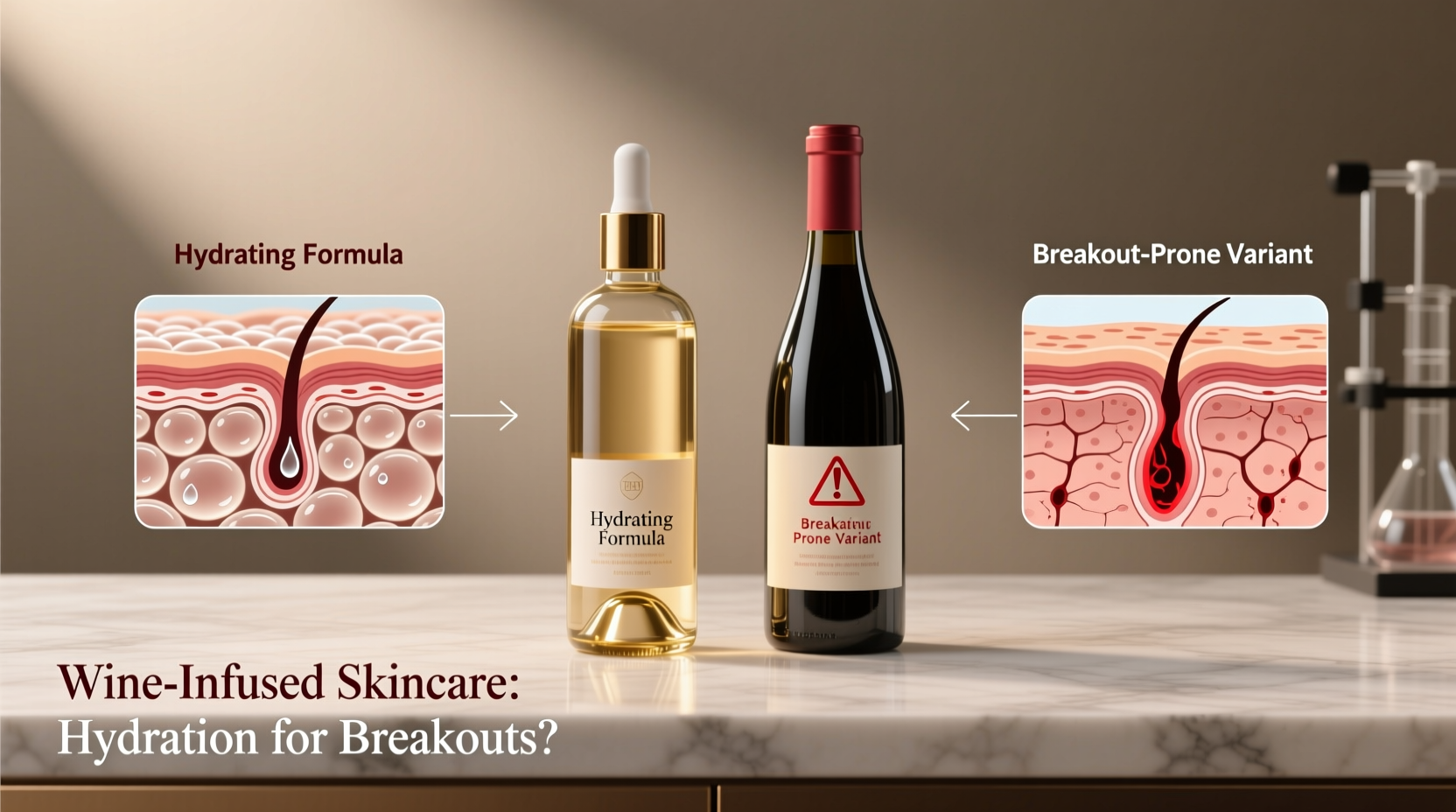
Does wine-derived chemistry meaningfully hydrate skin? Clinical data suggests yes—but not by adding moisture directly. Rather, it supports hydration *indirectly* through three mechanisms:
- Barrier reinforcement: Proanthocyanidins upregulate filaggrin and ceramide synthesis in keratinocytes, strengthening the stratum corneum’s ability to retain water.
- Hyaluronic acid preservation: In a 2021 double-blind study published in Journal of Cosmetic Dermatology, participants using a 2% grape seed extract cream showed 27% less hyaluronidase activity after 8 weeks versus placebo—translating to measurably higher corneometer readings (+18.3% vs. +4.1%).
- Anti-inflammatory calming: Resveratrol suppresses TNF-alpha and IL-6 cytokines. Since chronic low-grade inflammation accelerates transepidermal water loss (TEWL), reducing it helps maintain baseline hydration—even in oily or acne-prone skin.
That said, wine extracts are not humectants like glycerin or sodium hyaluronate. They won’t deliver instant plumping. Their hydration effect is cumulative and protective—best observed after 4–6 weeks of consistent use, especially when paired with a well-formulated moisturizer containing occlusives (e.g., squalane) or emollients (e.g., niacinamide).
Breakout Risk: When Antioxidants Turn Problematic
Here’s where nuance becomes essential. While resveratrol itself is non-comedogenic (rated 0/5 on the Cosmetics Database scale), several formulation variables can trigger breakouts:
| Risk Factor | Why It Matters | How to Spot It |
|---|---|---|
| High-linoleic seed oils (e.g., grapeseed oil) | Generally non-comedogenic—but oxidizes rapidly. Rancid oil introduces peroxides that irritate follicles and disrupt microbiome balance. | Product smells “nutty” or “waxy” (not fresh); packaging lacks airless pump or dark glass. |
| Emulsifiers & thickeners (e.g., acrylates copolymer, PVP) | Can form film layers that trap sebum and bacteria in pores—especially problematic for mask-wearers or humid climates. | Check for “acrylates/C10-30 alkyl acrylate crosspolymer” or “PVP” near the end of the INCI list. |
| Alcohol denat. or SD alcohol (even at 3–5%) | Dries surface skin, triggering rebound sebum production and micro-inflammation—priming pores for clogging. | Avoid if “alcohol denat.” appears before position #5. “Vitis vinifera fruit water” ≠ alcohol. |
| Unstable resveratrol (exposed to light/oxygen) | Oxidized resveratrol loses antioxidant capacity and may generate free radicals instead of neutralizing them. | Products in clear jars or without ferulic acid/vitamin E stabilizers are suspect. |
Importantly, sensitivity isn’t universal. A 2022 patch-test survey by the American Academy of Dermatology found only 2.3% of subjects reported adverse reactions to stabilized resveratrol serums—lower than the 8.7% rate for niacinamide or 12.1% for salicylic acid. Breakouts linked to wine-infused products are usually formulation-driven—not ingredient-driven.
Real-World Experience: A Mini Case Study
Sophie, 28, works in digital marketing and has combination skin with persistent T-zone congestion and dehydration around her cheeks. She tried a popular “Bordeaux Resveratrol Elixir” after reading influencer reviews. Within 5 days, her jawline developed small, tender papules. She paused use, then reintroduced it—but this time applied only to her cheeks at night, skipping the forehead and chin. No new breakouts emerged, and her cheek dryness improved significantly by week 3. She later discovered the product contained 5% alcohol denat. and acrylates copolymer—ingredients she’d tolerated poorly in other products. By restricting application to less sebum-dense areas and layering it under a lightweight squalane oil (to buffer potential irritation), she accessed the hydration benefits without triggering folliculitis.
Sophie’s experience underscores a key principle: wine-infused actives aren’t inherently “good” or “bad.” Their impact depends entirely on *how*, *where*, and *with what* they’re used. Context transforms function.
Expert Insight: What Dermatologists Actually Say
“Resveratrol is one of the most promising topical antioxidants we have—but its value collapses if the formulation compromises stability or skin tolerance. I tell patients: Don’t chase the ‘wine’ label. Chase the data. Look for products with published stability testing, third-party HPLC verification of resveratrol concentration, and clinical hydration metrics—not just ‘glow’ claims.” — Dr. Lena Torres, Board-Certified Dermatologist and Lead Researcher, Skin Antioxidant Initiative, NYU Langone Health
Dr. Torres’ team recently completed a 12-week comparative trial on 124 participants with mild-to-moderate acne and dehydration. Those using a stabilized 1% resveratrol + 0.5% ferulic acid serum showed statistically significant improvements in both hydration (corneometer +22%) and lesion count (−31%) versus controls using vitamin C alone. Crucially, zero participants discontinued due to irritation—confirming that purity, stabilization, and delivery system outweigh raw ingredient origin.
Your Action Plan: Using Wine-Infused Products Safely & Effectively
Follow this step-by-step protocol to maximize hydration benefits while minimizing breakout risk:
- Week 1: Patch test intelligently. Apply a pea-sized amount to the side of your jaw (a zone prone to both breakouts and dehydration) every other night. Monitor for redness, stinging, or new papules.
- Week 2: Layer strategically. If tolerated, apply *after* water-based serums (like hyaluronic acid) but *before* oils or creams. Never mix with direct acids (glycolic, lactic) or retinoids—resveratrol degrades in low-pH environments.
- Week 3–4: Observe location-specific response. Note where improvement occurs (e.g., cheeks hydrate but chin feels tighter). Adjust application zones accordingly—many benefit from targeted use, not full-face coverage.
- Week 5+: Introduce consistency. Use nightly for 4 weeks, then reassess. True hydration support requires sustained exposure to modulate enzyme activity and gene expression in skin cells.
- Ongoing: Prioritize freshness. Discard opened products after 3 months—even refrigerated. Oxidized polyphenols lose efficacy and may irritate.
FAQ: Your Top Questions, Answered
Can wine-infused products help hormonal acne?
Not directly—but their anti-inflammatory action may reduce the severity and redness of existing lesions. Resveratrol inhibits 5-alpha-reductase activity in sebocytes (the enzyme converting testosterone to DHT), which *could* mildly lower sebum output over time. However, it’s not a replacement for medical acne treatment. For hormonal acne, combine with spironolactone or oral contraceptives only under dermatological supervision.
Are organic or “natural” wine extracts safer for sensitive skin?
Not necessarily. “Organic” refers to farming practices—not formulation safety. Unrefined grape extracts may contain variable polyphenol ratios and residual pesticides. Clinically tested, standardized isolates (e.g., resveratrol ≥98% purity) offer greater predictability and lower allergen load. Sensitive skin benefits more from purity than provenance.
Do white wine–derived ingredients differ from red wine–derived ones?
Yes—significantly. Red wine extracts contain 3–5× more resveratrol and proanthocyanidins due to extended skin contact during fermentation. White wine extracts (from juice only) are richer in tartaric acid and tyrosol but lack the robust antioxidant profile. For hydration support, red-derived actives hold stronger evidence. For gentle exfoliation + humectancy, white-derived tartaric acid may suit reactive skin better.
Conclusion: Choose Wisdom Over Wine Labels
Wine-infused skincare doesn’t hydrate like a hyaluronic acid serum—and it doesn’t cause breakouts like an occlusive petrolatum balm. It occupies a distinct therapeutic niche: long-term resilience. Its power lies in protecting your skin’s natural moisture infrastructure, quieting background inflammation, and reinforcing defenses against environmental stressors that silently erode hydration over time. Whether it works for you depends less on the vineyard on the bottle and more on the precision in the lab—the stability of the resveratrol, the absence of destabilizing alcohols, the intelligence of the delivery system. Stop asking, “Is this wine-based?” Start asking, “Is this *well-made*?” Read the INCI list. Respect your skin’s unique terrain. And remember: the most effective skincare isn’t the most romantic—it’s the most rigorously honest.
💬 Have you tried wine-infused skincare? Share your experience—what worked, what didn’t, and what ingredient you now check first. Your real-world insight helps others navigate the vineyard with confidence.