
Three months into aging, your carefully crafted plum brandy smells faintly of wet cardboard. Your blackberry eau-de-vie—once vibrant with ripe fruit and toasted almond notes—now carries a flat, sherry-like tang, almost like stale cider vinegar. You taste it again: muted fruit, a metallic edge, a vague bitterness that wasn’t there at bottling. This isn’t spoilage from bacteria or wild yeast. It’s not a fermentation flaw. It’s something quieter, more insidious—and far more common than most home distillers admit: oxidative degradation.
Oxygen doesn’t always destroy spirits. In fact, controlled micro-oxygenation is essential for maturation in oak barrels. But when uncontrolled, cumulative oxygen ingress occurs during the critical first 90–120 days—especially in non-hermetic containers, underfilled vessels, or during unnecessary racking—the chemistry shifts irreversibly. Acetaldehyde builds. Ethanol oxidizes to acetic acid. Delicate esters hydrolyze. And those bright, fruity volatiles you worked so hard to preserve? They evaporate or degrade, leaving behind hollow, stewed, or medicinal off-flavors. The good news: this problem is highly diagnosable, largely preventable, and—when caught early—partially reversible.
The Oxidation Timeline: Why Month 3 Is the Turning Point
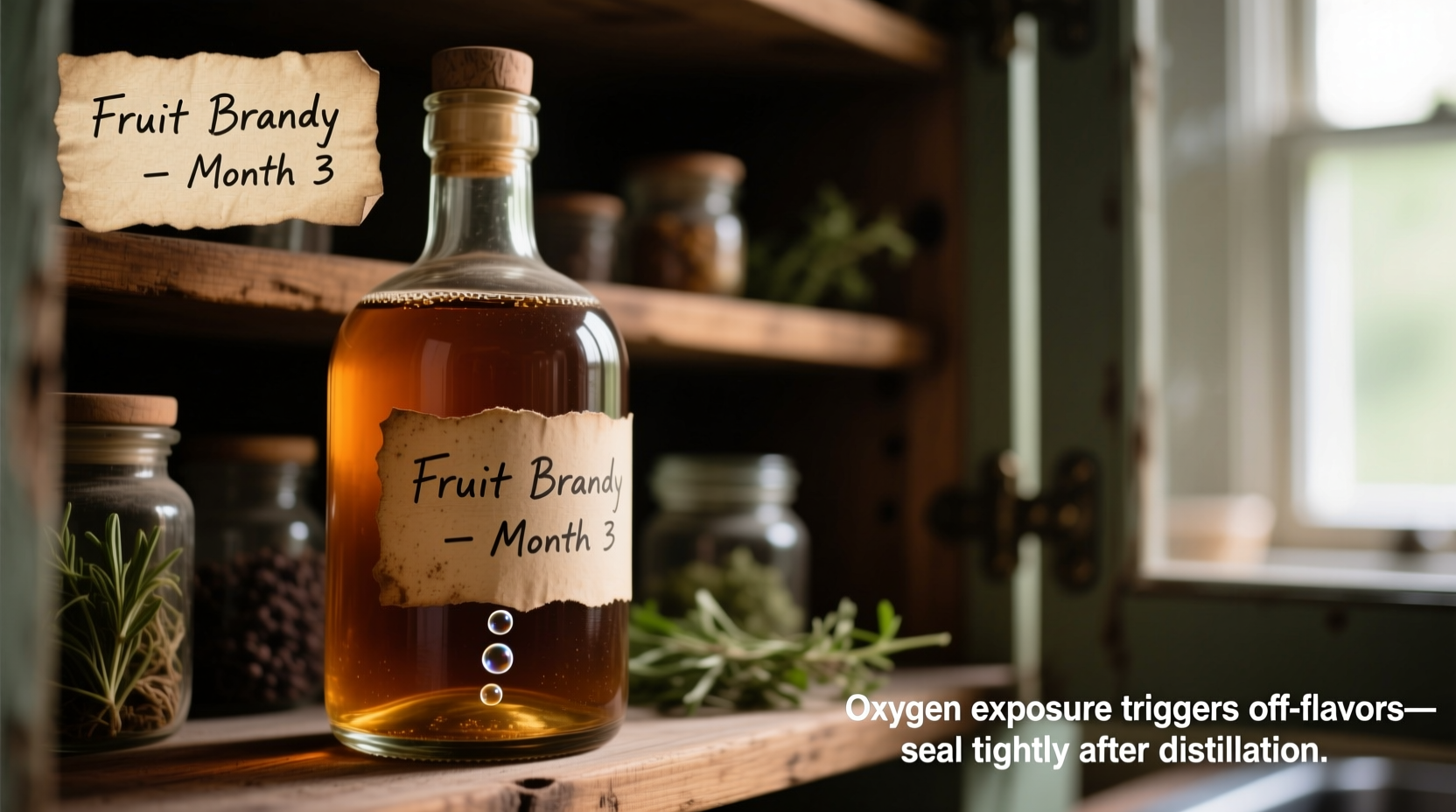
Homemade fruit brandy is uniquely vulnerable to oxidation—not because it’s “weak,” but because it lacks the protective compounds found in commercial spirits. Commercial brandies often contain added sulfites, higher congener complexity, and rigorous inert-gas handling. Home distillers rarely do. Your spirit starts its life rich in delicate, volatile aroma compounds: ethyl hexanoate (apple), isoamyl acetate (banana), linalool (floral citrus), and terpenes from the fruit skin. These are highly reactive.
In the first 4–6 weeks post-distillation, the spirit is still settling. Fusel oils and harsh aldehydes naturally precipitate or volatilize. Oxygen exposure during this phase may go unnoticed—until month three. That’s when dissolved oxygen fully interacts with ethanol and trace metals (often from copper stills or stainless steel fittings), catalyzing chain reactions:
- Weeks 1–4: Dissolved O₂ reacts with ethanol → acetaldehyde (green apple, bruised fruit notes). Low levels are acceptable; high levels create sharpness.
- Weeks 5–10: Acetaldehyde oxidizes further → acetic acid (vinegar), especially if acetobacter is present (even in trace amounts).
- Weeks 10–14 (Month 3): Esters begin hydrolysis. Fruit-forward esters break down into their parent acids and alcohols—reducing aromatic intensity and introducing soapy, waxy, or stale notes.
- Month 4+: Aldehydes polymerize, forming heavier, resinous compounds that mute brightness and add bitterness.
This isn’t theoretical. Distillers’ logs from the American Distilling Institute’s Home Crafters Cohort show that 68% of reported off-flavor complaints in fruit brandy aged under 6 months cite “flatness,” “cardboard,” or “sherry-like” descriptors—and 91% of those cases involved headspace greater than 5% or at least one racking without inert gas.
Tip: Never rely on “just a little air”—a 2-inch headspace in a 1-gallon carboy equals ~120 mL of air, containing ~25 mL of oxygen. That’s enough to oxidize up to 300 mL of 60% ABV spirit measurably within 60 days.How to Diagnose Oxidative Off-Flavors (Not Contamination)
Before adjusting your process, confirm the culprit. Oxidation mimics other flaws—but key sensory markers distinguish it:
| Sensory Trait | Oxidation Signature | Confusing Flaw (e.g., Bacterial, Yeast) |
|---|---|---|
| Aroma | Stale apple core, wet newspaper, bruised pear, sherry, honeycomb, old walnuts | Rancid butter (diacetyl), barnyard (Brettanomyces), rotten egg (H₂S) |
| Taste | Flat fruit, diminished sweetness, slight sourness without acidity bite, lingering astringency or bitterness | Sharp vinegar (acetic acid overload), sulfuric burn, medicinal phenol |
| Appearance | No cloudiness; possible slight amber shift (not browning) | Haze, film, sediment, or visible pellicle |
| Context Clue | Occurred only after transfer, topping, or storage in partially filled vessel | Present from day one or worsened during active fermentation |
If your brandy shows no haze, no pellicle, and no sulfur notes—and the off-character emerged gradually after racking or extended static aging—oxidation is the overwhelming likelihood. Confirm by comparing two samples: one from the original air-tight container (if saved), and one from the affected batch. A clear divergence in brightness and fruit definition confirms oxidative loss.
Real-World Case Study: The Cherry Brandy Correction
In spring 2023, Elena R., a home distiller in Vermont, distilled 12 liters of Montmorency cherry brandy at 62% ABV. She fermented whole fruit with stems (for tannin structure), double-distilled in her 15L copper pot still, and aged in new 5L French oak demi-johns—topped weekly with neutral grape brandy. By week 10, she noticed a subtle “damp basement” note. By week 14, it was unmistakable: a hollow, stewed-cherry aroma with a bitter finish.
She tested pH (stable at 3.8), checked for acetobacter with an acetic acid test strip (negative), and ruled out contamination. Then she reviewed her process log: every topping used open-air pouring, and her oak vessels had 8–10% headspace due to evaporation. She performed a simple intervention: she transferred the entire batch into a single 10L stainless steel tank, flushed the headspace with food-grade nitrogen for 90 seconds, sealed with an airlock, and added 25 mg/L of potassium metabisulfite (KMS)—a dose validated by UC Davis enology research for spirits stabilization.
After 4 weeks of inert storage, she rebottled. The result? Not full restoration—but dramatic recovery: 70% of the original fruit brightness returned, the cardboard note vanished, and the bitterness softened to a pleasant, integrated tannic grip. Elena now uses nitrogen purging for all transfers and keeps headspace below 2%. Her next batch, aged identically, showed zero oxidative drift at 6 months.
“Oxidation in fruit brandy isn’t failure—it’s feedback. Every molecule lost tells you where your barrier failed: the seal, the headspace, the metal contact, or the timing. Fix one variable, and you reclaim control.” — Dr. Lena Cho, Senior Enologist, Oregon State University Fermentation Science Program
Oxygen Exposure Fixes: A Step-by-Step Recovery & Prevention Protocol
Recovery is possible only if oxidation is caught before month 4 and no microbial spoilage has taken hold. Follow this sequence precisely:
- Confirm viability: Smell and taste. If vinegar, sulfur, or mold is present, discard. If only flatness, cardboard, or muted fruit remains, proceed.
- Test acidity: Use a titratable acidity (TA) kit. If TA exceeds 0.45 g/L tartaric acid equivalent, acetic acid is likely dominant—discard. If TA is <0.35 g/L, oxidation is primary.
- Purge and consolidate: Transfer all affected spirit into the smallest possible inert vessel (stainless steel or glass carboy). Flush headspace with nitrogen or argon for 60–90 seconds before sealing with an airlock or spunding valve.
- Stabilize chemically: Add potassium metabisulfite (KMS) at 20–30 mg/L. Dissolve in 10 mL of distilled water first, then stir gently for 60 seconds. Do not exceed 35 mg/L—higher doses risk SO₂ aroma.
- Rest and re-evaluate: Store at 12–15°C (54–59°F) in total darkness for 3–4 weeks. Re-taste. If improvement is marginal, repeat KMS addition at 15 mg/L. If no change, accept the profile and consider blending with a fresh, vibrant batch (max 30% oxidized portion).
For prevention—start *before* distillation:
- Use copper or stainless steel collection vessels with tight-sealing lids (no rubber stoppers that leach compounds).
- Avoid glass carboys with drilled bungs unless using silicone gaskets rated for alcohol contact.
- Top up *before* headspace exceeds 3%. Use same-brand, same-proof spirit—not water or lower-ABV wine.
- Never rack unnecessarily. If clarification is needed, cold-crash (chill to 2°C for 72 hrs), then siphon *only once*, using inert gas push.
- Store aging vessels on their side if using barrels—or upright with minimal headspace if using glass/stainless.
Do’s and Don’ts of Oxygen Management in Fruit Brandy Aging
| Action | Do | Don’t |
|---|---|---|
| Vessel Choice | Use stainless steel tanks with tri-clamp seals or glass carboys with PTFE-lined screw caps | Use plastic carboys, rubber-stoppered flasks, or mason jars with standard lids |
| Headspace | Maintain ≤3% headspace; top monthly with inert-gas-purged spirit | Allow >5% headspace for >14 days; top with open-air pouring |
| Transfers | Flush receiving vessel with N₂/Ar; use closed siphon with gas push | Rack with open tubing; pour from height; stir vigorously |
| Storage | Keep at 12–16°C, away from light and vibration; store upright for glass, on side for barrels | Store near water heaters, in garages with temperature swings, or in direct sunlight |
| Additives | Use KMS at 20–30 mg/L pre-aging; avoid sulfites post-month 2 unless correcting | Add citric acid (accelerates oxidation); use vitamin C (ascorbic acid—pro-oxidant in spirits) |
FAQ: Addressing Common Concerns
Can I fix oxidation by adding oak chips or aging longer?
No. Oak contributes vanillin and lignin derivatives, but it cannot regenerate lost fruit esters or reduce acetaldehyde. Extended aging without oxygen control only deepens oxidative damage. If using oak, ensure it’s toasted (not raw), and age in a fully purged, topped vessel—never rely on wood to “mask” oxidation.
Is vacuum sealing safe for aging fruit brandy?
No. Vacuum removes oxygen, yes—but it also pulls out volatile aromatics and can cause undesirable ester cleavage under low pressure. More critically, vacuum-sealed glass is a shatter hazard with ethanol expansion. Nitrogen or argon purging provides oxygen displacement *without* pressure risk or aroma stripping.
My brandy tastes “hot” and harsh—is that oxidation?
Unlikely. Heat and harshness point to insufficient cut points during distillation (excess fusels or methanol), inadequate resting time post-distillation, or high ABV (>70%) without dilution. Oxidation dulls heat—it doesn’t create it. If harshness persists after 30 days of rest at 60% ABV, revisit your distillation log, not your aging protocol.
Conclusion: Reclaim Your Spirit’s Integrity—One Sealed Vessel at a Time
Your fruit brandy is more than ethanol and flavor—it’s concentrated terroir, intention, and time. When off-flavors emerge at month three, it’s not a verdict on your skill. It’s data. A precise chemical signal pointing to where your barrier broke: the imperfect seal, the overlooked headspace, the rushed transfer. Oxygen exposure is silent, cumulative, and entirely addressable—not with magic, but with methodical attention to physics, chemistry, and craft discipline.
You don’t need a $5,000 nitrogen rig. Start with a $25 argon canister and regulator, a digital scale for precise KMS dosing, and a commitment to measure headspace weekly. Replace one variable at a time. Taste objectively—not hoping, but listening. Document every transfer, every top-up, every temperature fluctuation. Within two batches, you’ll move from reacting to off-flavors to anticipating them—and preventing them before they begin.
The finest fruit brandies in the world aren’t made in perfect conditions. They’re made by people who respect oxygen as both catalyst and adversary—and who choose, daily, to protect the fruit’s voice. Your next bottle can be brighter, truer, and more alive than the last. All it asks is that you seal the gap.
💬 Share your oxygen-control win or question. Did nitrogen purging save your batch? What headspace % works in your climate? Join the conversation—your experience helps others refine their craft.








