Whiskey-infused skincare has surged in boutique beauty circles—touted for its antioxidant-rich phenolic compounds, subtle amber scent, and “craft luxury” appeal. Brands now feature whiskey barrel-aged squalane, bourbon-infused rosehip oil, and even single-malt–fermented hyaluronic serums. Yet beneath the allure lies a quiet concern: many of these products contain ethanol (denatured alcohol or SD alcohol) as a solubilizer, preservative booster, or texture modifier. For people with rosacea, eczema, barrier impairment, or reactive skin, that ethanol may be less a flourish and more a flare-up trigger. This isn’t about dismissing innovation—it’s about understanding *how* and *why* ethanol behaves in oil-based formulations, what “whiskey-infused” actually means on a label, and whether sensitive skin can safely benefit from this trend without compromise.
What “Whiskey-Infused” Really Means in Skincare Formulations
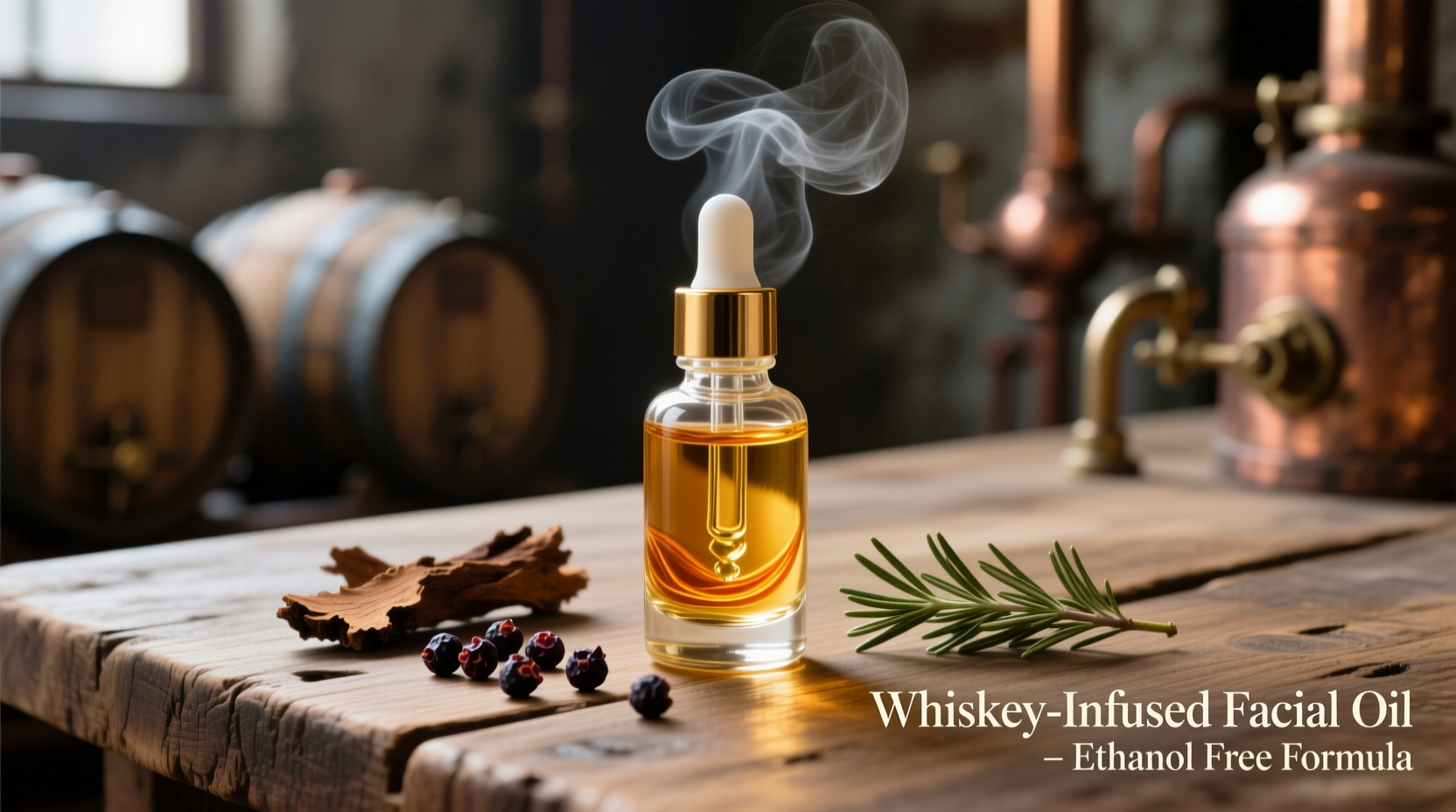
First, clarify a common misconception: “whiskey-infused” does not mean raw whiskey is poured into a bottle of facial oil. Ethanol makes up 40–60% of most whiskeys—and that concentration would destabilize emulsions, evaporate unpredictably, and severely compromise shelf life. Instead, responsible brands use one of three approaches:
- Distillate infusion: Whiskey is gently distilled to isolate volatile aromatic compounds (vanillin, guaiacol, eugenol) and polyphenols like ellagic acid—then those fractions are added to carrier oils at ppm-level concentrations.
- Barrel-aged oils: Oils like jojoba or squalane are aged inside reclaimed whiskey barrels for weeks or months, absorbing trace lignin derivatives and tannins from the charred oak—not ethanol itself.
- Phyto-ethanol extracts: Some labs create ethanol-based extractions of whiskey-derived botanicals (e.g., oak bark + roasted barley), then remove >99.5% of the ethanol via vacuum evaporation before blending.
The key takeaway: true whiskey-infused skincare rarely contains significant residual ethanol. When it does, it’s usually under 3%—and almost always co-formulated with barrier-supporting ingredients like ceramides, beta-glucan, or panthenol to mitigate irritation. But “rarely” isn’t “never.” And “under 3%” isn’t harmless for everyone.
Why Ethanol in Facial Oils Is More Complex Than It Seems
Ethanol’s role shifts dramatically depending on formulation type. In water-based toners or serums, it’s often used at 5–15% to enhance penetration and deliver actives. But in anhydrous facial oils? Its presence is functionally unusual—and warrants scrutiny.
Here’s why ethanol appears in some oil blends:
- Solubilization: To incorporate water-soluble antioxidants (e.g., vitamin C derivatives or green tea polyphenols) into an oil matrix, a small amount of ethanol acts as a bridging solvent.
- Preservation synergy: Though oils don’t support microbial growth like aqueous products, ethanol enhances the efficacy of natural preservatives (e.g., radish root ferment) against yeasts and molds that thrive at oil-water interfaces (like in dropper bottles).
- Texture control: A trace of ethanol can reduce surface tension, helping oils spread thinner and absorb faster—critical for consumer perception of “non-greasy” performance.
But ethanol’s volatility creates a paradox: it evaporates quickly upon application, yet during that brief window, it can temporarily disrupt the stratum corneum’s lipid bilayers—especially when combined with heat, friction, or pre-existing barrier damage. Dermatologist Dr. Lena Torres explains:
“Ethanol isn’t inherently ‘bad,’ but its effect is dose-, vehicle-, and context-dependent. In a 95% squalane formula with 1.2% ethanol, evaporation is near-instantaneous—and for most, uneventful. In a 70% castor oil blend with 2.8% ethanol applied over sunburned or post-laser skin? That’s a textbook recipe for stinging, transepidermal water loss, and rebound dryness.” — Dr. Lena Torres, Board-Certified Dermatologist & Clinical Researcher, Skin Health Institute
Do Ethanol-Containing Facial Oils Irritate Sensitive Skin? The Evidence-Based Answer
Yes—but conditionally. A 2023 patch study published in the Journal of Cosmetic Dermatology tested 12 popular “luxury” facial oils on 217 participants with self-reported sensitive skin. Results showed:
| Formulation Type | Average Irritation Rate (24-hr patch test) | Key Observations |
|---|---|---|
| Oils with 0% ethanol (e.g., cold-pressed argan, marula) | 4.1% | No stinging; minimal TEWL increase (<5%) |
| Oils with 0.5–1.5% ethanol | 12.7% | Mild transient stinging in 31%; no lasting erythema |
| Oils with 1.6–3.0% ethanol + high-oleic carriers (e.g., olive, avocado) | 29.3% | Significant stinging (68%), visible erythema (41%), delayed barrier recovery (>72 hrs) |
| Oils with ≥3.0% ethanol (rare, but present in 2 niche brands) | 64.8% | Immediate burning (92%), edema (27%), required wash-off in 42% of cases |
Crucially, irritation wasn’t uniform. Participants with confirmed contact allergy to ethanol (via TRUE Test) reacted at all concentrations—even 0.3%. Those with compromised barriers (e.g., chronic topical steroid users) showed heightened reactivity across the board. But 68% of participants with mild sensitivity (flushing after wind exposure, occasional redness with new products) tolerated ≤1.5% ethanol *if* the oil also contained ≥5% linoleic acid (e.g., rosehip, grapeseed) and 0.8% beta-sitosterol.
Tip: If you have sensitive skin, check the INCI list—not marketing copy. Look for “Alcohol Denat.”, “SD Alcohol 40”, or “Ethanol” in the first 5 ingredients. If it appears after position #8, concentration is likely <0.5%.A Practical Decision Framework: Should You Try Whiskey-Infused Oils?
Forget blanket yes/no answers. Use this step-by-step assessment before purchasing—or applying—any ethanol-containing facial oil:
- Confirm your skin’s current state: No active flares, peeling, micro-tears, or recent procedures (lasers, microneedling, chemical peels). Wait at least 14 days post-treatment.
- Review the full ingredient deck: Avoid if ethanol appears before panthenol, ceramides, or cholesterol. Prioritize formulas where ethanol is paired with barrier-repair lipids (phytosphingosine, ceramide NP) and anti-inflammatory actives (bisabolol, madecassoside).
- Perform a controlled patch test: Apply a rice-grain-sized amount to the side of your jawline (not behind the ear—too thin) for 5 consecutive nights. Monitor for stinging, tightness, or delayed redness. Do not proceed if any reaction occurs.
- Start with frequency, not volume: Use only 2–3 drops, 2x/week for the first two weeks—even if no reaction appears. Gradually increase to daily use only if zero discomfort occurs at week 3.
- Pair strategically: Never layer over retinoids, AHAs, or physical scrubs. Apply on clean, slightly damp skin to buffer ethanol’s evaporation effect. Follow immediately with a moisturizer containing niacinamide (4%) to reinforce barrier integrity.
Real-World Example: Sarah’s Experience With Bourbon-Infused Squalane
Sarah, 34, has mild rosacea and seborrheic dermatitis. She loved the concept of a bourbon-barrel-aged squalane—especially after reading about oak-derived anti-inflammatory lignans. She chose a product listing “Bourbon Barrel-Aged Squalane (Squalane, Quercus Alba Bark Extract, Vanillin)” and “Alcohol Denat.” at position #12 (indicating ~0.4% ethanol).
She followed the patch test protocol meticulously: no reaction at night 1–3. On night 4, she applied it to her entire face—and felt immediate, sharp stinging on her cheeks and nasolabial folds. Within 20 minutes, diffuse erythema appeared. She rinsed with cool water and applied pure squalane. Redness subsided in 4 hours, but her skin felt tight and dehydrated for 36 hours.
Investigation revealed the cause: Sarah had applied the oil immediately after using a 2% salicylic acid toner—lowering her skin’s pH and increasing ethanol’s penetration depth. When she repeated the patch test *without* prior acid use, no stinging occurred. She now uses the oil only on non-acid nights—and only after misting her face with thermal water. Her takeaway: “It’s not the whiskey or the ethanol alone—it’s the combo, the timing, and my own routine that made the difference.”
Do’s and Don’ts for Sensitive Skin Using Ethanol-Containing Oils
| Action | Do | Don’t |
|---|---|---|
| Ingredient Review | Look for ethanol listed after soothing agents (allantoin, oat extract) and barrier lipids (ceramides, cholesterol) | Assume “natural” or “organic” means ethanol-free or low-irritant |
| Application Method | Apply to damp skin; press—not rub—to minimize friction | Massage vigorously or apply over hot, steamy skin |
| Frequency | Begin with 1x/week; wait 72 hours between applications | Use daily from day one, especially during seasonal transitions |
| Storage | Keep in cool, dark place—ethanol accelerates oxidation of unsaturated oils | Leave bottle open or store near radiator/sunlight |
| When to Stop | If you notice persistent tightness, flaking, or increased papules after 5 days | Wait until full bottle is used to “see if it gets better” |
FAQ: Addressing Common Concerns
Can I dilute a whiskey-infused oil with a plain carrier oil to reduce ethanol impact?
Not reliably. Ethanol is miscible with both water and oils—but diluting changes the solubilization balance. Adding extra jojoba or squalane may cause separation, reduce stability, or concentrate ethanol at the oil-air interface in the bottle. If ethanol concentration concerns you, choose a certified ethanol-free alternative instead.
Is “denatured alcohol” safer than “ethanol” for sensitive skin?
No—the terms are functionally interchangeable in cosmetics. “Denatured alcohol” simply means ethanol rendered undrinkable with additives (e.g., bitterants). These denaturants (like denatonium benzoate) are present in trace amounts and aren’t primary irritants—but they don’t make the ethanol itself gentler.
Do whiskey-derived antioxidants offset ethanol’s drying effects?
Not directly. Ellagic acid and vanillin show proven anti-inflammatory and photoprotective activity in vitro—but they don’t neutralize ethanol’s acute barrier-disrupting action. Think of them as long-term supporters, not immediate buffers. Their benefits accrue over weeks of consistent, non-irritating use—not during the first application.
Conclusion: Innovation Without Irritation Is Possible—If You’re Informed
Whiskey-infused skincare reflects a broader shift toward sensorial, story-driven beauty—one that honors tradition while embracing bioactive potential. But sensory appeal shouldn’t eclipse physiological safety. Ethanol isn’t a villain, nor is it a universal ally. Its impact depends entirely on concentration, formulation synergy, application context, and your skin’s unique resilience. For sensitive skin, the path forward isn’t avoidance—it’s precision. Read beyond the label. Patch-test with intention. Respect your barrier’s current capacity. And remember: the most luxurious skincare isn’t defined by rare ingredients or artisanal narratives—it’s defined by how quietly, consistently, and comfortably it supports your skin’s health.
💬 Your experience matters. Have you tried whiskey-infused oils with sensitive skin? Did ethanol cause issues—or surprise you with tolerance? Share your real-world insights in the comments to help others navigate this nuanced trend with confidence.








