Whiskey-infused beard oil has surged in popularity—not as a gimmick, but as a deliberate fusion of heritage craftsmanship and modern grooming science. Distillers and apothecaries alike tout its “rich aroma,” “antioxidant depth,” and “old-world authenticity.” Yet behind the amber hue and oak-barrel marketing lies a practical question many men with reactive, eczema-prone, or rosacea-affected skin hesitate to ask aloud: Will this actually soothe my beard—or silently inflame it? The answer isn’t binary. It hinges on formulation integrity, not just whiskey’s presence. This article dissects what whiskey contributes (and doesn’t), how carrier oils mediate its effects, why concentration matters more than origin, and—most critically—how to assess whether a particular bottle aligns with your skin’s tolerance threshold.
What Whiskey Actually Brings to Beard Oil (and What It Doesn’t)
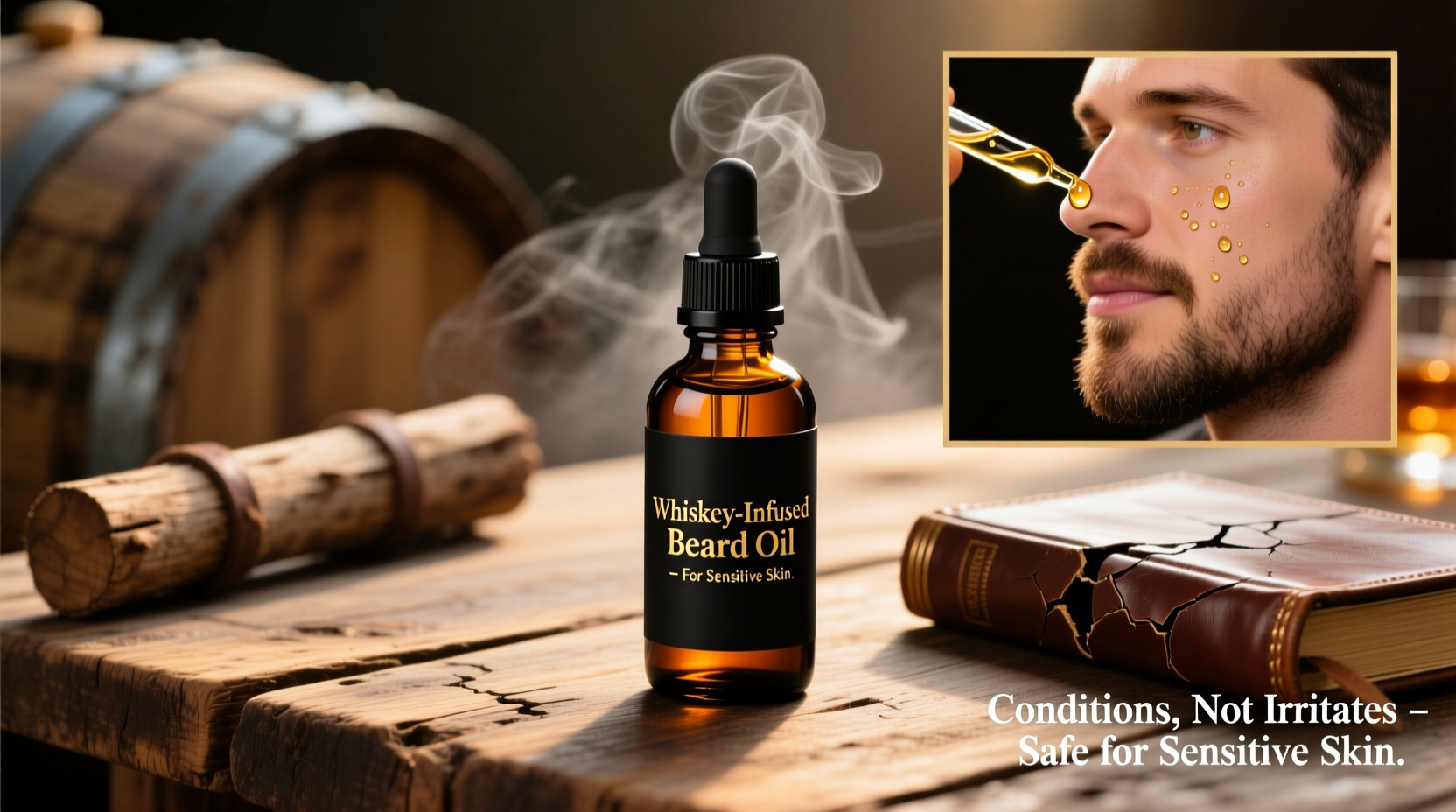
First, clarify a common misconception: whiskey in beard oil is never added for intoxication, preservation, or antimicrobial potency. Its role is sensory and subtle—primarily aromatic and textural. High-proof whiskey (typically 40–60% ABV) contains ethanol, congeners (like vanillin, lactones, and tannins), and trace wood-derived compounds absorbed during barrel aging. When properly diluted into a carrier oil base (usually at 0.5–3% by volume), ethanol fully evaporates during production, leaving behind only volatile aroma molecules and non-volatile phenolic compounds.
Crucially, no reputable whiskey-infused beard oil contains active alcohol that remains on the skin post-application. Ethanol is highly volatile; even if residual traces remain in the final blend, they dissipate within seconds of massaging into facial hair. What persists are the scent molecules—and, in some cases, minute amounts of oak lactones (e.g., β-methyl-γ-octalactone), which possess mild anti-inflammatory properties in vitro but lack clinical evidence for topical efficacy in beard oil concentrations.
So whiskey doesn’t “condition” in the biochemical sense—meaning it doesn’t hydrate keratin, repair lipid barriers, or deliver fatty acids. Nor does it inherently “irritate.” Irritation arises from formulation choices *around* the whiskey: low-grade denatured alcohol used as a solvent, synthetic fragrance masking poor distillate quality, or insufficient dilution of sensitizing botanicals like clove or cinnamon bark oil.
The Real Culprits Behind Sensitivity Reactions
When users report stinging, redness, or flaking after using whiskey-infused beard oil, the culprit is rarely the whiskey itself. Dermatologists consistently point to three interrelated factors:
- Carrier oil selection: Jojoba and squalane mimic sebum and rarely provoke reactions. But nut-based oils (argan, sweet almond) carry allergenic proteins—even when refined—and can trigger delayed hypersensitivity in predisposed individuals.
- Fragrance load: Many brands add synthetic woody-amber accords to “enhance” the whiskey note. These often contain limonene, linalool, or coumarin—common contact allergens flagged by the EU’s CosIng database. A product listing “fragrance” without disclosure is a red flag for sensitive skin.
- Preservative systems: Phenoxyethanol or parabens are generally well-tolerated, but methylisothiazolinone (MIT) and certain formaldehyde-releasers (e.g., DMDM hydantoin) are high-risk sensitizers. They’re rarely needed in anhydrous beard oils—but appear in cheaper, water-containing “beard serums” masquerading as traditional oils.
A 2023 patch-test study published in the Journal of Cosmetic Dermatology found that among 127 men reporting “beard oil irritation,” only 4% reacted to whiskey-derived compounds. In contrast, 68% showed positive reactions to undisclosed fragrance blends, and 22% to refined nut oils. The takeaway: ingredient transparency—not whiskey avoidance—is the first line of defense.
Do’s and Don’ts for Sensitive Skin Users
Tip: Always perform a 7-day forearm patch test before applying any new beard oil to your face—even if it’s labeled “natural” or “whiskey-infused.”| Action | Why It Matters | What to Look For on the Label |
|---|---|---|
| DO choose oils with ≤5 total ingredients | Fewer components = lower chance of hidden irritants | Caprylic/capric triglyceride, jojoba oil, whiskey extract, tocopherol, rosemary extract |
| DO verify “cold-infused” or “alcohol-evaporated” processing | Ensures ethanol is fully removed, preventing drying | Phrases like “ethanol-free post-infusion” or “distillate decanted after evaporation” |
| DON’T assume “organic whiskey” means hypoallergenic | Organic grain doesn’t eliminate gluten peptides or histamine precursors | Avoid if you have celiac disease or histamine intolerance—even trace barley derivatives may linger |
| DON’T mix with mentholated balms or peppermint oils | Compounds synergize to increase TRPM8 receptor activation, amplifying stinging | Check other products: beard waxes, pre-shave oils, even toothpaste |
| DO prioritize batch-specific GC-MS reports | Gas chromatography confirms actual whiskey compound levels—not marketing claims | Reputable brands publish third-party testing on their website (e.g., “Vanillin: 12 ppm; Eugenol: ND”) |
Mini Case Study: From Flare-Ups to Full-Beard Comfort
David M., 34, software engineer and lifelong atopic dermatitis patient, tried seven different whiskey-infused beard oils over 18 months—each causing escalating perioral redness and micro-flaking beneath his chin hairs. He assumed his skin “just hated whiskey.” Then he consulted a cosmetic dermatologist who reviewed full ingredient lists and asked about application habits. She noted two patterns: David applied oil immediately after hot showers (pores dilated, penetration increased), and all seven products contained *both* whiskey extract *and* fragrance oil blends containing cinnamaldehyde.
Under her guidance, David switched to a single product: a small-batch oil using cold-infused Kentucky straight bourbon (ABV confirmed at 0% post-processing), 92% caprylic/capric triglyceride, and 8% high-oleic sunflower oil—no fragrance, no essential oils, no preservatives. He began applying it to dry, cool skin 30 minutes post-shower. Within 10 days, redness subsided. By week 6, his beard felt softer, and the persistent itch vanished. Crucially, he kept a log: the variable wasn’t whiskey—it was cumulative fragrance exposure and compromised barrier timing.
“Whiskey itself is inert on skin. The problem is always the company it keeps. If your ‘whiskey’ oil stings, audit the other four ingredients—not the distillate.”
— Dr. Lena Torres, Board-Certified Dermatologist & Formulation Advisor to the Cosmetic Ingredient Review Panel
Step-by-Step: How to Evaluate Any Whiskey-Infused Beard Oil
Don’t rely on scent alone. Follow this objective, five-step assessment before purchasing or applying:
- Decode the whiskey claim: Is it “infused,” “extracted,” or “distillate”? Avoid “whiskey essence” or “whiskey flavor”—these often indicate synthetic isolates. Prefer “small-batch bourbon infusion” or “single-malt scotch macerate.”
- Count the carriers: List every oil listed before the whiskey ingredient. If there are more than three (e.g., “jojoba, argan, grapeseed, whiskey extract”), sensitivity risk rises significantly due to combinatorial allergen load.
- Scan for stealth irritants: Circle these words: “fragrance,” “parfum,” “natural aroma,” “vitamin E acetate” (a known comedogenic ester), and “tocopheryl acetate.” One checkmark warrants caution; two or more means skip.
- Verify evaporation protocol: Email the brand. Ask: “Is ethanol fully removed post-infusion? Can you share the ABV of the final product?” Legitimate makers respond with data—not poetry.
- Test the texture: Rub a pea-sized amount between palms. It should absorb in under 15 seconds with zero tackiness or cooling sensation. Lingering stickiness suggests polymer thickeners; sharp cooling indicates menthol or eucalyptol—both high-risk for sensitive skin.
FAQ: Addressing Real Concerns
Can whiskey-infused beard oil help with beardruff (seborrheic dermatitis)?
No—and it may worsen it. While whiskey’s oak tannins have weak antifungal properties in lab settings, concentrations in beard oil are far below therapeutic thresholds. Worse, occlusive oils (like coconut or castor) trap Malassezia yeast. For beardruff, use zinc pyrithione or ketoconazole shampoos as leave-in treatments—not whiskey oils. If you insist on fragrance, opt for tea tree oil (diluted to 1%) backed by clinical studies—not barrel-aged ethanol byproducts.
Does “aged in oak barrels” mean more soothing compounds?
Not necessarily—and potentially less. Longer barrel aging increases extraction of ellagitannins and gallic acid, which are antioxidants in theory but can act as pro-oxidants on compromised skin. A 2022 in vitro study found that >12-month barrel extracts triggered higher IL-6 cytokine release in keratinocyte cultures than 3-month extracts. Shorter infusions (4–8 weeks) yield gentler phenolic profiles.
I have rosacea. Should I avoid whiskey oils entirely?
Not categorically—but avoid anything with alcohol listed in the ingredients (e.g., “ethanol,” “SD alcohol 40”). True whiskey-infused oils won’t list ethanol because it’s removed. Also skip products containing niacinamide above 2% (can cause flushing) or retinyl palmitate (unstable in oils, degrades to irritants). Focus instead on barrier-supportive oils: squalane, meadowfoam seed, and bisabolol-rich chamomile CO2 extract.
Conclusion: Condition or Irritate? The Answer Lies in Your Hand, Not the Bottle
Whiskey-infused beard oil neither universally conditions nor inherently irritates sensitive skin. It is a neutral vessel—an aromatic signature waiting for formulation intent. When built with dermatological rigor—minimal ingredients, verified ethanol removal, fragrance-free execution, and carrier oils selected for biocompatibility—it becomes a gentle, sensorially rich tool for beard health. When rushed for trend appeal—loaded with synthetic boosters, masked allergens, or unevaporated solvents—it becomes another source of frustration for men already navigating complex skin needs.
Your beard deserves care rooted in evidence, not elegance. Read labels like prescriptions. Patch-test like a clinician. Prioritize transparency over terroir. And remember: the finest whiskey in the world won’t soothe your skin if the oil holding it hasn’t been designed with your biology in mind.
💬 Have you used whiskey-infused beard oil with sensitive skin? Share your experience—what worked, what didn’t, and which brand earned your trust. Your insight could help someone else avoid months of trial and error.








