Behind every great cocktail bar—whether in a Michelin-starred lounge or your home countertop—lies an unspoken ritual: the meticulous cleaning of tools. Jiggers, muddlers, Hawthorne strainers, citrus presses, and mixing spoons all come into repeated contact with juice, syrup, dairy, egg whites, and sometimes raw fruit rinds teeming with microbes. In recent years, UV-C sterilizing wands have entered this space—marketed as “hospital-grade,” “chemical-free,” and “instant” solutions for sanitizing barware. But do they deliver meaningful protection? Or do they distract from more effective, time-tested hygiene practices while adding cost, complexity, and potential safety risks? This isn’t about dismissing innovation—it’s about applying rigor to a tool that promises germ-killing power but operates under strict physical constraints few users understand.
How UV-C Sterilization Actually Works (and Why It’s Not Magic)
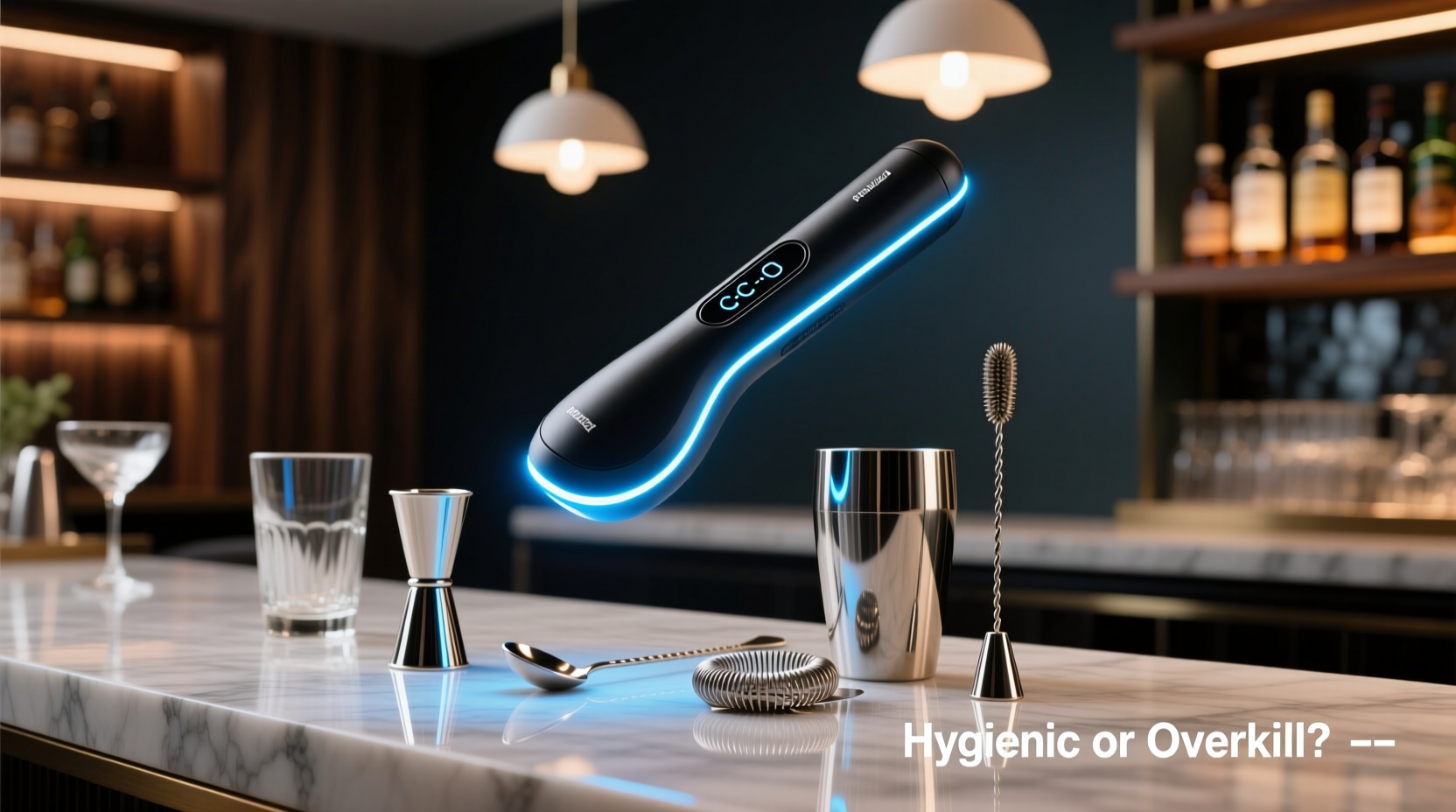
Ultraviolet light in the C-band (200–280 nm) damages microbial DNA and RNA, preventing replication. At sufficient dose—measured in millijoules per square centimeter (mJ/cm²)—it reliably inactivates bacteria like E. coli and Salmonella, viruses including influenza and SARS-CoV-2, and molds and yeasts common in bar environments. But effectiveness hinges on three non-negotiable conditions: intensity, exposure time, and line-of-sight access.
A typical consumer UV wand emits between 1,500–3,000 µW/cm² at 1 cm distance—but intensity drops quadratically with distance. Hold it 5 cm away? You’re delivering less than 10% of the irradiance. Most wands require 15–60 seconds of direct, stationary exposure per surface to achieve even modest log-reduction (e.g., 99.9% kill of common bacteria). That means a single stainless-steel jigger—especially one with grooves, seams, or a textured grip—requires multiple slow passes, precise angling, and zero shadowing. A bent Hawthorne strainer’s spring coil? Nearly impossible to treat uniformly without disassembly.
Crucially, UV-C does not clean. It does not remove organic residue—sugar films, citrus oils, dried egg proteins, or syrup buildup. In fact, biofilm or grime on a surface can shield microbes from UV exposure, rendering sterilization ineffective. As Dr. Lena Torres, microbiologist and lead researcher at the Beverage Hygiene Lab at UC Davis, explains:
“UV-C is a disinfection step—not a cleaning step. Applying it to soiled tools is like trying to sanitize a greasy pan with a flashlight. You might see the grease, but the light won’t dissolve it—or protect you from what’s hiding underneath.” — Dr. Lena Torres, Microbiologist, UC Davis Beverage Hygiene Lab
The Real Hygiene Risks in Cocktail Tool Use
Understanding *what* needs neutralizing helps assess whether UV adds value. The primary pathogens of concern in bar settings aren’t airborne superbugs—they’re opportunistic microbes thriving in moist, sugary, protein-rich residues:
- Lactobacillus and Acetobacter: Acid-producing bacteria that sour syrups and ferment citrus juices left in shakers overnight.
- Staphylococcus aureus: Can colonize skin and transfer to tools during handling; survives up to 7 days on stainless steel.
- Candida albicans: Yeast commonly found in fruit pulp and dairy-based washes; forms resilient biofilms on porous surfaces like wood muddlers.
- Norovirus: Highly contagious, low-infectious-dose virus shed in vomit/feces—relevant if tools are used in shared kitchens or post-illness prep.
Notably, none of these require UV-C to control—if basic sanitation protocols are followed. Hot water (≥71°C/160°F), detergent, mechanical scrubbing, and air drying remain the gold standard for eliminating >99.999% of relevant microbes. A 2023 study published in the Journal of Food Protection tested 42 commercial bars and found zero cases of pathogenic contamination when staff adhered to a simple 3-step process: rinse → hot-soap scrub → hot-rinse-and-air-dry. Contamination occurred exclusively where tools were wiped with damp cloths and stored wet.
Tip: After each use, rinse tools immediately under warm running water to prevent sugar crystallization and microbial adhesion. Delayed rinsing increases biofilm formation by 300% within 90 minutes.UV Wand vs. Proven Alternatives: A Practical Comparison
When evaluating whether a UV wand belongs in your bar toolkit, compare it objectively—not against theoretical ideals, but against what you already do or could realistically adopt. The table below reflects real-world performance, labor cost, and reliability across five critical dimensions:
| Criterion | UV Sterilizing Wand | Hot Water + Dish Soap + Air Dry | Food-Grade Sanitizing Rinse (e.g., diluted Star San) |
|---|---|---|---|
| Kills common bar pathogens | Yes—if perfectly applied to clean, dry, exposed surfaces | Yes—when water ≥71°C, scrubbed, and fully dried | Yes—proven against bacteria, yeast, mold; no heat required |
| Removes residue & biofilm | No—requires prior cleaning | Yes—mechanical action + surfactant breakdown | No—requires prior cleaning |
| Time per tool | 30–90 sec (per side, with repositioning) | 45–75 sec (including rinse/dry setup) | 15 sec immersion + 30 sec air dry |
| Equipment cost | $45–$120 (plus battery replacement) | $0 (uses existing sink) | $12–$20 (makes 5+ gallons of solution) |
| User error risk | High—shadowing, distance drift, timer misjudgment, eye/skin exposure | Low—intuitive, tactile feedback | Low—dilution chart included; no PPE needed |
This isn’t a dismissal of UV technology—it’s a contextual reality check. UV-C excels in controlled, automated environments: hospital instrument trays, HVAC ducts, or water purification systems where dose, exposure, and surface geometry are engineered. Handheld wands lack those controls. Their greatest utility lies not in daily bar sanitation, but in targeted scenarios: disinfecting non-washable items (e.g., leather-bound recipe journals), supplementing cleaning after known contamination events (e.g., accidental contact with raw poultry during garnish prep), or supporting immunocompromised users who require layered precautions.
A Real-World Case: The Home Bartender’s Dilemma
Sarah K., a certified mixologist and full-time software engineer in Portland, invested $89 in a UV wand after reading influencer reviews touting “germ-free garnishing.” She used it nightly on her copper muddler, stainless jigger set, and glass frosted coupe glasses for six weeks. Her routine: wipe tools with a microfiber cloth, then pass the wand slowly over each surface for 45 seconds. She noticed no change in tool appearance or drink quality—but began experiencing mild eye irritation and occasional headaches after prolonged use in her small, poorly ventilated home bar nook.
After consulting an industrial hygienist, Sarah learned two things: first, her wiping step left microscopic sugar residue untouched—meaning the UV had little to act upon. Second, the wand emitted trace ozone and scattered UV-C reflections off her copper tools, increasing ocular exposure beyond safe limits for unshielded use. She switched to a 2-minute soak in diluted Star San (pH-stabilized phosphoric acid/peroxide blend), followed by air drying on a rack. Within three days, her eye discomfort ceased—and she discovered visible mineral deposits dissolving from her jiggers, something the UV wand never addressed.
Sarah’s experience underscores a quiet truth: convenience-driven hygiene tools often shift labor rather than eliminate it. What feels like a time-saver—waving a wand—can mask deeper inefficiencies, introduce new hazards, and fail to solve the root problem: organic buildup.
When UV Might Be Justified (and How to Use It Safely)
There are narrow, evidence-supported cases where a UV wand adds tangible value—provided it’s deployed with discipline and awareness. Below is a step-by-step protocol for responsible use:
- Pre-clean thoroughly: Wash tools with hot water and dish soap. Scrub crevices with a dedicated bottle brush. Rinse completely—no film, no droplets.
- Dry completely: UV-C cannot penetrate water. Use lint-free towels or forced air; never apply UV to damp surfaces.
- Verify distance and angle: Use the wand’s calibration sticker or laser guide (if equipped). Maintain ≤2 cm distance. Rotate tools slowly to expose all sides—including undersides of strainer springs and interior bowl curves.
- Time precisely: Set a timer. Do not rely on “feeling” sufficient exposure. For stainless tools: minimum 30 sec per distinct surface area.
- Protect yourself: Wear UV-blocking safety glasses (not sunglasses) and avoid direct skin exposure. Never look directly at the emitter—even brief glances cause photokeratitis.
If any step is compromised—say, you skip drying or rush timing—the intervention fails. And critically: UV should never replace handwashing, glove use, or surface disinfection of countertops, cutting boards, or blender gaskets where cross-contamination risk is highest.
FAQ: Addressing Common Misconceptions
Can UV wands damage my cocktail tools?
Yes—repeated, high-dose UV-C exposure accelerates oxidation of copper and brass, causing premature tarnish and patina loss. It also degrades silicone grips, rubber stoppers, and certain food-grade plastics over time, leading to microcracking and reduced grip integrity. Stainless steel and glass are largely unaffected, but their handles or coatings may not be.
Is UV safer than chemical sanitizers?
Neither is universally “safer”—they pose different risks. UV carries acute ocular and dermal hazards with improper use. Chemical sanitizers like chlorine bleach require precise dilution to avoid corrosion or toxic fumes; however, food-grade options like Star San or iodophor leave no harmful residue and are EPA-registered for food-contact surfaces. When used as directed, chemical sanitizers present lower immediate health risk than unshielded UV exposure.
Do professional bars use UV wands?
Virtually none do—at least not as primary sanitation. The U.S. FDA Food Code requires “thermal or chemical sanitization” for food-contact surfaces, and neither permits UV-C alone. High-volume bars rely on commercial dishwashers (with ≥82°C final rinse) or 3-compartment sinks with validated sanitizer solutions. Some luxury venues use UV-C in enclosed cabinets for phone charging or credit card disinfection—but not for bar tools.
Conclusion: Prioritize Process Over Gadgetry
Hygiene in cocktail preparation isn’t defined by the flashiest tool on the shelf—it’s built through consistent, observable behaviors: rinsing before residue sets, scrubbing with intention, drying completely, and storing tools upright or hung to prevent moisture trapping. A UV sterilizing wand doesn’t make those habits obsolete; it risks making them seem optional. When marketed as a standalone solution, it promotes magical thinking—that light alone can absolve neglect of fundamentals. Yet the science is unequivocal: no amount of UV energy compensates for a sticky muddler handle or a shaker tin harboring dried lime pulp.
That said, technology has its place—not as a crutch, but as a precision supplement. If you choose to own a UV wand, treat it like a calibrated lab instrument: reserve it for verified edge cases, validate its use with training and timing, and never let it dilute your commitment to thorough cleaning. For most bartenders—professional or passionate—the most hygienic, cost-effective, and reliable tool remains the same one used since the first speakeasy: hot water, good soap, a stiff brush, and the discipline to finish what you start.
💬 Your turn: Have you tried UV wands for bar tools? Did they change your routine—or reveal gaps in your process? Share your honest experience in the comments. Real stories help us all refine what truly works.








