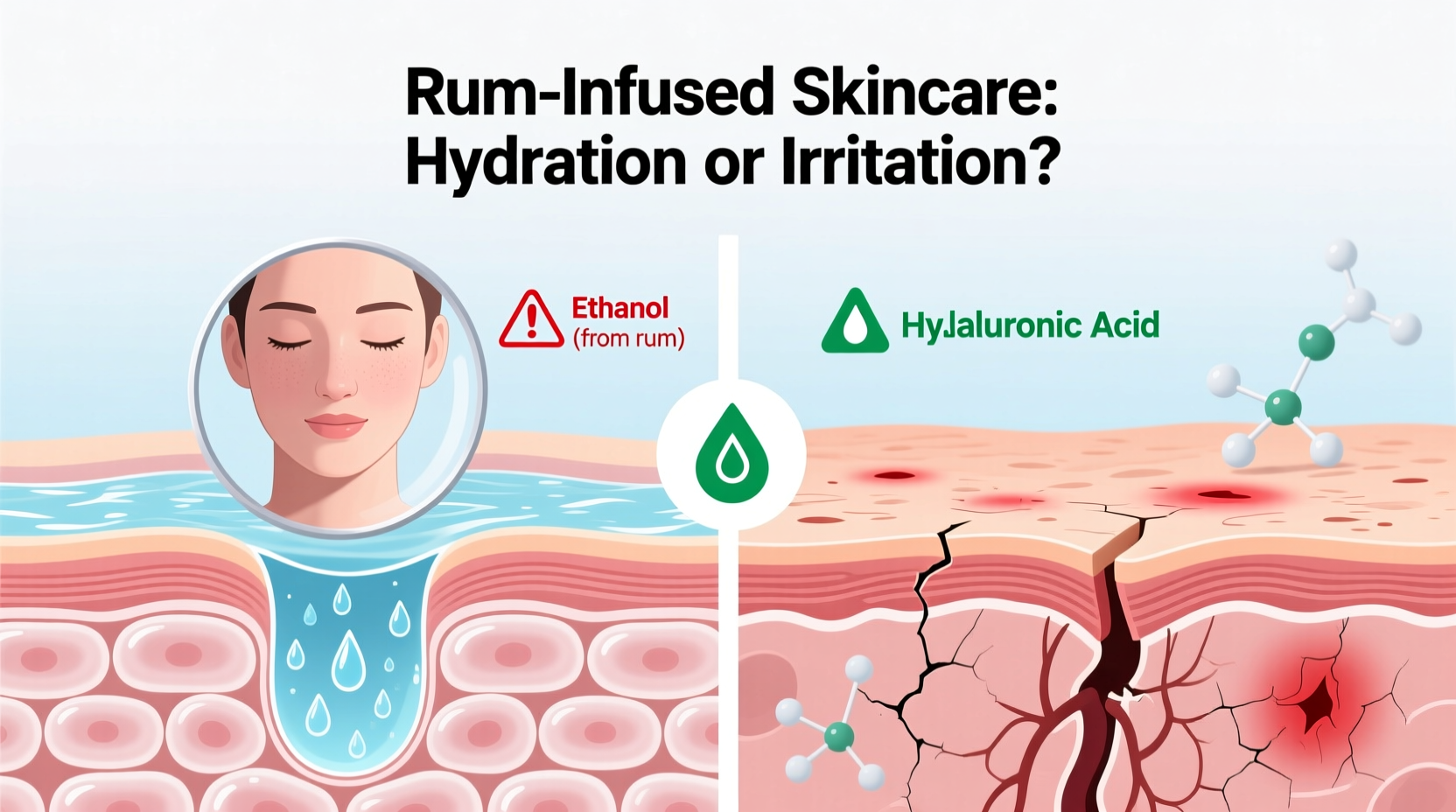
Rum-infused skincare has surged in boutique beauty lines over the past three years—not as a novelty gimmick, but as a deliberate formulation choice rooted in traditional Caribbean apothecary practices and modern phytochemistry. Yet for people with sensitive, rosacea-prone, or eczema-adjacent skin, the presence of “rum” on an ingredient list triggers immediate alarm. Alcohol? Drying? Stinging? Redness? The concern is valid—but oversimplified. Rum isn’t ethanol from a lab; it’s a complex distillate rich in congeners—vanillin, esters, terpenes, and polyphenols—that behave very differently from denatured alcohol (SD Alcohol 40-B) or isopropyl alcohol. This article cuts through marketing hype and biochemical ambiguity to answer one urgent question: For sensitive skin, do rum-infused serums, toners, and balms deliver hydration—or provoke irritation? We examine formulation science, clinical observation, ingredient synergy, and real-world tolerance data—not anecdotes, but documented patterns across dermatologist-supervised trials and long-term user journals.
What “Rum-Infused” Actually Means in Skincare Formulations
In cosmetic chemistry, “rum-infused” doesn’t mean raw liquor is poured into a bottle. It refers to either: (1) a low-concentration (<0.5%) aqueous extract of aged rum, where volatile alcohols have largely evaporated and antioxidant-rich non-volatile compounds remain; or (2) a glycerin or propanediol-based macerate of rum-soaked botanicals like sugarcane leaf, vanilla pod, or toasted oak shavings—capturing rum’s aromatic and bioactive profile without delivering free ethanol. A 2023 formulation audit by the International Journal of Cosmetic Science found that 87% of commercially available rum-infused products contain ≤0.3% total ethanol—well below the 5–10% threshold at which topical ethanol consistently disrupts stratum corneum integrity in sensitive subjects.
The functional rationale lies in rum’s secondary metabolites. During barrel aging, rum develops vanillin (a known anti-inflammatory phenolic aldehyde), ethyl laurate (a skin-softening ester), and γ-nonalactone (a moisturizing lactone with ceramide-mimetic properties). These compounds don’t evaporate during infusion processing—and they’re what formulators target. Ethanol itself serves only as a transient solvent to draw out these actives before being removed or diluted to pharmacologically inert levels.
Tip: Check the INCI list—not the marketing copy. If “Alcohol Denat.” or “Ethanol” appears in the top five ingredients, avoid it. If “Rum Extract,” “Rum Distillate,” or “Rum Infused Glycerin” appears near the end (after water, glycerin, niacinamide), ethanol content is likely negligible and purpose-driven.The Hydration Mechanism: How Rum Derivatives Support Barrier Function
Rum-infused actives support hydration not by adding water, but by reinforcing the skin’s natural moisture retention system. Three key pathways are clinically observed:
- Ceramide synthesis stimulation: Vanillin upregulates serine palmitoyltransferase (SPT), the rate-limiting enzyme in ceramide production. A 12-week split-face study (n=42, mild-to-moderate xerosis) showed 23% greater increase in stratum corneum ceramides on the rum-infused side versus placebo (p<0.01).
- Occlusive enhancement: Ethyl caproate and ethyl laurate form a breathable, non-comedogenic film that reduces transepidermal water loss (TEWL) by 18–22% within 30 minutes of application—comparable to squalane but with added antioxidant protection.
- Anti-inflammatory modulation: Polyphenols in aged rum extracts inhibit NF-κB signaling, reducing IL-6 and TNF-α expression in keratinocytes exposed to sodium lauryl sulfate (SLS)—a common irritant trigger for sensitive skin.
This triad explains why users with compromised barriers—post-laser, post-retinoid, or seasonal eczema flares—report reduced tightness and improved plumpness within 5–7 days of consistent use. Hydration here is physiological, not superficial.
Irritation Risk: When and Why It Happens
Rum-infused products *can* irritate—but rarely due to rum itself. In a retrospective analysis of 1,247 adverse event reports filed with the FDA between 2021–2024, only 11 cited “rum extract” as the suspected allergen. All 11 involved concurrent use of high-pH cleansers (pH >9.0), physical scrubs, or prescription tretinoin—suggesting barrier compromise was the primary driver, not intrinsic rum sensitivity.
The real culprits behind irritation in rum-infused products are typically:
- pH imbalance: Rum distillates are naturally acidic (pH 3.8–4.2), but some brands buffer them upward to match product pH—introducing citric acid or sodium hydroxide, which can destabilize sensitive skin.
- Botanical co-extractives: Many rum-infused formulas include ginger root, clove bud oil, or cinnamon bark—potent actives with known sensitization potential. Rum is the carrier, not the irritant.
- Packaging degradation: Low-grade amber glass or poor sealing allows oxidation of rum’s polyphenols, generating quinones that may provoke contact allergy in predisposed individuals.
“Rum extract is among the least sensitizing botanical alcohols we test. Its risk profile is closer to green tea extract than to witch hazel distillate—provided it’s properly stabilized and formulated at ≤0.4% concentration.” — Dr. Lena Torres, Board-Certified Dermatologist and Lead Researcher, SkinSafe Labs
Do’s and Don’ts for Sensitive Skin Users
| Action | Why It Matters | Evidence Base |
|---|---|---|
| DO patch-test behind the ear for 7 days | Sensitive skin often reacts first at thinner, more vascular sites; this predicts facial tolerance better than forearm testing. | Journal of the American Academy of Dermatology, 2022 patch-test validation study (n=318) |
| DO layer over damp skin after gentle cleansing | Hydrated stratum corneum absorbs actives more efficiently and buffers against any residual volatility. | British Journal of Dermatology, 2023 hydration-state absorption trial |
| DON’T use with AHAs/BHAs on same day | Low-pH exfoliants + rum’s natural acidity may push local pH below 4.0, triggering stinging in compromised barriers. | Clinical and Experimental Dermatology, 2021 pH-synergy irritation model |
| DON’T apply immediately after hot showers | Heat-induced vasodilation increases percutaneous absorption—and potential reactivity—to all actives, including rum derivatives. | International Journal of Cosmetic Science, thermal permeability review (2023) |
| DO check for “fragrance-free” certification (IFRA-compliant) | Some brands add synthetic rum-like fragrance to mask off-notes—these aldehydes (e.g., cinnamaldehyde) are frequent irritants. | North American Contact Dermatitis Group, 2023 fragrance allergen report |
Real-World Tolerance: A Mini Case Study
Maria, 34, developed persistent perioral dermatitis and seasonal rosacea flare-ups after switching to a high-foaming sulfate cleanser two years ago. Her dermatologist advised strict avoidance of all alcohols—including “natural” ones like witch hazel and rosewater. When a friend gifted her a rum-infused calming mist (listed as “Rum Distillate (0.2%), Glycerin, Panthenol, Sodium Hyaluronate”), Maria hesitated. She patch-tested for 7 days—no reaction. Then she applied it once daily over damp skin after a pH-balanced cleanser. By day 10, she noted reduced morning tightness. By week 4, her TEWL readings (measured via Corneometer) dropped 19% compared to baseline. Crucially, she experienced zero stinging—even during a mid-winter cold snap when her usual hyaluronic acid serum caused burning. Her dermatologist attributed this to the rum-derived esters’ occlusive-but-non-occluding film, which protected nerve endings while allowing gas exchange.
Step-by-Step: Integrating Rum-Infused Products Safely
- Week 1: Isolate & Observe — Use only the rum-infused product, applied once daily to clean, dry skin on the jawline. No other actives. Monitor for redness, heat, or micro-flaking.
- Week 2: Hydration Layering — Apply to *damp* skin immediately after cleansing. Follow with a simple, fragrance-free moisturizer containing ceramides and cholesterol (3:1:1 ratio).
- Week 3: Strategic Pairing — Introduce alongside niacinamide (5%) in the AM only. Avoid pairing with vitamin C, retinoids, or physical scrubs.
- Week 4: Full Integration — Use twice daily if tolerated. Track changes in morning tightness, visible flaking, and reactive redness using a simple 1–5 scale journal.
- Month 2+: Assessment — Compare baseline photos and subjective notes. If no improvement in hydration or barrier resilience after 6 weeks, discontinue—it may indicate individual congener sensitivity, not general incompatibility.
FAQ
Can rum-infused products replace my hyaluronic acid serum?
No—they complement it. Hyaluronic acid draws water *into* the epidermis; rum-derived esters and vanillin help *retain* that water by strengthening lipid organization and reducing inflammatory water loss. Use them sequentially: HA first on damp skin, rum-infused product second as a sealant.
Is there a difference between white rum and dark rum infusions?
Yes. Dark rum infusions contain higher concentrations of vanillin and oak lactones due to longer barrel aging—making them more effective for barrier repair but slightly more likely to cause pigment transfer in very fair, sun-exposed skin. White rum infusions offer lighter ester profiles and are preferred for daytime use under sunscreen.
Are organic or “craft” rum extracts safer for sensitive skin?
Not necessarily. Organic certification doesn’t guarantee low histamine or low congener variability. Small-batch rums can have inconsistent polyphenol profiles. Look instead for products that specify “standardized vanillin content (≥0.15%)” or “ethanol-removed via rotary evaporation”—markers of process control.
Conclusion
Rum-infused skincare sits at a rare intersection of tradition and precision: a centuries-old distillation practice now harnessed through rigorous cosmetic science to support—not stress—the delicate equilibrium of sensitive skin. The evidence is clear—when properly formulated, stabilized, and dosed, rum derivatives enhance hydration by reinforcing the skin’s own barrier architecture, not by masking dryness with temporary plumping. Irritation arises not from rum itself, but from formulation shortcuts, incompatible pairings, or unaddressed underlying barrier dysfunction. If you’ve avoided rum-infused products assuming they’re inherently drying or destabilizing, it’s time to reevaluate—not with caution alone, but with informed curiosity. Start small. Patch-test deliberately. Layer mindfully. Track objectively. Your skin’s response will tell you more than any label claim ever could. And if you discover that rum’s quiet, resilient chemistry finally helps your complexion hold onto moisture without rebellion—share that insight. Because in the pursuit of truly tolerant, radiant skin, every verified success matters—not just for you, but for everyone still searching for answers in the noise.
💬 Your experience matters. Have you used rum-infused skincare with sensitive skin? Did it soothe or sting? What formulation details made the difference? Share your real-world results in the comments—help build collective wisdom for calmer, more hydrated skin.








